
China
How Trump Pushed the World Toward Beijing


Paris (Imran Y. CHOUDHRY) :- Former Press Secretary to the President, Former Press Minister to the Embassy of Pakistan to France, Former MD, SRBC Mr. Qamar Bashir analysis : There are moments in history when power does not merely shift—it exposes itself. The first year of Donald Trump’s second term has become such a moment, not because it introduced entirely new instruments of American statecraft, but because it redirected the same tools of pressure, coercion, and economic weaponization that the United States once reserved for weaker or dependent nations toward its own traditional allies. In doing so, Washington did not just shock the global system; it fractured it, driving country after country—by calculation, necessity, or defiance—into the strategic and economic orbit of China.
For decades, the United States shaped the political and financial architecture of much of the developing world through a familiar mechanism: military reach, dollar dominance, and institutional leverage over global bodies such as the IMF and World Bank. Countries in South Asia, the Middle East, Latin America, Eastern Europe, and parts of Africa learned to live within a system where access to capital, trade, and even political legitimacy could be expanded or constricted at Washington’s discretion. Many endured in silence, not because they agreed, but because they lacked the economic or military weight to resist.
What changed in this era is not the method, but the target. The same logic of tariffs, sanctions, threats, and strategic intimidation was applied to nations that had long believed themselves protected by alliance and shared identity. Canada, Europe, and the wider Western hemisphere were confronted not as partners, but as economic adversaries and strategic liabilities. This reversal carried a powerful message: loyalty offered no immunity.
Canada’s experience became a defining case study. Accusations of economic exploitation, sweeping tariff threats, and rhetoric that questioned Canada’s sovereignty struck at the heart of a relationship built on the world’s deepest bilateral trade integration. For Ottawa, the conclusion was stark. Dependency on a single market had become a strategic risk. The response was not submission, but diversification. Trade corridors were widened toward the European Union through CETA, expanded across the Asia-Pacific via the CPTPP, and recalibrated toward energy and investment ties with the Gulf and Asia. China, as the world’s largest trading nation, inevitably became central to this recalibration—not by ideological alignment, but by economic gravity.
Europe’s pivot followed a parallel but more consequential path. The dispute over Greenland, framed by Washington as a strategic necessity for missile defense and Arctic dominance, was read in European capitals as a unilateral assertion of power that disregarded sovereignty and alliance consultation. The European Union, often divided on policy, responded with rare cohesion. The rejection of American demands was not merely territorial—it was systemic. It reflected a growing determination to insulate Europe’s political and economic future from what it increasingly viewed as unpredictable American pressure.
This shift soon extended into the financial realm. European policymakers began openly discussing the risks of overexposure to U.S. Treasury holdings and the vulnerability created by dollar-dominated trade and settlement systems. This trend has taken on new political meaning in an environment where financial access is increasingly treated as a strategic weapon.
At the same time, the BRICS bloc—now expanded to include major energy producers and regional powers—has accelerated efforts to build alternative mechanisms for trade settlement, development finance, and cross-border investment that bypass traditional Western-controlled institutions. Local-currency trade arrangements, new development banks, and parallel payment systems are no longer theoretical exercises; they are active projects driven by a shared desire to reduce vulnerability to American financial leverage.
In this environment, China has not needed to aggressively recruit allies. Its role as the central node of global manufacturing, trade, and infrastructure has done much of the work. With annual trade volumes exceeding $4 trillion and deep supply-chain integration across Asia, Europe, Africa, and Latin America, China has become economically indispensable to much of the world. The Belt and Road Initiative, spanning more than 140 countries, has embedded Chinese capital, logistics, and construction into the physical and economic foundations of entire regions. For many states, disengaging from China is no longer a policy option—it is an economic impossibility.
Europe’s own posture toward Beijing illustrates this reality. Only a few years ago, European policy focused on “de-risking” and restricting Chinese investment in strategic sectors. Today, that posture is being recalibrated at unprecedented speed. High-level dialogues on industrial cooperation, green technology, electric vehicles, and infrastructure investment reflect a recognition that Europe’s economic competitiveness is tied to engagement with China, not isolation from it.
Canada’s recalibration mirrors this logic. Energy partnerships with the Gulf, expanded Asian trade, and financial diversification are not ideological statements; they are strategic hedges against a United States that has signaled its willingness to weaponize economic interdependence.
Across the Global South, the pattern is even more pronounced. Countries in Africa, Central Asia, Latin America, and Southeast Asia—many already deeply embedded in Belt and Road projects—see in this Western fracture a confirmation of their long-held belief that reliance on a single power center is dangerous. For them, China’s appeal lies not in moral claims or ideological alignment, but in scale, speed, and predictability of economic engagement.
This is where the geopolitical landscape takes on its starkest contrast. As China’s economic centrality expands, the United States finds itself increasingly isolated in political terms. In this emerging narrative, only one relationship remains absolute: the United States and Israel, bound together in mutual political and strategic defense as much by global criticism as by shared policy.
Israel, facing growing diplomatic, legal, and public pressure across Europe, the Global South, and even within Western societies, leans heavily on American veto power and political backing in international forums. The United States, in turn, finds itself defending Israel in a world where sympathy and alignment are steadily shifting elsewhere. The result is a form of strategic isolation that contrasts sharply with China’s expanding web of economic partnerships.
The Western hemisphere, once considered America’s natural sphere of influence, now reflects this tension. Caribbean and Latin American states increasingly engage China as a primary trade partner, infrastructure financier, and development lender. In Africa, China has surpassed traditional Western powers in trade volume and project scale. In the Middle East, even long-standing U.S. partners diversify toward Beijing for energy, technology, and investment ties.
What emerges is not a world won by China through conquest or coercion, but one reshaped by America’s own confrontational posture. The paradox of this moment is that America’s political capital is eroding. China, by contrast, often avoids overt military or ideological confrontation, relying instead on the slow, cumulative force of economic integration. The gravitational pull of markets, supply chains, and infrastructure has proven more durable than the shock of tariffs or the threat of sanctions.
In the unfolding order, China’s rise has not been driven solely by its own strategy, but by the vacuum created as the United States confronts rather than consolidates. The world’s capitals, boardrooms, and ministries increasingly calculate their futures not in terms of allegiance, but in terms of access—to markets, to capital, to infrastructure, and to stability. In that calculation, Beijing now sits at the center of the equation.
What history may ultimately record is not merely a contest between two powers, but a transformation in how power itself is measured. Military strength and financial dominance remain formidable, but in a world bound by trade, technology, and shared vulnerability, the ability to attract, integrate, and sustain economic relationships may prove to be the decisive force of the century.








Paris (Imran Y. CHOUDHRY) :- Former Press Secretary to the President, Former Press Minister to the Embassy of Pakistan to France, Former MD, SRBC Mr. Qamar Bashir analysis : Artificial intelligence and robotics are becoming the defining instruments of economic, scientific and strategic power. Nations leading these fields will shape manufacturing, healthcare, agriculture, education, transportation, defence and scientific discovery. China has emerged as an extraordinarily powerful force in this new age, competing directly with the United States and moving ahead in several areas. This achievement is not the result of one company or an isolated breakthrough. It reflects an entire national ecosystem built around education, research, manufacturing, energy, infrastructure and technological innovation.
Behind this transformation stands a political and philosophical approach that places national development, collective advancement and long-term planning above short-lived political considerations. Under President Xi Jinping and the Communist Party of China, scientific and technological self-reliance has become a central national objective. The continuity of Chinese leadership—frequently presented in Western political discourse as a weakness or democratic deficiency—has enabled China to pursue strategic goals over decades.
The results are visible in China’s extraordinary development of human resources. By 2025, China had established 3,167 higher-education institutions enrolling approximately 48.7 million students, while its gross higher-education enrolment rate had reached 60.8 percent—more than twice its 2012 level. Chinese universities produced more than 55 million graduates between 2021 and 2025, while the country’s research-and-development workforce reached approximately 7.95 million full-time-equivalent person-years, the world’s largest. Vocational colleges also supplied more than 70 percent of the newly added skilled workers required by modern industries. China has therefore converted the numerical advantage of a vast population into a formidable scientific, technical and industrial asset.
China recognized the strategic significance of artificial intelligence comparatively early. Its 2017 New Generation Artificial Intelligence Development Plan established objectives extending to 2030 and connected fundamental research, infrastructure, education, industrial applications and regulation. Artificial intelligence was treated not as a fashionable consumer service but as a general-purpose technology capable of transforming the entire economy.
The scale of the resulting achievement is demonstrated by China’s patent output. Updated figures published by the World Intellectual Property Organization in July 2026 show that more than 56,000 new generative-AI patent families were published worldwide during 2024 and 2025—exceeding the entire global output of the preceding decade.
China-based inventors accounted for more than 43,000 of those new patent families. When added to approximately 38,000 published between 2014 and 2023, China’s cumulative output since 2014 exceeds 81,000. Chinese generative-AI patent publications recorded a compound annual growth rate of 64 percent between 2023 and 2025, while six of the world’s ten largest applicants are based in China.
China’s open-weight models represent another remarkable achievement. DeepSeek, Alibaba and Moonshot AI have challenged Silicon Valley’s traditionally proprietary approach by releasing powerful systems whose mathematical weights can be downloaded and adapted. These companies have demonstrated that Chinese laboratories can produce frontier-class AI, optimize it under hardware constraints and distribute it globally at highly competitive prices.
Alibaba’s Qwen has become one of the world’s most influential open-model families. It ranges from compact systems to the 2.4-trillion-parameter Qwen3.8 model. According to Hugging Face, Qwen repositories recorded approximately 2.06 billion downloads during the first seven months of 2026, while developers had created more than 151,000 derivative repositories based upon the family. Download totals do not establish overall market share or prove that Qwen is superior to every competitor, but they demonstrate extraordinary global adoption.
DeepSeek has similarly advanced the open-weight paradigm. Its R1 reasoning system was released under the permissive MIT licence. In 2026, DeepSeek introduced the V4 family, including V4-Pro and the smaller V4-Flash. These models employ mixture-of-experts architectures, activating only part of their total parameters during each operation. This improves efficiency while supporting reasoning, coding and autonomous agent functions. Both versions offer context windows of up to one million tokens.
Moonshot AI’s Kimi K3 provides another example. Released in July 2026, it is a 2.8-trillion-parameter, natively multimodal model designed for complex reasoning, extended coding and knowledge work. Its release further strengthened China’s position in the frontier open-weight ecosystem. Although benchmark comparisons should always be treated carefully, the broader direction is unmistakable: competitive AI no longer originates exclusively from closed American laboratories.
These developments are particularly significant because American export controls have restricted Chinese access to certain advanced semiconductors. Rather than ending Chinese progress, the restrictions have encouraged greater attention to software efficiency, sparse attention, mixture-of-experts architectures, inference optimization and domestic hardware. Export controls remain a genuine obstacle, but they have neither removed China from the competition nor prevented its developers from producing advanced models.
Open-weight technology also provides a degree of sovereignty. Governments, universities and companies can deploy suitable models on infrastructure within their own jurisdictions. Proper local deployment can prevent sensitive information from being transmitted to an external provider.
China’s achievements extend from software into the physical economy. Companies such as Unitree and AgiBot are developing humanoid robots capable of walking across difficult terrain, recovering from falls, carrying loads and performing complex movements balancing machine vision, dexterity, durability and affordability.
China possesses a decisive advantage in converting such inventions into manufactured products. It has dense supply chains for batteries, motors, sensors, cameras, electronics and precision components, together with enormous factories and a large domestic market. The same industrial ecosystem supported China’s rise in electric vehicles, commercial drones, telecommunications equipment and solar technology. China has become exceptionally capable of carrying innovation from the laboratory through engineering and into mass production.
NVIDIA chief executive Jensen Huang has repeatedly emphasized China’s universities, engineering culture and technical workforce. His widely reported observation that approximately half of the world’s AI researchers are Chinese illustrates the immense contribution Chinese scientists make to global artificial-intelligence research.
China has demonstrated that political continuity, when combined with capable leadership, education and measurable national objectives, can become an instrument of rapid advancement.
Only after recognizing the foundations and magnitude of China’s achievement does the larger lesson become clear. This is not a warning solely for Pakistan, Africa, Latin America or the Muslim world. It is a lesson for every developed or developing nation that has failed to prioritize artificial intelligence and robotics as seriously as China and the United States.
Countries neglecting scientific education, reliable energy, computing facilities and advanced manufacturing may gradually lose their economic independence. They may continue importing intelligent machines and foreign software, but they will not control the technologies determining productivity, employment and national security.
Pakistan and other developing nations face an especially serious danger because many still depend upon inexpensive labour and inadequately educated populations. In an age of automation, a young population without scientific and technical competence may produce unemployment, inequality and instability rather than a demographic dividend.
These nations need measurable programmes in mathematics, science, AI, robotics, semiconductors and advanced manufacturing. They require modern universities, research funding, computing facilities and dependable electricity. International partnerships must transfer knowledge and create local capability rather than permanent dependence.
China’s rise demonstrates that lasting national power grows from educated people, scientific institutions, productive industries, infrastructure and leadership capable of sustaining a vision. Other countries need not copy China’s political system mechanically, but its discipline, continuity and investment in human capability deserve serious study. Every nation that has not entered the AI and robotics race must begin immediately. The opportunity to participate in the emerging technological order still exists, but it will not remain open forever.
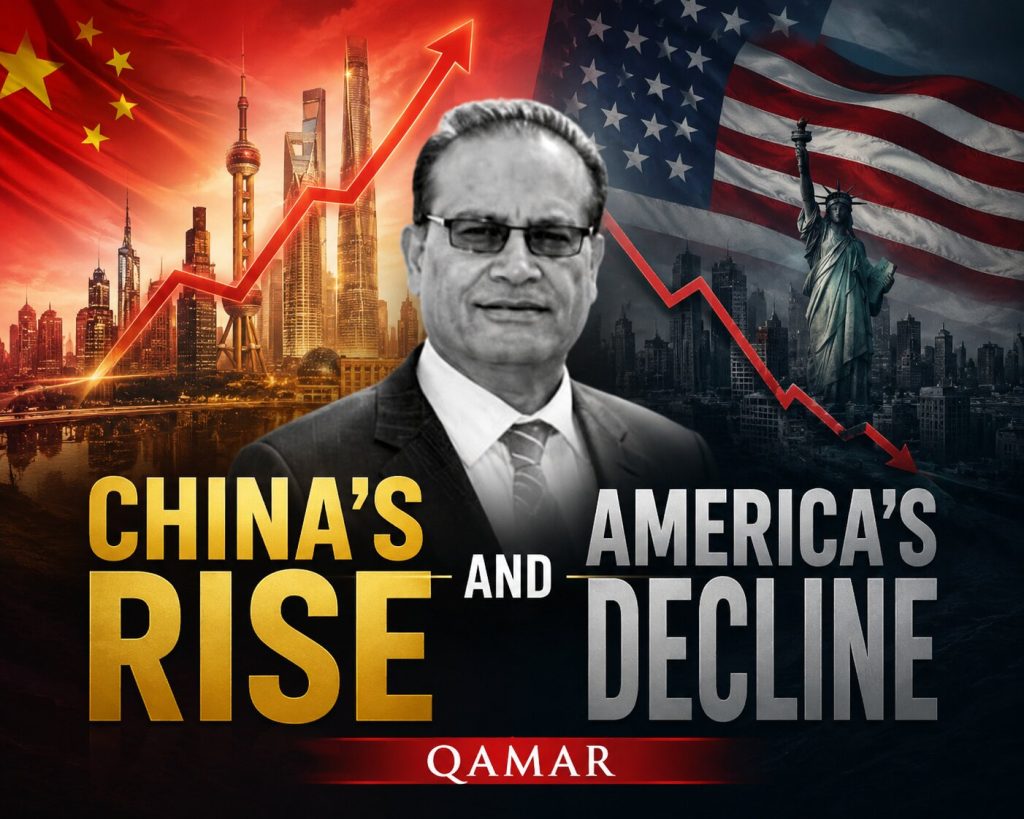
Paris (Imran Y. CHOUDHRY) :- Former Press Secretary to the President, Former Press Minister to the Embassy of Pakistan to France, Former MD, SRBC Mr. Qamar Bashir analysis : The contrasting trajectories of China and the United States reveal a fundamental lesson of national development: civilian infrastructure creates lasting wealth, while prolonged warfare consumes it. For decades, China concentrated overwhelmingly on economic development, industrial capacity, education, research, infrastructure and technological self-reliance. The United States, despite possessing greater wealth and formidable innovative capacity, repeatedly diverted enormous resources toward overseas wars, military deployments and the maintenance of global strategic dominance. The consequences are now visible in their respective economic priorities and physical landscapes.
China has avoided a major, sustained kinetic war for nearly five decades. During the same period, the United States fought or intervened militarily in Vietnam, Lebanon, Grenada, Panama, Iraq, Somalia, the Balkans, Afghanistan, Libya, Syria, Yemen and, most recently, Iran, while maintaining hundreds of military installations across the world.
This difference in strategic emphasis produced an enormous opportunity gap. Estimates based on Congressional Research Service figures and Brown University’s Costs of War project suggest that the direct and broader fiscal costs of American wars since World War I may approach $18 trillion in 2026 dollars. The total includes direct military operations, post-9/11 homeland-security expenditures, war-related increases in Pentagon spending, interest on borrowed funds and present and future obligations toward veterans. Even this amount does not fully capture the economic consequences of higher energy prices, disrupted trade, inflation, lost productivity or the lifetime costs of caring for wounded personnel.
Half of that estimated burden—$9 trillion—would almost equal the entire amount that the American Society of Civil Engineers says is required between 2024 and 2033 to bring the country’s major infrastructure categories into good condition.
The organization estimates that America faces a $3.7 trillion infrastructure financing gap over that period. Had only half of the historical war expenditure been invested efficiently at home, the United States could have closed that gap, repaired its roads and bridges, modernized public transportation, expanded healthcare facilities and still retained trillions for housing, education and scientific research.
More than 41,000 American bridges are presently classified as being in poor condition, while approximately one-third require some form of repair or replacement. Roads face an estimated funding gap of nearly $684 billion. Transit agencies confront a repair and modernization backlog exceeding $140 billion. Water systems continue to lose treated water through aging pipes, communities still struggle with lead contamination, and electricity networks remain vulnerable to extreme weather, cyberattacks and rising demand. These are not signs of a country lacking resources. They are signs of a country that has allocated its resources elsewhere.
China made a different choice. It constructed the world’s largest high-speed railway network, extending approximately 48,000 kilometres, together with a vast expressway, port, airport, electricity and telecommunications systems. It developed globally competitive industries in electric vehicles, batteries, solar panels, wind turbines, nuclear power, shipbuilding, telecommunications and high-speed rail. It invested heavily in universities, laboratories, space exploration, satellite systems and advanced manufacturing. Its infrastructure became the foundation upon which industry, trade and productivity could expand.
China’s economic growth at the extraordinary 8–10% translating to rapid expansion transformed the country from a largely agrarian economy into the world’s leading manufacturing power. By contrast, the mature American economy normally grows between 1% and 3%. This slower growth is not caused exclusively by military expenditure, but recurrent wars, growing debt and the diversion of public investment have undoubtedly imposed significant opportunity costs.
China has now extended its development approach abroad through the Belt and Road Initiative. Across approximately 140 participating countries, Chinese companies and financial institutions have supported ports, roads, railways, power plants, pipelines, telecommunications networks and industrial zones. Cumulative Chinese BRI investment and construction engagement reached an estimated $1.4 trillion through 2025. China is therefore converting national capacity into commercial access, supply chains, political influence and long-term economic partnerships.
The American model remains different. Washington generally supplies loans, guarantees, grants, insurance and technical assistance, leaving partner governments and private companies to construct and operate projects. Although the United States supports important ventures such as the Lobito Corridor in Africa, its state-supported overseas infrastructure programme remains much smaller than China’s. America’s most visible global presence continues to be military, whereas China’s is increasingly associated with ports, railways, energy projects and trade.
At home, the consequences of American priorities are becoming harder to ignore. Millions remain inadequately insured or exposed to medical bills capable of destroying household savings. Higher education can leave students burdened with debt for decades. Homeownership is increasingly beyond the reach of ordinary working families. Public transportation remains inadequate in many metropolitan areas, forcing households to maintain expensive vehicles. Families facing high housing, insurance, food, healthcare and education costs often live from paycheck to paycheck despite working full-time.
Against this background, the proposed increase in American defence resources from roughly $1 trillion in FY2026 to $1.5 trillion in FY2027 demands serious examination. The increase is approximately $441 billion, while proposed reductions in nondefence discretionary programmes amount to only about $73 billion. Consequently, civilian cuts would offset less than one-fifth of the military increase. The remaining amount would require additional revenue, further reductions or new borrowing.
War costs are not necessarily included within the regular defence budget. When a new conflict begins, the Pentagon can seek emergency supplemental appropriations. For the Iran war, the administration submitted a package of $87.6 billion, including approximately $67.1 billion for military operations and weapons replenishment. Such emergency financing, when not matched by taxation or expenditure reductions, enlarges the deficit and ultimately adds to the national debt. The public consequently pays twice: first for the military operation and later through interest on the money borrowed to finance it.
Military capability remains necessary. China itself continues modernizing its armed forces, nuclear deterrent, navy, missile systems, cyber capabilities and space assets. No major power can ignore national defence. The real issue is proportion, purpose and strategic discipline. Defence should protect national development; it should not consume the resources required to sustain it. A military that weakens the society and economy behind it ultimately undermines its own foundation.
The Iran war may therefore offer Washington an opportunity for strategic reconsideration. America’s greatest long-term strength will not be measured only by aircraft carriers, overseas bases or missile inventories. It will be measured by the condition of its bridges, affordability of its homes, accessibility of healthcare, quality of its schools, reliability of public transportation and leadership in science and technology.
China’s rise demonstrates that patient investment in productive capacity can generate influence more durable than military intervention. If the United States wishes to preserve its position, it must restore balance between power projected abroad and prosperity created at home. The choice is not between defence and development. It is between a defence policy that protects national prosperity and one that gradually consumes it.
Paris (Imran Y. CHOUDHRY) :- Former Press Secretary to the President, Former Press Minister to the Embassy of Pakistan to France, Former MD, SRBC Mr. Qamar Bashir analysis : For nearly half a century following the Second World War, the Soviet Union stood as the United States’ principal strategic adversary. The Cold War divided the international system into two competing ideological, political and military blocs. Washington championed liberal democracy and market capitalism, while Moscow promoted centralized communist governance. Their rivalry extended far beyond military confrontation; it encompassed economics, science, technology, diplomacy, intelligence, space exploration and global influence.
The Soviet Union possessed virtually every attribute of a superpower. It maintained one of the world’s largest industrial bases, commanded an immense conventional military, developed strategic nuclear parity with the United States and became the first nation to launch both an artificial satellite (Sputnik) and a human (Yuri Gagarin) into space. Through the Warsaw Pact and extensive political relationships across Eastern Europe, Asia, Africa and Latin America, Moscow projected global influence that challenged American leadership for decades.
However, sustaining competition with the United States imposed enormous economic burdens. Central planning increasingly failed to generate innovation and productivity. Industrial inefficiency, declining economic growth, fiscal strain from the arms race, and political rigidity gradually weakened the Soviet system. The decade-long Soviet intervention in Afghanistan (1979–1989) further strained national resources and damaged international prestige. While Afghanistan contributed to Soviet exhaustion, historians generally agree that the collapse of the USSR resulted from multiple structural causes rather than any single conflict.
In December 1991, the Soviet Union dissolved into fifteen independent republics. Russia inherited the Soviet Union’s permanent seat on the United Nations Security Council, most of its nuclear arsenal and much of its military-industrial infrastructure. Yet it did not inherit the Soviet Union’s comprehensive economic power.
Today, Russia remains one of the world’s foremost military powers. According to the Stockholm International Peace Research Institute (SIPRI), Russia ranked as the world’s third-largest military spender in 2025, allocating approximately US$190 billion, equivalent to 7.5 percent of GDP, while the United States remained first at US$954 billion and China second at US$336 billion. Together, these three countries accounted for more than half of global military expenditure.
Russia also retains one of the world’s two largest nuclear arsenals. Alongside the United States, it possesses the overwhelming majority of global nuclear warheads, ensuring that Moscow remains a decisive military and strategic actor in international security.
Nevertheless, military strength alone no longer defines comprehensive global leadership. Unlike the Soviet Union, contemporary Russia does not compete with the United States across the full spectrum of national power. Russia’s economy, while resilient under difficult geopolitical circumstances, remains relatively modest in global terms. According to the World Bank, Russia’s nominal GDP in 2025 stood at approximately US$2.56 trillion, compared with an American economy exceeding US$32 trillion and a Chinese economy exceeding US$20 trillion.
Russia continues to be an important exporter of oil, natural gas, wheat, fertilizers, metals and military equipment. These sectors provide strategic influence and significant export revenues. However, Russia is not a dominant global supplier of consumer electronics, advanced semiconductors, electric vehicles, telecommunications equipment, commercial aircraft, digital platforms, pharmaceutical products or large-scale civilian infrastructure systems.
This distinction is crucial. Russia can threaten the United States through military deterrence, nuclear capabilities, cyber operations and geopolitical disruption. It remains capable of altering regional security dynamics and challenging NATO in Europe. Yet Russia does not possess the broad-based industrial, technological and commercial ecosystem necessary to reshape the global economy.
China does. Over the past four decades, China has transformed itself from a relatively poor developing nation into one of the world’s largest economic powers. Unlike the Soviet Union, whose influence depended heavily on military and ideological competition, China’s rise has been driven primarily by industrialization, manufacturing, infrastructure development, international trade, education, technological innovation and long-term economic planning.
The scale of China’s transformation is unprecedented in modern economic history. According to the International Monetary Fund (IMF), China remains the world’s second-largest economy in nominal GDP and the largest economy when measured by purchasing power parity (PPP), reflecting the enormous scale of its domestic productive capacity. The IMF projects China’s economy to continue expanding in 2026 despite global economic headwinds.
Unlike Russia, China has embedded itself deeply within global production networks. Its factories manufacture everything from smartphones and consumer electronics to high-speed trains, renewable-energy equipment, industrial machinery and advanced electric vehicles. Chinese companies participate in supply chains that reach virtually every continent.
Trade has become one of China’s greatest strategic assets. The World Trade Organization’s latest trade data continue to rank China among the world’s largest trading nations, with merchandise imports exceeding US$2.47 trillion in 2024 alone and exports remaining among the highest globally. China has become the principal trading partner for dozens of countries across Asia, Africa, Latin America and the Middle East.
This economic integration fundamentally distinguishes China from the Soviet Union. The USSR largely operated outside the capitalist global economy. China, by contrast, operates at its very center. Businesses, governments and consumers around the world rely on Chinese manufacturing, logistics, industrial inputs and consumer products. Even countries that maintain strategic disagreements with Beijing often remain economically interconnected with China through trade and investment.
This level of economic integration gives China forms of influence that military power alone cannot achieve. It is therefore increasingly evident why successive American administrations—Republican and Democratic alike—have identified China, rather than Russia, as the United States’ principal long-term strategic competitor. Russia remains a formidable military power. China is a comprehensive national power. That distinction defines the strategic landscape of the twenty-first century.
(Part II will examine how China’s manufacturing strength, Belt and Road Initiative, technological innovation, renewable-energy leadership and control of critical supply chains have transformed it into America’s foremost comprehensive strategic challenger.)


Quetta’s Daughter, Pakistan’s Pride

Why is Trump a Dictator?

America Must Rebuild Within


-

 Sports4 months ago
South Korea’s Yoo Useong Steps Onto the Global Strongman Stage as World Strongman Federation Professional Athlete
-

 Art & Culture1 year ago
A Survey of Mata-E-Zeest
-

 Europe News2 years ago
Chaos and unproven theories surround Tates’ release from Romania
-

 American News2 years ago
Trump expands exemptions from Canada and Mexico tariffs
-

 American News2 years ago
Trump Expels Zelensky from the White House
-

 Art & Culture2 years ago
Will Snow White be a ‘victim of its moment’? How the Disney remake became 2025’s most divisive film
-

 Entertainment2 years ago
Champions Trophy: Pakistan aim to defend coveted title as historic tournament kicks off today
-

 Pakistan News1 year ago
Comprehensive Analysis Report-The Faranian National Conference on Maritime Affairs-By Kashif Firaz Ahmed