
Europe News
Bioeconomy and Small Businesses Take Center Stage at COP30

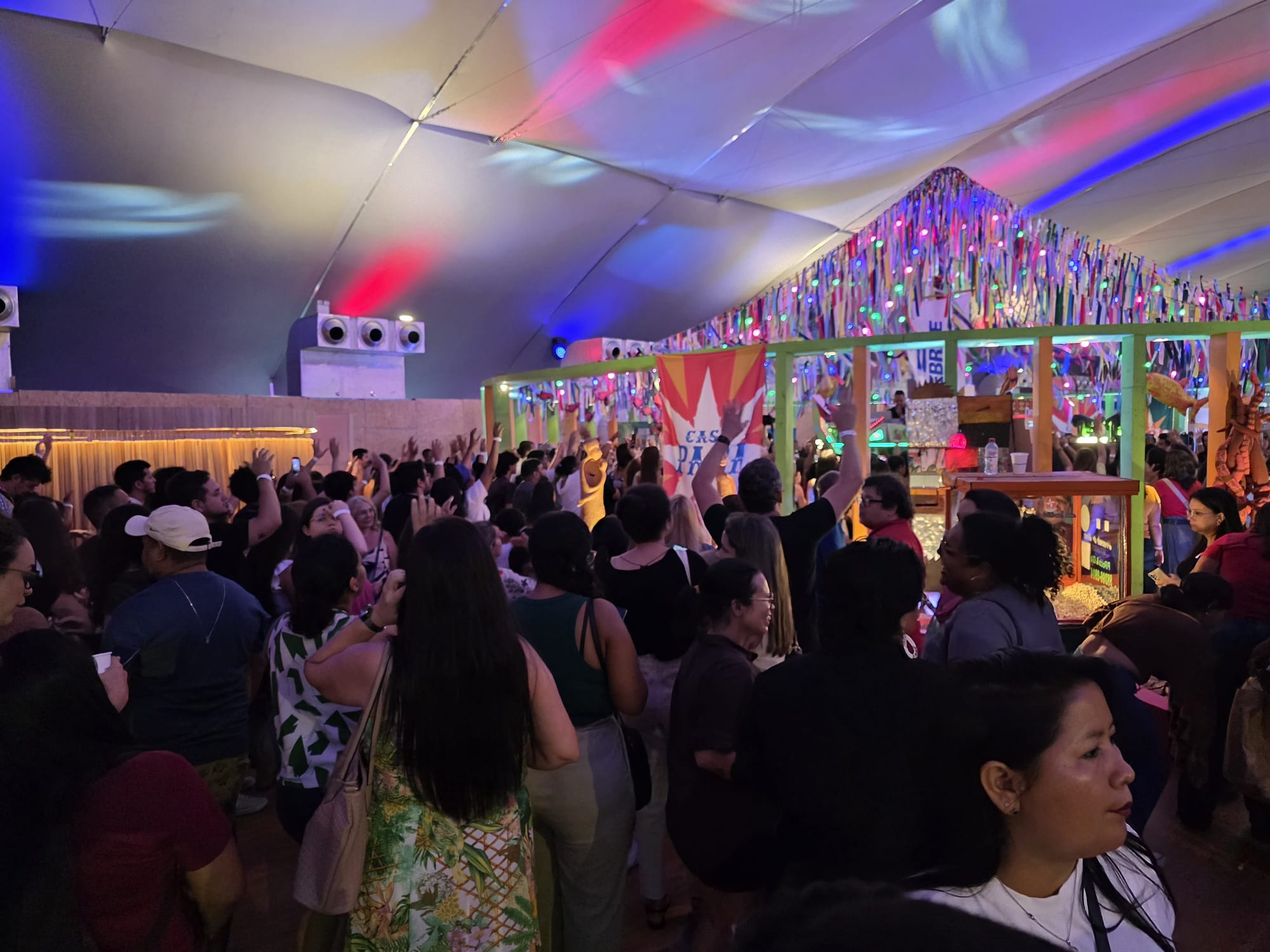
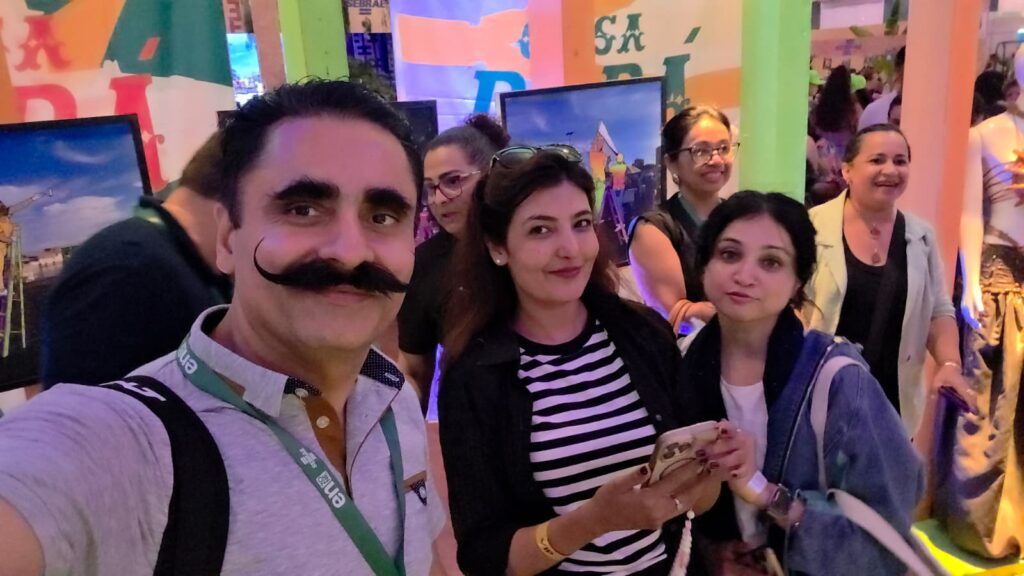
Belem ( Imran Y. CHOUDHRY):- United Nations Climate Change Conference COP30 continue in Belem, Brazil to talks and dialogues for plains to strict roles and regulations.
Outside of the venue lots of different events host by different organisation and companies. One of the Bioeconomy and Small Businesses Take Center Stage at COP30 Organized by Sebrae in Pará, the En-Zone will be the international showcase of entrepreneurship and sustainability in the Amazon during the Conference.
Visitors and residents of Belém have the opportunity to see firsthand the entrepreneurship that makes a diference in the lives of Amazonians and respects the forest. During the 30th Conference of the Parties on Climate Change of the UN (COP 30), Sebrae in Pará is promoting the
Entrepreneurship Zone (En-Zone), which will be open to the public from November 10th to 21st, in the parking lot of the
Belém Porto Futuro I Urban Park, with free admission.
More than an exhibition space, the En-Zone is a hub of connections that highlights the leading role of small Amazonian businesses and
reinforces Sebrae’s role as an articulator of the new green economy. In an area of almost 17,000 square meters, it houses a store with products
from 250 businesses from all Brazilian biomes, the BioMarket store, Casa Pará, training opportunities, immersive spaces to promote national
tourism, a food court with restaurants, and a stage for musical programming.
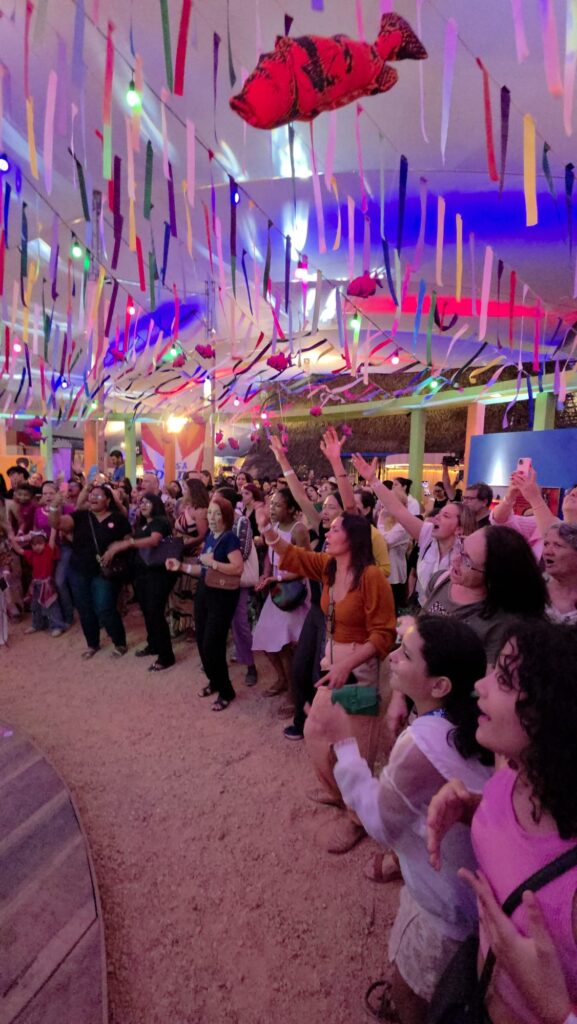
With the theme “Living Amazon – The Future Revolves Here,” En-Zone ofers a sensory journey featuring works by Amazonian artists, miriti installations, sculptures, and interactive panels. The artistic curation highlights the muralist Sebá Tapajós, internationally recognized for portraying the forest in vibrant colors. At night, the scenic lighting creates an immersive and Instagrammable atmosphere, enhancing the Amazonian aesthetic and inviting public interaction.
“The Amazon Rainforest is at the centre of global debates about the future of the planet. Therefore, nothing is more fitting than showcasing a vibrant Amazon that preserves traditions, harbors immeasurable natural wealth, and generates income for those who live in and from it. That’s why Sebrae is leading a movement to position small businesses at the heart of sustainable development,” says Rubens Magno, Superintendent
Director of Sebrae in Pará.
En-Zone is an initiative of Sebrae/PA, with Claro Empresas as a connectivity partner, sponsorship from Hydro and Sicredi, and institutional support from the Municipality of Belém, the Government of Pará, and the Federal Government.
To see the complete En-Zone programme and register to visit the space, visitors should download the En-Zone SuperApp, available for Android and Apple. The Digital Agency, ofering Sebrae services to entrepreneurs, will also be integrated into the app.
Brazil BioMarket, the name of Sebrae’s collaborative store, is a living showcase of sustainable and innovative entrepreneurship during COP30.
Between November 10th and 21st, attendees of the global climate conference will have the opportunity to meet approximately 250 small businesses that connect with new ways of thinking about development without compromising care for nature and people.
The selected small businesses represent all six Brazilian biomes, in the segments of food and beverages, fashion and accessories, crafts and decoration, beauty and cosmetics. In addition to exhibiting and selling Brazilian products, the store aims to strengthen the regional economy,
generating employment, income, and visibility for entrepreneurs.
The initiative also involves the participation of the Association of Socio-bioeconomic Businesses of the Amazon (ASSOBIO), contracted to operate the store, and Vimer Retail Experience, which developed the brand and the concept of experiential retail that the space will provide. The idea is that the entrepreneurs’ stories will be “told” through the display of the products that the store will ofer. In addition to the physical space, some entrepreneurs will have their products available in an exclusive online store within the Mercado Livre platform, with free access. This initiative ofers entrepreneurs another alternative for digital presence, complementing the physical store experience with a broader catalog more
accessible to consumers throughout Brazil.
The Loja Brasil BioMarket also has a unit in the Green Zone.
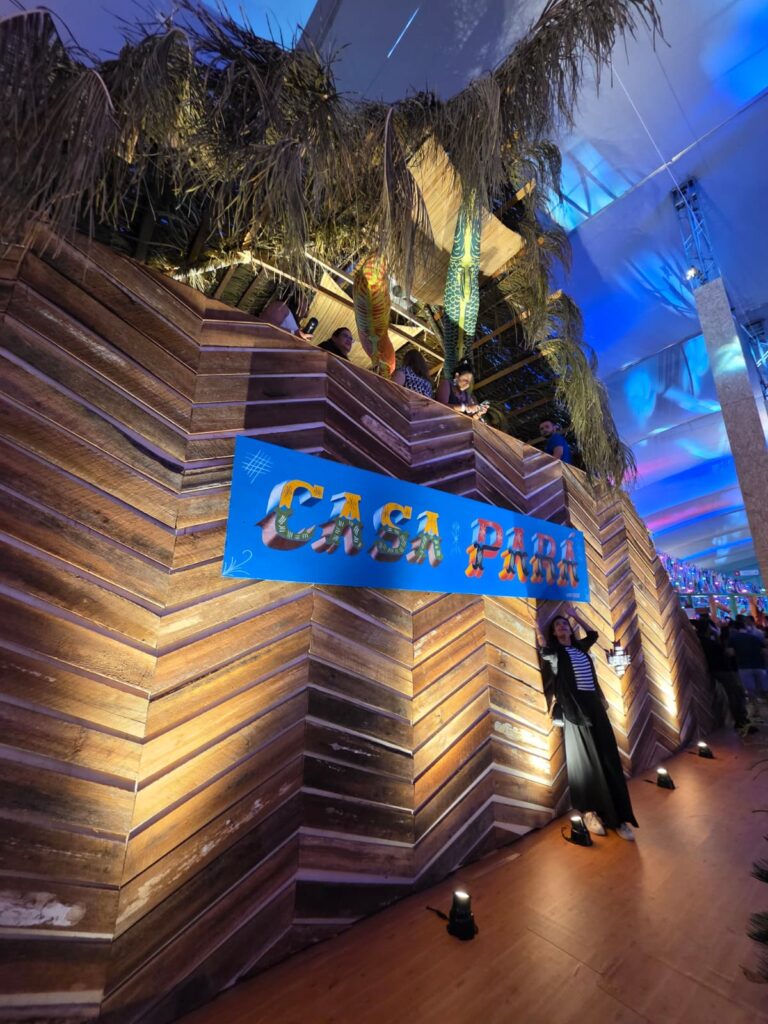
The host state of COP30 is highlighted at Casa Pará, one of the most emblematic spaces in the En-Zone. With 500 m², the space aims to promote a cultural and sensory immersion in the Amazon, as well as reflections on relevant themes, focusing on sustainable design, hospitality,
and the circular economy, through a rich program of exhibitions by artists from Pará, performances, discussion panels, and daily debates.
Among the cultural attractions are a special exhibition featuring popular manifestations such as the “big-headed” figures, pierrots, and masks by
Mestre Vital, as well as the Miriti Pavilion, conceived by Guá Arquitetura and Atelier Miriti Sustentabilidade, which presents miriti as an Amazonian social technology, and works by Éder Oliveira, Erica Saraiva, Roberta Carvalho, Marinaldo Santos, and Walda Marques.
This will be the first time that Casa Pará opens its doors in its own territory. The space was born during the Tiradentes Creative Week in October of this year.
The program also includes regenerative tourism experiences, which are based on the premise of transforming an environment for the better, with workshops on bioeconomy, reforestation, and experiences in riverside communities, in addition to the promotion of sustainable Brazilian tourist destinations, such as the Combu Route, a reference in community-based tourism and local production.
Other immersive tourism experiences can be enjoyed at the Visit Brasil Center, a partnership between Sebrae/PA and Embratur. The center will be an interactive space focused on promoting sustainable tourism and authentic experiences in the country, through the use of technologies
such as artificial intelligence and augmented reality, allowing for the exploration of Brazilian ecosystems in 3D. In the “Feel Brasil” area, visitors ill have the opportunity to discover more than 100 sustainable experiences created by small entrepreneurs.Gastronomy on the rise
Pará’s cuisine is one of the most original and celebrated in the world. As expected, this striking feature of the local culture will receive due prominence at the Gastronomic Festival, which will bring together renowned Amazonian chefs in creations that combine tradition and innovation.
In the Em-Zone food court, the richness of Pará’s and the Amazon region’s gastronomy is highlighted. The menu was designed to ofer a diverse and inclusive experience, bringing together typical dishes, regional, oriental, natural and Amazonian cuisine, as well as pasta and
healthy options.
In addition to sampling Amazonian delicacies, visitors can discover bioproducts from Brazilian biomes produced by national entrepreneurs,
which will be on display at the Brasil Biomarket store, as well as bioproducts from the Sustenta e Inova Program, an international cooperation initiative coordinated by Sebrae/PA and financed by the European Union. Cultural Programme
At En-Zone, fun and sustainability always go hand in hand. One of the attractions will be the Amazon Wheel, a 90-meter Ferris wheel powered by solar energy and with 18 gondolas, one of which is accessible to people with disabilities. The venue will ofer exclusive experiences, such ashappy hour at sunset, regional cuisine, an ice cream parlor, a cofee shop, and a sustainable souvenir shop.
Visitors to En-Zone can enjoy free musical performances by Amazonian artists that reflect and echo the musical identity of the Northern region.
Brega, techno brega, calypso, carimbó, and lambada are among the styles selected by the Sebrae curation team, with programming on a stage
set up at Em-Zone.
The Brazilian Army, through the Northern Military Command, will also be present with an exhibition highlighting the role of the Armed Forces in the Amazon, combining sustainability, technology, and innovation. The space will showcase projects, equipment, and educational work from theBelém Military College, as well as exhibiting equipment that assists its military corps in the preservation and scientific development of the
region, such as the SABER M60 radar and the RBS 70 missile launcher.
Journalists and digital influencers from Brazil and around the world will be able to count on the Media Hub, an exclusive and fully equipped structure, designed especially for them to produce and distribute, in real time, content on strategic topics such as sustainable entrepreneurship, bioeconomy, and the Amazonian business environment.
The “Sebrae Communication House” during COP30, as the media hub is being called, will operate from November 10th to 21st, at the Belém Porto Futuro I Urban Park. Access for communicators will be free and will be done directly through the oficial En-Zone app.
En-Zone has a Digital Agency integrated into the En-Zone COP30 app, ofering exclusive content for entrepreneurs. This feature, called “Conecta Negócios” (Connect Businesses), will only be accessible to users with a National Registry of Legal Entities (CNPJ).
To make the En-Zone space functional, measures were adopted for carbon neutrality, management of waste generated during COP, and the promotion of accessibility to the site. This demonstrates Sebrae/PA’s commitment to adopting ESG (environmental, social, and governance) practices, consolidating the event as an example of sustainability and inclusion.
At En-Zone, there will be a welcome team on standby to handle various situations that may arise throughout the 12 days of the event. The space has been structured with a focus on humanized service, prioritizing the well-being and safety of all participants.
Among the services ofered are first aid for cases of allergies, pain or discomfort, as well as providing insect repellent, sunscreen, and even emergency sewing services for damaged clothing or accessories, ensuring that the experience of visitors and guests is not compromised.
Accessibility and Inclusion The space will also pay special attention to accessibility, with the presence of a sign language interpreter and audio description, ensuring that people with disabilities have the same opportunities for participation and interaction at the event. The aim is to make the Welcome Area a welcoming, inclusive and safe environment for everyone.
During En-Zone, visitor flow will be organized through the En-Zone COP30 Super App, an application that functions as a digital profile, facilitating access to areas of interest and optimizing the consumption experience within the space. Available free of charge for Android and iOS systems, the application will accompany the public, speakers, and entrepreneurs throughout the event, simplifying entry and exit control, and
digitizing functions such as tickets via QR Code.Areas of Operation En-Zone is one of Sebrae’s areas of operation at COP30. The entity also has activities in the Green Zone, Vila Domos, and Casa Brasil, in addition to being one of the executors of the City in Motion Circuit and presenting Global Citizen in Belterra. It was also one of the supporters of the Global Citizen Amazon Festival, which took place last Saturday, at Mangueirão, in Belém, organizing the food service entrepreneurs of the event.






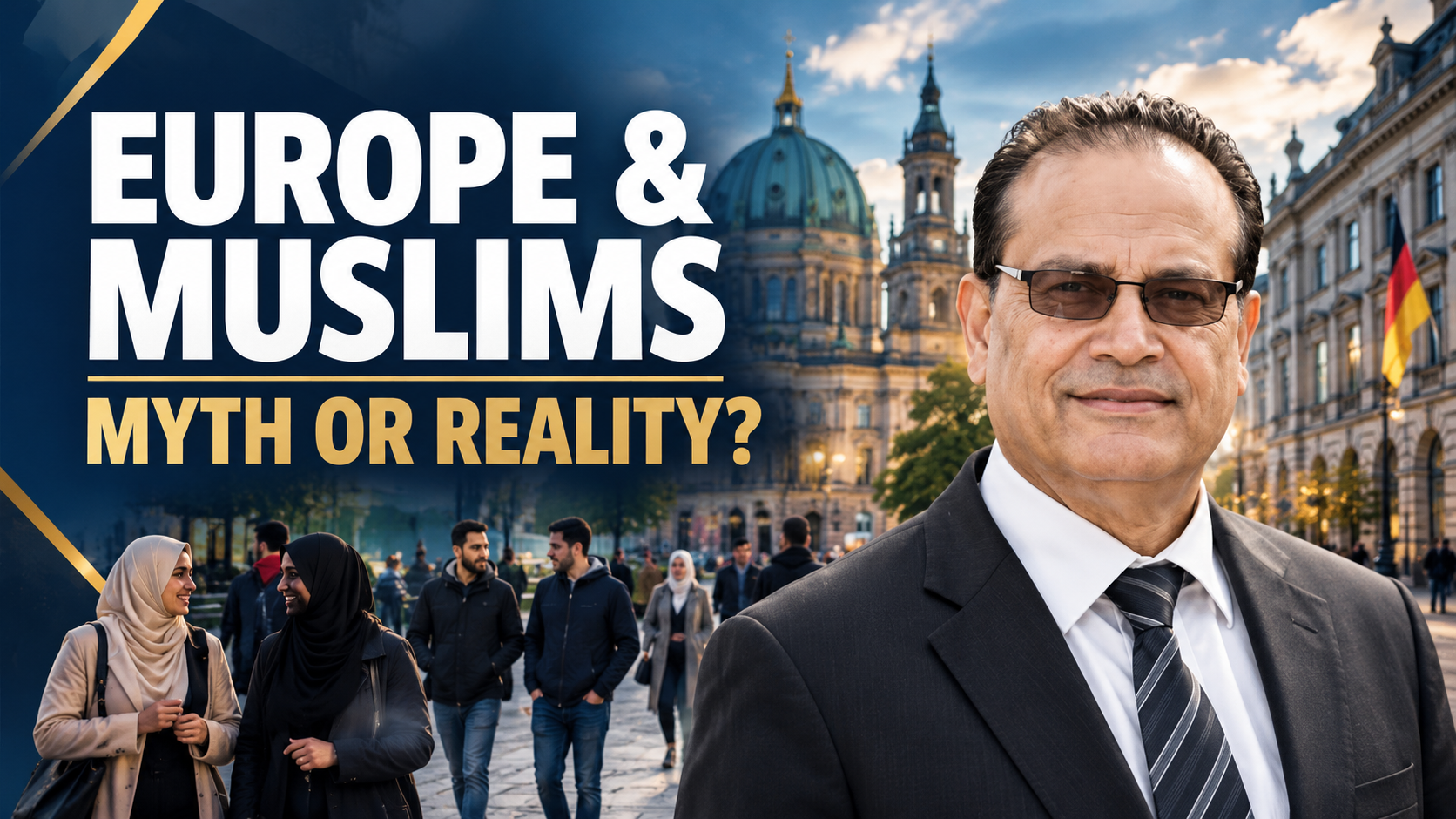
Paris (Imran Y. CHOUDHRY) :- Former Press Secretary to the President, Former Press Minister to the Embassy of Pakistan to France, Former MD, SRBC Mr. Qamar Bashir analysis : Part One of this series examined the distance between the language of a Muslim invasion and the history of workers recruited to sustain European economies. It also drew on my diplomatic service in France and community contacts elsewhere to describe families absorbed in earning a living. The next question concerns their future: will their children and grandchildren be accepted as equal members of the societies they help sustain?
A society reveals the meaning of its equality when a cleaner’s child becomes qualified to lead. If that child’s ambition triggers suspicion because of a Muslim name or faith, the obstacle has moved beyond immigration policy into the rights of people who already belong. Education, citizenship and public service then become tests of whether proclaimed principles extend to everyone.
What has struck me most in the United States is the fear of becoming visible. In community conversations and WhatsApp groups, I have encountered people reluctant to discuss politics, criticise government policy or openly express their feelings. Some avoid even educational, religious or community gatherings because they fear attracting attention. They worry about deportation, their green cards, permanent residence or citizenship. I describe the fears they expressed and the silence those fears produced.
These are people trying to protect whatever security they have managed to build. They work, pay their bills and lower their voices. To hear them described as an organised invading force is, to me, a profound distortion of the lives I have witnessed. Their reserve is interpreted as separation, their religious identity as an agenda, and their children’s advancement as a threat.
That experience informs my objection to the invasion narrative. A waiter is not an occupying soldier. A taxi driver supporting his children is not evidence of a coordinated religious project. A mosque does not establish a conspiracy, and a Muslim graduate seeking public office is exercising a claim to equal citizenship. Neither modest work nor professional success should become grounds for permanent suspicion.
The consequences of exclusion are measurable. The EU Agency for Fundamental Rights’ 2024 report, based on its 2022 survey, found that 47 percent of Muslim respondents experienced racial discrimination during the preceding five years, compared with 39 percent in the earlier survey. The experiences reported across the participating countries expose a serious gap between proclaimed equality and lived experience.
Education provides another window into the changing lives of these families. In France’s 2025 figures, 36.5 percent of first-generation immigrants from the Maghreb had at most a lower-secondary qualification, compared with 20 percent of their France-born second generation. For people of Turkish origin, the corresponding shares were 63.2 and 19.6 percent. Higher-education qualifications were held by 10.6 percent of Turkish immigrants and 37.5 percent of their France-born descendants. These origin-based figures record both educational disadvantage and the growing qualifications of the next generation.
Research extending to a third generation also shows substantial advancement alongside persistent inequality. An INED account of a study using the 2019–2020 TeO2 survey reports that 46 percent of North African immigrants’ grandchildren pursued higher education, compared with 55 percent in families without a migration history. These grandchildren belong to the societies in which they grew up. Their educational advancement strengthens their claim to opportunity and makes the portrayal of permanent foreignness still more indefensible.
In my assessment, resentment becomes particularly visible when the children of immigrants move beyond the occupations associated with their parents. The objection then appears to be less about whether they contribute than whether they may compete for authority, status and opportunity. A Muslim seeking professional or political office is not taking something reserved by birth for another race or religion.
America’s constitutional commitments provide a clear standard against which to judge its leaders. The First Amendment prohibits religious establishment and protects free exercise; Article VI prohibits religious tests for federal public office. These guarantees protect Muslim citizens alongside their fellow Americans. Government measures that discriminate on religious grounds must face constitutional scrutiny.
Trump’s March 1, 2025 order designated English as the official language while allowing agencies to continue other-language services. Its practical effects deserve scrutiny wherever language policy restricts access to public services or opportunity. In employment, EEOC guidance requires justification for restrictive workplace language rules and prohibits unlawful national-origin discrimination.
France’s Constitution identifies the republic as secular and guarantees citizens equality regardless of origin, race or religion. Germany’s Basic Law protects religious freedom and prohibits discrimination on specified grounds including faith and origin. These principles require governments to respect equal citizenship and provide a basis for challenging discriminatory state action.
Freedom of religion protects belief, expression and practice within the law. It belongs to Muslims as fully as to other citizens. Peaceful prayer and religious dress are expressions of identity; accusations of coercion or unlawful conduct require evidence of the conduct alleged.
In France, Éric Zemmour described Muslim presence as an invasion and colonisation and argued that Muslims should choose between Islam and France. His conviction for inciting discrimination and religious hatred survived scrutiny at the European Court of Human Rights in December 2022. The court found no violation of his freedom of expression. Accountability was already available through law.
In the Netherlands, Geert Wilders asked supporters in 2014 whether they wanted more or fewer Moroccans. They chanted for fewer. In July 2021, the Dutch Supreme Court upheld his conviction for insulting a group. The judgment addressed ethnic targeting and demonstrated that political prominence carries accountability under domestic law.
Accountability must therefore distinguish protected opinion from punishable conduct. American law broadly protects offensive speech. Under Brandenburg, advocacy can be punished as incitement when directed toward producing imminent unlawful action and likely to produce it. European systems permit certain wider restrictions, as these French and Dutch cases demonstrate. Legal accountability requires a defined offence, evidence and due process.
The practical response is to enforce anti-discrimination laws, investigate threats and violence, provide accessible complaints procedures, challenge unlawful state measures and apply valid incitement laws through independent courts. Where speech remains protected, voters, journalists and parties should impose political accountability. Equal protection must coexist with freedom to criticise religion and government.
The Universal Declaration of Human Rights affirms equality and freedom of religion and expression. Its international authorship underscores the shared ownership of those principles. Speaking in Florida on October 20, 2026, Bill Clinton echoed the message of Surah Al-Hujurat, verse 13: humanity was created as different nations and tribes so that people might know one another. He presented that message as a call to mutual understanding rather than contempt, offering a powerful counterpoint to the collective suspicion directed at Muslims.
Europe and America may regulate immigration. They may prosecute crime and resist coercive extremism. But Muslim identity is not proof of criminality, foreign allegiance or invasion. The decisive question is whether societies that proclaim universal rights will uphold them when the people claiming equality pray differently.
Paris (Imran Y. CHOUDHRY) :- Former Press Secretary to the President, Former Press Minister to the Embassy of Pakistan to France, Former MD, SRBC Mr. Qamar Bashir analysis : A Muslim who cleans a European railway station is useful. His daughter who seeks to run the railway becomes, in the language of exclusion, evidence that the country is being taken over. That contradiction lies at the heart of the “Muslim invasion” narrative: minorities are welcomed as labour but too often treated as intruders when they claim equal standing.
Immigration presents legitimate questions about housing, public services, borders and integration. Governments must address them. But describing Muslims collectively as invaders replaces policy with religious suspicion. It blurs distinctions between citizens and foreigners, workers and refugees, peaceful believers and violent extremists. A population becomes an accusation.
Donald Trump helped normalise this language long before returning to the presidency. On December 7, 2015, his campaign demanded a “total and complete shutdown of Muslims entering the United States.” The proposed distinction was explicitly religious. A Muslim doctor and a Muslim child were placed within the same category of exclusion, regardless of their conduct.
At the United Nations on September 23, 2025, Trump warned European leaders: “Your countries are going to hell.” He linked migration and energy policies to Western Europe’s destruction. His broad attack on migration portrayed demographic change as civilisational collapse, providing fertile ground for those who define Muslim presence itself as a threat.
The pattern has continued. Le Monde reported on October 19, 2026, that Trump and Russian officials portrayed unrest in France as evidence of immigration-driven decline, although its reporting identified education and living-cost grievances among the protesters. This illustrates why claims about migrants must be checked against the actual causes of events, rather than accepted as political explanations.
European examples are equally revealing. Germany’s Alternative für Deutschland states in its programme that Islam does not belong to Germany and presents the growing Muslim population as a danger. The same programme acknowledges that many Muslims are law-abiding and integrated. Its position leaves a fundamental contradiction between accepting individual Muslims and declaring their faith alien to national life.
The historical irony is considerable. European empires carried their languages, institutions, religions and commercial systems across continents through conquest and unequal power. English, French, Spanish and Portuguese remain global languages partly because colonial rule reorganised administration, education and opportunity. Those histories should encourage humility when European politicians portray cultural change as an intolerable injury.
America’s colonial foundations included a substantial trade in convicted prisoners. Between 1718 and 1775, British courts banished approximately 50,000 convicts to the American colonies, including people convicted of theft and other offences. Britain used transportation to remove people its authorities considered undesirable, while colonial employers purchased their labour. Penal exile and commercial exploitation were joined in a system that helped build the colonies. Enslaved Africans were separately transported by force and subjected to hereditary racial slavery.
For Indigenous peoples, European colonisation and American expansion brought catastrophic population loss and dispossession. Demographic research summarised by J. David Hacker and Michael R. Haines places the population decline in the area of the contiguous United States between 1492 and 1900 at more than 85 percent under commonly used estimates. Epidemics, warfare, massacres, forced removal and the destruction of livelihoods contributed to this catastrophe.
The scale of land seizure is equally stark. A 2021 study published in Science found that Indigenous nations in the contiguous United States had lost 98.9 percent of their historical land base. These histories of forced labour, mass death and territorial dispossession should weigh heavily on political rhetoric that depicts families seeking work and safety as invaders. [7]
Postwar migration was also shaped by European demand for workers. Former colonial powers and other European states sought labour to sustain their economies. Britain recruited from the Commonwealth. Under West Germany’s agreement with Turkey, approximately 870,000 Turkish workers arrived between 1961 and 1973; around 80 percent performed demanding physical work in construction and manufacturing. Approximately half a million returned to Turkey by 1973.
France recorded 211,775 permanent-worker arrivals from Algeria, Morocco and Tunisia during 1971–1975 alone. These were substantial labour movements serving European economic needs. Employers and governments helped create movements later portrayed as entirely unwanted.
There is a profound moral difference between arriving to conquer a population and arriving to work within its laws. The presence of mosques, halal shops or Muslim elected representatives does not establish territorial conquest. Equally, European Muslims cannot all be described as recent arrivals. Some belong to longstanding communities; others were born in the countries whose belonging politicians now question.
My understanding of these communities comes from direct professional engagement. During four years in France as a public policy and media adviser to Pakistan’s ambassador, I maintained close contact with the Pakistani community. Professional assignments also took me to almost twenty countries, where I met Pakistanis living and working abroad. Over the past two years in the United States, I have continued those conversations with Pakistani and other Muslim communities.
Across the communities I encountered, the recurring picture was of people earning their living through demanding, modestly paid work. They served in restaurants, drove taxis, painted buildings, worked on construction sites, cleaned premises and laboured in agriculture. Their days revolved around employment, rent, family obligations and their children’s future. This was the world I knew through sustained contact, rather than the imagined army of religious expansion portrayed in hostile political speeches.
In those circles, high-level professionals were a very small minority. My own impression would place them at around one percent of the people I encountered. Some appeared socially distant from the wider immigrant community, finding greater acceptance and prestige through their employers and the majority population. Their language, communication skills and professional networks opened doors unavailable to many manual workers. That contrast shaped my understanding of the divisions within immigrant life.
The pattern I observed was not confined to Pakistanis. Conversations with other Muslim communities repeatedly brought me back to poverty, restricted opportunity and the enduring economic inequalities associated with colonial histories. People sought a place where their labour could sustain a household. In my experience, their overriding ambition was a decent living and a secure future, rather than a campaign to convert Europe or replace its laws.
The history of recruitment and the lives I encountered lead to a question that reaches beyond immigration: what happens when the children of those workers seek the education, influence and authority their parents rarely possessed? Part Two follows that transition, examining how fear and discrimination confront educational advancement, and whether Western constitutional promises can deliver equal belonging.

Paris (Imran Y. CHOUDHRY) :- Former Press Secretary to the President, Former Press Minister to the Embassy of Pakistan to France, Former MD, SRBC Mr. Qamar Bashir analysis : The world stands at a critical juncture in its relationship with Israel. For decades, the international community has watched as Palestinians have been systematically displaced, their homes destroyed, and their rights violated under the guise of security concerns. The recent announcement by the United Kingdom government to impose comprehensive sanctions on Israeli settlements in the occupied West Bank represents a watershed moment—one that challenges the long-standing impunity with which Israel has operated. These measures are not merely diplomatic gestures but essential tools for justice, peace, and the preservation of human dignity.
Ironically it was the UK which spearheaded the foundation of Israel in 1948, and was instrumental in ethnically cleansing 750,000 Palestinians from their homes in Majdal Ashkelan to establish the state of Israel. These Palestinians were forcibly removed, placed in prison camps, and eventually dumped into the Gaza Strip, where they have been permanently warehoused under siege conditions.
However, as repentance of its past crimes, the encouraging British government’s decision to ban imports from illegal Israeli settlements, impose strict arms export controls, and sanction individuals involved in settler violence represents a courageous stand for international law, is a step in the right direction.. These settlements are unequivocally illegal under the Fourth Geneva Convention, which prohibits an occupying power from transferring parts of its own civilian population into territory it occupies. For too long, the international community has paid lip service to this principle while allowing Israel to continue its expansion unabated.
Foreign Secretary Ed Miliband’s characterization of settler activities as “ethnic cleansing” is not hyperbole but an accurate description of reality. When Israeli settlers, often with state protection, systematically drive Palestinian communities from their land through violence, intimidation, and the destruction of homes and olive groves, this is ethnic cleansing by any reasonable definition. The UK’s sanctions send a clear message: such practices have consequences, and the era of impunity is ending.
Israel’s reaction to the UK sanctions has been telling. President Herzog and Prime Minister Netanyahu have condemned the measures, claiming that sanctions are not the solution and that dialogue is the only path forward. Yet this appeal to dialogue is fundamentally disingenuous when Israel itself has consistently rejected dialogue in favor of military action. The same government that has flattened Gaza, destroyed southern Lebanon, occupied the Golan Heights, and continues to expand settlements in the West Bank cannot credibly lecture others about the virtues of peaceful negotiation.
The Israeli government’s countermeasures—closing the British consulate in Jerusalem, expelling UK representatives from coordination centers, and denying entry to British officials—reveal a government more interested in retaliation than reconciliation. This is the behavior of a state that believes it can act with complete impunity, that international law applies to others but not to itself. The irony of Israel’s position becomes even more apparent when considering its enthusiastic support for US sanctions against Iran. If sanctions are illegitimate when applied to Israel, why are they legitimate when applied to others?
What makes the current moment particularly significant is the growing global consensus around the need to hold Israel accountable. Canada and France have already implemented matching bans on settlement trade, and other nations are expected to follow. This is not a fringe movement but a mainstream diplomatic position grounded in international law and basic human rights principles.
The United States, Israel’s most steadfast ally, is increasingly isolated in its unconditional support. The proposed congressional resolution declaring that the United States will not aid Israel or enter into wars on its behalf represents a significant shift in American public sentiment. Even within the US, there is growing recognition that uncritical support for Israel has damaged American interests, destabilized the Middle East, and put the United States on the wrong side of history.
The call for boycott has extended beyond governments to include religious authorities and civil society organizations. Christian leaders, including Archbishop J. Black, have called for boycott of Israeli products, drawing parallels to the successful international campaign against apartheid South Africa. Their position is rooted not in anti-Semitism but in a profound commitment to justice—the recognition that any system built on racial or religious supremacy must be dismantled.
The boycott movement has practical implications. Consumers are being urged to check labels and avoid products from Israeli settlements, which are often sold under supermarket own brands or other disguises. Items ranging from fruits and vegetables to beauty products, diamonds, and plastic goods should be scrutinized for Israeli origins. The economic impact of such boycotts, if sustained, could be substantial—UK trade with Israel amounts to approximately $1.6 billion annually.
The UK’s leadership in this matter provides an opportunity for Muslim countries to take decisive action. While individual boycotts have existed in some Muslim nations, coordinated government-level sanctions would send an even stronger message. Islamic countries should follow the British example by imposing comprehensive bans on Israeli products, regardless of how they are branded or marketed. They should also consider severing diplomatic, economic, and cultural ties with Israel until it complies with international law.
This is not about targeting Jewish people—a charge that Israeli leaders cynically weaponize to deflect legitimate criticism. It is about opposing a state that has institutionalized discrimination, collective punishment, and territorial expansion. The vast majority of pro-Palestinian advocates, whether Muslim, Christian, Jewish, or secular, are motivated by a commitment to human rights, not by prejudice.
No discussion of Israel’s accountability would be complete without addressing the United States’ role as its primary enabler. For decades, the US has provided Israel with billions of dollars in annual aid, diplomatic cover at the United Nations, and military support that has been used to commit atrocities against Palestinians. This relationship has not only facilitated Israeli aggression but has also undermined US credibility in the Middle East and the global South.
The American people, who are hardworking, peace-loving, and committed to justice, must pressure their representatives to end this unconditional support. Individual Americans can participate in boycotts, campaign for congressional action, and raise their voices in solidarity with Palestinians. The Israeli government’s increasingly extreme rhetoric, including calls for a “greater Israel” from the Nile to the Euphrates, should alarm all Americans who value stability and international law.
The South African anti-apartheid movement demonstrated that sustained international pressure can bring about change. Sanctions, boycotts, and diplomatic isolation were instrumental in forcing the apartheid regime to negotiate an end to its discriminatory system. The same strategy can and must be applied to Israel.
Making Israel a pariah state serves multiple purposes. First, it strips away the illusion that Israel’s actions are legitimate, forcing the Israeli public to confront the reality of their government’s policies. Second, it creates tangible consequences for continued occupation and settlement expansion. Third, it signals to the world that the era of unconditional tolerance for Israeli atrocities is over.
The UK’s sanctions against Israeli settlements are not an act of hostility but an expression of hope—hope that international law can be restored, hope that justice can prevail over might, hope that the Palestinian people will finally receive the recognition and rights they have been denied for three generations.
Justice for Palestinians is not about choosing sides in a conflict; it is about upholding fundamental principles of human dignity, equality, and the rule of law. Israel must now confront the fact that its political establishment has become a pariah in the community of nations. The question is not whether Israel will change—it is whether the world will have the courage to demand that change. History will judge us all by our response to this defining moment. The time for action is now, and the world must recognize Palestine as a state and ensure its borders are protected. Only through collective action can we ensure that justice, truth, and humanity prevail.


The Dawn of Physical, Intimacy and Consciousness Intelligence

Tehran’s Diplomatic Bombshell

Netanyahu’s Electoral Setback: Will Israel Choose War or Diplomacy?

New Chapter for Dragon Boating in Punjab and Khyber Pakhtunkhwa Provincial associations officially set up with sights locked on national competitions and international representation.

South Korea’s Yoo Useong Steps Onto the Global Strongman Stage as World Strongman Federation Professional Athlete

A Survey of Mata-E-Zeest


-
 Pakistan News3 weeks ago
New Chapter for Dragon Boating in Punjab and Khyber Pakhtunkhwa Provincial associations officially set up with sights locked on national competitions and international representation.
-
 Sports5 months ago
South Korea’s Yoo Useong Steps Onto the Global Strongman Stage as World Strongman Federation Professional Athlete
-
 Art & Culture1 year ago
A Survey of Mata-E-Zeest
-

 Europe News2 years ago
Chaos and unproven theories surround Tates’ release from Romania
-

 American News2 years ago
Trump expands exemptions from Canada and Mexico tariffs
-

 Art & Culture2 years ago
Will Snow White be a ‘victim of its moment’? How the Disney remake became 2025’s most divisive film
-

 American News2 years ago
Trump Expels Zelensky from the White House
-

 Entertainment2 years ago
Champions Trophy: Pakistan aim to defend coveted title as historic tournament kicks off today