
Art & Culture
The unseen masterpieces of Frida Kahlo

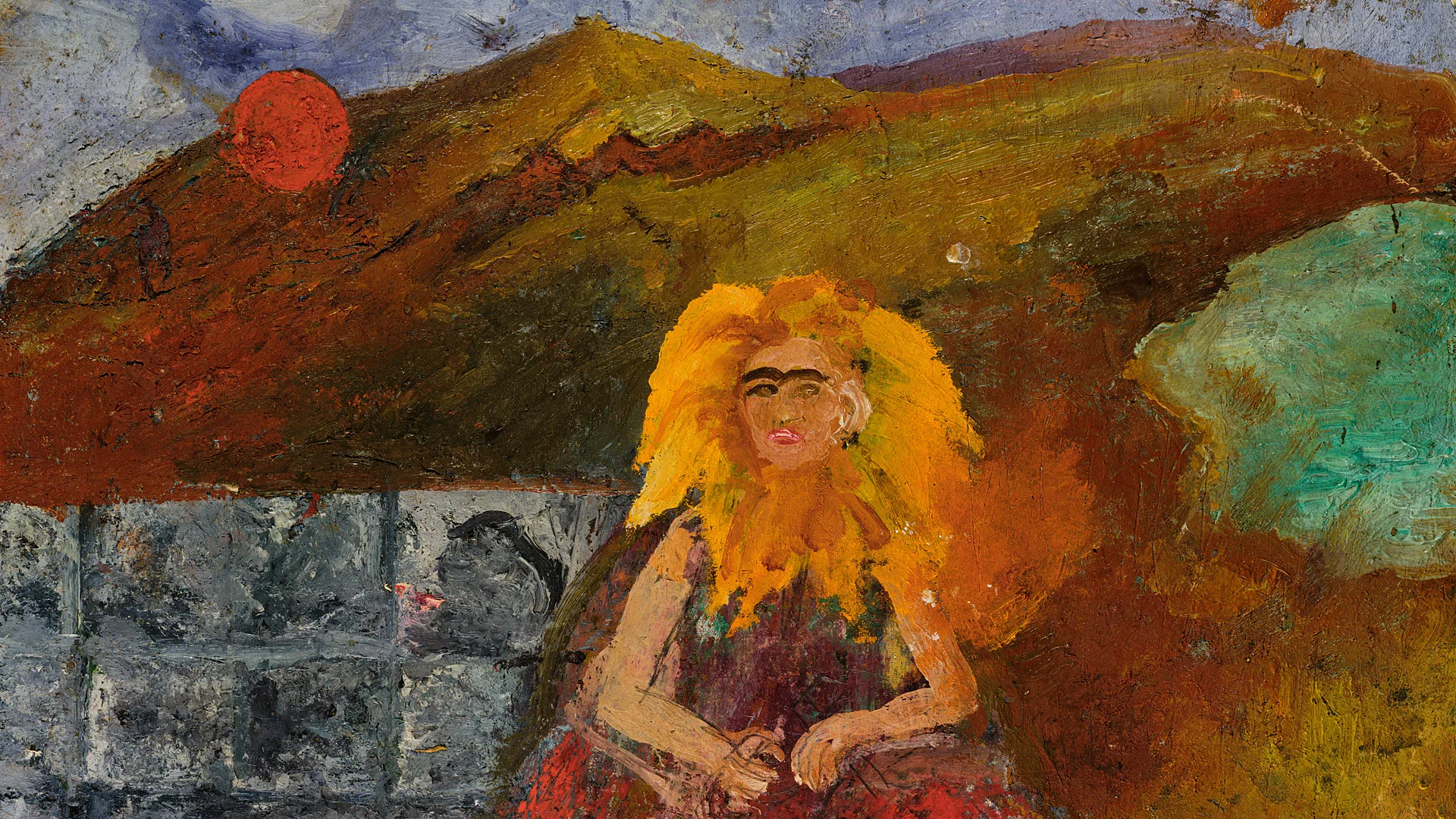
Lost or little-known works by the Mexican artist provide fresh insights on her life and work. Holly Williams explores the rarely seen art included in a new book of the complete paintings.
You know Frida Kahlo – of course you do. She is the most famous female artist of all time, and her image is instantly recognisable, and unavoidable. Kahlo can be found everywhere, on T-shirts and notebooks and mugs. While writing this piece, I spotted a selection of cutesy cartoon Kahlo merchandise in the window of a shop, maybe three minutes’ walk from my home. I bet many readers are similarly in striking distance of some representation of her, with her monobrow and traditional Mexican clothing, her flowery headbands and red lipstick.
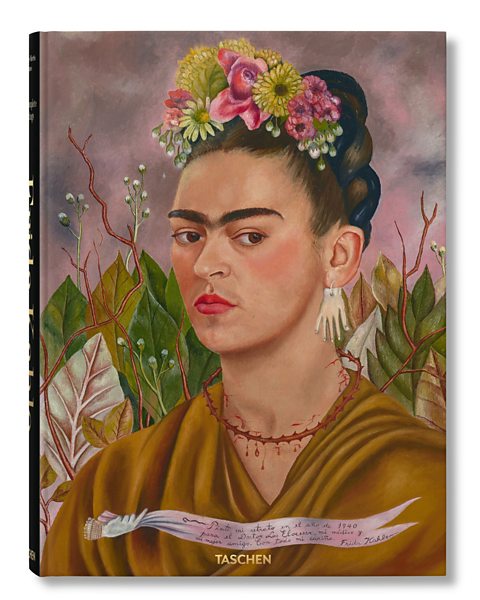
Partly, this is because her own image was a major subject for Kahlo – around a third of her works were self-portraits. Although she died in 1954, her work still reads as bracingly fresh: her self-portraits speak volumes about identity, of the need to craft your own image and tell your own story. She paints herself looking out at the viewer: direct, fierce, challenging.
All of which means Kahlo can fit snugly into certain contemporary, feminist narratives – the strong independent woman, using herself as her subject, and unflinchingly exploring the complicated, messy, painful aspects of being female. Her paintings intensely represent dramatic elements of a dramatic life: a miscarriage, and being unable to have children; bodily pain (she was in a horrific crash at 18, and suffered physically all her life); great love (she had a tempestuous relationship with the Mexican artist Diego Rivera, as well as many other lovers, male and female, including Leon Trotsky), and great jealousy (Rivera cheated on her repeatedly, including with her own sister).
Kahlo has become a bankable blockbuster topic, guaranteed to get visitors through the door
But thats not all they show – her art is not always just about her life, although you could be forgiven for assuming it was. Books are written about her trauma, her love life; she’s been the subject of a Hollywood movie starring Salma Hayek. Kahlo has become a bankable blockbuster topic, guaranteed to get visitors through the door of galleries, even if what they see is often more about the woman than her art.
But what about her work? For some art historians, the relentless focus on the person rather than the output has become tiresome, which is why a new, monumental book – Frida Kahlo: The Complete Paintings – has just been published by Taschen, offering for the first time a survey of her entire oeuvre. Mexican art historian Luis-Martín Lozano, working with Andrea Kettenmann and Marina Vázquez Ramos, provides notes on every single Kahlo work we have images of – 152 in total, including many lost works we only know from photographs.
Speaking to Lozano on a video call from Mexico City, I ask if a comprehensive survey of her work is overdue, despite there being so many shows about her all over the world?
“As an art historian, my main interest in Kahlo has been in her work as an artist. If this had been the main concern of most projects in recent decades, maybe I would say this book has no reason to be. But the truth is, it hasn’t,” he says. “Most people at exhibitions, they’re interested in her personality – who she is, how she dressed, who does she go to bed with, her lovers, her story.”
Because of this, exhibitions and their catalogues have often focused on that story, and tend to “repeat the same paintings, and the same ideas about the same paintings. They leave aside a whole bunch of works,” says Lozano. Books also re-tread the same ground: “You repeat the same things, and it will sell – because everything about Kahlo sells. It’s unfortunate to say, but she’s become a merchandise. But this explains why [exhibitions and books] don’t go beyond this – because they don’t need to.”
The result is that certain mistakes get made – paintings mis-titled, mis-dated, or the same poor-quality, off-colour photographs reproduced. But it also means that ideas about what her works mean get repeated ad infinitum. “The interpretation level becomes contaminated,” suggests Lozano. “All they say about the paintings, over and over, is ‘oh it’s because she loved Rivera’, ‘because she couldn’t have a kid’, ‘because she’s in the hospital’. In some cases, it is true – but there’s so much more to it than that.”
The number of paintings – 152 – is not an enormous body of work for a major artist. And yet, astonishingly, some of these havenever been written about before: “never, not a single sentence!” laughs Lozano. “It’s kind of a mess, in terms of art history.”
Offering a comprehensive survey of her work means bringing together lost or little-known works, including those that have come to light in auctions in the past decade or so, and others that are rarely loaned by private collectors and so have remained obscure. Lozano hopes to open up our understanding of Kahlo. “First of all – who was she as an artist? What did she think of her own work? What did she want to achieve as an artist? And what do these paintings mean by themselves?”
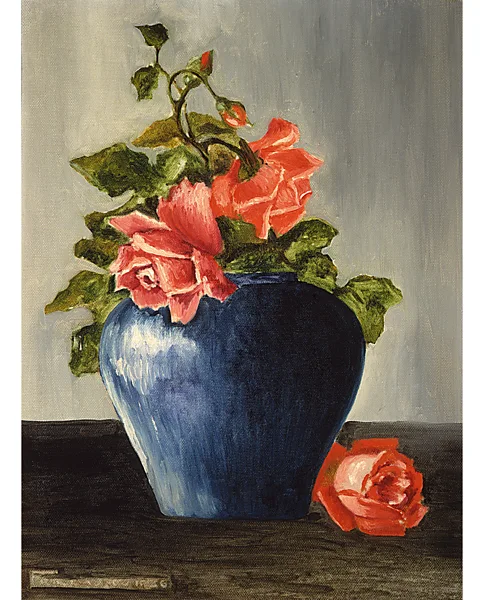
This means looking again at early works, which might not be the sort of thing we associate with Kahlo – but reveal how much she was inspired by her father, Guillermo, a professional photographer and an amateur painter of floral still lifes. Pieces such as the little-known Still Life (with Roses) from 1925, which has not been exhibited since 1953, are notably similar in style to his.
Kahlo continued to paint astonishing, vibrant still lifes her whole career – although they are less well-known to the general public than her self-portraits, less collectable, and less studied. An understanding of their importance to her has been strengthened since Lozano and co discovered documents revealing Kahlo’s life-long interest in the symbolic meaning of plants. She learnt this from her father, and discussed it in letters with her half-sister Margarita (her father’s child from an earlier marriage), who became a nun.
The missing links
Kahlo and Margarita’s letters “talk about the symbolic meaning of flowers and fruits and the garden of Eden, that our body is like a flower we have to take care of because it was ripped off from paradise,” says Lozano. “This is amazing, and proves why this topic of still lifes and flowers had such meaning to her.”
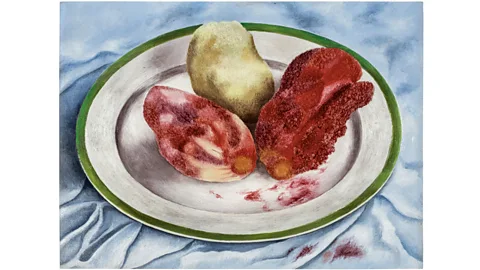
He offers a new interpretation of a painting from 1938, called Tunas, which depicts three prickly pears in different stages of ripening – from green and unripe to a vibrant, juicy, blood-red – as representing Kahlo’s own understanding of her maturation as an artist and person, but as also potentially having religious symbolism (the bloody flesh evoking sacrifice).
The Complete Paintings book also takes pains to reveal the depths of Kahlo’s intellectual engagement with art-world developments – countering the notion that she was merely influenced by meeting Rivera in 1928, or that her work is some self-taught, instinctive howl of womanly pain. Her paintings reveal Kahlo’s research into and experiments in art movements, from the youthful Mexican take on Modernism, Stridentism, to Cubism and later Surrealism.
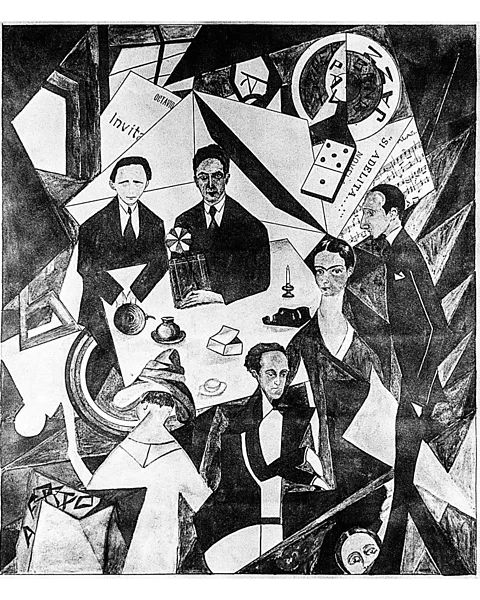
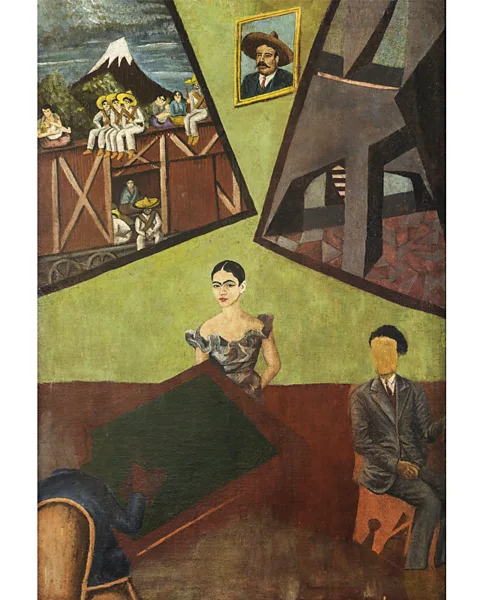
“Frida Kahlo’s paintings were not only the result of her personal issues, but she looked around at who was painting, what were the trends, the discussions,” says Lozano. He points to her first attempts at avant-garde paintings – 1927’s Pancho Villa and Adelita, and the lost work If Adelita, both of which use sharp, Modernist lines and angles – as proof that “she was looking at trends in Mexican art even before she met Rivera”.
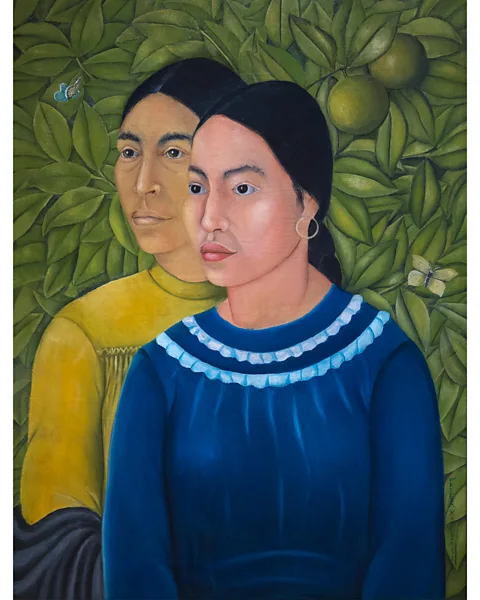
You can also see her interest in Renaissance Old Masters, which she discovered prints of in her father’s library, in early work: it’s suggested her 1928 painting, Two Women (Portrait of Salvadora and Herminia), depicting two maids against a lush, leafy background, was inspired by Renaissance portraiture traditions, as seen in the works of Leonardo da Vinci. Bought in the year it was painted, the location of this work remained unknown until it was acquired by the Museum of Fine Arts, Boston, in 2015.
Given she only made around 152 paintings, a surprising number are lost. But then, Kahlo wasn’t so successful in her lifetime – she didn’t have so many shows, or sell that many works through galleries and dealers. Instead, many of her paintings were sold or given away directly to artists, friends and family, as well as movie stars and other glittering admirers, often living abroad. That means less of a paper trail, making it harder to track down works.
There are some astonishing paintings still missing
In honesty, looking at black-and-white pictures of lost portraits probably isn’t going to prove revelatory to anyone beyond the most hard-core scholars – although there are some astonishing paintings still missing. One lost 1938 image, Girl with Death Mask II, depicts a little girl in a skull mask in an empty landscape; it chills, and we know Kahlo discussed this painting in relation to her sorrow at being unable to conceive. Check your attics, too, for Kahlo’s painting of a horrific plane crash – which we only have a photograph of now – which she’s known to have made in a period of great personal turmoil in the years after discovering her sister’s affair with Rivera in 1935.
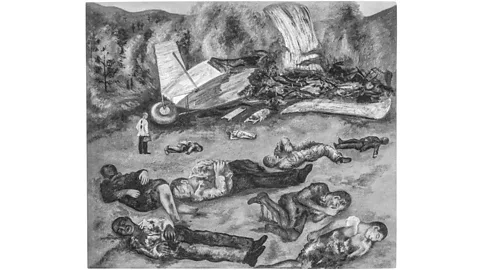
Like another of her very well-known paintings, Passionately in Love or A Few Small Nips, depicting a woman murdered by her husband, The Airplane Crash was based very closely on a real-life news report; Lozano’s team have unearthed both original articles in their research. While Kahlo may have been drawn to these traumatic events because she was suffering pain in her own life, her degree of almost documentary precision in external news stories here should not be overlooked.
Kahlo was an avowed Communist, and politically engaged all her life, but it is in less well-known works from the final years of her life where you see this most explicitly emerge. At this time, she suffered a great deal of pain, and underwent many operations, eventually including amputation below the knee. But Kahlo continued painting till 1953, with difficulty but also with renewed purpose. Her biographer Raquel Tibol documented her saying: “I am very concerned about my painting.
More than anything, to change it, to make it into something useful, because up until now all I have painted is faithful portraits of my own self, but that’s so far removed from what my painting could be doing to serve the [Communist] Party. I must fight with all my strength so that the small amount of good I am able to do with my health in the way it is will be directed toward helping the Revolution. That’s the only real reason for living.”
This resulted in works like 1952’s Congress of the Peoples for Peace (which has not been exhibited since 1953), showing a dove in broad fruit tree – and two mushroom clouds, representing Kahlo’s nightmares about nuclear warfare. She became an active member of many peace groups – collecting signatures from Mexican artists in support of a World Peace Council, helping form the Mexican Committee of Partisans for Peace, and making this painting for Rivera to take to the Congress of the Peoples for Peace in Vienna in 1952.
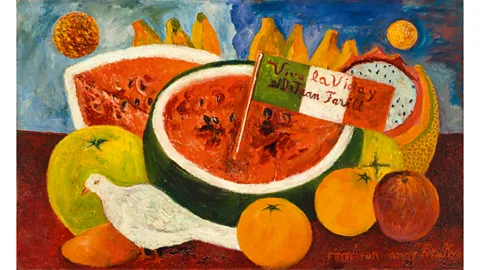
Doves feature in several of her late still lifes – as do an increasing number of Mexican flags or colour schemes (using watermelons to reflect the green, white and red of the flag), suggesting Kahlo’s intention was that her work should show her nationalism and Communism. More uncomfortably, her final paintings include loving depictions of Stalin, as her politics became more militant.
Perhaps her most moving late painting, however, is a self-portrait: Frida in Flames (Self-portrait Inside a Sunflower). It’s harrowing, painted in thick, colourful impasto; shortly before her death, Kahlo slashed at it with a knife, scraping away the paint, frustrated at her inability to make work or perhaps in an acknowledgment that her end was nearing. Tibol, who was witness to this decisive, destructive act, called it “a ritual of self-sacrifice”. “It’s a tremendous image,” says Lozano.
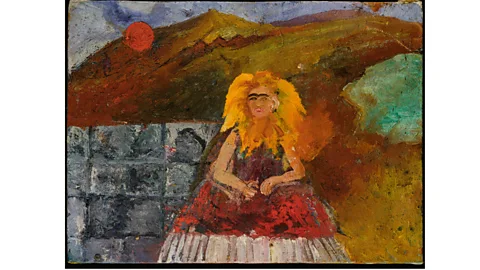
“It’s very interesting in terms of aesthetics – when your body is not working anymore, when your brain is not enough to portray what you want to paint, the only source she’s left with is to deconstruct the image. This is a very contemporary, conceptual position about art: that the painting exists not only in its craft, but also what I think the painting stands for.”
We are left with a painting that is imperfect, certainly a world away from the fine, smooth surfaces and attention to detail of Kahlo’s more famous self-portraits – but it nonetheless is an astonishingly powerful work that deserves to be known. There is something tremendously poignant in an artist so well-known for crafting their own image using their final creative act to deliberately destroy that image. Even in obliterating herself, Kahlo made her work speak loudly to us.
Frida Kahlo: The Complete Paintings is published by Taschen.
Love film and TV? Join BBC Culture Film and TV Club on Facebook, a community for cinephiles all over the world.
If you would like to comment on this story or anything else you have seen on BBC Culture, head over to our Facebook page or message us on Twitter.

As Moby Dick turns 175, some of the last American scrimshanders grapple with the legacy of maintaining one of the US’s oldest art forms.
Jade Gotauco spent her childhood among the skeletons of giants. Her father, Chet Gotauco, was a scrimshander – an artist who etched images onto the ivory of hunted whales. In pensive moments, she would slip under the arched jaw of a whale in his Rhode Island garden and sit atop a massive vertebra, watching insects scrabble across the porous bone.
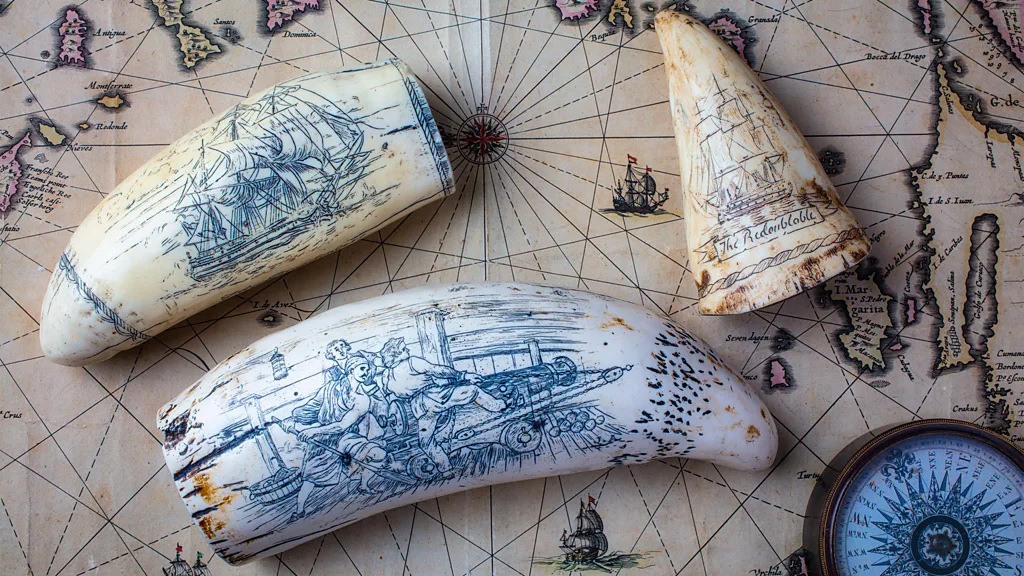
“My favourite smell in the world is the sandy aroma of ivory dust,” said Gotauco, now an artist herself. Whale teeth adorn the walls of her studio in New Bedford, Massachusetts; she engraves them with nautical scenes in which sperm whales thrash the ocean to foam and whalers hurl barbed harpoons from minute boats.
Ask Americans about the cultural legacy of whaling, and many will point to Herman Melville’s classic novel Moby Dick, which turns 175 next month. Yet for all the book’s brilliance, it’s scrimshaw – the practice of artistically carving whale teeth and bones, which is considered one of the US’s earliest homegrown art forms – that offers a true insider’s view of the industry.
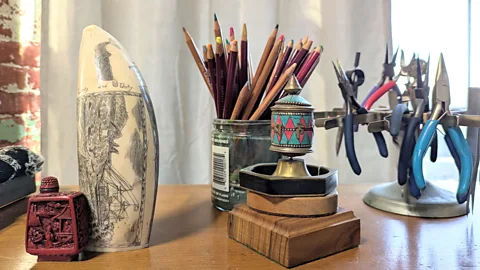
Today, there’s hardly any of those teeth and bones left on the legal market. Some scrimshanders, including Gotauco, believe the art form should disappear with them. “When the ivory is gone, this is over,” she said.
Scrimshaw was developed by sailors whose lives unfolded on whaling grounds around the globe as the industry expanded into a 19th-Century behemoth. They strove to depict a culture that, for a few lucrative decades, made New Bedford North America’s wealthiest city per capita.
Back then, everyone was a scrimshander. Now I’m one of the last – Michael Vienneau
“They saw their experiences as important,” said Marina Wells, an assistant curator at the New Bedford Whaling Museum, which is home to the largest scrimshaw collection is the world. “You see that in their commemoration of whaling scenes, in all their meticulous detail.”
Some of the carvings throb with yearning, depicting homey scenes of faraway families. Others capture sailors rowing fragile, open boats dwarfed by the whales they pursued. They’re communicating “the dangerous, faraway world of whaling”, Wells said. “You have the bloody spouts of the whales after their lungs have been punctured… the intimacy of whalemen interacting with whale bodies that’s really hands-on.”
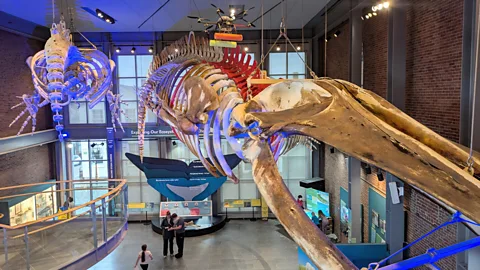
To modern eyes, the scenes evoke the heartbreaking impacts on species hunted to the brink of extinction; yet the whalers, too, were often broken by the industry. At the Seamen’s Bethel, an 1832 mariner’s church located across the street from the museum in New Bedford (and which features in the opening chapters of Moby Dick), such risks are on poignant display. Lining its whitewashed sanctuary are marble cenotaphs commemorating those lost at sea.
“After fastning to a whale, was carried overboard by a line and drowned,” reads the tomb of Captain William Swain. Three sailors from the whaleship Cowper, aged 19, 22 and 24, share another memorial: “All lost by the upsetting of their boat, July 15, 1854, in the Ochotsk Sea.”
They died as American whaling reached a short-lived fever pitch. In 1857, more than 10,000 men worked aboard New Bedford whaleships, half the city’s population at the time. Two years later, petroleum was discovered in Pennsylvania and the ensuing oil rush flooded American cities with kerosene – a comparatively cheap fossil fuel that would eclipse the whale oil used in lamps around the globe.
By the turn of the century, American whaling was all but over.
Scrimshaw lived on, however. The massive scale of the whaling industry produced a glut of teeth and bones, a byproduct that, at the time, had little commercial value. They gathered dust in attics and warehouses.
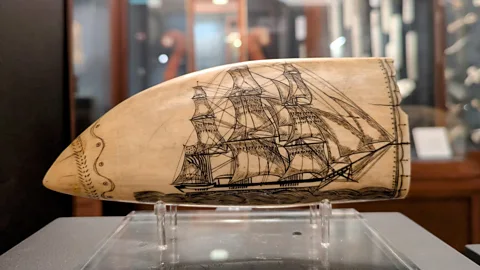
“When I was a kid they had barrels of whale teeth down at the wharves and sold them for a couple of bucks apiece,” recalled Michael Vienneau, a scrimshander on the nearby island of Nantucket, Massachusetts – another onetime whaling hub. Former homes of whaleboat captains surround his small shop, Scrimshander Gallery, in the heart of the island’s historic district. A few blocks away is the Nantucket Whaling Museum, whose own significant scrimshaw collection includes pieces by Nantucket whalemen – and famed scrimshanders – Frederick Myrick and Edward Burdett.
In the 1960s, scrimshawing surged in popularity, part of a folk-craft revival. (It even got a boost from US President John F Kennedy, an avid collector.) That’s when Vienneau got his start, rummaging for cheap whale teeth as a teenager while visiting the island with his family.
“Back then, everyone was a scrimshander,” he said. “Now I’m one of the last.”
In part, that’s because of the 1973 Endangered Species Act, which tightly restricted the sale of marine ivory. Today, scrimshanders engraving whale teeth and bones must work from the dwindling supply of teeth and bones that remain from before the act was passed – Vienneau has a stash in the back of his shop. “You’ll pay several thousand dollars for a raw tooth now,” said Vienneau.
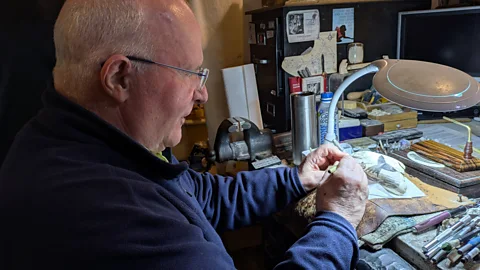
On a recent afternoon, he was sitting at his workstation squinting at a sperm whale tooth he was engraving with a scene of a sailor brandishing a harpoon at the tail of a diving whale. More teeth were piled in a nearby filing cabinet. His dog, Petey, grabbed a tooth and began to chew on it. Vienneau laughed. “Any dog that gnaws on a sperm whale tooth is a scrimshander’s dog,” he said, not getting up.
As whale teeth grew scarce and expensive, some scrimshanders innovated, carving on cow bones and deer antlers. Even comparatively tooth-rich Vienneau experimented. Once, he flew to Alaska on a tip and spent three days digging a 30,000-year-old mammoth tusk out of permafrost near a remote copper mine.
Yet, many purists insist that while such projects are both art and craft, they are not true scrimshaw, since the authentic form relies on the byproducts of historical whaling. Gotauco is one of them. Like some of her peers, she believes this means that scrimshaw is on the brink of extinction.
Gotauco works exclusively on pre-1973 ivory and bones. Nearly a century ago, her grandmother emigrated to Boston from Newfoundland, and among her few belongings was a collection of whale teeth and bones she’d inherited from her family of seal hunters, cod fishermen and whalers. That’s what Gotauco carves in her New Bedford studio, etching images onto the physical remains of her ancestors’ legacy.
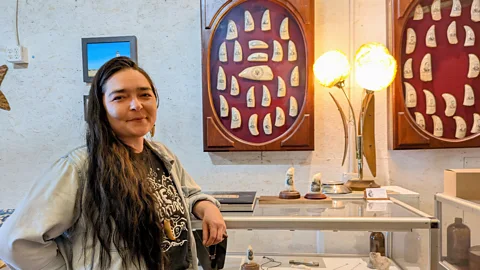
Along with the whale teeth, Gotauco’s grandmother passed along stories of what she said were Mi’kmaq roots. Whales factor into traditional Mi’kmaq stories, and the First Nations community hunted the animals sustainably long before the arrival of Europeans in North America. With her own deep reverence for whales, Gotauco has, at times, felt deeply uneasy about working with ivory.
In the years since she learned how to carve scrimshaw by sitting beside her father in his workshop, Gotauco often wondered about the ethics of using materials pulled from the sea with such violence. Commercial whaling was an environmental disaster and a cruelly dangerous job; the beauty of the art form it spurred still catches at her heart. In the end, she embraced it as a form of remembering, calling it “the best way to honour the whales and whalers”, albeit one that will likely fade in her lifetime.
“When I run out of teeth along with everyone else, I’ll raise a cup to the story’s end,” she said. “May we never get more.”
This News is taken from BBC News
Art & Culture
‘A distinct Canadian character’: The 1920s paintings that changed how the world saw Canada
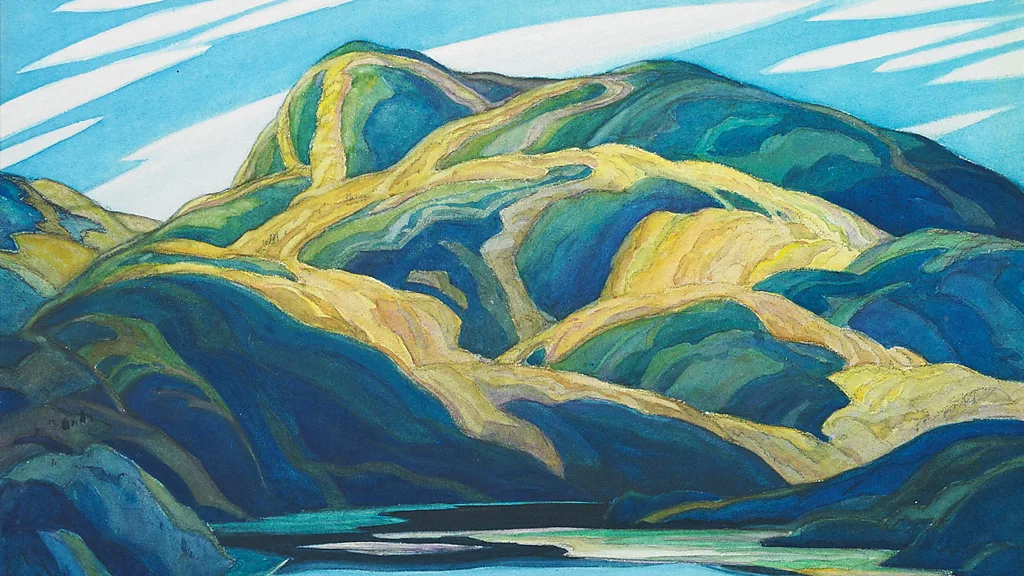
The Group of Seven was Canada’s first internationally recognised national art movement, and they helped create a distinct, modern Canadian identity in the 1920s. As the official Group of Seven Day is celebrated in Canada, what is their legacy – and are their ideas in harmony or conflict with the so-called “Indian Group of Seven”, founded later in the 1970s?
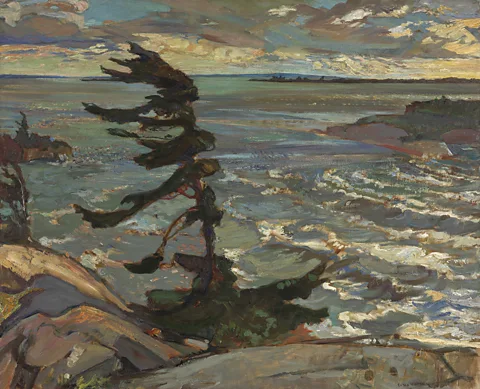
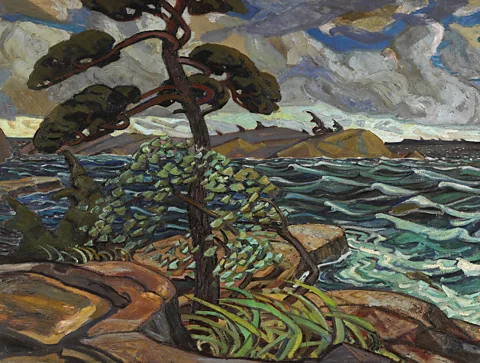
In the 1921 painting Stormy Weather, Georgian Bay, a lone tree perches perilously between a rocky outcrop and a vast, churning lake, buffeted by the elements yet refusing to yield to their force. Executed in rough brushstrokes and simplified lines, it celebrates not only the resilience of Canadian settlers and their ability to survive against all odds, but also the dramatic, untamed landscapes with which they joyfully communed.
The painting by FH Varley is one of the most iconic works by The Group of Seven, a groundbreaking art collective who broke with the dominant tradition of European academic painting to create a uniquely Canadian style that revelled in the country’s vast natural beauty.
The group’s most celebrated works are “almost like what the Statue of Liberty is for the United States,” says Katerina Atanassova, senior curator of Canadian art at The National Gallery of Canada. So beloved are they that 7 July is now celebrated as Group of Seven Day. What is it about their paintings that, for many, embody the Canadian spirit and identity? And where does the group’s work stand in relation to the country’s Indigenous art?
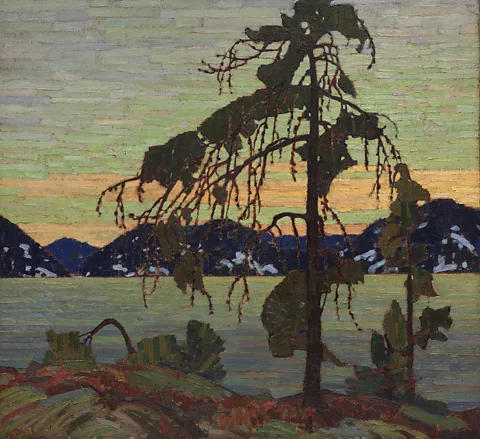
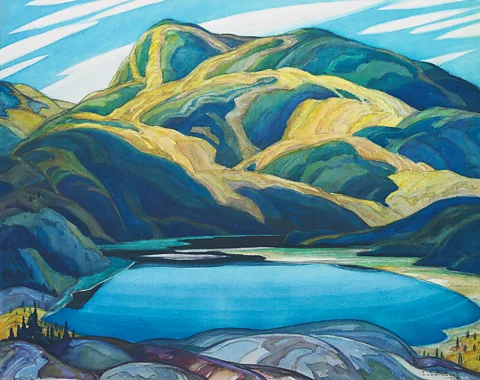
The group which – in addition to Varley – comprised Franklin Carmichael, Lawren Harris, AY Jackson, Franz Johnston, Arthur Lismer and JEH MacDonald remains hugely popular today, as does Tom Thomson, a major influence, who died before its official formation. Their most acclaimed paintings, which include Thomson’s The Jack Pine, The West Wind and Harris’s North Shore, Lake Superior, have become, for many, the national paintings of Canada – embodying the country’s spirit.
A turning point
They began painting in the 1910s, an era when Canada – a self-governing dominion of the British Empire since 1867 – was beginning to find its own social and political identity, but had yet to find an artistic voice. The nascent group was intent on providing just that. A turning point occurred when MacDonald and Harris visited a landmark exhibition of contemporary Scandinavian art in Buffalo, US, in 1913. Norway, Sweden and Finland were all forging their own independent paths at the time. In their sparse landscapes, vividly depicted in flat, bright colours, the two artists saw an expression of national identity that was unequivocally modern.
Their intention was not to portray what nature looked like, but how it made them feel, the emotional state created by the starry sky and the windswept pine – Katerina Atanassova
The aesthetic and intellectual inspiration they took from the Scandinavians was strengthened by the influence of Thomson, a self-taught artist and graphic designer who frequently embarked on lengthy trips into the wilderness, often by canoe, to paint and sketch. “He embodied that ideal, that direct experience that every artist wants to have,” Atanassova tells the BBC. It was Thomson who “started the images of the solitary tree”, and inspired the future Group of Seven artists to see that the Canadian wilderness “can be viewed as modern and painted as modern”, says Atanassova.
Thomson’s death in 1917, at the age of only 40, turned him into a cultural legend, and when the group officially formed in 1920, “the goal was defined that they ought to follow in his footsteps,” says Atanassova. Their intention “was not to portray what nature looked like, but how it made them feel, the emotional state created by the starry sky, the windswept pine or the barren coastal line on the north shore of Lake Superior.” The initial response to their innovative approach was anything but favourable. One review of their first exhibition compared their work to “the contents of a drunkard’s stomach”.
Somewhat ironically, it would take the approval of the very people from whom they were trying to distance themselves to change public opinion. The group’s work was selected for the British Empire Exhibition, held at Wembley in 1924, where it received a rapturous response with the British press praising its “distinct Canadian character. ” Recognition abroad meant that it “suddenly became popular in Canada”, explains Atanassova.
The fact that this “distinct Canadian character” excluded the Indigenous population has led to criticism of the group in some quarters, although Atanassova feels that this is unfair. “You don’t see any signs of civilisation in [the Group of Seven’s] paintings,” she says. They were “looking for untamed nature in the tradition of modern Scandinavian art”, which meant that they also excluded any sign of industrialisation.
While that may be true, we are now painfully aware that in the areas the group were travelling to, they could not have painted Indigenous populations if they had wanted to. The government’s brutal policies, begun in the late 19th Century, had seen them forcibly removed to reservations or residential schools where their movement was restricted and their cultural practices suppressed.
‘The Indian Group of Seven’
These policies had a devastating effect on all aspects of Indigenous life, including artistic production and recognition, a fact that led to the formation of another group of seven in the early 1970s, the Professional Native Indian Artists Incorporated (PNIAI). Jackson Beardy, Eddy Cobiness, Alex Janvier, Norval Morrisseau, Daphne Odjig, Carl Ray and Joseph Sanchez first started meeting in Odjig’s craft shop in Winnipeg.
“They were quite distinct in that they were the first self-organised Indigenous-artists-run arts advocacy group that was formally incorporated that ever existed in Canada,” says Michelle LaVallee, Director of the Indigenous Ways and Decolonization Department and Curatorial Initiatives of the National Gallery of Canada. She herself is Ojibway and a member of the Chippewas of Nawash Unceded First Nation.
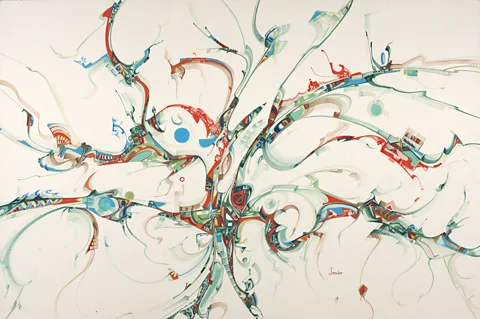
Although they all had different styles and opinions, they wanted to band together to support other artists and challenge exclusionary practices and the narrow view of what “native” art actually was. “We had no one to show our work, so we had to do it ourselves. We acknowledged and supported each other as artists when the world of fine art refused us entry… Together we broke down barriers that would have been so much more difficult faced alone,” Odjig later said.
“At that time, there were no Indigenous curators, no Indigenous people working in institutions,” LaVallee tells the BBC. And where Indigenous art was collected it tended to be relegated to ethno-centric galleries rather than the contemporary fine art collections in which the artists felt they deserved to be exhibited. “It really wasn’t held in the same esteem as [work by their] non-Indigenous peers, even though it is the first and the most authentic art that can be and should be called Canadian,” says LaVallee.
The first art of this land was Indigenous, and the first people of these lands were Indigenous, and that needs to be recognised – Michelle LaVallee
Although the media soon dubbed them “the Indian Group of Seven”, LaVallee isn’t sure they would have appreciated the name. “They were very intentional about what they called themselves,” she says. It was very important for them to have “Professional” and “Native Indian” present in the name of the group.
While LaVallee herself likes the paintings of the Group of Seven, she points out that their approach to landscape is vastly different to the PNIAI. “A lot of the PNIAI’s works you would look at and not necessarily call it a landscape.” They are different ways of referencing the land”. Alex Janvier often incorporated maps in his works, while Norval Morrisseau “draws those connections between land and animals and spirits”. It is art by “somebody from the land versus settlers coming and appreciating the land”, she says.
Even if the Group of Seven weren’t conscious of doing so, they “would have contributed to the circumstances around how Indigenous people were being perceived and treated”, says LaVallee. This was largely down to the way their art was used to “create this popular narrative of Canada” which was picturesque but “excluded the Indigenous populations”, she says.
The PNIAI played a vital role in correcting that, and LaVallee credits her own position – as one of the senior management of the National Gallery of Canada – to their activism. “For me to get to a place like that would not have happened had these earlier artists not fought for these types of rights and opportunities and created avenues of support and camaraderie between Indigenous peoples,” she says.
The National Gallery now displays Indigenous and non-Indigenous art side by side in the same galleries. LaVallee emphasises that this is not meant to “erase or discredit any existing histories”.
“Part of the change we’re trying to assert is the idea that, yes, within Canada, it’s very multicultural, but the first art of this land was Indigenous, and the first people of these lands were Indigenous, and that needs to be acknowledged and respected and recognised.”
In the 1970s, the Group of Seven’s work may have been interpreted by some as exclusionary and colonial, but in the 21st Century it is largely viewed differently. For today’s outdoor-loving Canadians, the group’s art is a celebration of the country’s outstanding natural beauty. It embodies, says Atanassova, “that raw connection with nature – and it’s exactly the nature you see [in the paintings]. The lakes are the same, the skies are the same. It’s an expression of your own experience. What you see and what you feel and what you live.”
Art by the Group of Seven is displayed at the National Gallery of Canada, Ottawa.
—
If you liked this story, sign up for The Essential List newsletter – a handpicked selection of features, videos and can’t-miss news, delivered to your inbox twice a week.
Taken From BBC News
Art & Culture
‘Chest-thumping machismo’: The Bayeux Tapestry reveals the bloody, bawdy truth about the Middle Ages
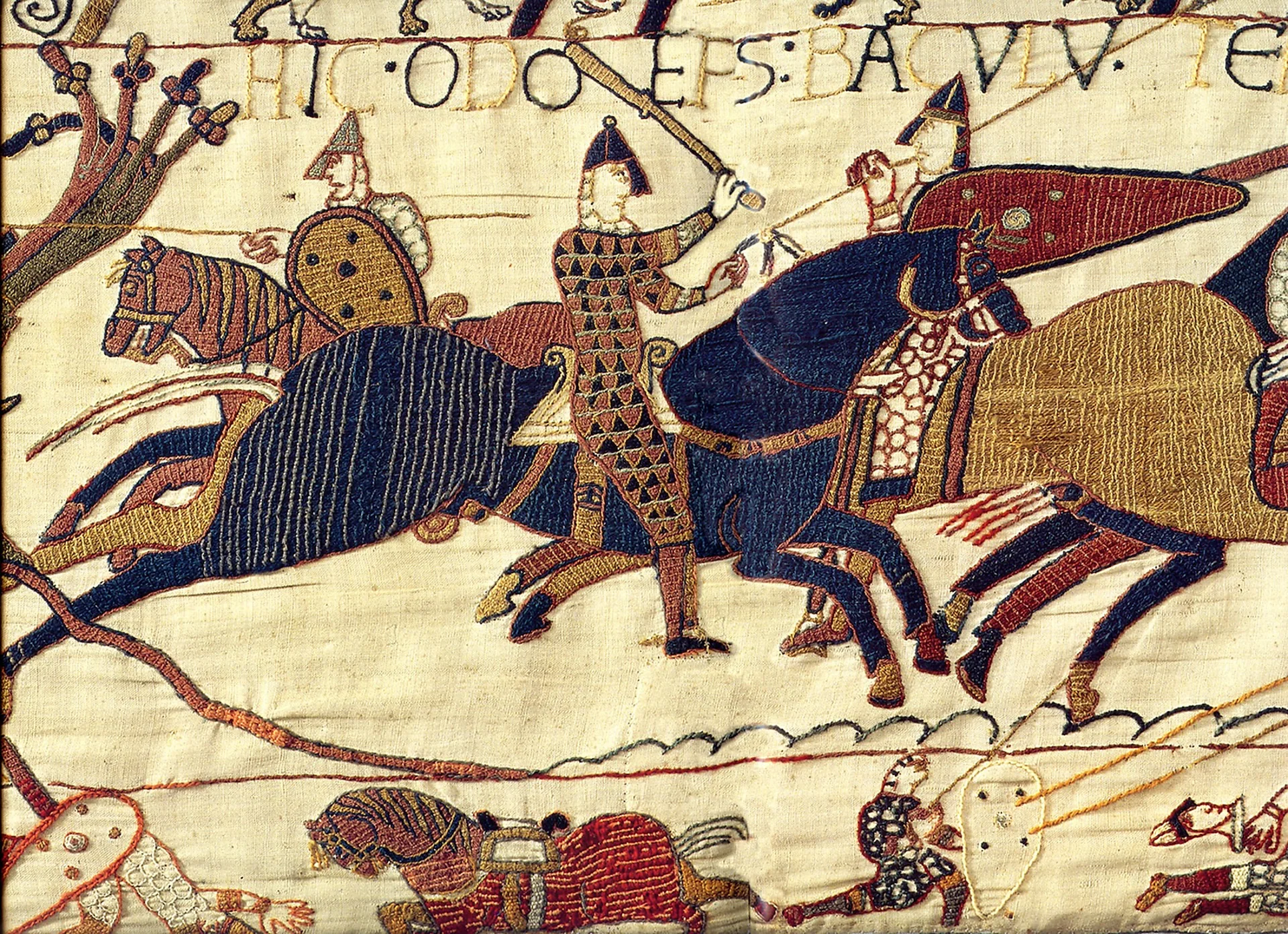
In the 11th-Century masterpiece’s tale of a contested throne, about to be exhibited in the UK, virility is equated to power – and the largest and proudest appendage. It tells a story that feels familiar today.
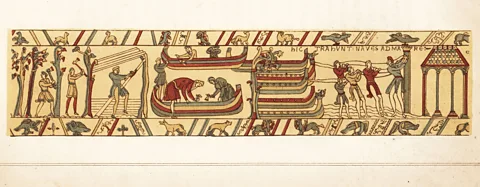
The Bayeux Tapestry tells a bloody − and occasionally bawdy − story of the Norman conquest of England. The intricate masterpiece is embroidered on to 70 metres (77 yards) of flax linen, and weaves a tale of broken promises, greed and aggression that culminates in the death of King Harold II at the Battle of Hastings.
After almost 1,000 years, the iconic artwork is returning from Normandy, France to England, where it was skilfully stitched in the 1070s, and from this September is to be exhibited at the British Museum.
It’s an artwork depicting a medieval version of today’s digital manosphere: an ideology and world centred on hypermasculinity and men’s experiences. And a world where size matters.
It is men’s contributions that form the focus of the 11th-Century society the tapestry portrays. A third of its men are armed, while others are vigorously engaged in tree-felling, boatbuilding and construction. A woodcutter straddling a length of timber readies his axe, while hunters wave large clubs about their heads as they pursue their quarry. All of this helps communicate the heightened atmosphere of an impending confrontation between two alpha males: William, Duke of Normandy and Harold Godwinson. “A more testosterone-soaked scene is hard to find,” Dr Christopher Monk, a cultural historian of medieval England, comments.
This suggestive display of chest-thumping machismo reveals a medieval society made for and by men, where violence settles disputes and laddish humour scores political points. Armed pillagers rampage through Hastings, and fallen soldiers in the lower margin are stripped nude for their armour, just as Harold, slain above them, is denuded of his royal claim.
The recurring penis
If there’s a recurrent motif in the iconic artwork, it’s the penis. In 2018, George Garnett, professor of medieval history at Oxford University in the UK, counted 93 – mostly tumescent – specimens in the embroidery. Eighty-eight belonged to horses, and another five to men, with a pendulous scabbard (which he rules out) causing considerable debate in academic circles.
The use of male genitalia, be it human or equine, is shorthand for political machismo – Dr Christopher Monk
“Size matters on the Bayeux Tapestry,” observes Janina Ramirez in Femina: A New History of the Middle Ages, Through the Women Written Out of It (2022). In the tapestry’s tale of a contested throne, virility is equated to power and the largest and proudest appendage, she notes, “belongs to the fine stallion William is presented with on the eve of the battle”. Second place goes to King Harold’s mount, “the implication being that he is a worthy opponent”.
Within the traditions of 11th-Century art, graphic nudity was commonplace, and it’s quite possible that these penises were stitched by nuns. “They reflect what was so evident more broadly in elite medieval society – by and large, men were the primary drivers of political sovereignty,” Monk tells the BBC. “The use of male genitalia, be it human or equine,” he says, is “shorthand for the political machismo within the context of the transition to the new Anglo-Norman world in medieval England.”
If women play a minor role in the tapestry, it’s primarily because “the narrative revolves around male action”, Dr Emily Joan Ward, a lecturer in medieval history at Edinburgh University in the UK, tells the BBC. “It’s largely depictions of militarily active men, and in those battle scenes we wouldn’t expect women.”
If a ratio of one to 100 still seems unbalanced, there may be a clue in who the artwork was intended for. Historians believe the tapestry’s likely patron is William’s half-brother, the Bishop Odo of Bayeux, who features prominently in it and may have used the tapestry to emphasise his important role in the campaign for William’s rightful rule.
“The content is probably to resonate with him and his immediate social circle, which will largely be a homosocial circle of men,” says Ward. With a Norman sponsor, the messaging needed to be on brand. “Introducing too many women into the story is actually a bit risky,” she adds. “William’s attempts to stress his legitimacy to the throne through the female line may have made the designer or patron wary of drawing attention to this tenuous claim.”
The six women in the tapestry
The women in the central story mostly serve as what Monk calls “emotional punctuation”. Queen Edith, a highly influential figure in court politics, mops her tears with her scarf as her husband, Edward the Confessor, takes his final breaths; and a woman and her child flee as gigantic Norman soldiers casually torch their home. Bizarre expressions and proportions aside, it’s a scene that reminds us, says Ward, “that warfare is not just a male-dominated event, not just what’s happening on the battlefield.”
She references the historian Catherine Karkov, who observes that the women in the main register appear at moments of shifting power relations. “If we interpret it that way,” Ward remarks, “it gives them quite a powerful role in the tapestry.”
Others have been more dismissive. As one 20th-Century historian commented: “since it contributes nothing to the story, except a moment of confusion, we have felt justified in leaving it out”.
[The embroiderers] were no doubt working to a design but that does not mean that they were merely executors of another’s will – Dr Chirstopher Monk
Just as monks inserted illustrations in the margins of manuscripts, it’s possible that female embroiderers were permitted a little creative liberty with these cryptic comments on the central story. “They were no doubt working to a design,” Monk tells the BBC. “But that does not have to mean that they were merely executors of another’s will, or indeed that every detail was dictated.”
Perhaps in the border, the invisible women behind the artwork had the last laugh. “Was it a way of expressing despair at bellicose men, or at their own plight as subjugated English women? Is there any sense of mockery, particularly of William? Or were they indulging in playful, earthy humour to pass the time?” Monk asks.
“It’s impossible, perhaps, to answer these questions, but it should at the very least make us reflect on the fact that the Bayeux Tapestry only exists because of the skilled and intelligent labour of women.”
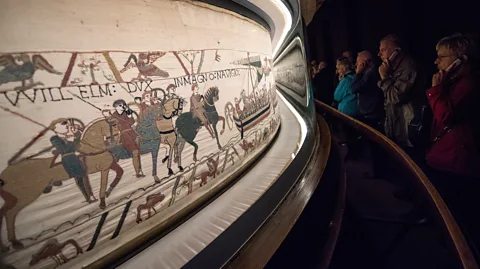
It was Victorian sensibilities that would eventually subdue some of the original tapestry’s machismo. In a faithful replica, created in 1885 by a group of 35 women belonging to the Leek Embroidery Society (currently on display at Reading Museum), the advancing armies are still full of men, but the horses’ oversized members have retreated. Unsurprisingly, the naked man with the outsized genitals who was mimicking the priest in the border is shown in the new version wearing shorts.


Pakistan’s Yemen Dilemma

U.S. Sanctions the International Criminal Court to Shield Netanyahu

Pakistan Reaffirms Commitment to Multilateralism, Peace and International Cooperation at the Executive Board of UNESCO


-

 Sports4 months ago
South Korea’s Yoo Useong Steps Onto the Global Strongman Stage as World Strongman Federation Professional Athlete
-

 Art & Culture1 year ago
A Survey of Mata-E-Zeest
-

 Europe News2 years ago
Chaos and unproven theories surround Tates’ release from Romania
-

 American News2 years ago
Trump expands exemptions from Canada and Mexico tariffs
-

 American News2 years ago
Trump Expels Zelensky from the White House
-

 Art & Culture2 years ago
Will Snow White be a ‘victim of its moment’? How the Disney remake became 2025’s most divisive film
-

 Entertainment2 years ago
Champions Trophy: Pakistan aim to defend coveted title as historic tournament kicks off today
-

 Pakistan News1 year ago
Comprehensive Analysis Report-The Faranian National Conference on Maritime Affairs-By Kashif Firaz Ahmed