
Knowledge
Inheritance of a woman in Islamic law ; From Implications to Challenges!


by Syeda Fatima Batool
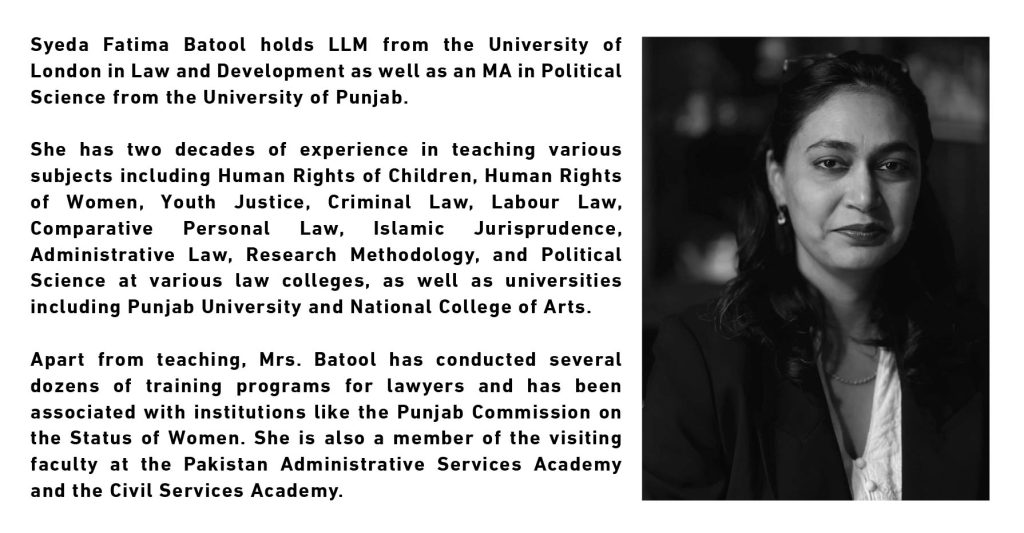
Inheritance is a very special and technical branch of law, recognized in Shariah and mostly the principles therein derive their origin from the primary sources of Islamic law which are the Holy Quran and the Sunnah, which further finds evolutionary development in Usul-ul-Fiqh (Islamic Jurisprudence). Few principles are operating while facing illegal practices affecting women’s inheritance rights in socio-religious and socio-economic perspectives. Acknowledging the doctrine of Maqasid-e-Shariah as defined by Al-Ghazali, are aimed for preservation of five essentials of human well-being including protection of religion, life, intellect, lineage, and property.Despite clear rules in Shariah and legislative efforts within “the state”, many women face denial of their rights ( Meerath- “مِیراث” ) due to cultural and social norms of our society. The ethnographic dimension of this very domain suggests, few following atrocities in non-furtherance of the women’s right of inheritance to investigate:
| Forced\coercive waivers of inheritance\by wives\daughters\mothers\ sisters. Verbal family settlements without consent and non-inclusion of wives\ daughters\mothers\sisters. Post marriage pressure on the daughters\wives\sisters to give up shares. Lack of female empowerment amid non-inclusive existence in socio-religious, socio-cultural, socio-economic fabric of our society. Delayed distribution of property wives\daughters\mothers\sisters. Customary practices despite being declared criminal offences including marriage with Holy Quran within the Pakistan Penal Code 1860; (498C. Prohibition of marriage with the Holy Quran) Levirate marriage. Bridal Gifts and Dowry in any form In lieu of inheritance share. Lack of awareness; “accessibility to read and understand the clauses of Nikahnama Form.” Systematic and Procedural Challenges; Such process can be daunting, requiring interaction with male-dominated institutions like revenue departments and police, where gender bias and inefficiencies persist . Patriarchal mind-set hazard; Claiming a share can be seen as an act of rebellion and unsuited demand or wish in patriarchal landscape of our society from family to legal, procedural and technical forums. |
Let’s take a judicial landscape purview first; aiming to bridge the gap between law and practice regarding women’s rights. Aforementioned few practices have no legal value and can be challenged and called in question in a court of law. A significant landmark judgment is a step forward highlighting the critical issue of women being deprived of their rightful inheritance rights in Pakistan. In Muhammad Sajid Tareen V The Govt. of Balochistan through Chief Secretary Balochistan & others, (PLD 2021 Balochistan 172) it fundamentally restructured how inheritance rights for women are enforced, particularly in regions where customs often override Islamic legal principles. Judicial paradigm is also vigilant and sensitized with regard to women inheritance rights. In essence, this very ruling manifests and suggests the following helping tools which play a vital role for women combating inheritance rights effectively;
| Automated Assumption Mechanism: If a woman’s name is missing from a mutation (transfer of title) of inherited land, she ought not to file a separate civil suit; the transfer assumed to be automatically void. |
| Government Responsibility: The burden of enforcing the right no longer rests solely on the woman. Revenue officials are legally obligated to ensure inclusion and can face criminal prosecution for failure to do so. |
| Protection Against Coercion: Agreements where a woman “gives up” or “waives” her share for cash or a gift are not legally binding if they were obtained through coercion, undue influence or pressure. |
A very common scenario within social and cultural fabric of our society is rightly emphasized in this very case Bakht Biland Khan & others vs Zahid Khan & other PLD 2024 SC 1273. Worth mentioning para 4 of the said judgement specifying, “this is yet another classic case of brothers’ depriving their sisters of their inheritance, and did so for decades.…..It was intolerable to deprive vulnerable persons and females of their legal rights.”
A welcoming verdict where Apex Court upheld the sisters’ inheritance rights, and fined the petitioners (brothers) Rs. 500,000 for wasting court time and depriving women of their inheritance.
In another landmark case ruling of Aksar Jan and others vs Shamim Akhtar and others 2025 SCLR 12 the Honorable Chief Justice observed in para 5 thatthe inheritance shares in the estate left by a Muslim is stipulated in the Holy Qur’an and a deceased’s legal heirs become owners on his/her death — Unfortunately, and all too often, females continue to be deprived of their inheritance by employing various nefarious tactics, bogus documentation, fraudulent statements with the facilitation of Revenue department officials and some advocates.The courts too at times are not vigilant enough to protect inheritance rights, particularly of females and other vulnerable members of society.And, simple inheritance cases are not expeditiously decided,...The practice of depriving females of their inheritance must be put a stop to, and those who do so must be made to pay substantial costs and not be permitted to benefit from procedural technicalities.
Another Recent judicial milestone is achieved by a recent judgement ensuring and re-acknowledging by another Supreme Court ruling titled Abrar Hussain Vs Mst. Bibi Shahida and others PLD 2026 SC 42 also established that women have a “divine, automatic right” to inherit, which cannot be nullified by unproven gifts or mere claims by male heirs .
“The Court emphasized that denying inheritance contradicts the Qur’anic injunctions that clearly define women’s shares, and any attempt to deprive a woman of her share without her free consent is invalid.”
Another most recent landmark judgement ofMst. Amara Waqas vs. Muhammad Waqas Rasheed, W.P. No. 365 \2023 decided in March 2026, the Islamabad High Court (IHC) has ruled“that all assets acquired during the subsistence of a marriage “whether movable or immovable” regardless of the title holder shall constitute “matrimonial property.” Hence are subject to equitable distribution between spouses. Relying upon comparative jurisprudence from Malaysia, Indonesia, Turkey, and the United Kingdom, the court recommended that marriage in Pakistan must be recognised as an economic partnership.Study shows in Indonesia, property acquired during the marriage is considered joint property of the husband and wife. Tunisian Personal Status Code 1956 allow spouses to include clauses in their marital agreements governing the management and division of property.Similarly Iran, Jordan, Libya, Egypt, Turkey, Syria, Brunei Dar-us-Salam and Malaysia are the current examples of catering the issue of women property rights by legislations in respective civil codes and family laws.
Furthermore for the “first time in the judicial and legal history of Pakistan” such an innovative development is seen regarding property and inheritance rights whereby it very clearly ask for an amendment in nikahnama form for addition of a column stipulating any property if acquired after marriage by either spouse, shall be divided equally, secondly court emphasized the education and awareness of existing nikahnama form to young girls specifically to enable secure their proprietary rights.
Despite the amazing rulings by the honorable apex courts, implementation faces hurdles and struggle to change centuries-old norms and customs in a very slow pace. Key indicator is the role of the “Revenue officers” serving as the first line of defense in preventing and curbing such illegal transactions regarding female heirs. Such authority and officers can and shall actively scrutinize every mutation while not just relying upon presented documents alone. It’s high time that the Revenue , Police , and all respective departments shall be given extensive and women-centric sensitized trainings, via special workshops and social media tool mediums in local languages also.
In the ambit of Constitutional bindings, the Fundamental Right under Article 14 of the Constitution of Pakistan 1973 mandates inviolable right to human dignity Article 23 assures that all citizens of Pakistan shall enjoy equal right to acquire property and Article 24 ensures and guarantees the protection of every citizen’s property against unlawful deprivation; followed by Article 25promising equality of all citizens. In the light of Principles of Policy, Article 35 of the Constitution, state is responsible for protection of family, marriage, mother and child
From psychological perspective exclusion from mainstream empowering roles and decision making, more often women prefer, “not to claim their inheritance” and to avoid family conflict\s and keep sacrificing her “share” amid fear, from social or family isolation to stigmatization. Women are conditioned to believe that asking their rightful share in inheritance is morally, socially and ethically wrong despite the fact that a female claim is legal and religious. Familial breakdown acts as a profound health hazard. Stigma-related isolation is not solely a social issue rather medical effects of this exclusion can be worse than the mental health conditions themselves.
Now from the viewpoint of Shariah, we find clarity of the phenomenon of a female exclusive and independent right of inheritance declared by the primary sources of Islamic law, The Holy Quran and Sunnah. Sura Nisa:7 mentions that “For men there is a share in what their parents and close relatives leave, and for women there is a share in what their parents and close relatives leave”.We shall appreciate treatment of women’s inheritance rights as a revolutionary advancement for its time; determining a mandatory right for female\s who were often excluded earlier to the advent of Islam.The core ruling is found in Surah An-Nisa specifically verses 7 to 14 and 176.The Fundamental Rule in sura Nisa:11 is incorporated that “Allah commands you regarding your children: for the male a share equivalent to that of two females...”. It states that a son inherits twice the share of a daughter. This is often simplified as “a woman gets half of a man’s share,” but this is only in the specific case of siblings when there is no will. This is concept of taseeb i.e the differential share ratio of 2:1 and is linked to the financial responsibilities placed on men as sustainers and providers in Islamic law, while a woman’s inherited wealth is her own property with no obligation to spend it on anyone else.Hence the share of daughter alone is half where there is a brother, otherwise appreciate the key Shares for females as fixed shares (Fara’id) for several female relatives:
- Wife: 1/8 in case of children; 1/4 if no children.
- Daughter: 1/2 if alone; 2/3 if multiple (shared); if there is a son, they become residual heirs (‘Asaba) with the son taking double.
- Mother: 1/6 if the deceased has children; 1/3 if no children or siblings.
- Uterine sister : A fixed share of 1/6 if she is the only uterine sibling.
- If there are two or more uterine siblings (brothers or sisters), they share 1/3 of the estate equally, regardless of gender, as defined in Surah An-Nisa:12
- Full Sister: 1/2 if alone; 2/3 if multiple (shared); can inherit residually in some cases.
- Paternal Sister: 1/2 if alone; 2/3 if multiple; specific rules with other heirs.
Notably crucial concept shall be known that there are many scenarios where“a woman inherits an equal or even greater share than a man”:
- Mother and Father: When a person dies leaving both parents and no children, the mother gets 1/3 and the father gets 1/3 (the remainder goes to siblings). Here, they inherit equally.
- Uterine Siblings (brother & sister from same mother): They inherit equally, each getting 1/6 or 1/3
- Only Daughters: A single daughter can take half the estate, while multiple daughters take two-thirds. In the absence of sons, they can be the primary heirs.
- Case of Kalalah: (Deceased with no direct parents or children). Inheritance flows to siblings, with complex rules where sisters can sometimes become residual heirs and take a larger portion.
Allah commands in Al-baqrah:188 very clearly that “do not usurp one another’s property unjustly”.
The Sunnah of the Holy Prophet Muhammad (Peace be upon Him) places a profound emphasis on the mindfulness and protection of women’s rights, establishing their well-being as a direct responsibility before Allah. This is most powerfully manifested in his Khutbah Hajjatul Wida (Farewell Sermon), where he explicitly instructed men to fear Allah in their treatment of women, describing them as a “trust from God”. Islamic Law of Inheritance is indeed a complex, technical and mathematical science. In modern day, contemporary debates are commonly known by scholars and reformers urging for need of ijtihad (independent analogical reasoning) in this very regard. Tunisia and other Muslim-majority nations are bridging the gap between practice and principle by revising family laws to align with Quranic justice, actively overcoming customary, patriarchal interpretations.The Quranic inheritance system is purpose-driven. It is indeed time to legislate accordingly. The Quranic inheritance system (Faraid) is widely recognized by scholars as a purpose-driven framework aimed at ensuring social justice, family cohesion, and economic equity. One can not ignore another socio-economic woman right, incorporated in Sura bakra:241that reasonable provisions must be made for divorced women,—as a duty upon the righteous. Such phenomenon is called post-divorce alimony. It can be any kind of movable or immovable property or something valuable, for which we just have developed our jurisprudence in a recent case law judgement of equitable matrimonial asset division by IHC 2026 referred earlier.
Coming towards the land scape of Pakistan legal paradigm, we developed a remarkable piece of legislation, known as the ‘Women Property Rights Act 2020’. It was designed to redress the widespread issue of a woman being deprived of her rightful property acquired by Inheritance, Will, Gift /tamleek-nama or Hiba, Sale or any such like mode. It’s operation has recently been suspended by a judgement of Islamabad High Court Writ Petition.2665/2025. It has also been implemented in the province of Khyber Pakhtunkhwa (KPK). Previously the “Punjab Enforcement of Women’s Property Rights Act” 2021 was introduced within the Punjab. The Lahore High Court issued an interim order suspending this very law, halting all actions taken under it, and referring the matter to a full bench. Hence In Punjab we have only operational and active legislative medium for redressal of property grievances known as the “Punjab Protection of Ownership of Immovable Property Act” 2025, with the aim to protect women’s property and inheritance rights, more efficient and effective amid fast-track mechanism to claim property. In countries where continuous and systemic inequalities bars women’s participation in the formal economy, inheritance rights play a crucial role in supporting their economic independence. Such a financial security reduces women’s dependence on others also it allows them to make independent economic decision. As per ‘Gender Parity Report’(ICT)- 2025, “ the overwhelming majority of landholdings are controlled by men which is alarming systemic inequality in land ownership in paving inclination towards gender parity and gender discrimination. Recent data from the “Federal Bureau of Statistics and Parliamentary updates in Pakistan” 2025, indicate that only 2.5 per cent of women in Pakistan own a house in their own name, and 7.5 per cent hold joint property. Only 26% of women population in Pakistan enjoy ownership of property. Last year The World Economic Forum (WEF) issued it’s Global Gender Gap Report 2025, depicting Pakistan’s pillar-wise performance; showing minimal change from 2024, underscoring entrenched structural challenges. In Economic participation and opportunity, Pakistan remains 143rd, reflecting stagnant female labor force participation, persistent wage disparities, and limited access to leadership roles owing to low Female Workforce Participation with less than 25% of women active in the workforce. Pakistan fails to leverage half of its human capital for economic growth.Weak Policy Implementation: Last but not the least, a Global vision expansion amid Constitutional 18th Amendment marks each Province responsibility for legislation and initiatives regarding women’s inheritance and property rights. Hence it has increased resources to provinces to work for women’s empowerment with the aim to meet the Sustainable Developmental Goals (STG’s) 2030 No. 5, urging for gender equality and empowerment of females. International spectrum highlights CEDAW, “the Convention on the Elimination of All Forms of Discriminationagainst Women” which Pakistan ratified In 1996. Later in 2010 Pakistan ratified ICCPR“International Convention on Civil and Political Rights” ensuring specific protection against gender inequality in all civil and political matters. Secretary-General of the United Nations, ‘António Guterres’ urged all governments to eliminate legal barriers to women owning land, and to involve them in policy making. On 2nd March 2026 while highlighting ‘Eight Actions for More Equal World’ he further shared that Worldwide, women hold only 64 % of the legal rights enjoyed by men. In too many places, they cannot own property. Even where protections exist, women face higher barriers to access legal aid or the courts. Every country must commit to dismantling discriminatory laws, and to enforcing rights in practice.
Unless, we include women in formal and visible empowering scenarios at basic grass root levels, normalize socio-cultural co-existence, promote awareness using most modern digital tools ; use data age mediums in shifting the approach toward women, recognizing them not just as beneficiaries of care but as active citizens with fundamental rights, we may not be successfully struggling against identified aforementioned few key indicators. Academia shall play its role.Patriarchal structures continue to limit women’s mobility, access to jobs, hence weak Policy, despite gender equality laws on paper, enforcement remains absent. Legal protections for women are poorly and in efficiently implemented. Devastating effects for ineffective legislative measures for women inheritance leads to long lasting profound distress, which endanger wellbeing of the person. The failure to enforce women inheritance rights and laws, develops a self-sustaining cycle where subsequent generations of women are likely to be denied their rights, resulting in perpetuation of gender inequality. ‘Female Empowerment’ is the transformative tool for combating the gender-based discrimination and harassment, challenging patriarchy, customary practices, and power imbalance, that perpetuated such power crimes in society. It is effective only if paired with legal, judicial, institutional and educational reformative tools that target systematic roots discrimination. Sustainable, long-term success in securing women’s inheritance rights requires a collaborative approach that actively includes men to dismantle patriarchal structures playing as key enabler of change.



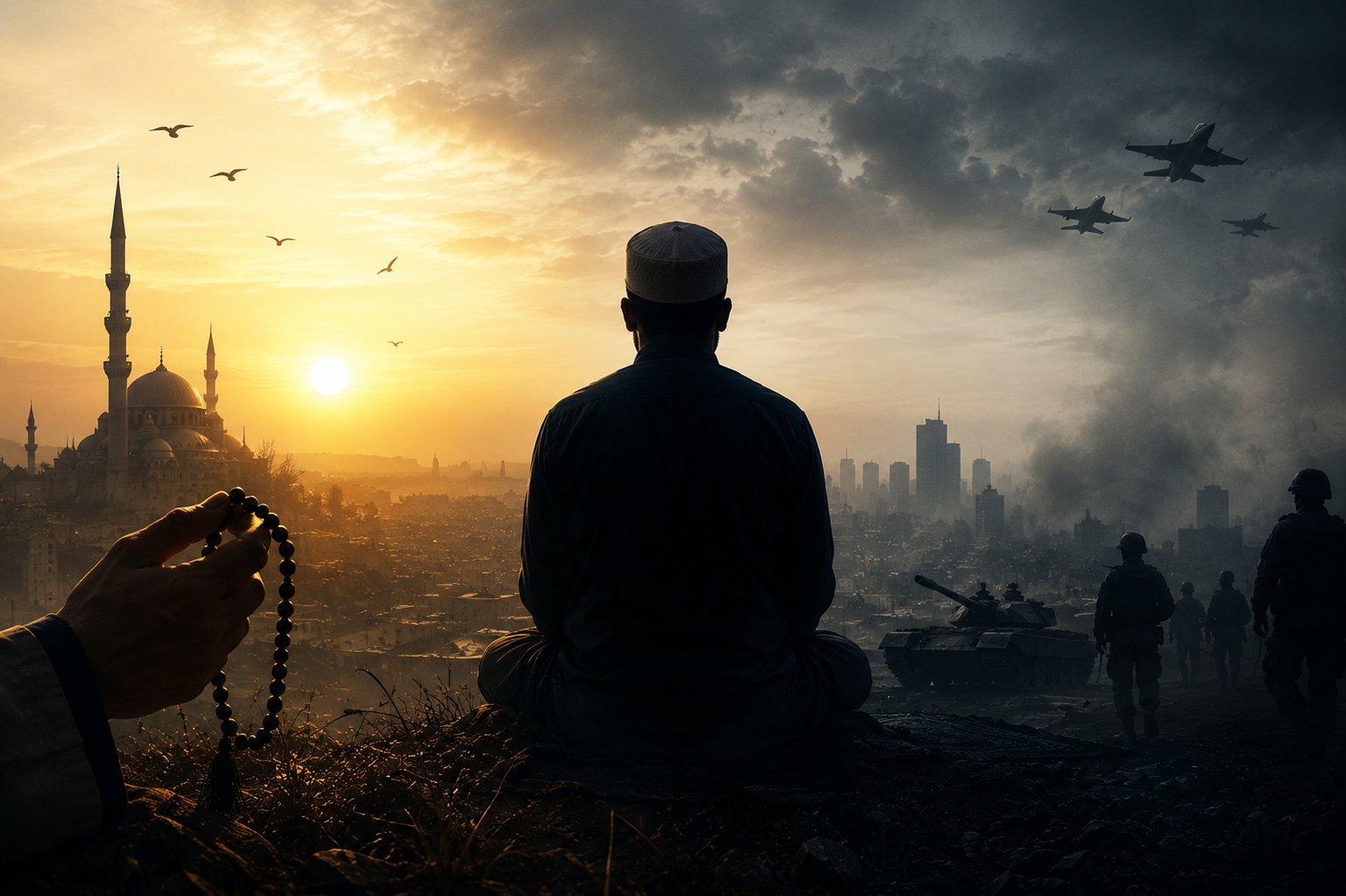
Paris (Imran Y. CHOUDHRY) :- Former Press Secretary to the President, Former Press Minister to the Embassy of Pakistan to France, Former MD, SRBC Mr. Qamar Bashir analysis : A striking observation by a renowned Jewish religious scholar widely circulated in social and traditional media that Muslims cannot be defeated through conventional military means alone raises a question far larger than the conflict in which his remarks are being circulated.
He attributes Muslim resilience to spiritual strength rooted in faith, prayer, sacrifice and an understanding of life and death extending beyond material existence. His observation points toward a broader proposition: military superiority may destroy physical capabilities, but it does not necessarily vanquish a people whose spiritual foundations remain intact.
History repeatedly demonstrates the distinction between defeating an army and defeating a nation. Armies may be destroyed, governments removed, economies crippled and territories occupied, yet a people can recover if their faith, identity and collective conviction survive.
This phenomenon is not peculiar to Islam. Judaism, Christianity, Hinduism, Buddhism and other great religious traditions have endured persecution, displacement and political upheaval because something deeper than material strength continued to sustain their communities.
In Islam, this spiritual foundation begins with iman: belief in Allah, His angels, His revealed books, His prophets and messengers, and the Hereafter. These convictions find practical manifestation through the declaration of faith, five daily prayers, fasting, zakat and pilgrimage to Makkah.
Together they cultivate discipline, sacrifice, accountability and attachment to purposes transcending material life. The stronger this relationship between belief and practice becomes, the more profoundly it shapes the believer’s response to fear, hardship, suffering and death.
This is where conventional deterrence encounters a different equation. Military power normally seeks to raise the cost of resistance until surrender appears preferable to continued suffering. But a person who regards earthly existence as temporary, sacrifice as meaningful and death as a transition rather than absolute extinction may calculate those costs differently.
Physical destruction remains painful, but its capacity to compel submission diminishes when the convictions sustaining resistance are stronger than fear.
The Jewish scholar’s observation becomes particularly significant in this context. The strength confronting an army is not merely the weapon carried by a fighter but the conviction residing within the person carrying it. A missile can be destroyed, an installation demolished and an army weakened, yet if the belief system producing courage and endurance survives, resistance can regenerate. The deeper contest therefore extends beyond weapons to the spiritual foundations sustaining collective purpose.
This introduces another dimension of confrontation. If spiritual conviction strengthens a population, weakening that conviction becomes another means of weakening resistance. Doubt may be directed toward fundamental beliefs; attachment to worship may be eroded; materialism may displace spiritual purpose; internal divisions may be encouraged; and succeeding generations may gradually become detached from the traditions through which religious identity is renewed. The battlefield then extends beyond territory into the mind, heart and spiritual consciousness of society.
Religious communities, however, are not without spiritual guardianship. Islam has its scholars, shaykhs, Sufi traditions and awliya, just as other religions possess their own spiritually accomplished personalities and inherited traditions of guidance. Within Islamic spiritual understanding, accomplished figures have historically strengthened belief, preserved sacred knowledge and exercised responsibility for communities entrusted to their care. Their role has often been to reinforce faith precisely when political, cultural or external pressures threatened to weaken it.
The history of Islam offers powerful examples. Across the Indian subcontinent, Indonesia, Malaysia and other parts of Asia, Islam frequently established deep social roots not primarily through military conquest but through merchants, scholars, Sufi shaykhs and spiritual personalities. Their influence came through character, teaching, service, devotion and spiritual attraction. Khanqahs, zawiyas and religious circles became centers of learning, charity and community cohesion, allowing spiritual influence to reach where political authority or military force never could.
This history illuminates the concept of spiritual jurisdiction. Within the religious framework, highly attained personalities carry responsibility not only for individual disciples but for wider communities or territories. They strengthen faith, respond to spiritual disturbances, preserve unity and protect the religious consciousness of those within their sphere. If a community’s spiritual foundations are challenged, such guardians seek to fortify belief and practice and, within this understanding, counter hostile spiritual influence through their own spiritual resources.
The same broad principle appears in different forms across other religions. Judaism has its rabbis, sages and mystical traditions; Christianity its saints, clergy, monastic orders and contemplative lineages; Hinduism its gurus, yogis and spiritual masters; Buddhism its monks, teachers and accomplished practitioners. Their doctrines are different, yet each tradition recognizes personalities whose spiritual attainment gives them responsibilities extending beyond ordinary religious instruction.
This creates, within the spiritual realm, something comparable to deterrence in the physical realm. Spiritual aggression cannot necessarily be assumed to remain unanswered. A community whose beliefs are challenged may respond by strengthening its own religious foundations, reviving worship, restoring unity and reinforcing the institutions through which sacred knowledge is transmitted. Spiritual attack can therefore generate spiritual defence, and spiritual defence can create counterbalancing pressure. In this sense, religious civilizations possess a form of spiritual strategic depth.
Afghanistan provides a powerful modern illustration of why physical superiority alone cannot guarantee complete victory. The United States and its allies possessed overwhelming advantages in aircraft, satellites, drones, precision weapons, intelligence and financial resources. The Taliban possessed nothing remotely comparable. Yet after two decades, foreign forces departed and the Taliban returned to Kabul. Political and strategic failures played major roles, but one undeniable factor was that the conviction sustaining resistance was never extinguished.
Iran offers another contemporary illustration. Whatever one’s political judgment of Tehran, the ability of Iranian society to withstand immense military, economic and psychological pressure cannot be understood exclusively through inventories of missiles or military hardware. Religion, nationalism, historical memory, collective sacrifice and a deeply cultivated narrative of resistance have all contributed to national cohesion. Destruction of infrastructure or military assets does not automatically produce collapse when the population continues to perceive endurance as meaningful.
This is precisely why the spiritual dimension matters in strategic calculations. A military installation can be rebuilt. Weapons can be replaced. Economic damage, however severe, can eventually be repaired. But the decisive question is whether a people still possess the conviction to absorb hardship and rebuild. If the answer remains yes, physical defeat may be temporary. When conviction itself collapses, however, even a materially powerful society may become vulnerable from within.
The lesson is not that one religion must spiritually conquer another. On the contrary, durable spiritual strength comes primarily from strengthening one’s own foundations. Muslims strengthen Islam through faith, prayer, knowledge, character, service and unity. Jews preserve Judaism through their sacred traditions and communal institutions. Christians, Hindus and Buddhists likewise safeguard their civilizations by transmitting their own spiritual inheritance with confidence, discipline and continuity.
That is the deeper importance of the Jewish scholar’s observation. A country may possess the world’s most sophisticated weapons and still fail to achieve complete victory over a people whose spiritual will survives every physical blow. Conversely, a materially weaker nation may endure overwhelming pressure if its people remain united by deeply rooted belief, disciplined practice and spiritual leadership.
A military can conquer territory; it cannot automatically conquer conviction. Governments may fall, armies may retreat and economies may suffer devastating losses, yet civilizations can rise again so long as the spiritual foundations that give their people identity, courage and purpose remain alive. A nation is therefore not completely defeated when its weapons are destroyed, but when the spiritual power sustaining its will to survive has been broken.
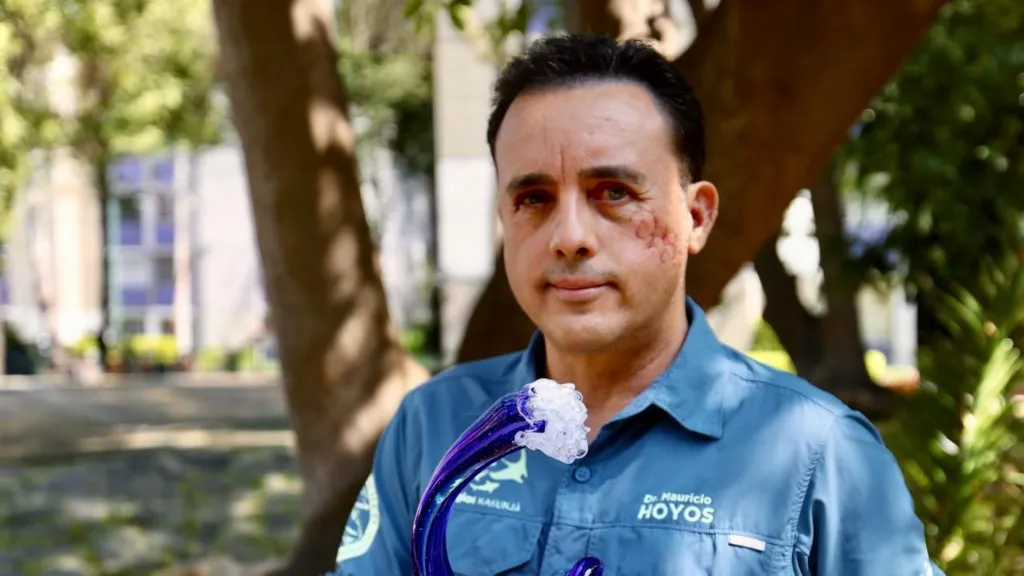
Mauricio Hoyos still remembers the pressure that the jaws of a female Galapagos shark, over 3m (10ft) in length, exerted on his skull.
The animal had lunged at him with astonishing speed, giving him barely enough time to duck his head in a last ditch effort to protect his jugular vein.
“When it closed its jaw, I felt the pressure of the bite, and then, after what I think was a second, it opened it again and it let me go,” Hoyos told BBC Mundo from his home in Baja California, Mexico, a little over month after surviving the incident.
Hoyos, a marine biologist with over 30 years of experience studying sharks in their natural habitat, was on a research trip in Costa Rica when he was attacked by the shark in September.
Less than two months on, and still bearing the scars from the attack on his face, he describes his recovery as “incredible” – and says he even hopes to encounter his assailant again.
For Hoyos, what happened to him that day in the waters off Cocos Island is the result of normal animal behaviour when confronted with a perceived threat.
“In this case, this bite was like a dog’s,” he says.
“Have you ever seen how dogs, when another dog gets too close, throw a quick bite? It doesn’t hurt it, but it calms the other dog down.”
Hoyos – who along with his colleagues attaches acoustic tags to sharks to help pinpoint their mating and spawning grounds as part of his work – was alerted to the shark’s presence in the water by tourists.
It was at a depth of 40m, and Hoyos told the captain of the boat he was on that he would be there “for a maximum of five minutes”.
He then entered the water and began his slow descent.
Hoyos recalls encountering the shark: “This giant female, measuring between 3 and 3.5m (11.5ft), swam by and headed toward the bottom, and I positioned myself to tag her at the base of her dorsal fin.”
But Hoyos, who has tagged many kinds of sharks in his decades-long career, says this animal reacted differently to others.
“Obviously the tip – the metal tip attached to the cable hanging from the probe – goes in, and unlike the other sharks I’ve tagged that immediately flee, she turns around and stares at me,” he recalls.
“I saw her little eye looking at me, and I saw her very calmly turning around.”
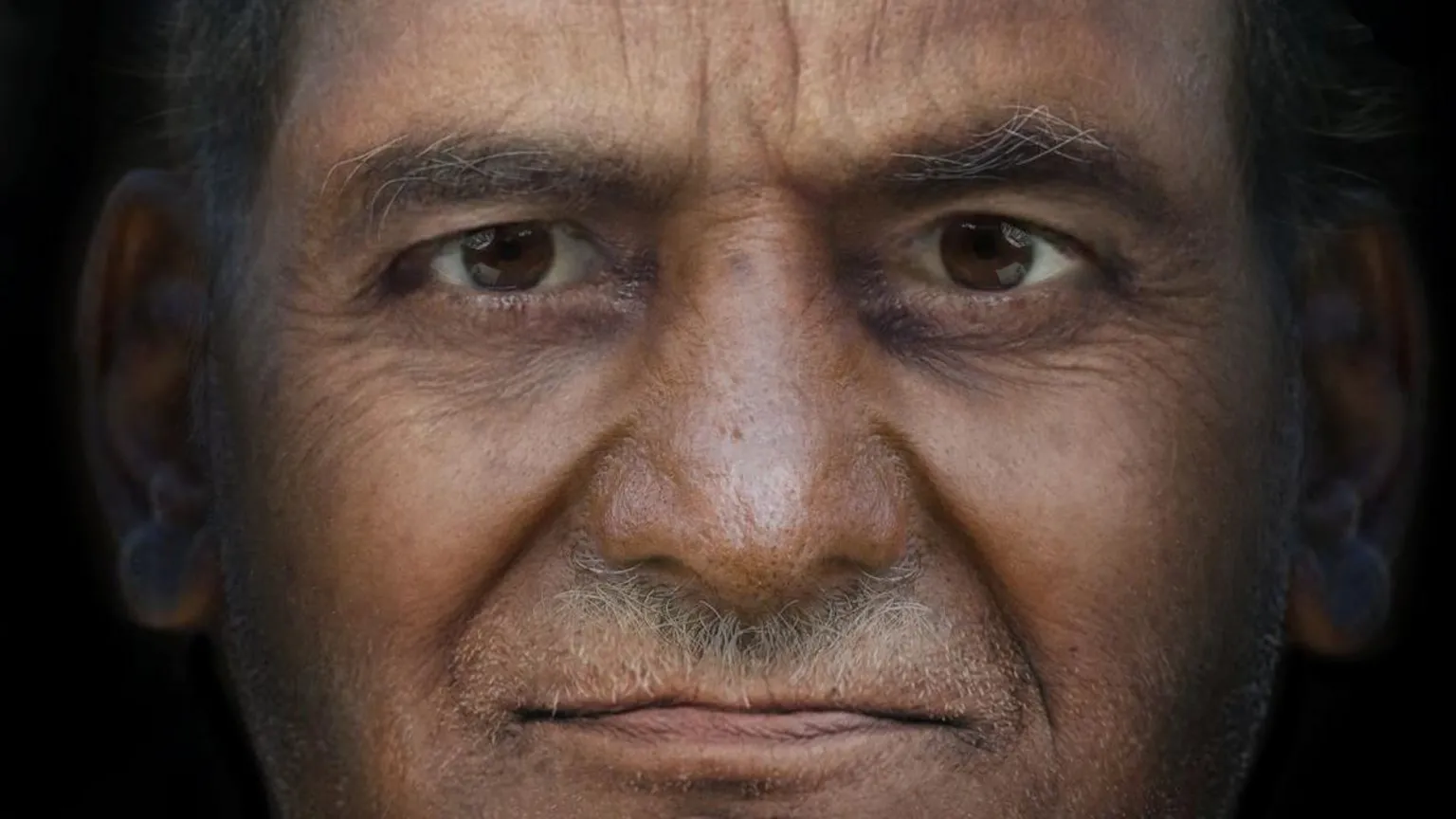
In a modest-sized university lab in the southern Indian state of Tamil Nadu, researchers are using a tiny drill to scrape away enamel from a 2,500-year-old tooth.
Researchers at Madurai Kamaraj University say the tooth belongs to one of two human skulls that they have used as models to digitally reconstruct faces to understand what the region’s early inhabitants might have looked like.
The skulls, both belonging to men, were excavated from Kondagai, an ancient burial site about 4km (2.5 miles) from Keeladi – an archaeological site that has become a political flashpoint in India.
Tamil Nadu state department archaeologists say an urban civilisation dating back to 580BC existed in Keeladi, a claim that adds a new dimension to the story of the Indian subcontinent.
The Indus Valley Civilisation, that emerged over 5,000 years ago in the northern and central parts of present-day India, is the country’s first major civilisation – and narratives around urbanisation have so far been confined to the north.
But state archaeologists say the findings at Keeladi indicate for the first time that an ancient independent civilisation existed in southern India as well.
They say the people of Keeladi were literate, highly-skilled and engaged in trade across the subcontinent and abroad. They lived in brick houses and buried their dead along with daily necessities like food grains and pots in massive burial urns in Kondagai.
Archaeologists have excavated about 50 such urns from the site so far.
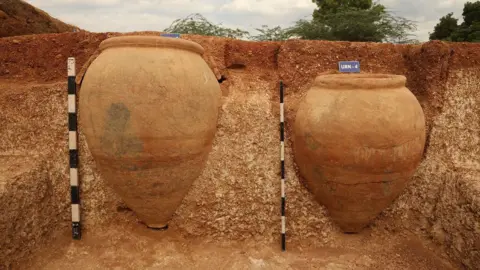
Researchers at Madurai Kamaraj University are now extracting DNA from human bones and other goods found in these urns to better understand who the inhabitants of Keeladi were and what their lifestyle was like.
But a more profound quest seems to be under way.
“We want to understand our ancestry and the migration routes of our ancestors,” says professor G Kumaresan, who heads the genetics department at the university. “It’s a journey towards answering the larger question of ‘who are we and how did we come to exist here’,” he adds.
- Ancient site stirs heated political debate on India’s past
- Did Iron Age ‘begin’ in India? Tamil Nadu dig sparks debate
The exercise of reconstructing faces of the 2,500-year-old skulls has revealed clues that can answer at least one part of this question.
“The faces mainly have features of Ancient Ancestral South Indians – a population group believed to be the first inhabitants of the Indian subcontinent,” says Prof Kumaresan.
The features also reveal traces of Middle-East Eurasian and Austro-Asiactic ancestries, hinting at global migration and the mixing of ancient population groups. But Prof Kumaresan says that more research is needed to properly establish the ancestries of Keeladi’s residents.
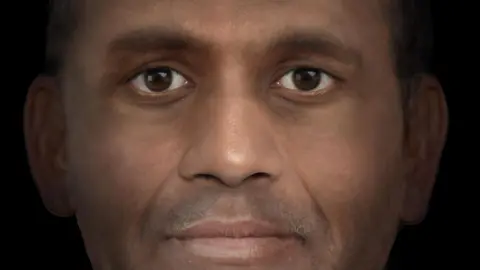
The facial reconstruction of the skulls began with researchers at Madurai Kamaraj University creating 3D scans of the skulls.
These digital scans were then sent to Face Lab at Liverpool John Moores University in the UK. Face Lab specialises in creating digital craniofacial reconstructions using forensic, artistic and scientific principles and technologies.
Experts at the lab used computer softwares to add muscles, flesh and skin to the scans of skulls, bringing out their facial features. These additions were made according to standard human anatomical proportions and measurements.

Then came the big challenge: adding colour to the images.
This brought up questions like which shade of brown should the men be, what colour should their eyes have and how should their hair look?
Prof Kumaresan says the standard practice of using colours that matched physical traits of people currently living in Tamil Nadu was followed, but the digital portraits still evoked lively discussions on social media.
They underscored longstanding divisions in Indian society – around race, culture and heritage.
Historical narratives championing Aryans (a term commonly used to describe people who settled in the northern part of India) as the “original citizens” of the country clashed with those that ascribed this title to Dravidians (a term used to describe people living primarily in India’s southern states).
India has always been plagued by a north-south divide that stems partly from the popular belief that Indian civilisation – and everything associated with it, like language, culture and even religion – took root in the north and shaped the rest of the country.
But Prof Kumaresan says the facial portraits of the Keeladi skulls reveal a message that’s more complex and inclusive.
“The message we can all take home is that we are more diverse than we realise, and the proof of this lies in our DNA,” he says.
This isn’t the first time that researchers in India have attempted to recreate faces from ancient skulls.
In 2019, scientists reconstructed faces of two skulls found at a cemetery in Rakhigarhi – an important Indus Valley Civilisation site in India. But the sketches lack colour and other physical traits.
“As humans, we have a fascination with faces – our ability to recognise and interpret faces is part of our success as a social species,” says Caroline Wilkinson, who headed the Face Lab team that worked on the Keeladi men.
“These facial depictions also encourage the audience to understand ancient remains as people rather than artefacts, and to establish a connection through personal narrative rather than a wider population history,” she adds.
At the Madurai Kamaraj University, efforts are under way to study Keeladi as thoroughly as the Indus Valley Civilisation.
“So far, we have learnt that the people of Keeladi were involved in agriculture, trade and cattle-rearing. They kept deer, goats and wild pigs and ate lots of rice and millets,” says Prof Kumaresan.
“Interestingly, we have found evidence that they also consumed dates, even though the date palm isn’t ubiquitous in Tamil Nadu at present,” he adds.
But the most challenging task for his team remains extracting sufficient DNA from human skeletons found at Kondagai to create a gene library. Because the skeletons are badly degraded, the DNA extracted from them is low and of poor quality. But Prof Kumaresan is hopeful that some good will come out of these endeavours.
“Ancient DNA libraries are like portals to the past; they can reveal fascinating insights about life as it was and life as we know it to be,” he says.
Follow BBC News India on Instagram, YouTube, Twitter and Facebook.


‘Great result for Canada’, says Carney as Alberta votes to reject separatism

Rare Earths: Pakistan’s Economic Part 2
Rare Earths: Pakistan’s Economic Part 1

New Chapter for Dragon Boating in Punjab and Khyber Pakhtunkhwa Provincial associations officially set up with sights locked on national competitions and international representation.

South Korea’s Yoo Useong Steps Onto the Global Strongman Stage as World Strongman Federation Professional Athlete

A Survey of Mata-E-Zeest


-
 Pakistan News1 week ago
New Chapter for Dragon Boating in Punjab and Khyber Pakhtunkhwa Provincial associations officially set up with sights locked on national competitions and international representation.
-
 Sports4 months ago
South Korea’s Yoo Useong Steps Onto the Global Strongman Stage as World Strongman Federation Professional Athlete
-
 Art & Culture1 year ago
A Survey of Mata-E-Zeest
-

 Europe News2 years ago
Chaos and unproven theories surround Tates’ release from Romania
-

 American News2 years ago
Trump expands exemptions from Canada and Mexico tariffs
-

 Art & Culture2 years ago
Will Snow White be a ‘victim of its moment’? How the Disney remake became 2025’s most divisive film
-

 American News2 years ago
Trump Expels Zelensky from the White House
-

 Entertainment2 years ago
Champions Trophy: Pakistan aim to defend coveted title as historic tournament kicks off today