
Gaza
Dividend of Gaza–Israel Peace for the Rest of the World

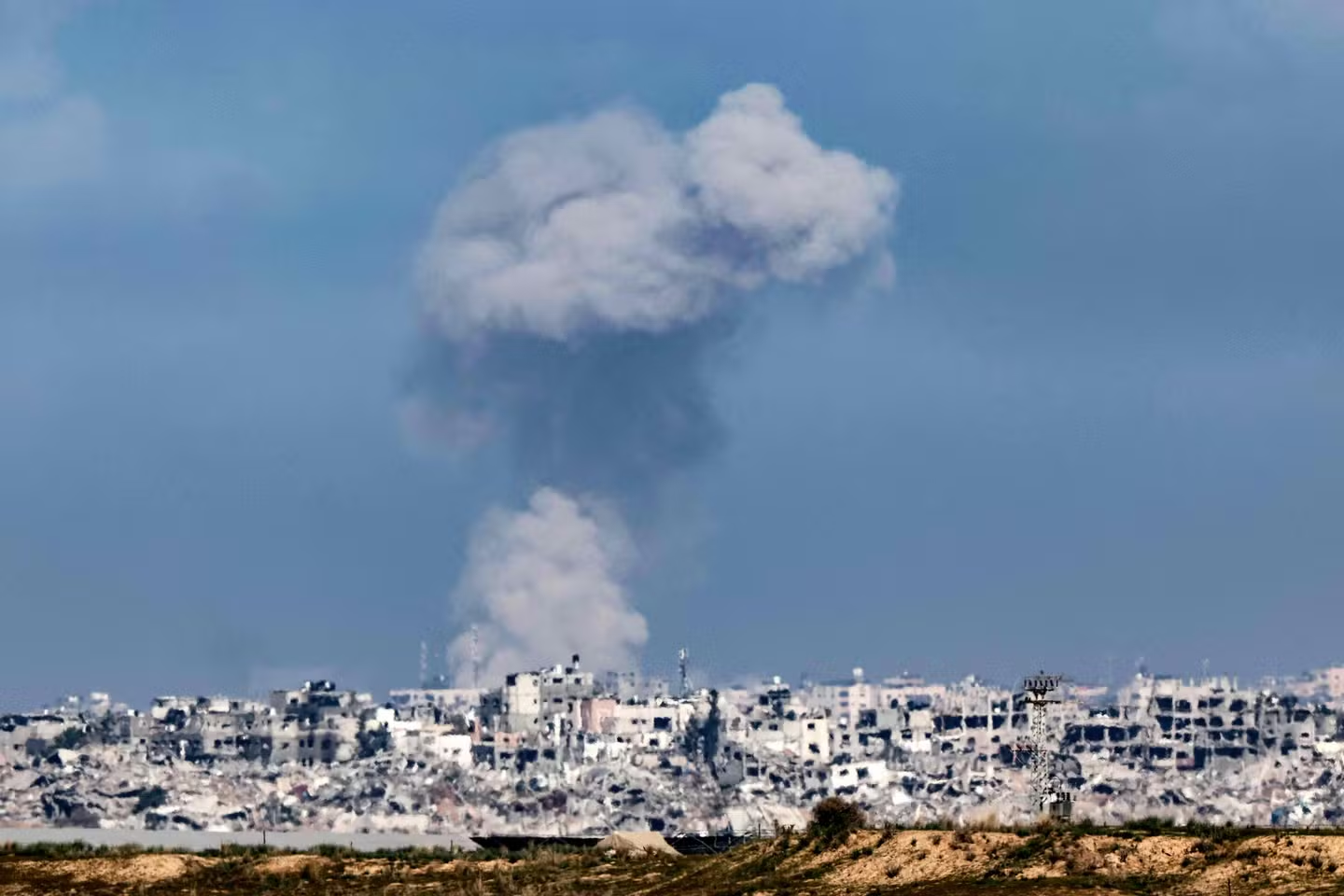
Paris (Imran Y. CHOUDHRY) :- Former Press Secretary to the President, Former Press Minister to the Embassy of Pakistan to France, Former MD, SRBC Mr. Qamar Bashir analysis : The world has finally witnessed an extraordinary development: the guns in Gaza have fallen silent. After months of relentless bombing, destruction, and the slow suffocation of a besieged population, Donald Trump’s unprecedented peace plan has brought at least a temporary halt to the horror. Aid is now trickling into Gaza, families that had endured starvation are receiving a semblance of relief, and the hope of survival, however fragile, is returning to a battered land. Yet the relief is tempered by the rhetoric of Benjamin Netanyahu, who insists that Israel’s objectives remain unchanged. His refusal to admit defeat conceals an anger at failing to persuade Trump to bless a complete annihilation of Gaza and its annexation into Israel’s expanding dream of territorial conquest.
This war, conceived by Israel and prosecuted with staggering ferocity, has ended in exhaustion rather than triumph. For the people of Gaza and the West Bank, the devastation is almost indescribable. United Nations and World Bank assessments estimate that Gaza alone faces over fifty billion dollars in reconstruction needs, with nearly seventy billion required to restore what has been lost. More than fifty-five million tons of rubble bury homes, schools, and hospitals, enough to fill thirteen pyramids of Giza. Electricity grids, water systems, hospitals, and telecommunications have been flattened. The human cost is greater still: tens of thousands dead, many more maimed, families erased, and an entire generation displaced.
Yet despite these horrors, the end of open conflict has already produced ripples felt far beyond the Levant. Perhaps the most immediate effect has been on global energy markets. During the war, the mere fear of disruption in Middle Eastern supply lines, particularly around the Strait of Hormuz and Red Sea trade routes, added a risk premium to oil. Brent crude had soared above eighty dollars a barrel, driving fuel and shipping costs higher across the globe. With hostilities ending, oil prices have tumbled to around sixty-one dollars a barrel, their lowest in five months. In the United States, gasoline prices that averaged four dollars a gallon only weeks ago are now edging closer to two dollars in some states, a correction that promises relief not only at the pump but across every layer of the economy.
Energy is the bloodstream of modern commerce. When oil and gas prices fall, every input cost—from transport to manufacturing to food distribution—drops in tandem. Lower energy costs ease inflationary pressure, reduce the consumer price index, and expand household purchasing power. For American families struggling with high costs of living, this decline may prove transformative. The dividend will be shared across the industrialized world, lowering inflation in Europe and Asia, reducing transport costs for global trade, and calming volatile markets that had priced in the risk of an expanded Middle Eastern war.
The greatest beneficiaries, however, may be in the developing world. Countries like Pakistan, Egypt, and those across Sub-Saharan Africa, which import most of their energy needs, have been spending much of their export earnings and foreign reserves on oil bills. High prices pushed them toward debt crises, leaving little for infrastructure or social spending. Now, with energy costs receding, these economies will regain some fiscal breathing space. Foreign exchange reserves will stabilize, debt servicing will become less crushing, and scarce resources can be redirected to development and poverty alleviation. For Pakistan, Afghanistan, and India—together home to over two billion people—the respite in energy costs is no less than a lifeline. Add China, the world’s largest energy importer, and the region accounts for nearly four billion people now benefiting directly from the dividends of this peace.
Equally important is the impact on trade. During the war, insurance premiums for ships passing through Middle Eastern waters soared, freight costs climbed, and global supply chains faced unpredictable delays. The ceasefire reduces these risks almost overnight. Cheaper shipping and lower risk premiums will improve the competitiveness of exporters, stabilize imports of food and essential goods, and ultimately lower costs for consumers worldwide. The IMF has already noted that a durable peace in Gaza could improve regional growth prospects by as much as one percentage point, a significant gain for struggling economies.
Peace also reshapes politics. Governments that were facing unrest from rising food and fuel prices suddenly have a cushion. Political leaders in fragile states can buy time, enact reforms, or at least ease the burden on citizens. This in turn creates a measure of stability, the very foundation of legitimacy and governance. The dividends of peace, therefore, are not only economic but also political, strengthening societies at their weakest points.
Still, there remains the urgent question of responsibility. Who will pay for Gaza’s reconstruction? It is not enough for wealthy states to open their treasuries out of charity while those who unleashed destruction escape unscathed. International law and morality demand that blame be apportioned. Israel, Hamas, regional actors, and global powers that contributed to the devastation should be compelled to shoulder the costs. Without such accountability, the precedent would be disastrous: that any powerful nation may devastate its weaker neighbor and walk away without consequence. Gaza must not become a template for impunity. Compensation must also reach families of innocent victims—children, women, doctors, and journalists—whose lives were shattered.
The road ahead is perilous. The peace is fragile and could collapse under renewed aggression. Donor pledges may falter, leaving reconstruction incomplete. Funds may be captured by elites or foreign contractors, breeding resentment rather than renewal. Regional tensions—whether in Lebanon, Syria, or Iran—could reignite conflict and restore the risk premium to oil markets. The dividends of peace are real but remain precariously balanced on the commitments of guarantors like the United States, which must enforce its plan with vigilance.
For Donald Trump, the Gaza ceasefire is not only a diplomatic achievement but also a political claim. He has boasted of stopping eight wars and now turns his gaze toward Russia and Ukraine, pledging to end that grinding conflict as well. Should he succeed, he would enter history as the president who halted nine wars in a single year of office. Whether this is bravado or foresight remains to be seen, but the Gaza experience proves that even entrenched conflicts can yield when backed by resolve and pressure from the most powerful office on earth.
In the final analysis, the dividends of Gaza–Israel peace are vast. Lower energy costs, subdued inflation, revitalized trade, fiscal space for fragile economies, and a political reprieve for leaders facing unrest all stem from this fragile truce. But the greatest dividend may be moral: the reminder that peace, even imperfect, enriches humanity far more than war, which impoverishes all. If the world seizes this moment to rebuild Gaza with justice, fairness, and accountability, it may set a precedent that aggression must pay and that peace, not conquest, yields the truest victory.








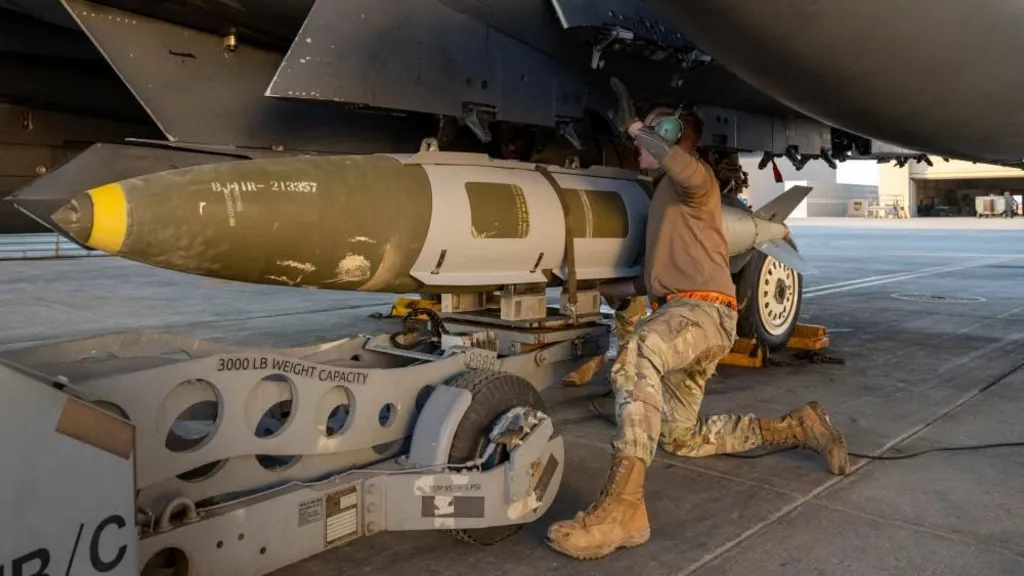
The US says its military has carried out a “massive strike” against the Islamic State group (IS) in Syria, in response to a deadly attack on American forces in the country.
The US Central Command (Centcom) said fighter jets, attack helicopters and artillery “struck more than 70 targets at multiple locations across central Syria”. Aircraft from Jordan were also involved.
It said the operation “employed more than 100 precision munitions” targeting known IS infrastructure and weapons sites.
President Donald Trump said “we are striking very strongly” against IS strongholds, following the 13 December IS ambush in the city of Palmyra in which two US soldiers and a US civilian interpreter were killed.
In a statement on X, Centcom – which directs American military operations in the Middle East, north-east Africa, central and southern Asia – said Operation Hawkeye Strike was launched at 16:00 Eastern Time (21:00 GMT) on Friday.
Centcom commander Admiral Brad Cooper said that the US “will continue to relentlessly pursue terrorists who seek to harm Americans and our partners across the region”.
Rami Abdel Rahman, the head of the Syrian Observatory for Human Rights (SOHR), told news agency AFP that “at least five members of the Islamic State group were killed” in eastern Syria’s Deir ez Zor province, including the leader of a cell responsible for drones in the area.
Petra, Jordan’s state-run news agency, announced the Royal Jordanian Air Force had participated in the strikes to “prevent extremist groups” from “threaten[ing] the security of Syria’s neighbours and the wider region”.
IS has not publicly commented. The BBC was unable to immediately verify the targets.
US Defence Secretary Pete Hegseth said the operation “is not the beginning of a war – it is a declaration of vengeance.
“If you target Americans – anywhere in the world – you will spend the rest of your brief, anxious life knowing the United States will hunt you, find you, and ruthlessly kill you.
“Today, we hunted and we killed our enemies. Lots of them. And we will continue,” the US defence secretary added.
Posting on Truth Social, President Trump said the US “is inflicting very serious retaliation, just as I promised, on the murderous terrorists responsible”.
He said the Syrian government was “fully in support”.
Centcom earlier said that the deadly attack in Palmyra was carried out by an IS gunman, who was “engaged and killed”.
Another three US soldiers were injured in the ambush, with a Pentagon official saying that it happened “in an area where the Syrian president does not have control.”
At the same time, the SOHR said the attacker was a member of the Syrian security forces.
No group has claimed responsibility for the attack, and the identity of the gunman has not been released.
In 2019, a US-backed alliance of Syrian fighters announced IS had lost the last pocket of territory in Syria it controlled, but since then the jihadist group has carried out some attacks.
The United Nations says the group still has between 5,000 and 7,000 fighters in Syria and Iraq.
US troops have maintained a presence in Syria since 2015 to help train other forces as part of a campaign against IS.
Syria has recently joined an international coalition to combat IS and has pledged to co-operate with the US.
In November, Syrian President Ahmed al-Sharaa – a former jihadist leader whose coalition forces toppled Bashar al-Assad’s regime in 2024 – met Trump at the White House, describing his visit as part of a “new era” for the two countries.
https://www.bbc.com/news/articles/c5yq7zzw618o
Taken From BBC News
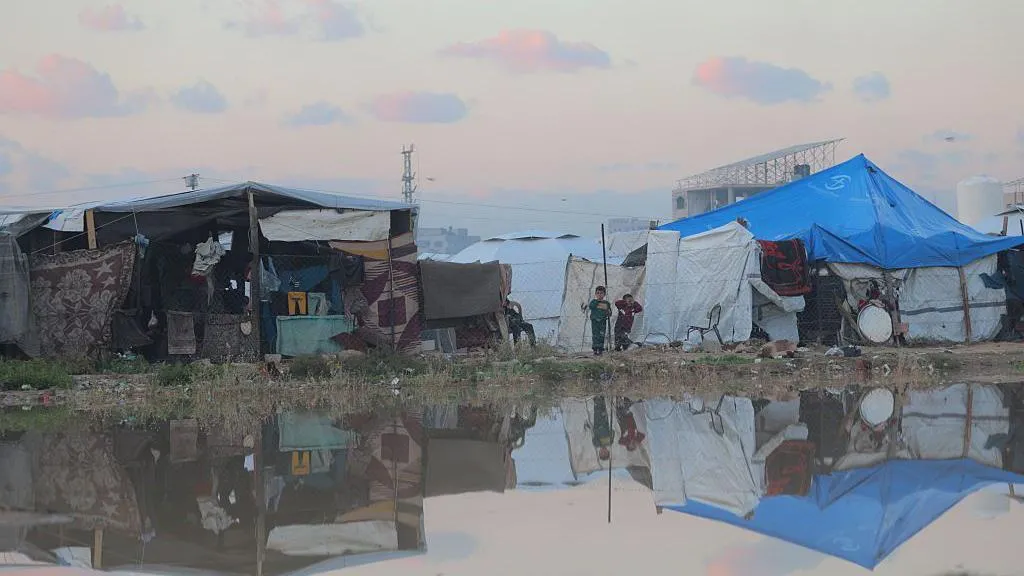
Heavy rains over the past week have compounded the already dire living conditions of the hundreds of thousands of displaced Palestinians in the Gaza Strip, UN agencies say.
Unicef spokesman Jonathan Crickx told the BBC that the weather overnight had been “horrendous”, with the rain so intense that he had seen up to 15cm (6in) of water on the ground near his office.
He said he was extremely concerned that children living in tents and makeshift shelters in wet clothing would succumb to hypothermia and other illnesses.
Gaza’s Hamas-run health ministry has said one baby has died from hypothermia and at least 11 other people have died in building collapses caused by the severe weather.
UN agencies have stepped up deliveries of tents, blankets and clothes since the Gaza ceasefire began nine weeks ago, but they have said there is still not enough aid getting in.
The UN and its partners estimate that almost 55,000 families have so far been affected by the rains, with their belongings and shelters damaged or destroyed.
More than 40 designated emergency shelters were severely flooded following downpours on Monday and Tuesday, forcing many people to relocate again.
“Last night was really horrendous for the families. The heavy rains were so intense that we could see from our office and guest house 10cm, 15cm (4-6in) of water at some point. And the winds were so strong,” Jonathan Crickx, chief of communications for Unicef State of Palestine, told the BBC’s Today programme on Wednesday.
“When I drove this morning, I could see that many, many people were trying with buckets to remove some of the water.”
He noted that most of the estimated one million people living in tents and makeshift shelters had been displaced many times during the two years of war between Israel and Hamas, and that they had no or very few changes of clothes.
“When I was seeing [children] this morning, their clothes were damp. I could see parents trying to dry some of the blankets they had. But it has been raining almost all of the time in the past four or five days, so it is extremely difficult to keep the children dry,” he said.
“With temperatures about 7C, 8C (45-46F) at night, we are extremely concerned about children getting sick or even worse, dying from hypothermia.”
Many tents were also at risk of being blown away or destroyed by the strong winds accompanying the rain because they were only made from a piece of tarpaulin or plastic sheeting nailed to a fragile wooden structure, he added.
Mr Crickx said Unicef had been able to bring in more aid during the ceasefire to help children cope with the harsh winter conditions, including 250,000 winter clothing kits, 600,000 blankets and 7,000 tents, but that it was not enough.
“We are working relentlessly to bring in that aid and to distribute it, but the scale of the needs is so immense that we still have thousands of people and children who are really suffering every night,” he warned.
Gaza’s health ministry said a two-week old boy named Mohammed Abu al-Khair had died of hypothermia on Monday, two days after he had been admitted to hospital and placed in intensive care. Another 11 people had so far died after the war-damaged buildings where they were sheltering collapsed, it added.
A spokesman for the Hamas-run Civil Defence agency, Mahmoud Bassal, put the death toll higher. He said in a video that a total of 17 people, including four children, had died because of building collapses and the cold.
He added that 17 residential buildings had collapsed completely because of the wind and rain and that another 90 buildings had collapsed partially.
On Tuesday, video footage showed first responders from the Civil Defence recovering the body of a man from the rubble of a building in Shati refugee camp, north-west of Gaza City. Its roof had collapsed suddenly, according to eyewitnesses.
“We call on the world to solve our problems and rebuild the territory so that people can have homes instead of being displaced and living in the streets,” said Ahmed al-Hosari, a relative of the man, told AFP news agency.
The International Committee of the Red Cross (ICRC) said the collapse of damaged buildings due to the severe weather conditions was “deeply concerning”.
It stressed the need for “increased and sustained humanitarian assistance to respond to urgent and long-term needs, including food, shelter and equipment for the repair of critical infrastructure”.
Cogat, the Israeli military body which controls Gaza’s border crossings, has dismissed claims of deliberate aid restrictions as “inconsistent with facts on the ground, and the ongoing co-ordination taking place daily”.
It says that between 600 and 800 lorries carrying humanitarian supplies enter Gaza daily, and that almost 310,000 tents and tarpaulins have been delivered since the start of the ceasefire, along with more than 1,800 lorry loads of warm blankets and clothing.
The UN says a total of 67,800 tents, 372,500 tarpaulins and 318,100 bedding items have been collected from crossings over the same period.
The second phase of the ceasefire between Israel and Hamas includes plans for the reconstruction of Gaza, along with post-war governance, the withdrawal of Israeli troops, and the disarmament of Hamas.
Last week, Israel’s prime minister said the second phase was close, with only the body of one dead Israeli hostage in Gaza still to be returned by Hamas as part of the first phase.
The war was triggered by the Hamas-led attack on southern Israel on 7 October 2023, in which about 1,200 people were killed and 251 others were taken hostage.
More than 70,600 people have been killed in Israeli attacks in Gaza since then, according to the territory’s health ministry.

Paris (Imran Y. CHOUDHRY) :- Former Press Secretary to the President, Former Press Minister to the Embassy of Pakistan to France, Former MD, SRBC Mr. Qamar Bashir analysis : On December 14, 2025, Australia was jolted out of its sense of safety. At Bondi Beach in Sydney, a space synonymous with openness, community, and peaceful coexistence, gunmen opened fire on members of the Jewish community gathered to celebrate Hanukkah. Eleven people were killed and many more injured. Families, children, and elders—people with no role in war, policy, or geopolitics—were turned into victims of terror.
The attack was immediately and rightly condemned by Australia and the world. There can be no ambiguity: the killing of civilians anywhere is criminal, immoral, and indefensible. No grievance, no ideology, no historical wound justifies such an act. The Jewish community in Australia, like Jewish communities everywhere, deserves safety, dignity, and protection.
Yet condemnation alone does not prevent recurrence. If the world wishes to stop such horrors from repeating, it must confront a harder truth: violence does not arise in isolation. It is shaped, amplified, and redirected by global political behavior—especially when power is exercised without accountability.
The Bondi Beach massacre occurred in a world already saturated with unresolved wars, mass civilian suffering, and a growing perception that international law is applied selectively. This perception—whether ignored or dismissed by those in power—has consequences. When pain is denied in one place, it does not disappear. It travels. It mutates. And it eventually erupts where the innocent live.
The Hamas attack of October 7, 2023, which killed Israeli civilians and took hostages, was universally condemned. That condemnation was justified. What followed, however, shattered moral balance. Israel’s military response in Gaza resulted in the deaths of tens of thousands of Palestinian civilians, the destruction of homes, hospitals, schools, and the deliberate deprivation of food, water, and medical aid. International legal institutions and humanitarian organizations warned that collective punishment and starvation had become tools of war.
This matters not to excuse terrorism or antisemitism—both are crimes—but to understand how unchecked state violence creates global insecurity. When a state presents itself as above scrutiny, when it dismisses civilian deaths as necessary or inevitable, it sends a message to the world that human life is conditional. That message does not stay confined to Gaza. It seeps into streets, minds, and communities across continents.
The Jewish community worldwide has increasingly been placed in an impossible position. Jews in Australia, Europe, or North America do not command armies, blockade borders, or authorize bombardments. Yet they increasingly find themselves vulnerable to backlash generated by actions taken by a government thousands of miles away. This conflation is unjust, dangerous, and morally wrong—but it is fueled by the refusal of powerful leaders to acknowledge the global consequences of their conduct.
This refusal was starkly illustrated in the aftermath of the Bondi Beach killings. Instead of engaging in self-reflection or acknowledging how Israel’s actions in Gaza have heightened global tensions and endangered Jewish communities abroad, Israeli Prime Minister Benjamin Netanyahu publicly criticized the Australian government, accusing it of failing to provide adequate security to the Jewish community.
In doing so, Netanyahu acted not as a statesman grappling with consequences, but as if he were a ruler passing judgment on sovereign nations—assigning blame outward while absolving himself entirely. There was no acknowledgment that the relentless violence in Gaza, the images of starving children, and the dismissal of international law have contributed to an environment in which rage is exported globally. There was no recognition that leadership carries responsibility not only for battlefield outcomes, but for the safety of one’s people everywhere.
By placing the burden solely on Australia’s security apparatus, Netanyahu effectively treated the Bondi Beach massacre as an isolated policing failure—rather than as a symptom of a wider moral and political breakdown. This posture is not only arrogant; it is dangerous. It ignores the simple reality that actions taken in the Middle East now reverberate instantly across the world.
A similar warning emerged just one day earlier, on December 13, 2025, in Palmyra, Syria. A lone suspected Islamic State gunman attacked a convoy of U.S. and Syrian partner forces during a key leader engagement. The assault killed two U.S. Army soldiers and a civilian interpreter, and wounded three others. Partner forces killed the attacker at the scene. President Donald Trump vowed serious retaliation.
That attack, like Bondi Beach, underscored the same truth: wars fought far from home do not remain distant. They return—sometimes as direct attacks, sometimes as unpredictable consequences. Soldiers, interpreters, and civilians pay the price for conflicts whose political roots remain unresolved.
This reality struck even closer to home in Washington, D.C., where a lone Afghan gunman killed one U.S. soldier and critically wounded another. His act was criminal and indefensible. But it was also a reminder that decades of war leave behind trauma and grievance that do not end with troop withdrawals. When conflicts are managed through force rather than resolution, the aftershocks linger in human lives.
Today, the same pattern threatens to repeat itself in the Western Hemisphere. Tensions between the United States and Venezuela, and increasingly involving Colombia, are escalating. Once again, familiar language is resurfacing—delegitimization, sanctions, pressure, and whispers of regime change. The narrative being constructed against Venezuela echoes the one once built against Iraq: moral urgency, existential threat, inevitability of action.
We know how that story ended. Iraq was destabilized. Libya collapsed. Syria fractured. The Middle East was turned upside down. Millions were displaced. Extremism flourished. And the consequences spilled into Europe, North America, and beyond.
Venezuela may be weaker than the United States militarily, but modern conflict teaches a clear lesson: retaliation does not strike power centers; it strikes soft targets. It does not reach presidents; it reaches soldiers, worshippers, commuters, and children. Innocent Americans—both civilians and service members—become exposed to the revenge of those whose loved ones were killed far away.
This is not justification. It is historical reality. Violence creates memory. Memory creates resentment. Resentment seeks release—often against those least responsible.
The tragedies at Bondi Beach, in Palmyra, in Washington, and the looming risks in Venezuela and Colombia all point to the same conclusion: when leaders refuse accountability, insecurity becomes global. No border, no ocean, no alliance can contain the consequences.
The only alternative is restraint, diplomacy, and genuine multilateral engagement. Institutions like the United Nations exist to prevent this chain reaction—to replace unilateral force with collective responsibility. They are imperfect, but bypassing them guarantees repetition of failure.
If humanity continues to normalize collective punishment, regime-change wars, and selective morality, the violence will keep returning—again and again—against people who never chose these conflicts. Peace is not a moral luxury. It is a strategic necessity.
Only by choosing introspection over arrogance, law over impunity, and dialogue over domination can the world hope to prevent the next Bondi Beach—and the next innocent life lost to a war they never owned.


Quetta’s Daughter, Pakistan’s Pride

Why is Trump a Dictator?

America Must Rebuild Within


-

 Sports4 months ago
South Korea’s Yoo Useong Steps Onto the Global Strongman Stage as World Strongman Federation Professional Athlete
-

 Art & Culture1 year ago
A Survey of Mata-E-Zeest
-

 Europe News2 years ago
Chaos and unproven theories surround Tates’ release from Romania
-

 American News2 years ago
Trump expands exemptions from Canada and Mexico tariffs
-

 American News2 years ago
Trump Expels Zelensky from the White House
-

 Art & Culture2 years ago
Will Snow White be a ‘victim of its moment’? How the Disney remake became 2025’s most divisive film
-

 Entertainment2 years ago
Champions Trophy: Pakistan aim to defend coveted title as historic tournament kicks off today
-

 Pakistan News1 year ago
Comprehensive Analysis Report-The Faranian National Conference on Maritime Affairs-By Kashif Firaz Ahmed