
Art & Culture
An Italian cultural ambassador’s guide to Rome


Alberto Angela has made a career out of exploring his hometown. Here are his favourite spots to unearth Rome’s millennia of secrets, from the Vatican Museums to Ostia Antica.
From the 1st-Century BCE ruins of the Imperial Forum to the Trevi Fountain’s Baroque splendour, Rome packs such an overwhelming myriad of postcard-worthy landmarks that digging through its historical layers can make any visitor feel like they’ve turned into an archaeologist.
Alberto Angela, a TV presenter, global ambassador for Italian heritage, art, history and culture, and a familiar face in Italian living rooms for nearly four decades knows a thing or two about his hometown’s 2,000 years of history – and he’s ready to help visitors discover it, especially as this year’s Jubilee newly puts it into the limelight.
“Rome has two faces,” says Angela. “The Papal – that of the rich – and its working-class soul, the one that is closest to us… the most interesting,” he says.
In a city where grand basilicas lie next to shady alleyways, Angela recommends exploring without cramming in too many sights – so that one can “immerse oneself in the world of the ancients”.
Having followed in the footsteps of his famous father, Piero Angela – Italy’s most well-known documentarist often called a “national treasure” – the younger Angela attributes his career and love of history to growing up in the Italian capital.
“You breathe history here,” he says. “Anyone who comes to Rome can see the same afterglow Caesar would have seen. You aren’t in a place that doesn’t exist anymore. Rome was rebuilt on top of its ancient structures.”
For Angela, this is what makes Rome so unique. “The city did not cancel its history, unlike many others,” he says. “Living here, you understand the ancients.”
Emerging from a small market settlement on the Tiber, the city of Rome was at an intersection between the Mediterranean and mainland Europe, making it a crossroads that swelled into the world’s first true metropolis. Angela believes that the city’s immense global-reaching political and symbolic impact throughout history means everyone has a “piece” of Rome inside them – which is why it can have such a profound impact on those who visit it.
Here are Angela’s favourite ways to experience ancient history in modern Rome.

1. Best place to experience ancient Rome: The Palatine Hill
Much of central Rome’s labyrinthine urban grid is a direct heir of the former imperial capital, with public spaces like the Baroque Piazza Navona or Campo de’ Fiori piazza taking their shape from a bygone stadium and theatre, respectively.
Tip:
Trying to cram in all of Rome’s main landmarks in a few days is an Olympian feat, so Angela recommends first-time visitors follow a three-day rule.
“See the major sights on the first and second days – Saint Peter’s, the Pantheon, the Colosseum,” he says. “And then on the third day, choose yourself, to see something cool [off the beaten path]. When you get home, you’ll feel you’ll have seen the things everyone talks about, but you’ll also have seen something you yourself like.”
But on the Palatine Hill, the mythical birthplace of Rome, you can actually walk on the same stones where emperors Augustus and Nero once dwelled.
“It’s the place where the Caesars lived and died,” Angela says.
As the legend goes, twin brothers Romulus and Remus received an omen from the gods and decided to lay the foundations of a new city on the Palatine Hill in 753 BCE. In the subsequent centuries, the Palatine developed into an exclusive neighbourhood of patrician villas and Imperial palaces – indeed, it’s where the word “palace” takes its root.
One of the legendary seven hills of the ancient city, offering an incomparable vantage point with a 360 panorama, Palatine Hill offers what Angela describes as “a beautiful walk”, with arguably the best views of the Colosseum – the unmistakable “star of ancient Rome”.
Visiting the Palatine is a full immersion into the life of the Roman empire, with a plethora of impressive ruins, including the mosaic floors of Augustus’s palace, Domitian’s hippodrome and the balcony overlooking the Circus Maximus racecourse.

2. The Vatican’s best-kept secret: The Necropolis
As the centre of Catholicism and one of the most important sites in Christendom, the Unesco-listed Vatican is firmly entrenched among Rome’s unmissable sights. In honour of the 2025 Jubilee, tourists and pilgrims alike are flocking to Saint Peter’s Basilica to walk through its Holy Door, opened for the occasion every quarter of a century.
But while much of the Holy See’s architectural majesty is immediately apparent – from the Michelangelo- and Giacomo della Porta-designed designed dome of Saint Peter’s all the way to the Sistine Chapel and Vatican Museums – some of its greatest treasures are hidden underground.
“Once in Saint Peter’s, you walk on beautiful marble floorings, you look up to the Baldachin,” says Angela, renowned for his 2015 TV miniseries Alla Scoperta dei Musei Vaticani (Discovering the Vatican Museums). “But you can go underground. The Popes’ tombs can be found underneath, but under those is the ancient Roman graveyard where Peter the Apostle himself was buried. The foundations of [the Basilica] are a graveyard.”
The Vatican Necropolis, excavated only in the 1940s, features mausoleums belonging to citizens of many faiths, as well as a cluster of tombs called “Field P”, suspected by some scholars to hold the burial chamber of the Church founder himself.
“It’s a trip into ancient Rome that you wouldn’t expect to find [there]”, Angela says. “It makes you understand how Rome really is.”
Visitors must book visits to the Necropolis on the official website of Saint Peter’s Basilica. The dress code mandates covered shoulders and below-the-knee clothing.

3. Best church for experiencing all of Rome’s historical eras in one fell swoop: The Basilica of San Clemente al Laterano
Rome has more than 900 Catholic sites of worship built over the course of the centuries. Now and then, there’s one that best encapsulates the city’s multi-millennial history, like Angela’s pick, the Basilica of San Clemente.
“This Basilica conceals the three souls of Rome – Baroque, medieval and ancient,” Angela says. “Anyone who comes across it is enchanted.”
Tucked behind the Colosseum and a composite of two different churches, San Clemente – dedicated to the third pope of the same name – has been a site of worship since ancient Roman times, when it served as a temple for the Zoroastrian cult of Mithras.
The temple eventually swelled into its grand current form, featuring an intricate overlay of architectural styles – from its Renaissance courtyard and the Mannerist facade of the main Basilica, all the way to its underground, early medieval second structure, which hides ancient Roman remnants.
“The exterior is beautiful and well-maintained, from the 16th Century, with a Cosmatesque [geometric] marble flooring, and then you take the stairs and arrive at the medieval Basilica,” says Angela. “And you find yourself right in ancient Rome, in a Roman temple.”

4. Best off-the-beaten-path museum: The Museo della Comunicazione Scritta dei Romani
From 17th-Century Villa Borghese to the Capitoline, the city’s oldest art gallery, Rome has no shortage of museums displaying a vast array of artefacts – matched by equally colossal crowds of spectators.
While Angela certainly recommends visitors enjoy the time-worn classics, he also suggests a quieter, quirkier alternative: the Museo della Comunicazione Scritta dei Romani.
Conveniently located a mere five-minute walk from the Termini train station, the museum is found inside the Baths of Diocletian, where the majestic 4th-Century Imperial termae have survived in remarkable condition. It is also home to a curious collection of esoteric Roman artefacts, showing how the ancients dabbled in the occult.
“It’s a museum dedicated to how Romans expressed themselves,” Angela says. “But there’s a part dedicated to magic, voodoo of sorts.”
Superstition was the unspoken crux of ancient Roman life, but one that we often overlook. “It’s a world that often gets left behind, that of spiritual beliefs,” he adds. “They found the objects in a parking lot.”
Among the objects on display is a large copper cauldron, curse tablets (defixiones), ritual tools and even Christian spells.
“For someone coming from the station, especially if it rains, it’s quite an intriguing thing to visit,” says Angela.

5. Best for exploring Baroque Rome: Palazzo Doria Pamphilj
The 16th to 18th Centuries were a crucial time for Rome’s urban development, as the city’s aristocratic families – including the Farnese, Borghese, Doria and Pamphilj – vied for social dominance through commissioning lavish building projects, all designed in the Baroque style favoured by the Papal Counter-Reformation.
“I’d advise anyone coming to visit Rome to see the palaces of the powerful Roman families,” says Angela.
While listing a few examples – Palazzo Colonna and Palazzo Farnese among them – few rival the opulence of the Palazzo Doria Pamphilj, Rome’s very own “Versailles”, in Angela’s words.
The product of an alliance of noble families, what resulted was a Baroque fantasy come to life and an impressive art collection featuring the works of many of Italy’s greats, from Titian to Raphael.
Its crown jewel is its Hall of Mirrors, commissioned by Gabriele Valvassori in the 1730s and featuring whimsical frescos, gilded Venetian frescos and ornate gold-plated furniture.
“I had never been prior to shooting [a TV special] and it’s truly spectacular,” he says. “It truly surpasses anything else.”

6. Best historic landmark outside of the centre: Ostia Antica
Many visitors coming to Rome don’t know that the city has what Angela considers its very own “Pompeii” around 32km from the city centre: Ostia Antica.
Once Rome’s sea port, potentially from as early as the 7th Century BCE, Ostia Antica developed into a bustling seaside suburb, reaching a peak of 75,000 inhabitants in the late Imperial age. While the city declined after the empire’s fall, and the coastline ended up advancing by 3.2km, much of the ancient town that once stood there has been preserved.
“You lose yourself there, you can see everything,” Angela says. “Bakeries, public bathrooms (latrines), homes, apartment blocks… street businesses, not too dissimilar to those of today.”
A tour of Ostia Antica can show you much of the amenities and features of ancient Roman life – from its 1st-Century BCE theatre, to its forum, public baths and necropolis.
For Angela, Ostia Antica best preserves the “popolare” (working-class) soul of ancient Rome – one which its newer counterpart, the beach suburb Lido di Ostia, has carried on in modern form.
Ostia Antica is a roughly 30-minute drive from central Rome, and can be reached in around the same time by taking the Metromare commuter rail from the Porta S Paolo station.
Taken From BBC News




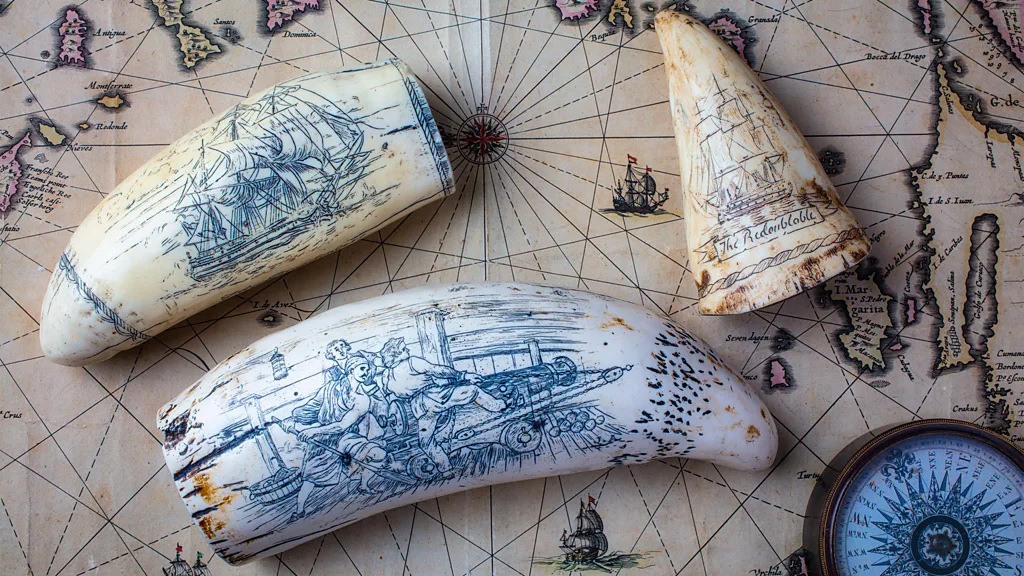
As Moby Dick turns 175, some of the last American scrimshanders grapple with the legacy of maintaining one of the US’s oldest art forms.
Jade Gotauco spent her childhood among the skeletons of giants. Her father, Chet Gotauco, was a scrimshander – an artist who etched images onto the ivory of hunted whales. In pensive moments, she would slip under the arched jaw of a whale in his Rhode Island garden and sit atop a massive vertebra, watching insects scrabble across the porous bone.
“My favourite smell in the world is the sandy aroma of ivory dust,” said Gotauco, now an artist herself. Whale teeth adorn the walls of her studio in New Bedford, Massachusetts; she engraves them with nautical scenes in which sperm whales thrash the ocean to foam and whalers hurl barbed harpoons from minute boats.
Ask Americans about the cultural legacy of whaling, and many will point to Herman Melville’s classic novel Moby Dick, which turns 175 next month. Yet for all the book’s brilliance, it’s scrimshaw – the practice of artistically carving whale teeth and bones, which is considered one of the US’s earliest homegrown art forms – that offers a true insider’s view of the industry.
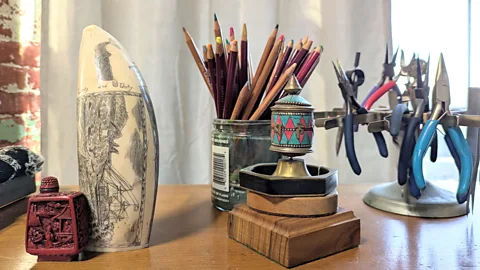
Today, there’s hardly any of those teeth and bones left on the legal market. Some scrimshanders, including Gotauco, believe the art form should disappear with them. “When the ivory is gone, this is over,” she said.
Scrimshaw was developed by sailors whose lives unfolded on whaling grounds around the globe as the industry expanded into a 19th-Century behemoth. They strove to depict a culture that, for a few lucrative decades, made New Bedford North America’s wealthiest city per capita.
Back then, everyone was a scrimshander. Now I’m one of the last – Michael Vienneau
“They saw their experiences as important,” said Marina Wells, an assistant curator at the New Bedford Whaling Museum, which is home to the largest scrimshaw collection is the world. “You see that in their commemoration of whaling scenes, in all their meticulous detail.”
Some of the carvings throb with yearning, depicting homey scenes of faraway families. Others capture sailors rowing fragile, open boats dwarfed by the whales they pursued. They’re communicating “the dangerous, faraway world of whaling”, Wells said. “You have the bloody spouts of the whales after their lungs have been punctured… the intimacy of whalemen interacting with whale bodies that’s really hands-on.”
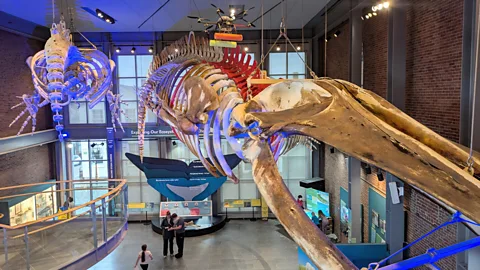
To modern eyes, the scenes evoke the heartbreaking impacts on species hunted to the brink of extinction; yet the whalers, too, were often broken by the industry. At the Seamen’s Bethel, an 1832 mariner’s church located across the street from the museum in New Bedford (and which features in the opening chapters of Moby Dick), such risks are on poignant display. Lining its whitewashed sanctuary are marble cenotaphs commemorating those lost at sea.
“After fastning to a whale, was carried overboard by a line and drowned,” reads the tomb of Captain William Swain. Three sailors from the whaleship Cowper, aged 19, 22 and 24, share another memorial: “All lost by the upsetting of their boat, July 15, 1854, in the Ochotsk Sea.”
They died as American whaling reached a short-lived fever pitch. In 1857, more than 10,000 men worked aboard New Bedford whaleships, half the city’s population at the time. Two years later, petroleum was discovered in Pennsylvania and the ensuing oil rush flooded American cities with kerosene – a comparatively cheap fossil fuel that would eclipse the whale oil used in lamps around the globe.
By the turn of the century, American whaling was all but over.
Scrimshaw lived on, however. The massive scale of the whaling industry produced a glut of teeth and bones, a byproduct that, at the time, had little commercial value. They gathered dust in attics and warehouses.
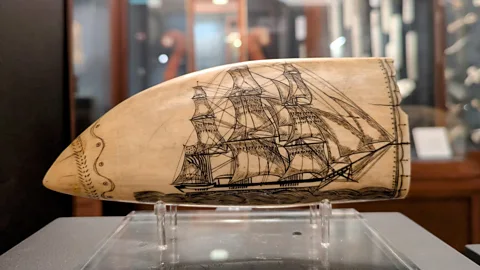
“When I was a kid they had barrels of whale teeth down at the wharves and sold them for a couple of bucks apiece,” recalled Michael Vienneau, a scrimshander on the nearby island of Nantucket, Massachusetts – another onetime whaling hub. Former homes of whaleboat captains surround his small shop, Scrimshander Gallery, in the heart of the island’s historic district. A few blocks away is the Nantucket Whaling Museum, whose own significant scrimshaw collection includes pieces by Nantucket whalemen – and famed scrimshanders – Frederick Myrick and Edward Burdett.
In the 1960s, scrimshawing surged in popularity, part of a folk-craft revival. (It even got a boost from US President John F Kennedy, an avid collector.) That’s when Vienneau got his start, rummaging for cheap whale teeth as a teenager while visiting the island with his family.
“Back then, everyone was a scrimshander,” he said. “Now I’m one of the last.”
In part, that’s because of the 1973 Endangered Species Act, which tightly restricted the sale of marine ivory. Today, scrimshanders engraving whale teeth and bones must work from the dwindling supply of teeth and bones that remain from before the act was passed – Vienneau has a stash in the back of his shop. “You’ll pay several thousand dollars for a raw tooth now,” said Vienneau.
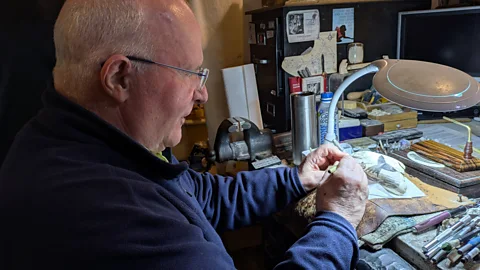
On a recent afternoon, he was sitting at his workstation squinting at a sperm whale tooth he was engraving with a scene of a sailor brandishing a harpoon at the tail of a diving whale. More teeth were piled in a nearby filing cabinet. His dog, Petey, grabbed a tooth and began to chew on it. Vienneau laughed. “Any dog that gnaws on a sperm whale tooth is a scrimshander’s dog,” he said, not getting up.
As whale teeth grew scarce and expensive, some scrimshanders innovated, carving on cow bones and deer antlers. Even comparatively tooth-rich Vienneau experimented. Once, he flew to Alaska on a tip and spent three days digging a 30,000-year-old mammoth tusk out of permafrost near a remote copper mine.
Yet, many purists insist that while such projects are both art and craft, they are not true scrimshaw, since the authentic form relies on the byproducts of historical whaling. Gotauco is one of them. Like some of her peers, she believes this means that scrimshaw is on the brink of extinction.
Gotauco works exclusively on pre-1973 ivory and bones. Nearly a century ago, her grandmother emigrated to Boston from Newfoundland, and among her few belongings was a collection of whale teeth and bones she’d inherited from her family of seal hunters, cod fishermen and whalers. That’s what Gotauco carves in her New Bedford studio, etching images onto the physical remains of her ancestors’ legacy.
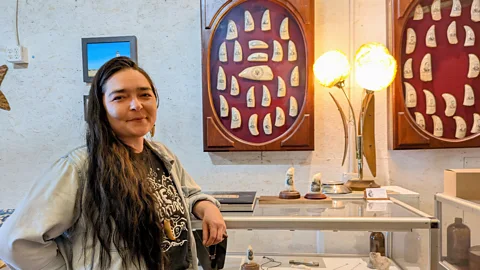
Along with the whale teeth, Gotauco’s grandmother passed along stories of what she said were Mi’kmaq roots. Whales factor into traditional Mi’kmaq stories, and the First Nations community hunted the animals sustainably long before the arrival of Europeans in North America. With her own deep reverence for whales, Gotauco has, at times, felt deeply uneasy about working with ivory.
In the years since she learned how to carve scrimshaw by sitting beside her father in his workshop, Gotauco often wondered about the ethics of using materials pulled from the sea with such violence. Commercial whaling was an environmental disaster and a cruelly dangerous job; the beauty of the art form it spurred still catches at her heart. In the end, she embraced it as a form of remembering, calling it “the best way to honour the whales and whalers”, albeit one that will likely fade in her lifetime.
“When I run out of teeth along with everyone else, I’ll raise a cup to the story’s end,” she said. “May we never get more.”
This News is taken from BBC News
Art & Culture
‘A distinct Canadian character’: The 1920s paintings that changed how the world saw Canada
The Group of Seven was Canada’s first internationally recognised national art movement, and they helped create a distinct, modern Canadian identity in the 1920s. As the official Group of Seven Day is celebrated in Canada, what is their legacy – and are their ideas in harmony or conflict with the so-called “Indian Group of Seven”, founded later in the 1970s?
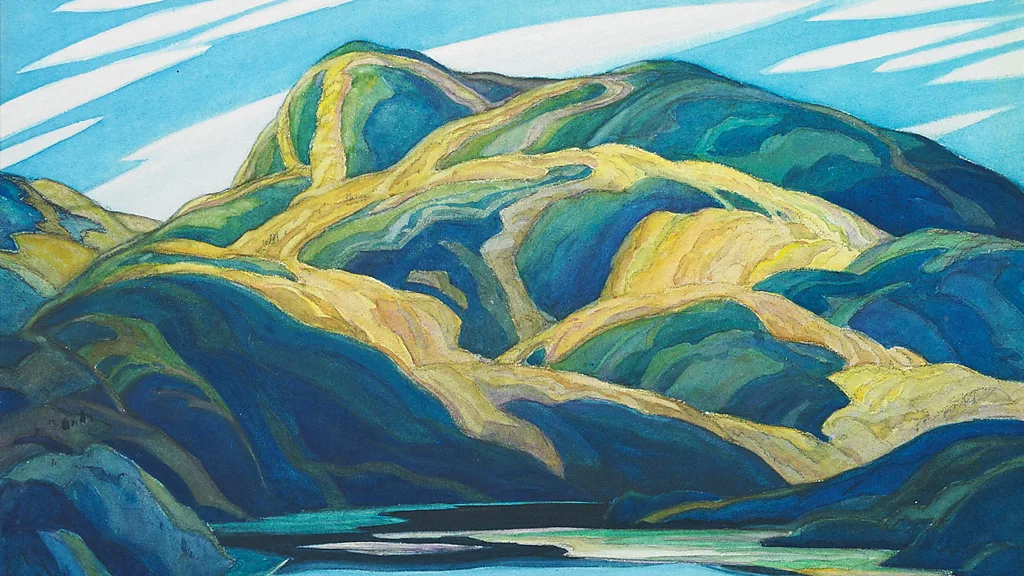
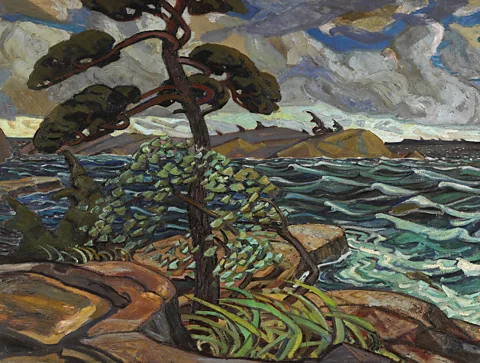
In the 1921 painting Stormy Weather, Georgian Bay, a lone tree perches perilously between a rocky outcrop and a vast, churning lake, buffeted by the elements yet refusing to yield to their force. Executed in rough brushstrokes and simplified lines, it celebrates not only the resilience of Canadian settlers and their ability to survive against all odds, but also the dramatic, untamed landscapes with which they joyfully communed.
The painting by FH Varley is one of the most iconic works by The Group of Seven, a groundbreaking art collective who broke with the dominant tradition of European academic painting to create a uniquely Canadian style that revelled in the country’s vast natural beauty.
The group’s most celebrated works are “almost like what the Statue of Liberty is for the United States,” says Katerina Atanassova, senior curator of Canadian art at The National Gallery of Canada. So beloved are they that 7 July is now celebrated as Group of Seven Day. What is it about their paintings that, for many, embody the Canadian spirit and identity? And where does the group’s work stand in relation to the country’s Indigenous art?
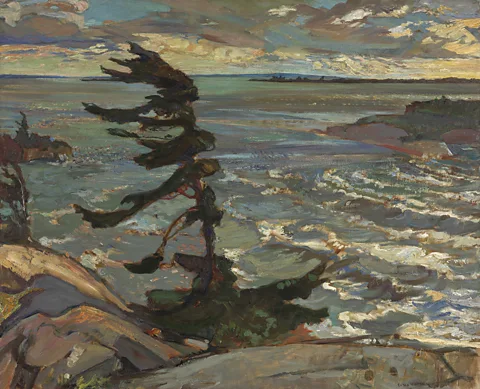
The group which – in addition to Varley – comprised Franklin Carmichael, Lawren Harris, AY Jackson, Franz Johnston, Arthur Lismer and JEH MacDonald remains hugely popular today, as does Tom Thomson, a major influence, who died before its official formation. Their most acclaimed paintings, which include Thomson’s The Jack Pine, The West Wind and Harris’s North Shore, Lake Superior, have become, for many, the national paintings of Canada – embodying the country’s spirit.
A turning point
They began painting in the 1910s, an era when Canada – a self-governing dominion of the British Empire since 1867 – was beginning to find its own social and political identity, but had yet to find an artistic voice. The nascent group was intent on providing just that. A turning point occurred when MacDonald and Harris visited a landmark exhibition of contemporary Scandinavian art in Buffalo, US, in 1913. Norway, Sweden and Finland were all forging their own independent paths at the time. In their sparse landscapes, vividly depicted in flat, bright colours, the two artists saw an expression of national identity that was unequivocally modern.
Their intention was not to portray what nature looked like, but how it made them feel, the emotional state created by the starry sky and the windswept pine – Katerina Atanassova
The aesthetic and intellectual inspiration they took from the Scandinavians was strengthened by the influence of Thomson, a self-taught artist and graphic designer who frequently embarked on lengthy trips into the wilderness, often by canoe, to paint and sketch. “He embodied that ideal, that direct experience that every artist wants to have,” Atanassova tells the BBC. It was Thomson who “started the images of the solitary tree”, and inspired the future Group of Seven artists to see that the Canadian wilderness “can be viewed as modern and painted as modern”, says Atanassova.
Thomson’s death in 1917, at the age of only 40, turned him into a cultural legend, and when the group officially formed in 1920, “the goal was defined that they ought to follow in his footsteps,” says Atanassova. Their intention “was not to portray what nature looked like, but how it made them feel, the emotional state created by the starry sky, the windswept pine or the barren coastal line on the north shore of Lake Superior.” The initial response to their innovative approach was anything but favourable. One review of their first exhibition compared their work to “the contents of a drunkard’s stomach”.
Somewhat ironically, it would take the approval of the very people from whom they were trying to distance themselves to change public opinion. The group’s work was selected for the British Empire Exhibition, held at Wembley in 1924, where it received a rapturous response with the British press praising its “distinct Canadian character. ” Recognition abroad meant that it “suddenly became popular in Canada”, explains Atanassova.
The fact that this “distinct Canadian character” excluded the Indigenous population has led to criticism of the group in some quarters, although Atanassova feels that this is unfair. “You don’t see any signs of civilisation in [the Group of Seven’s] paintings,” she says. They were “looking for untamed nature in the tradition of modern Scandinavian art”, which meant that they also excluded any sign of industrialisation.
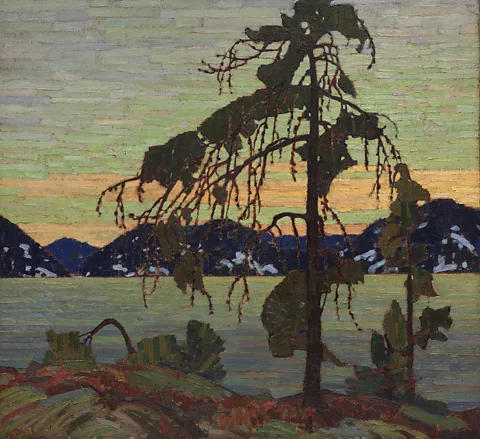
While that may be true, we are now painfully aware that in the areas the group were travelling to, they could not have painted Indigenous populations if they had wanted to. The government’s brutal policies, begun in the late 19th Century, had seen them forcibly removed to reservations or residential schools where their movement was restricted and their cultural practices suppressed.
‘The Indian Group of Seven’
These policies had a devastating effect on all aspects of Indigenous life, including artistic production and recognition, a fact that led to the formation of another group of seven in the early 1970s, the Professional Native Indian Artists Incorporated (PNIAI). Jackson Beardy, Eddy Cobiness, Alex Janvier, Norval Morrisseau, Daphne Odjig, Carl Ray and Joseph Sanchez first started meeting in Odjig’s craft shop in Winnipeg.
“They were quite distinct in that they were the first self-organised Indigenous-artists-run arts advocacy group that was formally incorporated that ever existed in Canada,” says Michelle LaVallee, Director of the Indigenous Ways and Decolonization Department and Curatorial Initiatives of the National Gallery of Canada. She herself is Ojibway and a member of the Chippewas of Nawash Unceded First Nation.
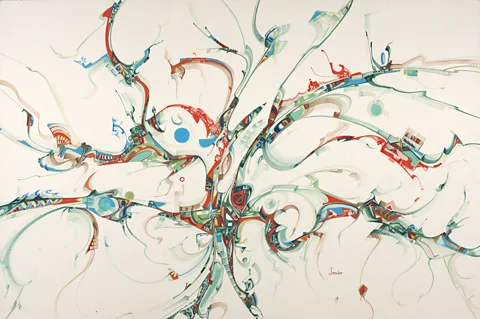
Although they all had different styles and opinions, they wanted to band together to support other artists and challenge exclusionary practices and the narrow view of what “native” art actually was. “We had no one to show our work, so we had to do it ourselves. We acknowledged and supported each other as artists when the world of fine art refused us entry… Together we broke down barriers that would have been so much more difficult faced alone,” Odjig later said.
“At that time, there were no Indigenous curators, no Indigenous people working in institutions,” LaVallee tells the BBC. And where Indigenous art was collected it tended to be relegated to ethno-centric galleries rather than the contemporary fine art collections in which the artists felt they deserved to be exhibited. “It really wasn’t held in the same esteem as [work by their] non-Indigenous peers, even though it is the first and the most authentic art that can be and should be called Canadian,” says LaVallee.
The first art of this land was Indigenous, and the first people of these lands were Indigenous, and that needs to be recognised – Michelle LaVallee
Although the media soon dubbed them “the Indian Group of Seven”, LaVallee isn’t sure they would have appreciated the name. “They were very intentional about what they called themselves,” she says. It was very important for them to have “Professional” and “Native Indian” present in the name of the group.
While LaVallee herself likes the paintings of the Group of Seven, she points out that their approach to landscape is vastly different to the PNIAI. “A lot of the PNIAI’s works you would look at and not necessarily call it a landscape.” They are different ways of referencing the land”. Alex Janvier often incorporated maps in his works, while Norval Morrisseau “draws those connections between land and animals and spirits”. It is art by “somebody from the land versus settlers coming and appreciating the land”, she says.
Even if the Group of Seven weren’t conscious of doing so, they “would have contributed to the circumstances around how Indigenous people were being perceived and treated”, says LaVallee. This was largely down to the way their art was used to “create this popular narrative of Canada” which was picturesque but “excluded the Indigenous populations”, she says.
The PNIAI played a vital role in correcting that, and LaVallee credits her own position – as one of the senior management of the National Gallery of Canada – to their activism. “For me to get to a place like that would not have happened had these earlier artists not fought for these types of rights and opportunities and created avenues of support and camaraderie between Indigenous peoples,” she says.
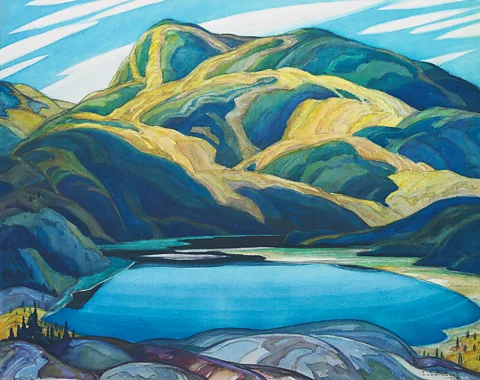
The National Gallery now displays Indigenous and non-Indigenous art side by side in the same galleries. LaVallee emphasises that this is not meant to “erase or discredit any existing histories”.
“Part of the change we’re trying to assert is the idea that, yes, within Canada, it’s very multicultural, but the first art of this land was Indigenous, and the first people of these lands were Indigenous, and that needs to be acknowledged and respected and recognised.”
In the 1970s, the Group of Seven’s work may have been interpreted by some as exclusionary and colonial, but in the 21st Century it is largely viewed differently. For today’s outdoor-loving Canadians, the group’s art is a celebration of the country’s outstanding natural beauty. It embodies, says Atanassova, “that raw connection with nature – and it’s exactly the nature you see [in the paintings]. The lakes are the same, the skies are the same. It’s an expression of your own experience. What you see and what you feel and what you live.”
Art by the Group of Seven is displayed at the National Gallery of Canada, Ottawa.
—
If you liked this story, sign up for The Essential List newsletter – a handpicked selection of features, videos and can’t-miss news, delivered to your inbox twice a week.
Taken From BBC News
Art & Culture
‘Chest-thumping machismo’: The Bayeux Tapestry reveals the bloody, bawdy truth about the Middle Ages
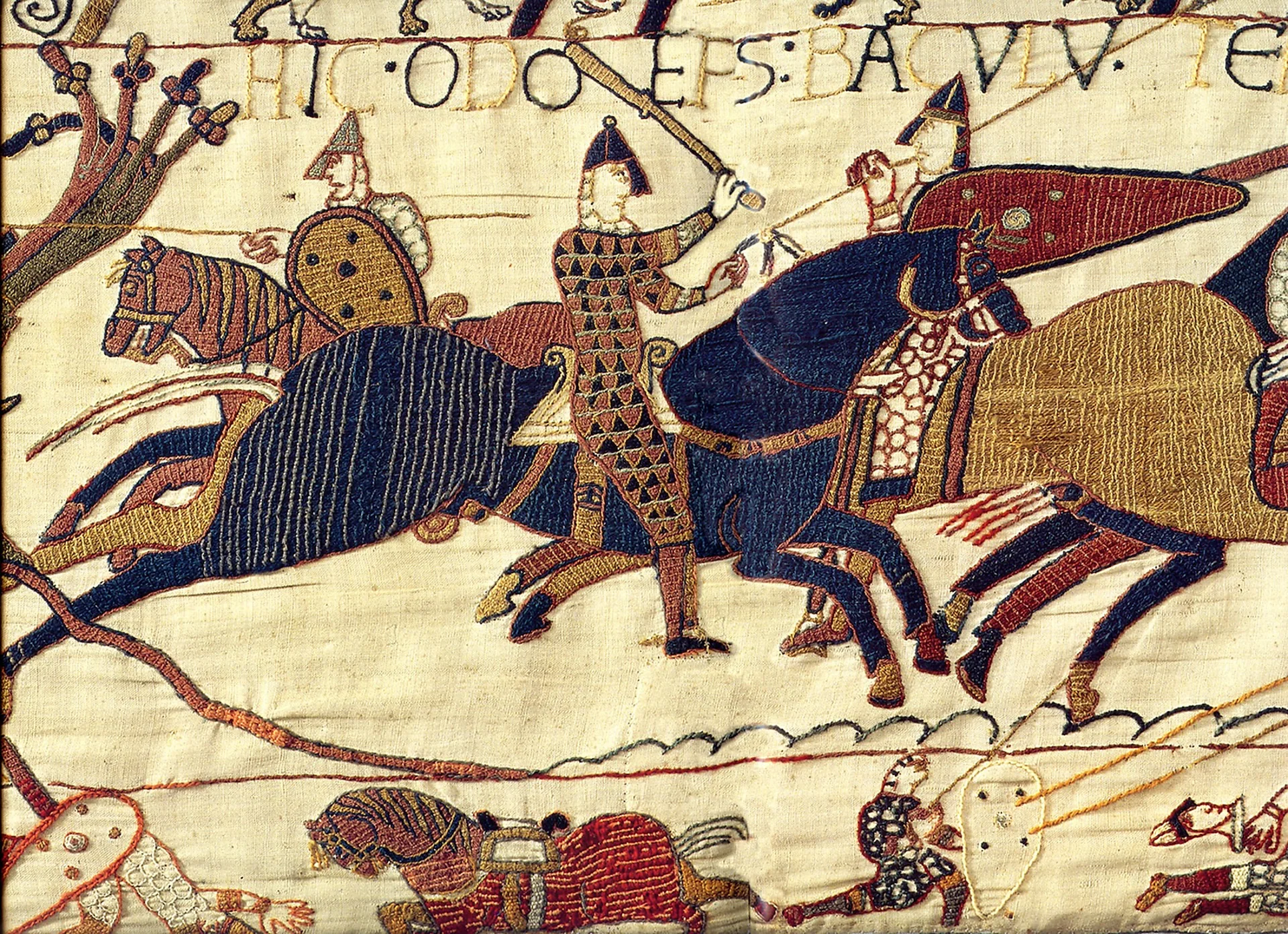
In the 11th-Century masterpiece’s tale of a contested throne, about to be exhibited in the UK, virility is equated to power – and the largest and proudest appendage. It tells a story that feels familiar today.
The Bayeux Tapestry tells a bloody − and occasionally bawdy − story of the Norman conquest of England. The intricate masterpiece is embroidered on to 70 metres (77 yards) of flax linen, and weaves a tale of broken promises, greed and aggression that culminates in the death of King Harold II at the Battle of Hastings.
After almost 1,000 years, the iconic artwork is returning from Normandy, France to England, where it was skilfully stitched in the 1070s, and from this September is to be exhibited at the British Museum.
It’s an artwork depicting a medieval version of today’s digital manosphere: an ideology and world centred on hypermasculinity and men’s experiences. And a world where size matters.
It is men’s contributions that form the focus of the 11th-Century society the tapestry portrays. A third of its men are armed, while others are vigorously engaged in tree-felling, boatbuilding and construction. A woodcutter straddling a length of timber readies his axe, while hunters wave large clubs about their heads as they pursue their quarry. All of this helps communicate the heightened atmosphere of an impending confrontation between two alpha males: William, Duke of Normandy and Harold Godwinson. “A more testosterone-soaked scene is hard to find,” Dr Christopher Monk, a cultural historian of medieval England, comments.
This suggestive display of chest-thumping machismo reveals a medieval society made for and by men, where violence settles disputes and laddish humour scores political points. Armed pillagers rampage through Hastings, and fallen soldiers in the lower margin are stripped nude for their armour, just as Harold, slain above them, is denuded of his royal claim.
The recurring penis
If there’s a recurrent motif in the iconic artwork, it’s the penis. In 2018, George Garnett, professor of medieval history at Oxford University in the UK, counted 93 – mostly tumescent – specimens in the embroidery. Eighty-eight belonged to horses, and another five to men, with a pendulous scabbard (which he rules out) causing considerable debate in academic circles.
The use of male genitalia, be it human or equine, is shorthand for political machismo – Dr Christopher Monk
“Size matters on the Bayeux Tapestry,” observes Janina Ramirez in Femina: A New History of the Middle Ages, Through the Women Written Out of It (2022). In the tapestry’s tale of a contested throne, virility is equated to power and the largest and proudest appendage, she notes, “belongs to the fine stallion William is presented with on the eve of the battle”. Second place goes to King Harold’s mount, “the implication being that he is a worthy opponent”.
Within the traditions of 11th-Century art, graphic nudity was commonplace, and it’s quite possible that these penises were stitched by nuns. “They reflect what was so evident more broadly in elite medieval society – by and large, men were the primary drivers of political sovereignty,” Monk tells the BBC. “The use of male genitalia, be it human or equine,” he says, is “shorthand for the political machismo within the context of the transition to the new Anglo-Norman world in medieval England.”
If women play a minor role in the tapestry, it’s primarily because “the narrative revolves around male action”, Dr Emily Joan Ward, a lecturer in medieval history at Edinburgh University in the UK, tells the BBC. “It’s largely depictions of militarily active men, and in those battle scenes we wouldn’t expect women.”
If a ratio of one to 100 still seems unbalanced, there may be a clue in who the artwork was intended for. Historians believe the tapestry’s likely patron is William’s half-brother, the Bishop Odo of Bayeux, who features prominently in it and may have used the tapestry to emphasise his important role in the campaign for William’s rightful rule.
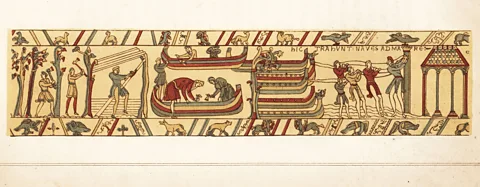
“The content is probably to resonate with him and his immediate social circle, which will largely be a homosocial circle of men,” says Ward. With a Norman sponsor, the messaging needed to be on brand. “Introducing too many women into the story is actually a bit risky,” she adds. “William’s attempts to stress his legitimacy to the throne through the female line may have made the designer or patron wary of drawing attention to this tenuous claim.”
The six women in the tapestry
The women in the central story mostly serve as what Monk calls “emotional punctuation”. Queen Edith, a highly influential figure in court politics, mops her tears with her scarf as her husband, Edward the Confessor, takes his final breaths; and a woman and her child flee as gigantic Norman soldiers casually torch their home. Bizarre expressions and proportions aside, it’s a scene that reminds us, says Ward, “that warfare is not just a male-dominated event, not just what’s happening on the battlefield.”
She references the historian Catherine Karkov, who observes that the women in the main register appear at moments of shifting power relations. “If we interpret it that way,” Ward remarks, “it gives them quite a powerful role in the tapestry.”
Others have been more dismissive. As one 20th-Century historian commented: “since it contributes nothing to the story, except a moment of confusion, we have felt justified in leaving it out”.
[The embroiderers] were no doubt working to a design but that does not mean that they were merely executors of another’s will – Dr Chirstopher Monk
Just as monks inserted illustrations in the margins of manuscripts, it’s possible that female embroiderers were permitted a little creative liberty with these cryptic comments on the central story. “They were no doubt working to a design,” Monk tells the BBC. “But that does not have to mean that they were merely executors of another’s will, or indeed that every detail was dictated.”
Perhaps in the border, the invisible women behind the artwork had the last laugh. “Was it a way of expressing despair at bellicose men, or at their own plight as subjugated English women? Is there any sense of mockery, particularly of William? Or were they indulging in playful, earthy humour to pass the time?” Monk asks.
“It’s impossible, perhaps, to answer these questions, but it should at the very least make us reflect on the fact that the Bayeux Tapestry only exists because of the skilled and intelligent labour of women.”
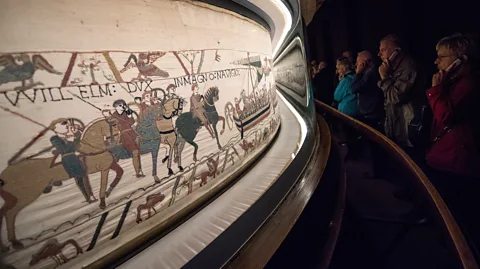
It was Victorian sensibilities that would eventually subdue some of the original tapestry’s machismo. In a faithful replica, created in 1885 by a group of 35 women belonging to the Leek Embroidery Society (currently on display at Reading Museum), the advancing armies are still full of men, but the horses’ oversized members have retreated. Unsurprisingly, the naked man with the outsized genitals who was mimicking the priest in the border is shown in the new version wearing shorts.


Quetta’s Daughter, Pakistan’s Pride

Why is Trump a Dictator?

America Must Rebuild Within


-

 Sports4 months ago
South Korea’s Yoo Useong Steps Onto the Global Strongman Stage as World Strongman Federation Professional Athlete
-

 Art & Culture1 year ago
A Survey of Mata-E-Zeest
-

 Europe News2 years ago
Chaos and unproven theories surround Tates’ release from Romania
-

 American News2 years ago
Trump expands exemptions from Canada and Mexico tariffs
-

 American News2 years ago
Trump Expels Zelensky from the White House
-

 Art & Culture2 years ago
Will Snow White be a ‘victim of its moment’? How the Disney remake became 2025’s most divisive film
-

 Entertainment2 years ago
Champions Trophy: Pakistan aim to defend coveted title as historic tournament kicks off today
-

 Pakistan News1 year ago
Comprehensive Analysis Report-The Faranian National Conference on Maritime Affairs-By Kashif Firaz Ahmed