
Pakistan News
Pakistan issues deadline for Afghan refugees after Trump blocks US resettlement pathway
Neque porro quisquam est, qui dolorem ipsum quia dolor sit amet, consectetur, adipisci velit, sed quia non numquam.


Shakoofa Khalili was waiting for her husband to return home with bread from the market when she heard their eight-year-old daughter scream from the balcony.
The girl had seen police approach her father in the street outside their safe house in Pakistan’s capital Islamabad and ran to confront them.
“(She) cried and grabbed the policeman’s hand begging him to let her father go,” Khalili told CNN, as she recounted what she thought was her worst fears coming true.
When Afghanistan fell to the Taliban in 2021, hundreds of thousands of refugees fled across the border to neighboring Pakistan, seeking safety away from the radical Islamist group.
Afghan nationals who had worked with the United States or NATO forces were particularly fearful of reprisals from the Taliban. Promised resettlement in the US, many traveled to Pakistan to await American visas. Khalili and her family were among them.
Now they fear they’ll be deported back to Afghanistan, following US President Donald Trump’s order to suspend the US Refugee Admissions Program (USRAP), effectively locking out refugees worldwide who had been on a pathway to US resettlement.
Soon after the executive order was signed, Pakistan’s Prime Minister’s Office drafted a three-stage repatriation plan for “Afghan nationals bound for 3rd country resettlement.”
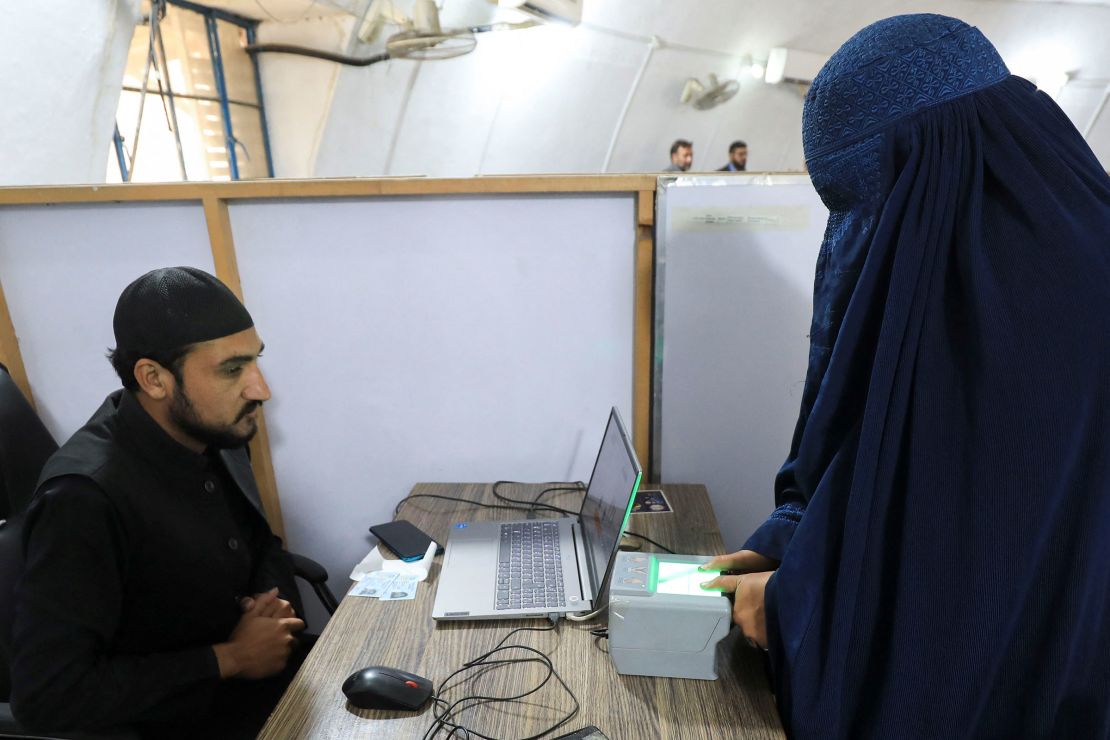
An Afghan refugee woman gives her fingerprints at the United Nations High Commissioner for Refugees repatriation center in Azakhel, Nowshera, Pakistan, on October 30, 2023. Fayaz Aziz/Reuters/File
The document, seen by CNN, calls for foreign missions to coordinate the relocation of Afghan nationals out of the capital Islamabad and its twin garrison city of Rawalpindi by March 31, 2025.
If they’re not removed by that date, they will be “repatriated to Afghanistan.”
For some Afghans, deportation is ‘a death sentence’
While living in Afghanistan, Khalili worked on a child abuse protection program funded by the US Embassy. She hoped to gain a US visa but ended up trapped in Pakistan, with few options to leave.
“For us, who worked alongside the United States, returning to Afghanistan is not just a risk – it is a death sentence,” Khalili told CNN.
This time, her daughter’s pleas to police worked, but although the father and child made it back to the safehouse they call home, Khalili’s daughter was deeply affected by what took place.
“For two days, because of this terrible incident … my daughter fell into a deep silence. She didn’t eat for two days. She talks and screams in her sleep at night,” said Khalili.
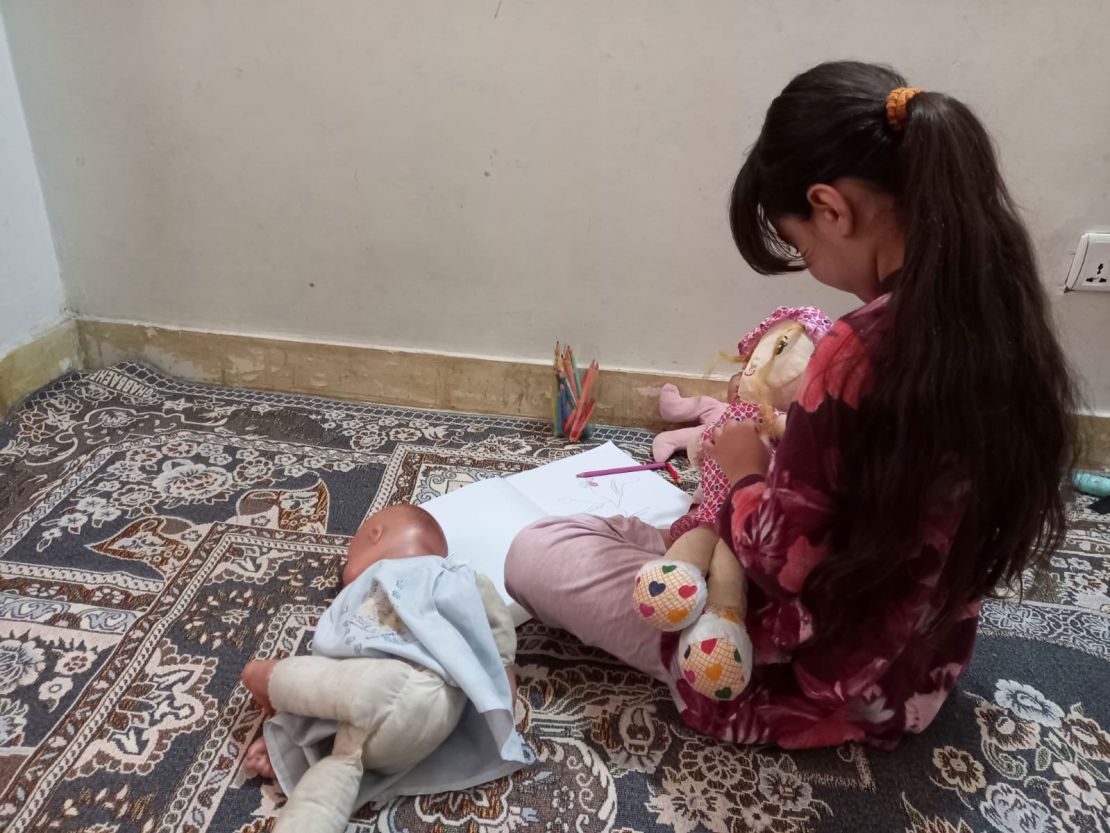
Khalili’s daughter didn’t speak for two days after seeing Pakistan police try to arrest her father. Shakoofa Khalili
Many Afghans who worked for the US but were unable to escape Afghanistan now live in hiding, in fear for their lives. Those in Pakistan are terrified of being killed should they be forced to return.
The UN Refugee Agency (UNHCR) and the International Organization for Migration (IOM) said in a statement Wednesday those forced to return face retribution from the Taliban – especially ethnic and religious minorities, women and girls, journalists, human rights activists, and members of artistic professions.
Shawn VanDiver, the founder of #AfghanEvac, a leading coalition of resettlement and veteran groups, says 10,000 to 15,000 Afghans are in Pakistan waiting for visas or resettlement in the US.
In a post on X, VanDiver said the pause in the USRAP disproportionately affects Afghan women in Pakistan, leaving them without work, without legal protections and without hope.
“Since the fall of Kabul, Afghan women have been systematically erased from public life —banned from education, work, and even basic freedoms. For many, USRAP was the only viable path to safety. With the pause, that door has slammed shut,” he said.
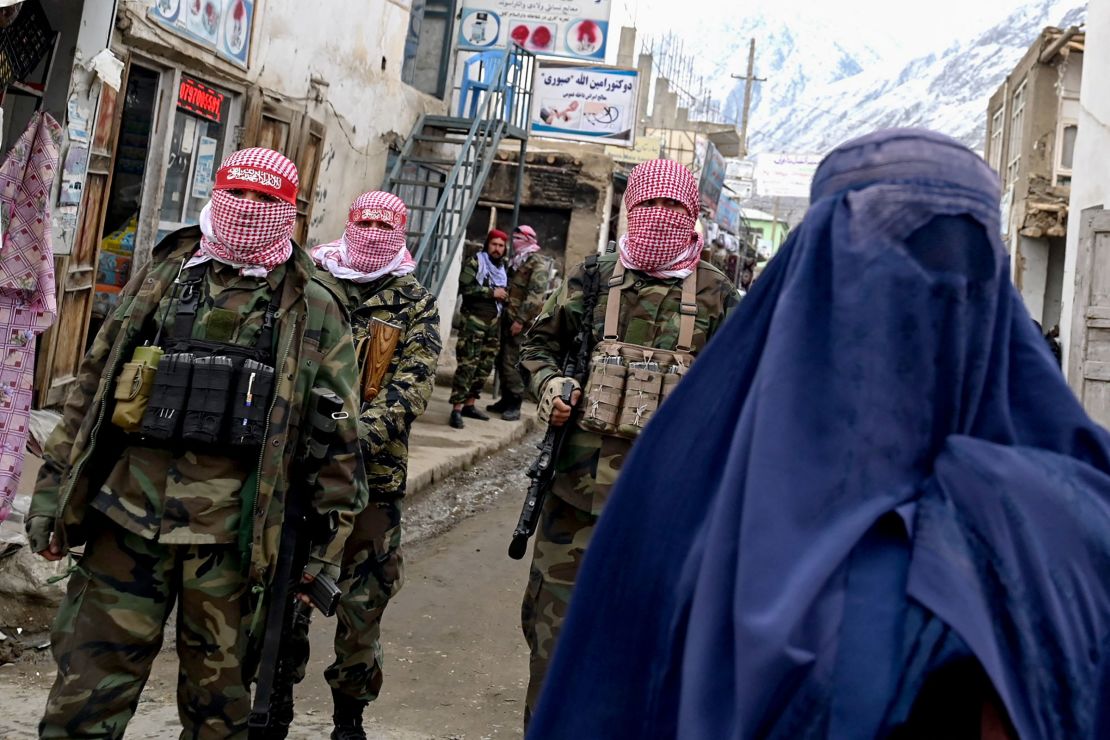
Taliban security personnel stand guard as an Afghan woman walks along a street at a market in the Baharak district of Badakhshan province, Afghanistan, on February 26, 2024. Wakil Kohsar/AFP/Getty Images/File
According to the document seen by CNN, Pakistan’s intelligence agencies are expected to coordinate with the Prime Minister’s Office to monitor and implement the relocation plan.
Pakistan’s Interior Ministry released a statement to CNN confirming that “all illegal foreigners including Afghans are to be deported back to their countries of origin under the Illegal Foreigners Repatriation Plan (IFRP).”
It urged countries sponsoring Afghan nationals for resettlement to complete the process quickly, or “the sponsored Afghans will be deported.”
The document also threatens to deport Afghans holding an Afghan Citizen Card, another form of registration for Afghan refugees in Pakistan issued almost a decade ago.
The US embassy and Pakistan’s Ministry of Foreign Affairs did not immediately respond to CNN’s question about the coordination between authorities to date.
Pakistan wants Afghan refugees to leave
Pakistan is home to one of the world’s largest refugee populations – most of them from Afghanistan. But the country has not always welcomed Afghan refugees, subjecting them to hostile living conditions and threatening deportation over the years.
According to the UNHCR, more than 3 million Afghan refugees, including registered refugees and more than 800,000 undocumented people, are living in Pakistan.
Many fled the Soviet invasion of Afghanistan in the 1980s. A new generation went to Pakistan in the aftermath of September 11 attacks, ebbing and flowing during the near two decades of conflict that followed.
The Taliban’s return to power in 2021 following the United States’ chaotic withdrawal sparked another wave of some 600,000 refugees.
Pakistan began a fresh crackdown on Afghan refugees in 2023 to pressure the Taliban to do more to curb militant attacks launched from Afghanistan.
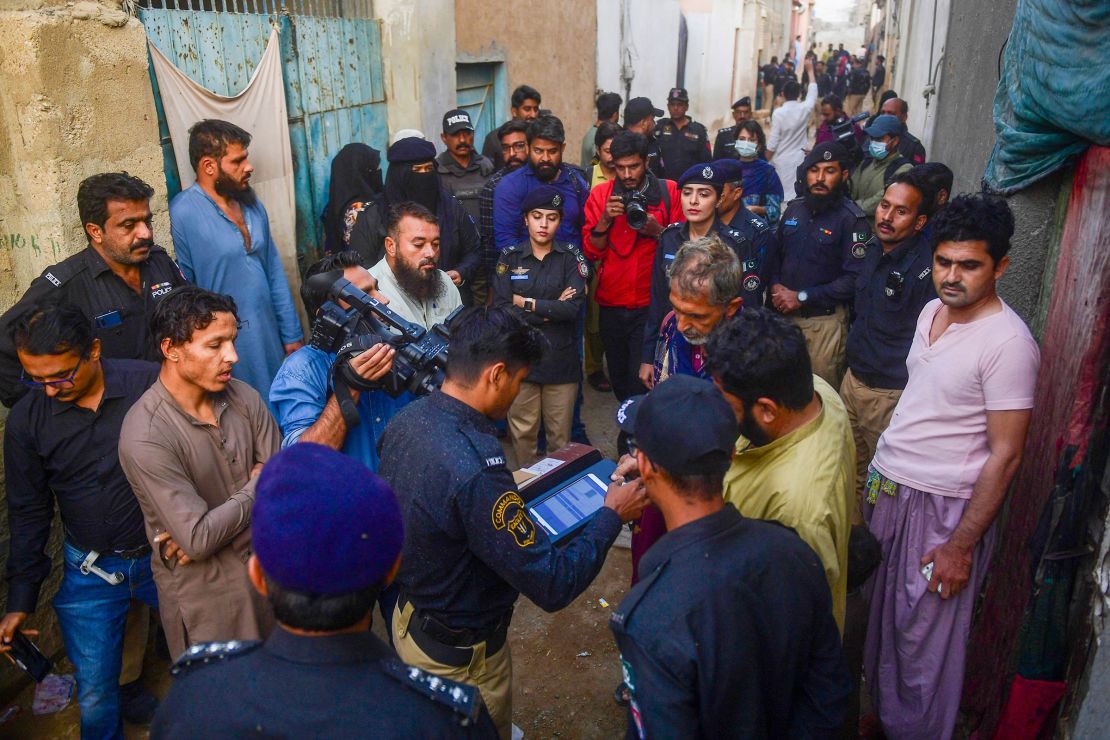
Police test the biometrics of Afghan refugees during a search operation on the outskirts of Karachi, Pakistan, on November 17, 2023. Asif Hassan/AFP/Getty Images/File
According to the UNHCR, 800,000 Afghan nationals have since left Pakistan.
The crackdown on those who are neither registered with the UNHCR nor awaiting resettlement to a third country is continuing in phases, with thousands of Afghans sheltering in safehouses and slums hoping to resist repatriation to their home country.
Khalili continues to hide with her husband and child in Islamabad, and her despair continues to mount. She told CNN of the risks she and others have taken “to support the United States’ mission as interpreters, contractors, human rights defenders and allies.”
According to Khalili, “the Taliban views us as enemies, and we face the grim reality of arrest, torture, or death if we are forced back.”
“This suspension (of the visa program) denies us the shelter and protection we were promised, leaving us vulnerable to unimaginable consequences and at the mercy of the Taliban.”
Taken From CNN
https://edition.cnn.com/2025/02/06/asia/pakistan-trump-afghan-repatriation-intl-hnk/index.html









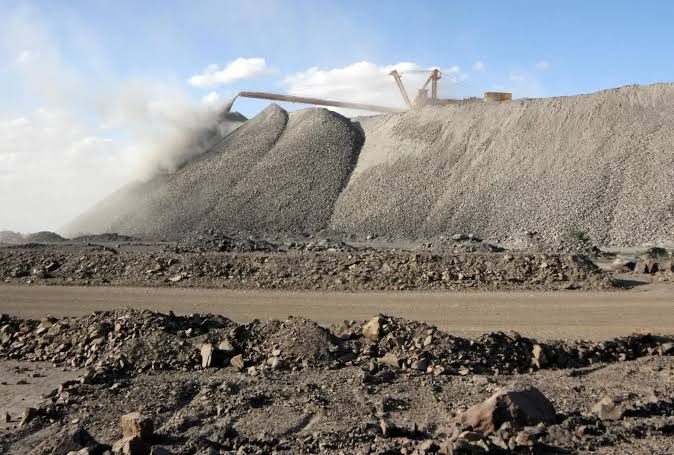
Paris (Imran Y. CHOUDHRY) :- Former Press Secretary to the President, Former Press Minister to the Embassy of Pakistan to France, Former MD, SRBC Mr. Qamar Bashir analysis : A mine has a finite life; the capabilities built around it can serve generations. Part One examined Pakistan’s mineral opportunity and the international partnerships that could help develop it. The next task is to connect extraction with a national industrial programme: Pakistani engineers operating sophisticated facilities, Pakistani enterprises supplying them, and Pakistani factories exporting increasingly valuable components and finished products.
This connection should become a central condition of mineral cooperation with China, Canada, the United States, Australia, European countries or any international consortium. Each major agreement should contribute to an industrial development plan, with responsibilities assigned to mining companies, manufacturers, infrastructure providers and public institutions. Measurable commitments can align commercial returns with Pakistan’s ambition to build a diversified economy.
The programme begins with infrastructure. Mines and processing plants require dependable electricity, water management, roads, rail connections and efficient ports. Industrial development also needs broadband, laboratories, workshops, warehouses and customs facilities. Planning these investments together would allow surrounding communities and businesses to share the benefits. A railway should connect productive regions; a power network should support factories and homes alongside mineral operations.
Industrial zones linked to mineral corridors could bring processors, component manufacturers and service businesses into connected locations. Their success would depend on reliable utilities, clear land rights, predictable regulation and access to customers. Common testing facilities, wastewater treatment and logistics services could reduce costs for smaller enterprises. Development should be measured through operating businesses, exports and employment.
Processing provides the first industrial bridge. Copper can support conductors, cables, transformers and electrical equipment. Suitable rare-earth feedstock can support separation, purified oxides, metals, alloys and magnet production. Commercial studies should identify which stages Pakistan can establish competitively and what partners, technology and scale they require. Investment agreements can then specify facilities, commissioning milestones and Pakistani participation.
Magnet manufacturing can connect these activities with motors, pumps, industrial automation, wind-energy equipment and automobile components. Engineering capability in these fields can gradually support more advanced production. Firms supplying one component reliably can qualify for larger contracts and more demanding markets. This progression gives mineral development a route into manufacturing through products that businesses can sell.
The wider ambition should include laptops, smartwatches, smartphones and other electronic devices. Partnerships with established manufacturers could develop components, precision parts, assembly and product testing, progressing toward design and engineering. Production for international brands, including devices such as iPhones, would require authorised commercial arrangements and qualification within their supply networks. Pakistan should negotiate pathways through which firms and workers can meet those standards.
Minerals supply one part of these products. Competitive electronics production also requires semiconductors, batteries, displays, software, precision equipment and dependable suppliers. Pakistan’s industrial programme should connect these requirements through joint ventures, licensing and research partnerships. A strategy would identify selected products, secure customers and build the complementary capabilities needed to manufacture them.
Automobiles offer another route through motors, wiring, sensors, power electronics and specialised components. Shipbuilding and frigate programmes could draw upon stronger capabilities in electrical systems, propulsion components and precision fabrication. Aerospace, satellite and space-launch ambitions would benefit from advances in materials, electronics, control systems and engineering. Participation should progress through civilian and other permitted partnerships, with the necessary certifications and technology approvals.
Pakistani people must occupy the centre of this transformation. Universities should expand relevant programmes in geology, mining, metallurgy, chemical engineering, materials science, electronics and industrial automation. Colleges and vocational institutions should prepare electricians, mechanics, welders, machinists and laboratory technicians. New institutions should be established where regional demand requires them, while existing institutions receive equipment, qualified teachers and industry partnerships.
Scholarships should give students from producing districts a direct route into these professions. Paid apprenticeships and supervised practical training should connect education with employment. Joint ventures should establish time-bound plans for Pakistani engineers and managers to assume greater operational responsibility. Success would be demonstrated by competence in running, maintaining, troubleshooting and improving complex facilities.
Research partnerships should leave permanent capacity within Pakistan. Shared laboratories, pilot plants, geological databases and negotiated access to technical knowledge can help institutions solve industrial problems. Agreements should define intellectual-property rights, licensing and opportunities for Pakistani innovation. Research funding should support processing efficiency, recycling, water conservation and new materials, allowing knowledge generated by collaboration to create further enterprises.
Business and financial infrastructure must develop alongside technical capacity. Local suppliers need working capital, equipment finance, insurance and timely payment. Exporters need trade finance, certification and efficient customs. Transparent procurement can help Pakistani companies enter supply networks, while long-term customer agreements improve investment confidence. Public financial support should carry clear limits, disclosed obligations and performance conditions.
Mineral revenues can finance this wider productive base. A transparent framework should provide predictable allocations for producing communities, investment in education and infrastructure, and savings against commodity downturns. Expenditure should follow verified receipts and public audits. Supporting manufacturing and local enterprise would broaden the sources of income available when particular mines approach the end of their lives.
Environmental management protects that future. Water use, tailings, emissions and eventual rehabilitation need funded obligations and independent monitoring. Communities should participate in decisions affecting their land and livelihoods, with lawful compensation and accessible remedies. Recycling metals and magnets can create additional businesses while retaining valuable material within the economy.
The foundation is accountable government. Credible elections, independent courts, empowered provinces and effective local authorities can give citizens a voice in the use of their wealth. Parliament should scrutinise major agreements, while independent regulators oversee environmental and commercial obligations. The armed forces should fulfil their constitutional security responsibilities, with economic policy directed by elected civilian institutions.
Pakistan’s economic promise will be fulfilled through the factories, skills, research and enterprises its mineral partnerships help create. Negotiating this connection is a national responsibility. With capable governance and sustained cooperation, Pakistan can export finished products, develop its own technology and build prosperity that outlives the deposits from which the transformation began.
Paris (Imran Y. CHOUDHRY) :- Former Press Secretary to the President, Former Press Minister to the Embassy of Pakistan to France, Former MD, SRBC Mr. Qamar Bashir analysis : Rare earths offer Pakistan an opportunity to change its economic destiny. Their greatest promise lies in connecting the country’s geological wealth with the industries shaping modern life: electric vehicles, electronics, clean energy, advanced machinery and aerospace. Growing international interest can bring the capital, technology and markets needed for this transformation. Pakistan’s task is to build partnerships that turn mineral deposits into lasting productive capacity, skilled employment and public prosperity.
America’s chargé d’affaires in Pakistan, Natalie A. Baker, has described cooperation extending from geological assessment and extraction to workforce training, schools and transport infrastructure. Her reference to mineral potential reaching seven trillion dollars sits within published estimates of $6 trillion to $8 trillion. The opportunity she outlined provides a basis for agreements that connect mining investment with local development and a wider industrial economy.
Energy Update, citing the Institute of Cost and Management Accountants of Pakistan, reports mineral-bearing areas extending across approximately 600,000 square kilometres, with 92 known minerals, including 52 commercially exploited. SFA (Oxford) estimates recoverable rare-earth oxide potential at 100,000 to 500,000 tonnes. These estimates offer a starting point for systematic exploration, deposit assessment and investment planning.
My own association with this opportunity reaches back four decades. In 1986, while working as a news producer, I accompanied a visiting Chinese state minister during a tour connected with mineral deposits in Balochistan. The delegation’s interest reflected an early appreciation of the region’s potential. Subsequent Chinese involvement at Saindak established an important chapter in Pakistan’s mineral development, providing experience upon which broader partnerships can build.
Reko Diq demonstrates the scale of Pakistan’s documented copper-gold opportunity. Barrick’s year-end 2025 disclosures identify 7.3 million tonnes of contained copper and 13 million ounces of gold attributable to its 50 percent interest. Project-wide quantities implied by these rounded figures are approximately 14.6 million tonnes of copper and 26 million ounces of gold. Federal Pakistani enterprises and Balochistan each hold 25 percent of the venture.
Using illustrative prices of $10,000 per tonne of copper and $3,000 per ounce of gold, those quantities represent approximately $224 billion in gross contained-metal value. Commercial returns will emerge over decades through production, sales and expenditure. Pakistan’s benefits will include agreed royalties, taxes, dividends, employment and domestic procurement. The volume of activity retained within the country will determine how widely these benefits spread.
Rare earths create a related avenue for industrial development. Geological research identifies promising formations at Sillai Patti, Koga, Loe Shilman, Warsak and Jambil in Khyber Pakhtunkhwa. Studies document light rare-earth enrichment involving cerium, lanthanum, neodymium, praseodymium and samarium. SFA also identifies prospects around Skardu and Chilas, Chagai and the Makran coast, together with potential secondary recovery from Thar coal fly ash.
Research on Sillai Patti cites earlier sampled-material averages of approximately 314 parts per million of neodymium, 915 of cerium and 519 of lanthanum. A hyperspectral investigation identified portions of samples reaching approximately 1,000 parts per million of neodymium. Representative drilling, mineralogical analysis and processing trials can translate this scientific knowledge into project-specific quantities, recovery rates and commercial values.
Neodymium and praseodymium are important inputs for powerful neodymium-iron-boron magnets. Samarium supports samarium-cobalt magnets used where temperature stability matters. Certain high-performance magnets also incorporate dysprosium or terbium. Developing these products involves concentration, separation, purification, metal production, alloying and precision manufacturing. Each stage offers a possible link between Pakistan’s resource base and a more technically capable economy.
American engagement already has a practical foundation. In September 2025, Pakistan announced a US Strategic Metals partnership with the Frontier Works Organization, envisaging approximately $500 million in initial investment and eventual development of a polymetallic refinery. USSM subsequently reported receiving antimony, copper concentrate and rare-earth material containing neodymium and praseodymium. The U.S. Export-Import Bank also lists $1.25 billion in authorised financing for Reko Diq.
Potential technical partners extend across the industrial chain. MP Materials operates in rare-earth processing and magnet manufacturing, Energy Fuels has demonstrated separated neodymium-praseodymium oxide production, and Arnold Magnetic Technologies manufactures advanced magnets. Their capabilities suggest possible commercial matches as Pakistani projects become investment-ready. Chinese, Canadian, Australian and European expertise can likewise contribute through competitive, transparent arrangements.
The economic scale is substantial. Barrick’s 2025 feasibility plan envisaged Phase 1 ramping up to 240,000 tonnes of copper and 297,000 ounces of gold annually. At the illustrative prices above, this represents about $3.29 billion in annual gross metal value. Its planned expanded operation’s specified ten-year average would represent approximately $6.16 billion annually on the same basis. Net national gains will depend on costs, financing and domestic value addition.
Barrick’s April 2026 update provided for slower development and a review through mid-2027. This makes phased planning valuable: exploration, infrastructure, skills and industrial investment should advance through clearly financed stages. SFA’s proposed rare-earth roadmap similarly progresses from initial exports toward processing and larger-scale mining. Timelines should guide coordination, with implementation measured through completed facilities and commercially qualified output.
Pakistan’s strengths are its mineral base and growing international attention. Its development needs include geological data, processing capacity, dependable utilities and specialised skills. Opportunities encompass exports, technology transfer and manufacturing; threats include security disruption, price fluctuations and environmental pressures. This SWOT assessment points toward coordinated investment, strong institutions and community participation.
The next step is to place industrial development at the centre of mineral policy. Agreements should connect extraction with infrastructure, Pakistani expertise and downstream production. That is the bridge from geological promise to economic transformation—and the question taken forward in Part Two: how Pakistan can use today’s mineral opportunity to build industries that continue creating wealth long after individual deposits are exhausted.

The Khyber Pakhtunkhwa (KP) government’s non-cooperation with the federal government’s policies and its opposition to military operations against terrorists led to the imposition of Governor’s Rule on 12 October 2026. Political hoopla has been a defining feature of Pakistan’s political history. The PTI’s dissenting and, moreover, defiant politics led its leadership and activists towards violence. However, the subsequent situation, in which security agencies reportedly identified deep links between KP-PTI leaders and the Taliban and Tehreek-e-Taliban Pakistan (TTP), convinced the federal government to impose Governor’s Rule. There are allegations that the KP government had a covert understanding with Afghanistan regarding cooperation. Although no one has presented evidence of such an understanding, the PTI’s non-cooperation with Pakistan Army operations, its silence on the deaths of law enforcement personnel, and its apathetic attitude towards equipping the KP police with the required modern weapons and other equipment reflect the provincial government’s detachment from federal policies. These factors have also reinforced the claims made by state institutions. Pakistan is a democratic country, but undemocratic policies and attitudes have devastated the dream of establishing a welfare state. The federal government has spent huge amounts of public money on maintaining a luxurious lifestyle for those in power, while the public has continued to endure severe hardships. Field Marshal Syed Asim Munir has expressed his desire to make Pakistan a hard state in which the rule of law empowers the state. However, this aspiration has yet to be realized because politicians remain reluctant to enforce the rule of law. The rule of law begins with genuine democracy, which is possible only through an empowered local government system. Yet, such a system is largely absent across Pakistan. It does not suit politicians and the civil bureaucracy because it transfers resources and decision-making powers to local governments for development work. Neither politicians nor the civil bureaucracy appears willing to share these resources and powers. Federal and provincial governments may formulate democratic policies, but their undemocratic attitudes towards implementation prevent those policies from producing the desired results. Governments are dominated by elite families that enjoy protection from accountability for illegal and corrupt activities. Such practices include shielding individuals from criminal proceedings, protecting the occupation of government land and plots, and benefiting from corruption, commissions from contractors, NGOs, fraudulent TA/DA claims, and bogus medical bills. This pathetic situation neither restores peace in society nor produces honest and competent leadership. Such a pathetic situation neither restores peace in society nor produces honest and competent leadership. After imposing Governor’s rule in KPK, what is to be done with the PTI followers and leaders? I opine that discarding the traditional policy of dividing the political party into factions is more harmful than declaring one party as a traitor and anti-Pakistan. It would have been better to create a parallel PTI faction instead of the Istehkam-i-Pakistan Party, etc. because the PTI workers must have been provided political shelter somewhere, but right now the establishment has left them in the doldrums, which can be more dangerous. This is what we warned about: it would be very easy for terrorist or violent groups to form governments in the proposed new provinces with small areas. Nobody can prevent violent groups such as TLP, TTP, BLA, etc. from clinching governments in the new provinces with small areas. Now, the federal government owes the entire responsibility to root out terrorism from KPK and to ensure the prosperity of the people. People expect positive results from this political strategy. To sum, if we genuinely want to transform Pakistan into a welfare state in which the rule of law is firmly enforced and crime and punishment are proportionate and consistently applied, ‘we’ must redefine the role of institutions. Who are ‘We’ is yet to be disclosed, although the Constitution ought to be the ‘we.’ Everyone, from politicians to those who exercise a strong grip on the system, must demonstrate the will to put Pakistan on the path to becoming a democratic country. The existing political system cannot transform Pakistan into a welfare state as long as elite capture (Gutterafia) continues to prevail and the powerful remain above the law.


‘Great result for Canada’, says Carney as Alberta votes to reject separatism

Rare Earths: Pakistan’s Economic Part 2
Rare Earths: Pakistan’s Economic Part 1

New Chapter for Dragon Boating in Punjab and Khyber Pakhtunkhwa Provincial associations officially set up with sights locked on national competitions and international representation.

South Korea’s Yoo Useong Steps Onto the Global Strongman Stage as World Strongman Federation Professional Athlete

A Survey of Mata-E-Zeest


-
 Pakistan News1 week ago
New Chapter for Dragon Boating in Punjab and Khyber Pakhtunkhwa Provincial associations officially set up with sights locked on national competitions and international representation.
-
 Sports4 months ago
South Korea’s Yoo Useong Steps Onto the Global Strongman Stage as World Strongman Federation Professional Athlete
-
 Art & Culture1 year ago
A Survey of Mata-E-Zeest
-

 Europe News2 years ago
Chaos and unproven theories surround Tates’ release from Romania
-

 American News2 years ago
Trump expands exemptions from Canada and Mexico tariffs
-

 Art & Culture2 years ago
Will Snow White be a ‘victim of its moment’? How the Disney remake became 2025’s most divisive film
-

 American News2 years ago
Trump Expels Zelensky from the White House
-

 Entertainment2 years ago
Champions Trophy: Pakistan aim to defend coveted title as historic tournament kicks off today