
World News
Would you work for no pay? The question behind the Air Canada strike

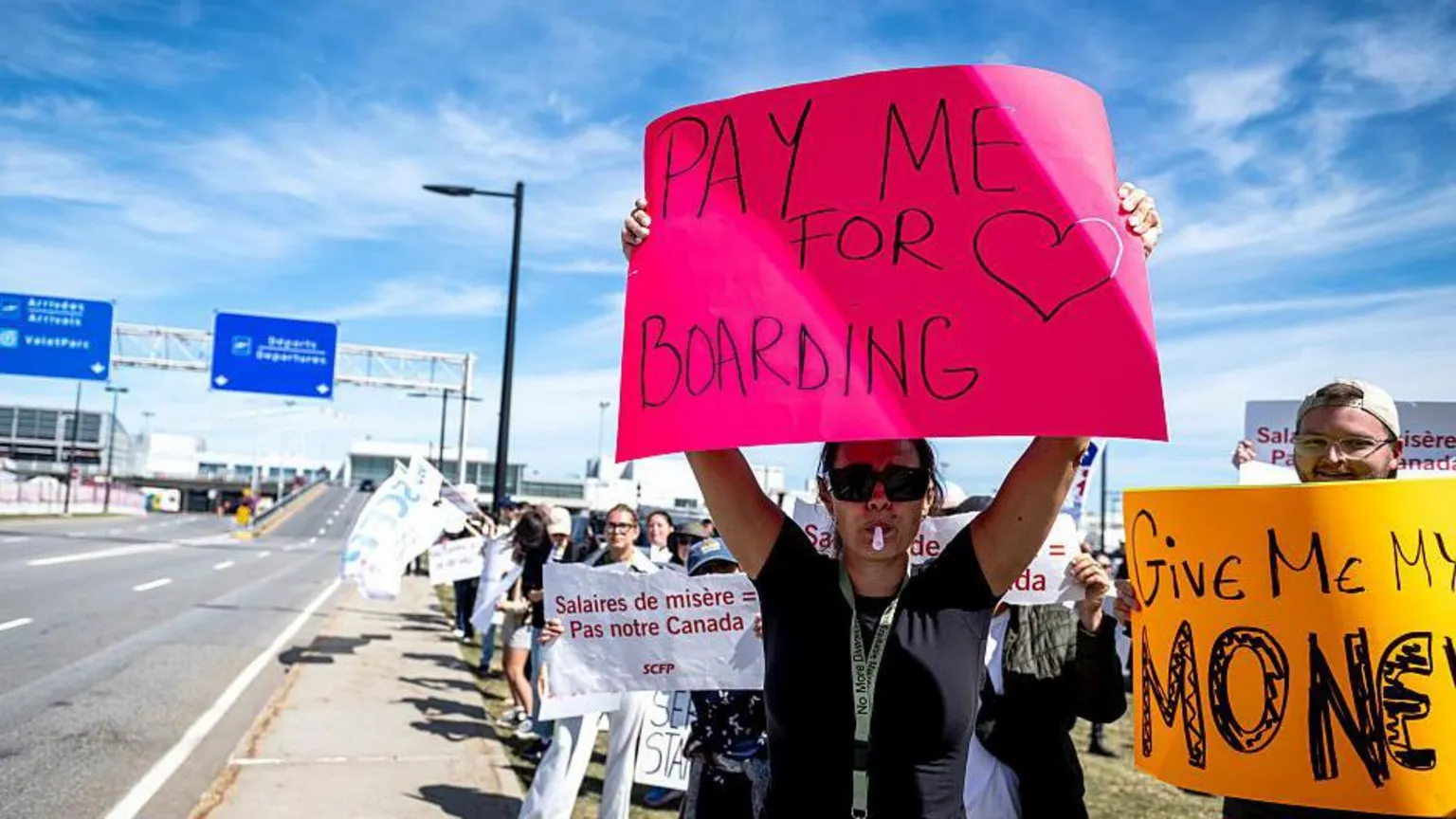
When Air Canada flight attendants walked off the job earlier a week ago, they had one rallying cry: “Unpaid work won’t fly.”
It was a reference to the long-standing practice in North America’s aviation industry of not paying cabin crew for work they do when they are on the ground, before the plane is in motion.
In contrast, some European airlines, industry experts told the BBC, pay cabin crew monthly wages rather than by the hour.
The pay structure surprised Canadian flyers, many of whom supported the striking workers, one poll commissioned by the union suggested.
The brief strike wreaked havoc during the peak summer travel season, but flights resumed after both sides agreed to a tentative deal on Tuesday.
The proposed agreement reached by the Canadian Union for Public Employees (Cupe) and Air Canada has not been fully released, but those familiar with its contents report that it includes a pay bump over several years and, most notably, partial pay for boarding duties and cabin secure checks before take off – a first.
Experts say the wins secured by Air Canada’s cabin crew could help solidify a new standard for aviation workers on the continent.
The union called it “historic” earlier this week, declaring unpaid work “over”.
But media has reported that many flight attendants, who must still vote to approve the deal, remain dissatisfied. It is unclear if the deal has enough support to pass, Reuters reported.

1:10Watch: ‘We do support what the flight attendants are trying to achieve’ – Air Canada passengers react to strike
Air Canada flight attendants were not alone in not being paid for what the industry calls “ground work”.
Cabin crew for other Canadian airlines Air Transat and WestJet do not have ground pay as part of their compensation structure. Neither do flight attendants at US-based United Airlines, though contract negotiations are currently ongoing.
John Gradek, a business professor and aviation management expert at McGill University in Montreal, said that introducing ground pay for Air Canada workers could trigger a “tsunami” that would soon sweep all major airlines in North America.
For decades, the practice was justified on the basis that it is easier to track hours of when a plane leaves the gate and lands, he said. It is more difficult to include boarding time, which can vary depending on delays and the number of passengers.
To mitigate this, airlines bumped up the hourly pay of cabin crew, though many argue the total wages are still low, especially for those living in major, often expensive, North American cities.
Air Canada has said that half of its “mainline flight attendants” earned more than C$54,000 ($39,000; £29,000) last year, with some of the more senior staff earning more than C$70,000.
The figures were slightly different for Air Canada Rouge, the carrier’s discount wing.
One long-time Air Canada flight attendant, Leslie Woolaver, told local news outlet the Halifax Examiner that she estimated she did about 40 hours of unpaid work a month.
That figure is similar to what was reported by nearly 10,000 flight attendants in a survey done by Cupe in late December 2022. At the time, Wesley Lesosky, president of the union’s airline division, called unpaid work “a dirty secret in this industry”.
Junior flight attendants are most affected, Ms Woolaver told the Halifax Examiner, as they tend to work shorter flights.

Changes in the air, and on the ground
Attitudes towards ground pay began to shift after the Covid-19 pandemic, which brought in new rules around masking on planes and greatly altered how cabin crew prepare a plane for take off.
Steven Tufts, a professor and labour expert at York University in Toronto, said this “increased complexity of boarding passengers put a lot of pressure on flight attendants” and forced them to work even more unpaid hours.
“Eventually they said: ‘No. This has to change,'” he said.
Delta Airlines led the charge in 2022 when it became the first in North America to offer cabin crew pay for work they did on the ground. American Airlines and Alaska Airlines quickly followed.
After the tentative agreement with Air Canada was reached, the airline’s chief operations officer Mark Nasr told the CBC that the carrier cabin crew will now receive “industry leading compensation”.
“Ground pay is settled. Our flight attendants will be paid for time on the ground.”
But the future of the deal remains unclear.
On Friday, Reuters spoke with several airline workers who remained unhappy with the proposed deal, specifically citing ground pay and how it impacts wages for entry-level workers.
Mr Lesosky told the outlet that further strikes would be illegal, and that wage disputes would likely be resolved at arbitration while the other parts of the agreement moved forward.
Regardless of the outcome, some form of ground pay is likely to stay.
With Air Canada – the largest airline in Canada – now hopping on board, industry watchers say a new precedent is being set for the global airline industry.
Both Air Transat and WestJet have contract negotiations coming up. Prof Gradek said he believes ground pay will be an easy win for them, as they will want to keep their wages competitive.
More broadly, the gains secured as a result of the Air Canada strike have also been hailed as a turning point for labour rights in Canada because of the union’s refusal to comply with a back-to-work order.
The federal government invoked Section 107 of the Canada Labour Code, which has been used in recent years to end job actions and force binding arbitration.
This time, public sympathy was largely on the side of the striking workers due to the focus on unpaid labour, Prof Gradek said.
“This was a master class of negotiation by the union,” he said.








Paris (Imran Y. CHOUDHRY) :- Former Press Secretary to the President, Former Press Minister to the Embassy of Pakistan to France, Former MD, SRBC Mr. Qamar Bashir analysis : For countless people living in developing countries, the United States and Europe have represented a dream. This attraction is not based only on wealth, employment or a higher standard of living. More importantly, these societies have been regarded as places where the state does not discriminate among citizens on the basis of religion, color, race or creed. For people persecuted because of their faith, ethnicity, culture or way of life, migration to the West has promised safety from hatred, violence and official discrimination.
The foundation of this dream is secular government. Secularism does not mean hostility to religion or the exclusion of religious people from public life. It means that the state itself does not belong to one religion. A secular government protects Christians, Muslims, Jews, Hindus, Sikhs, atheists and others under the same law. It asks citizens to obey the Constitution, not to adopt the religion or culture of the majority.
Today, however, a contrary narrative is gaining political power. Leaders and movements in the United States increasingly describe America as a Christian nation. President Donald Trump has promised to defend the “Judeo-Christian principles of our founding” and has declared that America is “one nation under God.” In Europe, Hungarian Prime Minister Viktor Orbán has stated even more directly: “Europe is a Christian continent, and this is how we want to keep it.” He has connected the preservation of this identity with opposition to immigration and the fear that Muslims will transform Europe’s ethnic and cultural composition.
Israel, meanwhile, expressly defines itself as a Jewish state. Its 2018 Nation-State Basic Law declares that Israel is “the nation state of the Jewish People” and that national self-determination in the state is “exclusive to the Jewish People.” It also describes Jewish settlement as a national value. The danger lies not in Judaism—or in Christianity or Islam—but in giving one religious or ethno-religious identity a constitutionally superior relationship with the state.
These declarations must be tested against the constitutional principles that made the West attractive. The U.S. Constitution neither establishes Christianity nor grants it privileged status: the First Amendment prohibits laws “respecting an establishment of religion,” while Article VI bars religious tests for public office. Although the Declaration of Independence refers to a Creator, the Constitution is the governing legal document and protects equal citizenship regardless of belief. Yet the tension persists: a 2024 Pew survey found that 13 percent of Americans supported declaring Christianity the official religion, while 44 percent favored promoting Christian values without formal establishment—a distinction that becomes dangerous when moral advocacy turns into state preference and the exclusion of other faiths.
European Convention on Human Rights. Article 9 guarantees everyone “freedom of thought, conscience and religion,” including the freedom to change religion and to manifest belief privately or publicly. The European Court of Human Rights has held that the state must remain a “neutral and impartial” organizer of religious life because pluralism is essential to democracy.
The Magna Carta is often invoked as a symbol of Western liberty and government under law, although it is not a modern constitution or a comprehensive guarantee of religious equality. Its lasting importance is the principle that political authority is subject to law. The modern constitutional descendants of that principle are equal citizenship, due process, religious liberty and protection against arbitrary power. Religious nationalism undermines this inheritance when it divides lawful citizens into authentic members and tolerated outsiders.
The consequences are visible in contemporary politics. During Zohran Mamdani’s campaign for mayor of New York, opponents and online commentators connected his Muslim identity with terrorism, jihad and Sharia. Some called for his denaturalization or deportation, despite the absence of evidence that he intended to impose Islamic law. Mamdani nevertheless won the November 2025 election and became New York City’s first Muslim mayor. His victory affirmed constitutional inclusion, but the reaction exposed how readily a Muslim candidate’s faith could be presented as a security threat.
Michigan politician Abdul El-Sayed has faced similar attempts to associate his Muslim identity with extremism. Dearborn, a city with a large Arab-American and Muslim population, has become a national target for agitators warning about the supposed “Islamification” of America. Yet electing Muslim mayors, council members or police officials is not evidence of religious conquest. It is democracy: citizens exercising the same political rights that the Constitution guarantees to Christians.
Nor is Sharia the governing law of Michigan, New York or any European country. Muslims may voluntarily follow religious principles in their private lives, just as Christians and Jews may consult their own traditions. Civil law nevertheless remains supreme. Raising the specter of Sharia without evidence transforms a religious minority into a permanently suspect population.
The problem is measurable. The U.S. Department of Justice recorded 236 anti-Muslim hate incidents and 156 anti-Sikh incidents in 2023. In the European Union, a survey of almost 10,000 Muslims across 13 countries found that 47 percent had experienced racial discrimination within the preceding five years, particularly in employment and housing.
The same constitutional test must be applied to Israel. Israel emerged from Zionism, British rule in Palestine, European antisemitism culminating in the Holocaust, and the United Nations’ 1947 proposal for separate Arab and Jewish states. It would be historically inaccurate to reduce its creation to a single Western plan for removing Jews from Europe. Nevertheless, defining national self-determination as exclusive to one people raises a profound question about equality for Palestinians and other non-Jewish citizens and residents.
That concern is intensified by occupation and settlement. In a 2024 advisory opinion, the International Court of Justice concluded that Israel’s continued presence in the occupied Palestinian territory is unlawful and that settlement activity must cease. United Nations satellite analysis later estimated that approximately 81 percent of structures in Gaza had been damaged by October 2025.
The conclusion is not that religion must disappear. Religion can inspire compassion, justice and service. The danger begins when it becomes a certificate of citizenship or a weapon for deciding who truly belongs. A Muslim, Jew, Christian, Hindu, Sikh or nonbeliever should not have to become culturally “like” the majority to receive equal protection.
The United States and Europe became dreams because they promised that law would stand above sectarian identity. If their leaders replace that promise with competing religious nationalisms, they will revive the divisions their constitutional systems were designed to restrain. Their future peace and prosperity therefore depend upon returning to the essential principle of secular democracy: the state has no favored faith, and every citizen stands equal before the law.

Paris (Imran Y. CHOUDHRY) :- Former Press Secretary to the President, Former Press Minister to the Embassy of Pakistan to France, Former MD, SRBC Mr. Qamar Bashir analysis : In a stunning reversal that has sent shockwaves through conservative circles, Tucker Carlson—the podcaster who once stood as one of Donald Trump’s most stalwart defenders—has called for the president’s immediate removal from office. But Carlson’s demand is not rooted in the partisan grievances that defined previous impeachment attempts. Rather, it stems from a far more urgent concern: the specter of nuclear war.
“The second any president actively considers the first use of nuclear weapons, that person should be removed from office immediately,” Carlson declared during a conversation with Joe Kent, the former director of the National Counterterrorism Center. “Because that’s got to be the red line—destroying all of humanity with a nuclear strike.”
Carlson, who was “strongly opposed” to the two impeachment attempts against Trump during his first term, has drawn a distinction that transcends political affiliation. What was once absurd to him—removing an elected president from office—has become not just acceptable but imperative. “Anyone who would even tolerate that kind of talk from any of his subordinates or employees is by definition unfit,” Carlson argued. “That’s the total destruction of the world.”
This dramatic shift in position illuminates a terrifying reality: the leaders of the world’s most powerful nations, caught in an escalation ladder of their own making, are steering humanity toward a precipice from which there may be no return.
The world today finds itself trapped in two simultaneous conflicts, each carrying the potential for nuclear conflagration. In Ukraine, Russia’s frustration with a proxy war backed by NATO and the United States has led Moscow to openly reconsider its nuclear doctrine. In the Middle East, the United States and Israel, having failed to subdue Iran through conventional means, are reportedly contemplating nuclear options to bring Tehran to its knees.
The parallels are striking and deeply troubling. In both theaters, conventional military might has proven insufficient to achieve the desired outcomes. And in both cases, the leaders involved—driven by ego, historical grievance, and strategic ambition—appear unwilling to accept anything less than total victory.
Carlson has highlighted the Russian dimension, interviewing Sergey Karaganov, a longtime political advisor to Vladimir Putin, who stated unequivocally that Russia is considering the use of nuclear weapons against the United Kingdom and Germany if the Ukraine war continues at its current tempo. “We will eliminate the UK and Germany with nuclear weapons,” Karaganov declared, a statement that Carlson described as “the biggest story of our lifetimes.”
Yet, Carlson noted with evident frustration, this story has been largely ignored by mainstream media. “Have you read that story?” he asked his audience. “Has anyone mentioned that to you? That the most famous public intellectual in Russia, a close friend of Vladimir Putin’s, is saying in public that Russia plans to use nuclear weapons against Western Europe?”
The fundamental problem, as Carlson’s commentary reveals, is not strategic necessity but the egoism of leaders who have painted themselves into corners from which they cannot retreat without perceived humiliation.
President Trump, who repeatedly promised to keep the United States out of foreign military conflicts, launched a war against Iran on February 28. President Putin, who expected a quick victory in Ukraine, has seen his forces bogged down in a protracted conflict that has depleted Russia’s military and isolated it internationally. President Zelensky, banking on European and American support, has refused to compromise, even as his country is depopulated and devastated.
Carlson himself has been a vocal opponent of the Iran war, and his clashes with Trump in recent months reflect a fundamental disagreement over foreign policy. Trump has lashed out at Carlson on Truth Social, calling him a “loser” for meeting with other Republican figures. But Carlson’s response has been to escalate his criticism, arguing that the president’s ego has blinded him to the catastrophic consequences of his actions. “Any leader of any country who suggests first use of nuclear weapons has forfeited his right to lead,” Carlson said. “He has to be removed immediately. I think that’s just a fair standard.”
The situation facing the world today is what strategists call an “escalation trap.” Each side, fearing that backing down will be perceived as weakness, escalates in the hope of forcing the other to blink first. But in a nuclear context, there is no victory—only varying degrees of annihilation.
This is precisely the dynamic that Carlson has identified. The administration, desperate for a “way out” of the Iran quagmire, has reportedly turned to nuclear planning. Under Secretary of Defense for Policy Elbridge Colby has publicly stated that officials are working to give the president and Defense Secretary Pete Hegseth “credible, rational nuclear options.” The very phrase “rational nuclear options” is an oxymoron that reflects the dangerous thinking that has taken hold in Washington.
Similarly, Russia has publicly rewritten its nuclear strategy to include the use of nuclear weapons against countries acting as proxies for nuclear-armed powers. Under Russian law, this means that Germany—which does not possess nuclear weapons—is now considered a legitimate target. The Russians have sent hypersonic missiles into Kiev not to destroy infrastructure but to send a message: if you push us further, the next missile will carry a nuclear warhead.
Carlson’s commentary has also drawn attention to the uncomfortable reality that Ukraine has been a proxy battleground from the beginning. In a revealing clip from a decade ago, Chrystia Freeland, now an economic adviser to Ukraine’s leadership, is shown acknowledging that everyone in Ukrainian leadership has been touched by George Soros’s Open Society. “Everyone she knows in Ukrainian leadership has taken money from George Soros,” Carlson observed. “Everyone running the country is actually employed by this Hungarian billionaire who’s got nothing to do with the country.”
This revelation, Carlson argues, proves that the war was never about Ukraine’s sovereignty but about using the country as a weapon against Russia. “The purpose of a system is its outcome,” he stated. “The current state of Ukraine was clearly the point all along: destroy the country, depopulate it, change the laws that prevent foreigners from buying its natural resources.”
As leaders on both sides of these conflicts pursue their ego-driven agendas, the people of the world are left to bear the consequences. The people of Ukraine have suffered hundreds of thousands of casualties. The people of Iran face the prospect of nuclear annihilation. And the people of Europe, the United States, and Russia themselves face the possibility of a war that could destroy civilization.
The United Nations, the forum once envisioned as the guardian of global peace, has proven powerless. “Nobody now bothers and nobody cares about the UN resolutions,” Carlson’s commentary has effectively argued through its analysis of the situation. The only force capable of stopping this madness, the argument goes, is the people themselves.
As Tucker Carlson has demonstrated with his dramatic reversal on impeachment, even the most committed partisans can recognize when the stakes transcend politics. The question now is whether the citizens of the warring nations—Americans, Russians, Ukrainians, Iranians, and Europeans—will similarly wake up to the danger and demand that their leaders step back from the brink.
Carlson’s demand that President Trump be removed “immediately” if he is considering nuclear first use is not a partisan attack but a moral imperative. It reflects the recognition that the egoism of leaders, when combined with nuclear weapons, represents an existential threat to humanity.
The escalation ladder that has trapped the United States, Russia, Iran, Ukraine, and Europe is not an inevitable product of geopolitical forces. It is the result of choices made by leaders who have prioritized their own ambitions and perceived interests over the survival of their people and the world.
The question is not whether nuclear weapons will be used but whether we will act in time to prevent it. As Tucker Carlson’s reversal demonstrates, the lines that once seemed unthinkable are now being crossed. The only question that remains is whether the people of the world will cross their own red line and demand that their leaders stop this march toward annihilation before it is too late.

Paris (Imran Y. CHOUDHRY) :- Former Press Secretary to the President, Former Press Minister to the Embassy of Pakistan to France, Former MD, SRBC Mr. Qamar Bashir analysis : Human beings have always resisted the idea that aging and death are unavoidable. Civilizations created stories about fountains of youth, elixirs of life, resurrection and immortality. Egyptian pharaohs were mummified and buried with possessions needed for the afterlife, although this reflected religious beliefs about spiritual continuity rather than a scientific plan to regenerate their bodies. Modern science fiction transformed the same ancient longing into suspended animation, imagining astronauts sleeping for centuries before awakening unchanged at distant destinations.
Until recently, however, restoring youth to an old body belonged almost entirely to mythology. Medicine could treat individual diseases, exercise could preserve strength and nutrition could reduce health risks, but nothing could instruct an aged cell to become biologically younger. Research into cellular reprogramming has made that possibility scientifically conceivable—although it remains far from proven in human beings.
The sequencing of the human genome and advances in molecular biology allowed scientists to study how genes behave as organisms grow older. Contrary to some popular explanations, aging is not controlled by one gene containing a predetermined expiration date. DNA itself can accumulate mutations and other damage, while mitochondria malfunction, proteins lose their proper form, stem cells become exhausted and senescent cells accumulate.
Another important process is epigenetic change. Epigenetic markers act like instructions telling cells which genes to activate or silence. The underlying DNA sequence may remain substantially the same, but cells can become less effective at reading and executing their instructions. Patterns of DNA methylation change predictably enough with age that researchers use them to construct “epigenetic clocks.”
Scientists have also observed a remarkable rejuvenation process during reproduction. Although an egg and sperm come from adults, a resulting embryo does not begin life at the biological age of its parents. During early development, many age-associated epigenetic markers are reset. The crucial question is whether part of that resetting process can be activated later in life without erasing a cell’s identity or causing cancer.
In 2006, Shinya Yamanaka discovered that four genes—Oct4, Sox2, Klf4 and c-Myc—could return mature cells to a state resembling embryonic stem cells. These became known as the Yamanaka factors. The discovery earned him the 2012 Nobel Prize, but applying all four factors inside a living organism can be dangerous. Excessive reprogramming may cause cells to lose their identities or form tumors.
Researchers subsequently explored “partial reprogramming”: turning back some biological markers of age while allowing cells to remain, for example, functioning skin, muscle or nerve cells.
In a landmark 2020 Nature study, researchers associated with David Sinclair’s Harvard laboratory used three factors—Oct4, Sox2 and Klf4, collectively called OSK—on retinal ganglion cells in mice. The treatment restored more youthful patterns of gene expression, promoted nerve regeneration and improved vision in aged mice and mouse models of glaucoma. The experiment supported the extraordinary possibility that old mammalian cells retain recoverable information about their younger state.
Other researchers have reported encouraging results involving muscle, skin and organs in animals. Yet rejuvenating cells in a mouse, or even improving a particular tissue in a primate, is not equivalent to reversing the age of an entire human being. Animal findings frequently fail when transferred to people, and the dangers of gene therapy and uncontrolled cell growth remain serious.
The field crossed an important threshold in 2026. The U.S. Food and Drug Administration cleared Life Biosciences to begin a Phase 1 trial of ER-100, an experimental epigenetic-reprogramming therapy for optic neuropathies, including open-angle glaucoma and non-arteritic anterior ischemic optic neuropathy.
This should be described precisely. It is not yet a trial proving that human aging can be reversed, nor is it intended to make participants generally younger. It is an early trial designed primarily to evaluate safety and tolerability in a small number of patients, while also observing whether visual function improves.
The eye is a logical starting point because treatment can be delivered locally and monitored closely. A harmful reaction may be easier to contain than it would be after attempting to reprogram the liver, brain or entire body. Even if the therapy restores some vision, years of larger trials would be needed before scientists could establish its effectiveness and understand its long-term cancer risk.
Still, successful rejuvenation of a human tissue would represent a historic medical advance. It could open a route toward treating diseases once considered irreversible rather than immediately producing ageless human beings.
The economic implications could be immense because aging contributes simultaneously to cancer, cardiovascular disease, dementia, diabetes, frailty and many other conditions. A therapy that delayed several diseases together could generate more value than treating each one separately after it appeared.
A 2021 study co-written by economists Andrew Scott and Martin Ellison and geneticist David Sinclair estimated that slowing aging sufficiently to add one year to American life expectancy would be worth approximately $38 trillion; a 10-year gain was valued at $367 trillion. These figures represent an estimated aggregate social willingness to pay—including the value assigned to healthier and longer lives.
A later international study estimated that a one-year improvement in healthy longevity could produce an annual welfare benefit equivalent to roughly 4 to 5 percent of GDP. The benefit would come through healthier workers, longer productive careers, reduced disability, lower demand for expensive late-life care and the intrinsic value people place on living well for longer.
Pakistan offers a different but equally important case. Its population reached approximately 255 million in 2025, life expectancy was about 68 years and nominal GDP was approximately $407 billion. Only 3.55 percent of the population was 65 or older in the 2023 census, while nearly 56 percent was of working age.
Applying the international estimate mechanically, a one-year improvement in healthy longevity might carry an annual welfare value equivalent to approximately $16 billion to $20 billion—4 to 5 percent of Pakistan’s present GDP.
The potential is enormous for the least developed and developing countries. These countries could retain experienced doctors, teachers, engineers, farmers and entrepreneurs for longer. Families might spend less on chronic illness, while healthier older adults could remain independent instead of requiring full-time care. Reduced disability could also increase household savings and national productivity.
Longer lives would also affect employment, pensions, inheritance, housing and population growth. If retirement ages remained unchanged, the fiscal burden could rise. If careers became longer without creating new jobs, younger workers could face blocked advancement. Women might experience new social pressures concerning fertility and caregiving. Religious scholars, ethicists, physicians and legislators would need to consider whether rejuvenation is simply medical treatment or something requiring a new ethical framework.
However, where developed countries are already in this crucial race, the third world countries and developing countries should not wait for the technology to arrive. It should strengthen biotechnology research, establish gene-therapy regulations, train geneticists and bioethicists, and negotiate policies ensuring that successful treatments are not restricted permanently to the wealthy. Public investment must continue prioritizing vaccines, sanitation, nutrition and primary care even while preparing for advanced medicine.
Humanity is not yet approaching immortality. It may, however, be approaching the ability to repair particular tissues by restoring some of their youthful biological instructions. If that achievement expands safely from eyes to other organs, it could transform medicine and economics. The greatest challenge will not only be making a longer, healthier life possible—but ensuring that its benefits belong to humanity rather than to a privileged minority.


CM Murad asks authorities to boost polio vaccination across Sindh

Dealers await answers as fuel subsidy rollout begins

Islamabad, Beijing activate joint border commission


-

 Sports3 months ago
South Korea’s Yoo Useong Steps Onto the Global Strongman Stage as World Strongman Federation Professional Athlete
-

 Art & Culture1 year ago
A Survey of Mata-E-Zeest
-

 Europe News2 years ago
Chaos and unproven theories surround Tates’ release from Romania
-

 American News2 years ago
Trump expands exemptions from Canada and Mexico tariffs
-

 American News2 years ago
Trump Expels Zelensky from the White House
-

 Art & Culture2 years ago
Will Snow White be a ‘victim of its moment’? How the Disney remake became 2025’s most divisive film
-

 Entertainment2 years ago
Champions Trophy: Pakistan aim to defend coveted title as historic tournament kicks off today
-

 Pakistan News1 year ago
Comprehensive Analysis Report-The Faranian National Conference on Maritime Affairs-By Kashif Firaz Ahmed