
American News
Trump’s Instigation of Treason: From Venezuela to Iran


Paris (Imran Y. CHOUDHRY) :- Former Press Secretary to the President, Former Press Minister to the Embassy of Pakistan to France, Former MD, SRBC Mr. Qamar Bashir analysis : Imagine a moment so extreme that it defies the basic logic of national loyalty. Picture American opposition leaders traveling to Moscow, praising Vladimir Putin, and applauding the removal or arrest of a sitting U.S. president. Then imagine them standing before Russian media, thanking the Kremlin for “helping restore democracy” in the United States. Such an act would not be celebrated as dissent. It would be condemned as criminal, as treasonous, as an open assault on the constitutional order and sovereignty of the nation itself.
In this context, Maria Corina Machado’s public gesture toward Donald Trump—offered in appreciation for the economic and financial strangulation of her own country and the abduction of a sitting Venezuelan president by U.S. power during the dark hours of January 3—strikes many as more than political theater. To her critics, it appears as an act of high treason: the symbolic selling of national sovereignty to a foreign power in exchange for political backing to ascend to office.
What makes the moment even more charged is the shadow of the Nobel Prize itself. Donald Trump, once an aspirant for the award and denied by the Nobel Committee, now stands publicly “honored” by a political figure whose rise is seen by some as inseparable from U.S. intervention. To them, this exchange feels less like recognition and more like a taunt—an implicit rebuke of the institution’s decision and a politicization of one of the world’s most revered symbols of peace.
Others interpret it more starkly: as the trading of national dignity for foreign endorsement, a calculated wager that power can be gained without the organic consent of the Venezuelan people. Beneath this view lies an even darker implication—that refusal to comply with Washington’s strategic and economic demands, including Trump’s openly declared ambition to seize Venezuela’s oil wealth for American gain, could invite the same fate that befell Maduro.
She perhaps put the exalted concept as a backburner that democracies breathe through dissent. From mass protests in Israel demanding accountability from Benjamin Netanyahu, to parliamentary resistance in Pakistan, to congressional scrutiny in Washington, internal struggle is the engine of reform. But there is a line—that line is crossed when a political movement steps outside its national ecosystem and invites a foreign state to intervene directly in the destiny of its own people.
This is why the language of treason enters the conversation. To challenge one’s own government is a political right. To applaud a foreign power for economically suffocating one’s own society is, in the eyes of many, a moral rupture. Sanctions do not fall on presidents alone. They fall on hospitals that cannot import medicine, on families whose wages collapse under inflation, on children whose futures are narrowed by scarcity. To praise these tools as instruments of “liberation” is, for critics, to sever political ambition from national responsibility.
The same pattern, many argue, is now being traced in Iran. For decades, Iranians have demonstrated that organic struggle is not only possible but powerful. In 1979, a mass popular movement overthrew one of the most entrenched, Western-backed monarchies in the region. That transformation, whatever its later consequences, was not engineered in foreign capitals. It was carried by millions in the streets of Tehran, Isfahan, and Shiraz. It was internal, national, and unmistakably indigenous.
Yet today, critics point to the re-emergence of Reza Pahlavi—who left Iran as a child more than four decades ago and has lived his adult life in the West—as a symbol of what they describe as “exiled leadership” being elevated by foreign powers. To them, the idea that someone disconnected from the daily realities of Iranian society can be positioned as a national alternative, while U.S. and Israeli leaders openly signal support for regime change, contaminates the authenticity of domestic protest.
When President Donald Trump issues statements hinting at military action “in support of protesters,” critics argue that the organic nature of Iranian dissent is immediately compromised. What may begin as a homegrown demand for reform becomes vulnerable to being branded—internally and internationally—as a foreign-engineered project. The protester in the street is no longer just a citizen with a grievance. He or she becomes, in the narrative of the state, a potential proxy of external power.
This is not merely a theoretical concern. History is crowded with examples where foreign intervention discredited legitimate internal movements by attaching them to geopolitical agendas. In 1953, Iran’s democratically elected Prime Minister Mohammad Mossadegh was overthrown in a covert U.S.-British operation after nationalizing the country’s oil industry. The Shah who replaced him ruled for more than two decades with Western backing, until a revolution erupted that reshaped the region and locked Iran and the United States into a cycle of hostility that continues to this day.
For those who view Venezuela and Iran through this historical lens, the pattern appears consistent. Sovereignty is tolerated when it aligns with great-power interests and challenged when it does not. Venezuela’s vast oil reserves—estimated at over 300 billion barrels, the largest proven reserves in the world—are not an abstract statistic. They represent strategic leverage in a global energy system where access to supply shapes diplomacy, alliances, and conflict.
This is why the charge of unpatriotism carries such emotional weight. To fight your own government is a political act. To fight your own society’s economic survival by endorsing foreign coercion is, for critics, something far more severe. It is seen as stepping outside the national tent and inviting an overwhelming external force inside—one that may crush institutions, fracture unity, and redraw the country’s future according to interests that are not its own.
Even the Arctic has entered this conversation. Greenland, an autonomous territory of Denmark that consistently ranks among the world’s strongest regions for governance, transparency, and human rights, has become a subject of geopolitical attention because of its rare earth minerals, strategic location, and emerging shipping routes. The implication is stark: in an era of intensifying global rivalry, even the most stable and democratic societies can become strategic assets rather than simply sovereign communities.
At its core, this controversy is not about medals, exiles, or speeches. It is about a red line between internal reform and external allegiance. It is about whether political ambition remains rooted in the will of the people or becomes dependent on the pressure of foreign capitals.
Organic struggle carries legitimacy because it is earned at home. It rises from neighborhoods, workplaces, universities, and streets. It persuades before it compels. It mobilizes before it conquers. Imported struggle arrives differently—through sanctions, asset seizures, diplomatic isolation, and military signaling.
History’s judgment on such alliances is rarely kind. Nations may survive bad governments. They rarely emerge whole when their sovereignty becomes a bargaining chip in someone else’s strategic game. The ultimate right to shape a country’s future, this argument insists, must remain in the hands of its own people—not in the applause of foreign leaders, and not in the shadow of global power.

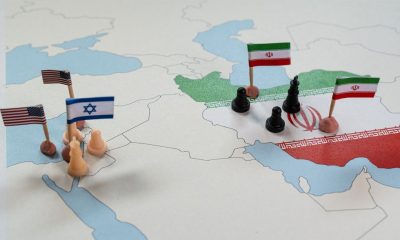


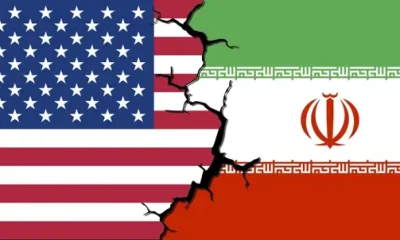


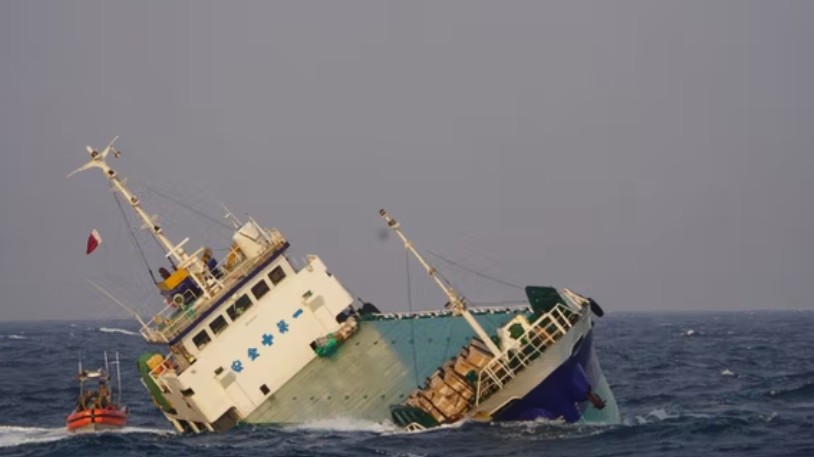
Paris (Imran Y. CHOUDHRY) :- Former Press Secretary to the President, Former Press Minister to the Embassy of Pakistan to France, Former MD, SRBC Mr. Qamar Bashir analysis : There is an old maritime warning that when a ship begins to sink, the first to flee are those who once thrived aboard it, and today that metaphor has taken on a striking geopolitical meaning as the United States, which entered its confrontation with Iran with confidence bordering on certainty, now finds itself navigating isolation, resistance, and strategic overstretch. At the outset of the conflict, President Donald Trump projected overwhelming dominance, presenting Iran as a weakened and sanctioned state that would collapse under pressure, with expectations that a rapid military campaign would dismantle its command structure, neutralize its capabilities, and ignite internal unrest leading to regime change aligned with U.S. and Israeli interests. The numerical disparity appeared to support this belief, with U.S. defense spending estimated at roughly $877 billion compared to Iran’s far smaller military budget, creating the impression that the outcome was predetermined, yet wars are not decided by budgets alone and within weeks the narrative began to fracture as Iran neither collapsed nor fragmented but instead demonstrated resilience, cohesion, and strategic adaptability.
The anticipated internal uprising never materialized, and instead Iran consolidated its domestic front while sustaining operational capabilities, thereby dismantling the central premise of Washington’s strategy which had relied on internal collapse as much as external force. The second shock came not from Tehran but from Washington’s allies, as the United States, having initiated the conflict without broad consultation, expected automatic alignment from NATO and Asian partners but encountered hesitation, distancing, and reluctance, with European nations emphasizing that they had neither been consulted nor mandated to participate in escalation, signaling not just diplomatic caution but a deeper fracture in alliance cohesion. Countries that once followed Washington’s lead are now recalibrating their positions based on economic risk, domestic pressure, and strategic autonomy, leaving the United States increasingly alone in a conflict it had expected to lead with coalition backing.
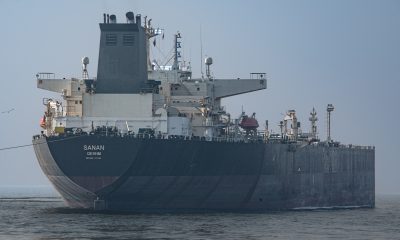
This reluctance is rooted in tangible global consequences, as the Strait of Hormuz, through which nearly one-fifth of global oil supply flows, has become a central pressure point, with disruptions driving energy prices upward, insurance costs surging dramatically, and global markets experiencing volatility with trillions of dollars temporarily wiped from valuations during peak escalation, transforming what was intended as a controlled military engagement into a global economic shockwave. Iran, far from being incapacitated, has leveraged this vulnerability by signaling its ability to disrupt shipping lanes and energy flows, compelling major economies to engage directly with Tehran to secure safe passage for their vessels, marking a significant shift in which nations are negotiating with Iran rather than isolating it, while within the United States analysts have begun warning of potential shortages in energy-linked sectors, industrial inputs, and essential goods, raising concerns about inflationary pressures and supply chain disruptions that could impact everyday life.
Yet perhaps the most consequential development lies in the expansion of the battlefield beyond Iran’s borders through the activation, or credible threat of activation, of Iran’s regional allies across Lebanon, Iraq, Syria, Yemen, and beyond, where networks cultivated over decades now provide Tehran with strategic depth and the ability to exert pressure across multiple fronts simultaneously. Armed groups aligned with Iran have already demonstrated their capacity to strike U.S. bases, logistical hubs, and allied infrastructure, creating a scenario in which American interests are no longer confined to a single theater but are exposed across a vast geographic arc encompassing land, sea, and air domains. This transforms the conflict from a bilateral confrontation into a broader regional contest in which the United States must defend a wide array of assets while its adversaries exploit asymmetry, mobility, and endurance.
Layered onto this expanding pressure is a critical but often underestimated vulnerability: logistics. The United States has deployed one of its largest naval buildups in the region, including advanced aircraft carriers such as the USS Gerald R. Ford and USS Abraham Lincoln along with accompanying fleets of destroyers, frigates, and support vessels, projecting formidable firepower across the Arabian Sea and the broader Gulf region. However, the sustained presence of such naval power depends not only on military strength but on continuous logistical support, including fuel, food, water, ammunition, maintenance, and personnel rotation, all of which rely on secure supply lines originating from regional bases, ports, and allied infrastructure.
This is where Iran’s strategy introduces a decisive complication, as Tehran has signaled that any ports, docking facilities, shipping routes, or regional bases that provide logistical support to U.S. naval forces could be considered legitimate targets, effectively extending the battlefield to include the entire supply chain that sustains American military presence. By threatening or targeting these logistical nodes through missiles, drones, and allied proxy actions, Iran can impose a form of indirect pressure that does not require direct confrontation with U.S. naval assets but instead aims to degrade their operational sustainability over time. If supply routes become unsafe or politically untenable for host nations, the ability of these massive naval formations to maintain prolonged deployment in contested waters becomes increasingly constrained, turning what appears to be overwhelming power into a complex logistical challenge.
In strategic terms, this represents a shift from confrontation to attrition, where the objective is not necessarily to defeat U.S. forces outright but to make their continued presence costly, vulnerable, and politically difficult to sustain. As Iran’s regional allies intensify pressure on U.S. installations and supply corridors while maritime threats disrupt shipping and energy flows, the United States finds itself forced to allocate resources toward defense, protection, and logistics rather than offensive dominance, gradually eroding the advantages of scale and technology. This dynamic raises critical questions about sustainability, as prolonged exposure to multi-front pressure tests not only military capabilities but also political will, economic resilience, and alliance cohesion.
Domestically, these pressures are beginning to influence public discourse, as rising economic uncertainty, market instability, and the perception of strategic overreach contribute to growing skepticism about the objectives and necessity of the conflict. As support becomes more conditional and debates intensify over national interest versus geopolitical alignment, the space for escalation narrows while the urgency for diplomatic resolution increases. At the same time, Iran’s negotiating posture reflects confidence shaped by battlefield endurance and regional leverage, with demands framed not as concessions but as prerequisites for de-escalation, underscoring a reversal in expectations from the early days of the conflict.
The broader implication is that the traditional model of power projection, built on overwhelming force and reliable alliances, is being tested by a combination of resilience, asymmetric strategy, and regional interconnectedness, where the ability to sustain pressure over time becomes as important as the ability to deliver decisive strikes. Observers in major powers such as China and Russia are closely studying these developments, analyzing the interplay between military capability, logistical vulnerability, alliance dynamics, and economic impact to refine their own strategic doctrines in an increasingly multipolar world.
At this juncture, the United States faces a critical choice between continued escalation, with its attendant risks and uncertainties, and strategic recalibration that acknowledges the changing nature of global power and conflict. The assumption that superiority guarantees success has been challenged, and the expectation of automatic alliance support has been replaced by a reality of selective engagement and strategic autonomy among partners. In this environment, the metaphor of the sinking ship resonates not as a prediction of collapse but as a warning about miscalculation, where confidence without adaptability can lead to isolation, and where the true test of power lies not only in its projection but in its sustainability.
As the conflict evolves, one conclusion becomes increasingly difficult to ignore: this is no longer a narrow confrontation but a widening contest shaped by endurance, logistics, alliances, and perception, and if Iran chooses to further activate its regional networks while maintaining pressure on supply chains and economic lifelines, the United States may find that the challenge it faces is not simply defeating an adversary but navigating a complex and expanding environment in which the cost of engagement continues to rise and the path to resolution becomes ever more uncertain.
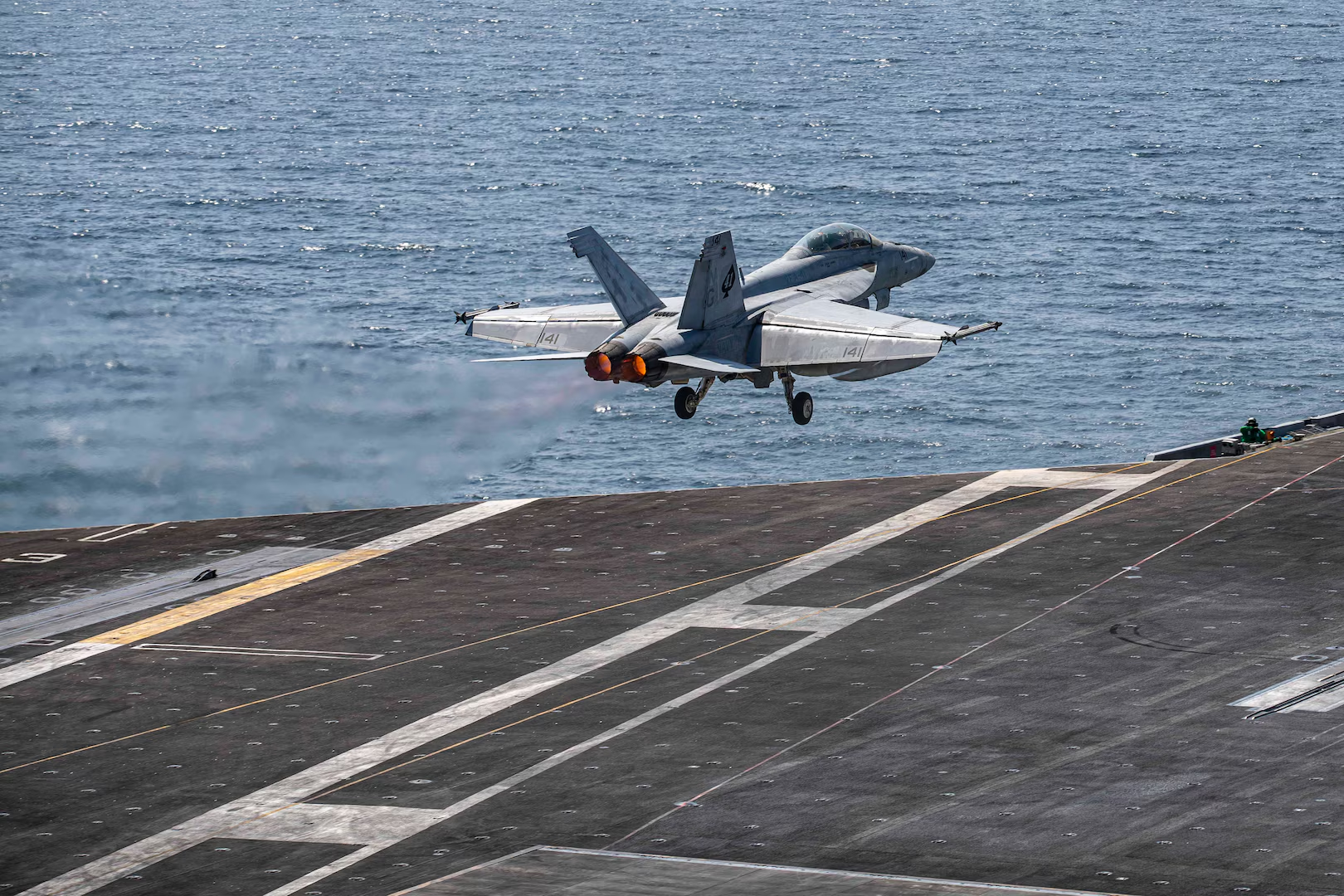
Paris (Imran Y. CHOUDHRY) :- Former Press Secretary to the President, Former Press Minister to the Embassy of Pakistan to France, Former MD, SRBC Mr. Qamar Bashir analysis : The past twenty-four hours have altered the geopolitical landscape in ways few anticipated, yet many feared. After weeks of military buildup in the Persian Gulf and Arabian Sea, the United States and Israel launched what officials described as a coordinated offensive targeting Iranian leadership and military infrastructure. The reported confirmation by Iranian state media of the death of Supreme Leader Ayatollah Ali Khamenei marks a turning point not only for Iran but for the broader Middle East.
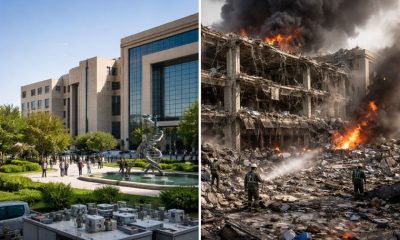
Images from inside Iran reflect a nation divided and shaken. Smoke rose above Tehran as airstrikes struck command centers and security compounds. Civilians were seen fleeing neighborhoods, rescuers searching through rubble, and families heading north from the capital amid uncertainty. In contrast, some pockets of the country witnessed celebrations following reports of Khamenei’s death—evidence of deep internal fractures that have long existed beneath the surface of the Islamic Republic.
Israeli officials have described the operation as one of the largest regime-decapitation strikes in modern warfare, claiming dozens of senior security and military figures were eliminated. Among those reported killed were high-ranking officials within the Revolutionary Guard, defense establishment, and intelligence apparatus. Whether every detail withstands independent verification remains to be seen, but the scale of the strike signals a deliberate attempt to dismantle the core of Iran’s command structure.
The central question is not simply what has happened—but why now.
For months, negotiations over Iran’s nuclear program had fluctuated between tension and cautious optimism. Technical discussions were reportedly scheduled to continue in Vienna. Yet amid those diplomatic channels, Washington and Tel Aviv appear to have concluded that the risks of waiting outweighed the risks of acting. Official statements emphasize preventing nuclear weaponization, degrading missile capabilities, and neutralizing what they call imminent threats. Critics, however, argue that the abrupt transition from negotiation to bombardment raises doubts about whether diplomacy was ever given sufficient space to succeed.
Beneath the surface of nuclear rhetoric lies a deeper strategic reality: energy leverage and global power competition.
Iran sits at the crossroads of one of the most vital arteries of global commerce—the Strait of Hormuz. Roughly one-fifth of the world’s oil and gas supply transits this narrow corridor. Any serious disruption there sends immediate shockwaves through global markets. Energy prices spike, supply chains tighten, shipping insurance costs rise, and inflationary pressures intensify worldwide.
China, in particular, relies heavily on Gulf energy flows. Even as Beijing invests aggressively in renewable energy and alternative supply chains, oil remains central to industrial continuity and economic growth. If the United States and its allies consolidate influence over major energy producers across the Gulf, they acquire a powerful instrument of geopolitical leverage. In an era defined by U.S.–China rivalry, control over energy corridors is not merely economic—it is strategic.
This broader context helps explain why Iran’s position extends beyond its borders. The confrontation is not solely about enrichment levels or centrifuge counts; it intersects with global power balances, trade routes, and long-term strategic containment.
At the same time, regime decapitation does not automatically produce stability. History offers multiple examples where eliminating leadership structures created power vacuums that fueled prolonged instability rather than swift transition. Within hours of the reported strike, the National Council of Resistance of Iran (NCRI) reintroduced its 10-point democratic plan, led by president-elect Maryam Rajavi. The proposal calls for universal suffrage, separation of religion and state, abolition of the death penalty, gender equality, dismantling of the IRGC, and a non-nuclear Iran aligned with international norms.
On paper, the plan outlines a comprehensive democratic transformation. In practice, implementing such reforms requires security guarantees, institutional continuity, and broad domestic consensus—conditions rarely present amid aerial bombardment and political shock.
International reactions have reflected caution rather than celebration. European leaders have urged restraint and a return to negotiations. Russia condemned the strikes as destabilizing. China expressed concern and called for de-escalation. Gulf states fear maritime disruption and regional spillover. The United Nations has warned that continued escalation risks undermining international peace and security.
Perhaps the most immediate economic concern remains the Strait of Hormuz. Iran’s parliament reportedly approved a motion to close the corridor, though final authority rests with its Supreme National Security Council. Analysts note that a full blockade would also harm Iran’s own economy and risk military confrontation with U.S. naval forces. Nonetheless, even partial interference could disrupt approximately 20 million barrels of oil per day—an amount sufficient to destabilize markets globally.
Markets have already responded with volatility. Aviation disruptions across the region have stranded travelers. Shipping routes are being recalculated. Energy futures have fluctuated sharply. For import-dependent nations in Asia, the stakes are profound.
Inside Iran, public sentiment appears complex and layered. Years of economic hardship, political repression, and protest crackdowns have eroded confidence in the clerical establishment for many citizens. Yet external military strikes can rapidly transform internal grievances into nationalist solidarity. Civilian casualties, if confirmed and sustained, may intensify anti-foreign sentiment rather than facilitate internal reform.
Israel, for its part, calculates that neutralizing Iran’s senior command reduces long-term threats from missile arsenals and proxy networks. The United States frames the action as defensive and preventive. However, military planners must now consider retaliation—whether through missile exchanges, cyber operations, or asymmetric tactics targeting U.S. assets in the region.
Russia and China, meanwhile, observe carefully. Both powers may seek to avoid direct confrontation while allowing geopolitical dynamics to weaken American influence if escalation becomes prolonged. A drawn-out conflict risks draining U.S. resources, complicating alliances, and eroding soft power credibility.
In this environment, the probability of swift resolution appears low. Decapitation strikes often initiate new phases of contestation rather than closure. Leadership succession struggles, regional retaliation, and diplomatic fragmentation can extend instability for months—or longer.
The humanitarian dimension must not be overlooked. Images of collapsed buildings and fleeing civilians underscore the human cost. Infrastructure damage, potential refugee flows, and economic paralysis could follow if hostilities persist.
Ultimately, this moment represents more than a bilateral confrontation. It is a strategic inflection point involving energy security, nuclear proliferation, regime legitimacy, and global power competition. The intersection of these forces makes the trajectory unpredictable and potentially prolonged.
The world must therefore prepare—not for a brief shock—but for sustained volatility. Energy markets, diplomatic channels, and regional security architectures will remain under strain. Whether the coming weeks produce negotiations, containment, or escalation will depend on decisions made in Tehran, Washington, Tel Aviv, Beijing, and Moscow.
What is clear is that the consequences of this operation will extend far beyond the initial strike. The Middle East has entered a new phase of uncertainty, and the global community must brace for economic, political, and strategic reverberations that may reshape the region for years to come.
When examined through this lens, the United States’ decision reflects calculated confidence in its strengths, yet it is shadowed by significant structural risks. Military superiority provides tactical advantage, but the strategic outcome will depend on political evolution inside Iran, the resilience of global markets, and the restraint—or escalation—of regional actors.
The war is unlikely to conclude swiftly. Leadership strikes may change faces, but they rarely end confrontations overnight. Economic volatility, diplomatic recalibration, and security tensions will likely persist for an extended period.
The world must prepare for sustained turbulence. Whether this moment becomes a gateway to negotiated transformation or a prolonged cycle of retaliation depends not only on battlefield capability but on strategic wisdom in the days ahead.
American News
Trump’s theatrical State of the Union address offers little hint of any change in course
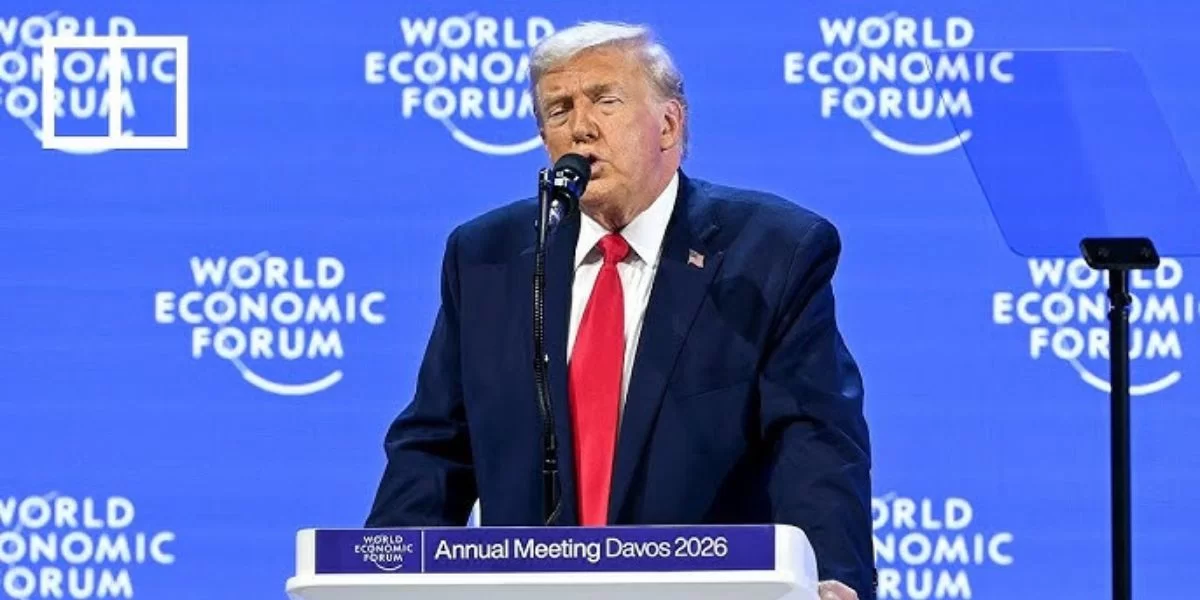
Donald Trump delivered a combative State of the Union address on Tuesday night that hailed what he said was an American “turnaround for the ages”.
At a time when polls suggest many in the US are dissatisfied with the current state of the nation – and with Trump’s leadership of it – the president offered little hint of a change of course.
Instead, with an eye on crucial midterm elections later this year, he delivered a sales pitch to the nation, a patriotic rallying cry to his loyal supporters and taunts for his political opponents.
It was a speech filled with theatrical flourishes – the kind of made-for-the-cameras moments the man who once hosted a reality television show seems to enjoy.
Early on, he welcomed the US Olympic men’s hockey team to the gallery. They held up their gold medals as Republicans chanted “USA!” and even Democrats stood and applauded.
Later, Trump praised military heroes including a 100-year-old World War Two veteran who received a Medal of Honor, and a Coast Guard swimmer who rescued 165 people trapped in last year’s Texas flooding and was given a Legion of Merit award for Extraordinary Heroism.
Although his speech set a record for length at 107 minutes, these moments quickened the pace of the evening and fit with the president’s larger theme of American patriotism and accomplishment.
His speech opened with familiar lines. “Our nation is back,” he said. It was the “hottest” country in the world. At one point, after blaming Democrats for creating a crisis of “affordability”, he added: “We are doing really well.”
He pointed to the rising incomes, a growing stock market, lower petrol prices, a southern border with dramatically reduced undocumented migrant crossing and tamed inflation.
“Our country is winning again,” he concluded.
The challenge for the president is that his public approval ratings are hovering around 40 percent, and the American public wants him to do more to address their concerns.
Two months ago, he gave a national address from the White House where he struck similar themes and cited similar statistics – but it hasn’t convinced the public. The president and his aides appear to be hoping that with a bigger State of the Union audience, which should measure in the tens of millions, the results will be different.
What Trump didn’t do in this speech, however, was offer much in the way of new policies.
He sprinkled the nearly two-hour address with a handful of ideas, including new retirement savings accounts for working-class Americans and a deal with AI companies to provide sufficient electricity for their plants to avoid consumers being hit with higher bills.
He made new pitches for other, older ideas, such as a healthcare plan that provides direct payments to Americans to help cover insurance premiums, a law to require all voters to prove their citizenship and a ban on providing commercial driver’s licences to undocumented migrants.
He also pledged to continue to push ahead with his broad tariff regime, even in the face of last Friday’s Supreme Court decision striking down many of the duties he had previously imposed.
Three of the justices who had ruled against the president remained expressionless as they watched on from the front row. Earlier, Trump and Chief Justice John Roberts – who penned the court’s tariff opinion – briefly shook hands, but neither man smiled.
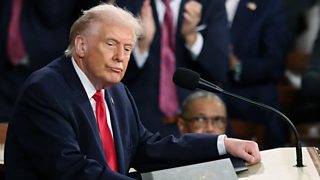
In a speech that was frequently interrupted by cheering Republicans in the crowd, Trump’s tariff discussion prompted murmurs from Democrats and uncomfortable silences from Republicans, many of whom have been uneasy about their economic cost and the threat their unpopularity with the public might pose to their electoral chances.
If tariffs sucked the air out of the chamber, when Trump turned to immigration tempers flared.
Trump’s passages on what he said was the threat of “illegal aliens” prompted some of the most thunderous applause from Republicans in the chamber and angry shouts and icy stares from Democrats.
The immigration issue had been one of Trump’s political strengths, but his enforcement surge in Minneapolis, which resulted in the shooting deaths of two American citizens by federal agents, has significantly eroded his standing.
The president made no mention of those fatal shootings – or the “softer approach” to enforcement he had suggested might be needed in the aftermath. Instead, Trump’s speech, with its focus on crimes committed by undocumented migrants – murders, accidents and corruption – was an attempt to wrest back the issue.
“The only thing standing between Americans and a wide-open border right now is President Donald J Trump and our great Republican patriots in Congress,” he said.
That was a tacit acknowledgement that in just over eight months, Americans will head to the polls in midterm elections that will determine the composition of both chambers of Congress.
As is typical with these congressional addresses, no matter who the president is, foreign policy tended to take a back seat. Despite the massive build-up of American forces near Iran, Trump did little to make the case to the American public that a sustained US military action was necessary.
“My preference is to solve this problem through diplomacy, but one thing is certain: I will never allow the world’s number one sponsor of terror to have a nuclear weapon,” he said, and then moved on.
For the moment, the political winds are blowing in the president’s face. But Trump may believe that the public’s mood is poised for a change.
Perhaps he is convinced Americans will begin to feel the economic benefits of his policies. Or maybe he believes the mood will shift, with a renewed sense of patriotisim, during the nation’s 250th birthday celebrations this summer.
His speech, with call-outs to military heroes and gold-medal-winning hockey players in the audience, could hint that this is a political wager he has placed.

Follow the twists and turns of Trump’s second term with North America correspondent Anthony Zurcher’s weekly US Politics Unspun newsletter. Readers in the UK can sign up here. Those outside the UK can sign up here.


How the World Is Forced to Fund the Iran War

Scholars Urge UN to Protect Iran’s Scientific Sites Amid Airstrikes Global Academics Warn Attacks Threaten Research, Health, and Civilian Safety

How Iran Humiliated U.S. and Israeli Power


-

 Europe News1 year ago
Chaos and unproven theories surround Tates’ release from Romania
-

 American News1 year ago
Trump expands exemptions from Canada and Mexico tariffs
-

 American News1 year ago
Trump Expels Zelensky from the White House
-

 Pakistan News9 months ago
Comprehensive Analysis Report-The Faranian National Conference on Maritime Affairs-By Kashif Firaz Ahmed
-

 American News1 year ago
Zelensky bruised but upbeat after diplomatic whirlwind
-

 Art & Culture1 year ago
The Indian film showing the bride’s ‘humiliation’ in arranged marriage
-

 Pakistan News1 year ago
Can Pakistan be a Hard State?
-

 Entertainment1 year ago
Champions Trophy: Pakistan aim to defend coveted title as historic tournament kicks off today