
Art & Culture
An Italian cultural ambassador’s guide to Rome


Alberto Angela has made a career out of exploring his hometown. Here are his favourite spots to unearth Rome’s millennia of secrets, from the Vatican Museums to Ostia Antica.
From the 1st-Century BCE ruins of the Imperial Forum to the Trevi Fountain’s Baroque splendour, Rome packs such an overwhelming myriad of postcard-worthy landmarks that digging through its historical layers can make any visitor feel like they’ve turned into an archaeologist.
Alberto Angela, a TV presenter, global ambassador for Italian heritage, art, history and culture, and a familiar face in Italian living rooms for nearly four decades knows a thing or two about his hometown’s 2,000 years of history – and he’s ready to help visitors discover it, especially as this year’s Jubilee newly puts it into the limelight.
“Rome has two faces,” says Angela. “The Papal – that of the rich – and its working-class soul, the one that is closest to us… the most interesting,” he says.
In a city where grand basilicas lie next to shady alleyways, Angela recommends exploring without cramming in too many sights – so that one can “immerse oneself in the world of the ancients”.
Having followed in the footsteps of his famous father, Piero Angela – Italy’s most well-known documentarist often called a “national treasure” – the younger Angela attributes his career and love of history to growing up in the Italian capital.
“You breathe history here,” he says. “Anyone who comes to Rome can see the same afterglow Caesar would have seen. You aren’t in a place that doesn’t exist anymore. Rome was rebuilt on top of its ancient structures.”
For Angela, this is what makes Rome so unique. “The city did not cancel its history, unlike many others,” he says. “Living here, you understand the ancients.”
Emerging from a small market settlement on the Tiber, the city of Rome was at an intersection between the Mediterranean and mainland Europe, making it a crossroads that swelled into the world’s first true metropolis. Angela believes that the city’s immense global-reaching political and symbolic impact throughout history means everyone has a “piece” of Rome inside them – which is why it can have such a profound impact on those who visit it.
Here are Angela’s favourite ways to experience ancient history in modern Rome.

1. Best place to experience ancient Rome: The Palatine Hill
Much of central Rome’s labyrinthine urban grid is a direct heir of the former imperial capital, with public spaces like the Baroque Piazza Navona or Campo de’ Fiori piazza taking their shape from a bygone stadium and theatre, respectively.
Tip:
Trying to cram in all of Rome’s main landmarks in a few days is an Olympian feat, so Angela recommends first-time visitors follow a three-day rule.
“See the major sights on the first and second days – Saint Peter’s, the Pantheon, the Colosseum,” he says. “And then on the third day, choose yourself, to see something cool [off the beaten path]. When you get home, you’ll feel you’ll have seen the things everyone talks about, but you’ll also have seen something you yourself like.”
But on the Palatine Hill, the mythical birthplace of Rome, you can actually walk on the same stones where emperors Augustus and Nero once dwelled.
“It’s the place where the Caesars lived and died,” Angela says.
As the legend goes, twin brothers Romulus and Remus received an omen from the gods and decided to lay the foundations of a new city on the Palatine Hill in 753 BCE. In the subsequent centuries, the Palatine developed into an exclusive neighbourhood of patrician villas and Imperial palaces – indeed, it’s where the word “palace” takes its root.
One of the legendary seven hills of the ancient city, offering an incomparable vantage point with a 360 panorama, Palatine Hill offers what Angela describes as “a beautiful walk”, with arguably the best views of the Colosseum – the unmistakable “star of ancient Rome”.
Visiting the Palatine is a full immersion into the life of the Roman empire, with a plethora of impressive ruins, including the mosaic floors of Augustus’s palace, Domitian’s hippodrome and the balcony overlooking the Circus Maximus racecourse.

2. The Vatican’s best-kept secret: The Necropolis
As the centre of Catholicism and one of the most important sites in Christendom, the Unesco-listed Vatican is firmly entrenched among Rome’s unmissable sights. In honour of the 2025 Jubilee, tourists and pilgrims alike are flocking to Saint Peter’s Basilica to walk through its Holy Door, opened for the occasion every quarter of a century.
But while much of the Holy See’s architectural majesty is immediately apparent – from the Michelangelo- and Giacomo della Porta-designed designed dome of Saint Peter’s all the way to the Sistine Chapel and Vatican Museums – some of its greatest treasures are hidden underground.
“Once in Saint Peter’s, you walk on beautiful marble floorings, you look up to the Baldachin,” says Angela, renowned for his 2015 TV miniseries Alla Scoperta dei Musei Vaticani (Discovering the Vatican Museums). “But you can go underground. The Popes’ tombs can be found underneath, but under those is the ancient Roman graveyard where Peter the Apostle himself was buried. The foundations of [the Basilica] are a graveyard.”
The Vatican Necropolis, excavated only in the 1940s, features mausoleums belonging to citizens of many faiths, as well as a cluster of tombs called “Field P”, suspected by some scholars to hold the burial chamber of the Church founder himself.
“It’s a trip into ancient Rome that you wouldn’t expect to find [there]”, Angela says. “It makes you understand how Rome really is.”
Visitors must book visits to the Necropolis on the official website of Saint Peter’s Basilica. The dress code mandates covered shoulders and below-the-knee clothing.

3. Best church for experiencing all of Rome’s historical eras in one fell swoop: The Basilica of San Clemente al Laterano
Rome has more than 900 Catholic sites of worship built over the course of the centuries. Now and then, there’s one that best encapsulates the city’s multi-millennial history, like Angela’s pick, the Basilica of San Clemente.
“This Basilica conceals the three souls of Rome – Baroque, medieval and ancient,” Angela says. “Anyone who comes across it is enchanted.”
Tucked behind the Colosseum and a composite of two different churches, San Clemente – dedicated to the third pope of the same name – has been a site of worship since ancient Roman times, when it served as a temple for the Zoroastrian cult of Mithras.
The temple eventually swelled into its grand current form, featuring an intricate overlay of architectural styles – from its Renaissance courtyard and the Mannerist facade of the main Basilica, all the way to its underground, early medieval second structure, which hides ancient Roman remnants.
“The exterior is beautiful and well-maintained, from the 16th Century, with a Cosmatesque [geometric] marble flooring, and then you take the stairs and arrive at the medieval Basilica,” says Angela. “And you find yourself right in ancient Rome, in a Roman temple.”

4. Best off-the-beaten-path museum: The Museo della Comunicazione Scritta dei Romani
From 17th-Century Villa Borghese to the Capitoline, the city’s oldest art gallery, Rome has no shortage of museums displaying a vast array of artefacts – matched by equally colossal crowds of spectators.
While Angela certainly recommends visitors enjoy the time-worn classics, he also suggests a quieter, quirkier alternative: the Museo della Comunicazione Scritta dei Romani.
Conveniently located a mere five-minute walk from the Termini train station, the museum is found inside the Baths of Diocletian, where the majestic 4th-Century Imperial termae have survived in remarkable condition. It is also home to a curious collection of esoteric Roman artefacts, showing how the ancients dabbled in the occult.
“It’s a museum dedicated to how Romans expressed themselves,” Angela says. “But there’s a part dedicated to magic, voodoo of sorts.”
Superstition was the unspoken crux of ancient Roman life, but one that we often overlook. “It’s a world that often gets left behind, that of spiritual beliefs,” he adds. “They found the objects in a parking lot.”
Among the objects on display is a large copper cauldron, curse tablets (defixiones), ritual tools and even Christian spells.
“For someone coming from the station, especially if it rains, it’s quite an intriguing thing to visit,” says Angela.

5. Best for exploring Baroque Rome: Palazzo Doria Pamphilj
The 16th to 18th Centuries were a crucial time for Rome’s urban development, as the city’s aristocratic families – including the Farnese, Borghese, Doria and Pamphilj – vied for social dominance through commissioning lavish building projects, all designed in the Baroque style favoured by the Papal Counter-Reformation.
“I’d advise anyone coming to visit Rome to see the palaces of the powerful Roman families,” says Angela.
While listing a few examples – Palazzo Colonna and Palazzo Farnese among them – few rival the opulence of the Palazzo Doria Pamphilj, Rome’s very own “Versailles”, in Angela’s words.
The product of an alliance of noble families, what resulted was a Baroque fantasy come to life and an impressive art collection featuring the works of many of Italy’s greats, from Titian to Raphael.
Its crown jewel is its Hall of Mirrors, commissioned by Gabriele Valvassori in the 1730s and featuring whimsical frescos, gilded Venetian frescos and ornate gold-plated furniture.
“I had never been prior to shooting [a TV special] and it’s truly spectacular,” he says. “It truly surpasses anything else.”

6. Best historic landmark outside of the centre: Ostia Antica
Many visitors coming to Rome don’t know that the city has what Angela considers its very own “Pompeii” around 32km from the city centre: Ostia Antica.
Once Rome’s sea port, potentially from as early as the 7th Century BCE, Ostia Antica developed into a bustling seaside suburb, reaching a peak of 75,000 inhabitants in the late Imperial age. While the city declined after the empire’s fall, and the coastline ended up advancing by 3.2km, much of the ancient town that once stood there has been preserved.
“You lose yourself there, you can see everything,” Angela says. “Bakeries, public bathrooms (latrines), homes, apartment blocks… street businesses, not too dissimilar to those of today.”
A tour of Ostia Antica can show you much of the amenities and features of ancient Roman life – from its 1st-Century BCE theatre, to its forum, public baths and necropolis.
For Angela, Ostia Antica best preserves the “popolare” (working-class) soul of ancient Rome – one which its newer counterpart, the beach suburb Lido di Ostia, has carried on in modern form.
Ostia Antica is a roughly 30-minute drive from central Rome, and can be reached in around the same time by taking the Metromare commuter rail from the Porta S Paolo station.
Taken From BBC News




Art & Culture
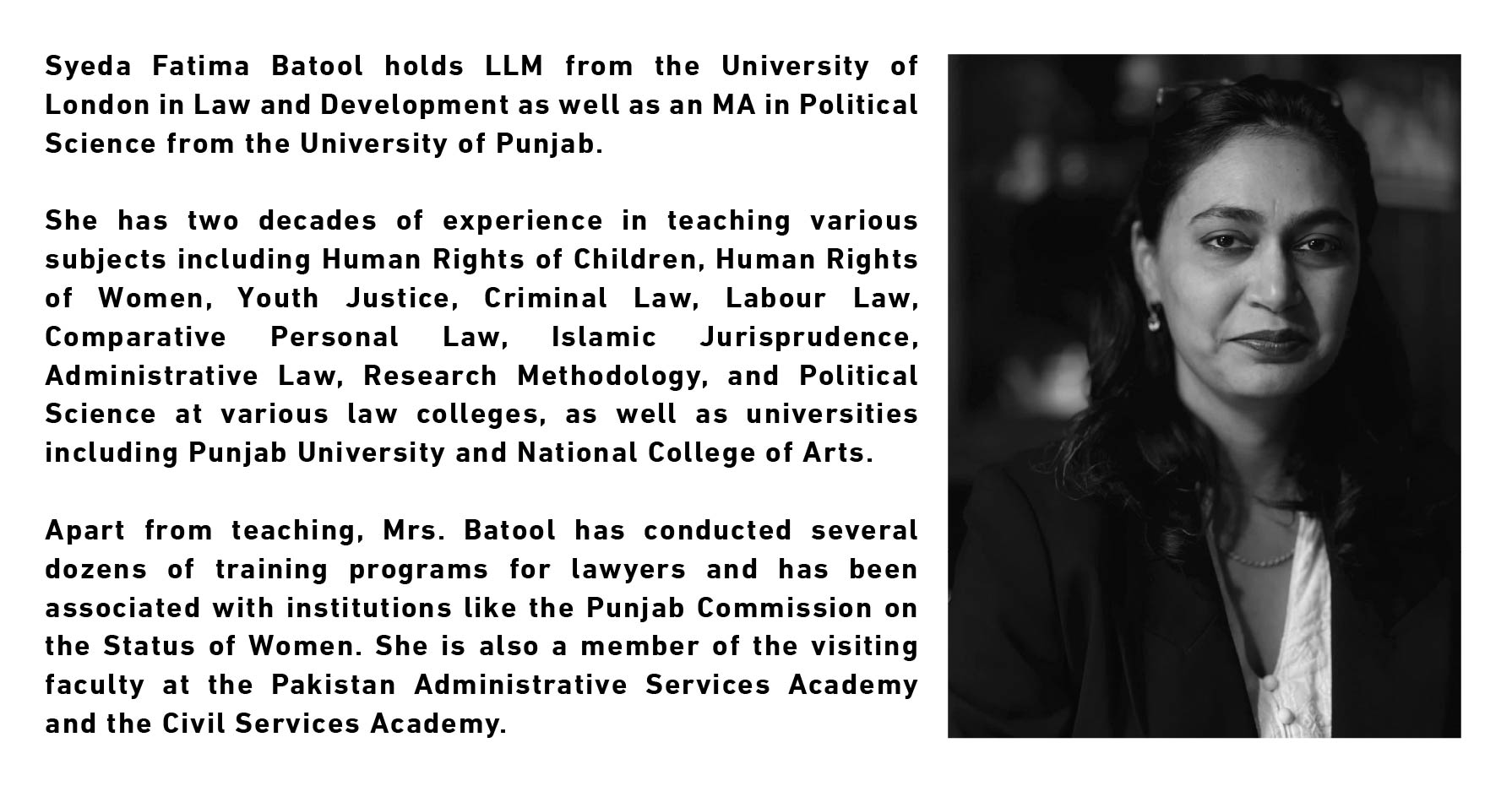
Inheritance of a woman in Islamic law ; From Implications to Challenges! _ By Syeda Fatima Batool
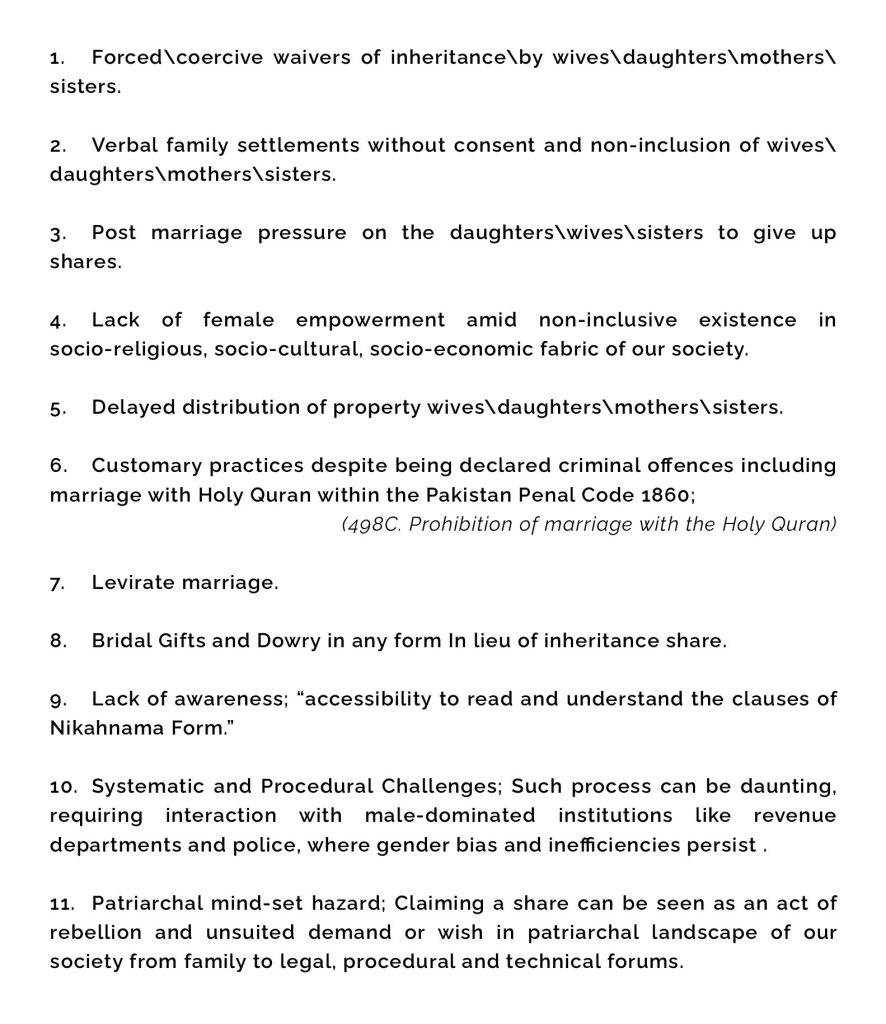
Inheritance is a very special and technical branch of law, recognized in Shariah and mostly the principles therein derive their origin from the primary sources of Islamic law which are the Holy Quran and the Sunnah, which further finds evolutionary development in Usul-ul-Fiqh (Islamic Jurisprudence). Few principles are operating while facing illegal practices affecting women’s inheritance rights in socio-religious and socio-economic perspectives. Acknowledging the doctrine of Maqasid-e-Shariah as defined by Al-Ghazali, are aimed for preservation of five essentials of human well-being including protection of religion, life, intellect, lineage, and property.Despite clear rules in Shariah and legislative efforts within “the state”, many women face denial of their rights ( Meerath- “مِیراث” ) due to cultural and social norms of our society. The ethnographic dimension of this very domain suggests, few following atrocities in non-furtherance of the women’s right of inheritance to investigate:
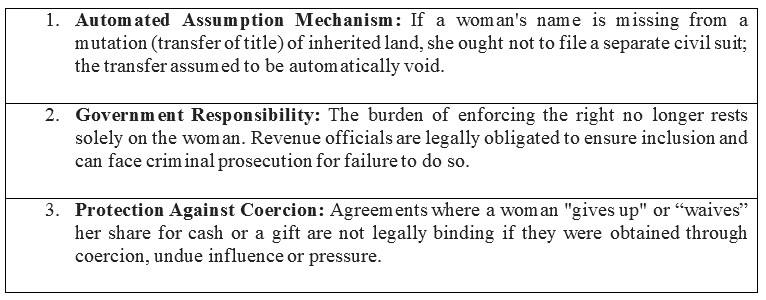
Let’s take a judicial landscape purview first; aiming to bridge the gap between law and practice regarding women’s rights. Aforementioned few practices have no legal value and can be challenged and called in question in a court of law. A significant landmark judgment is a step forward highlighting the critical issue of women being deprived of their rightful inheritance rights in Pakistan. In Muhammad Sajid Tareen V The Govt. of Balochistan through Chief Secretary Balochistan & others, (PLD 2021 Balochistan 172) it fundamentally restructured how inheritance rights for women are enforced, particularly in regions where customs often override Islamic legal principles. Judicial paradigm is also vigilant and sensitized with regard to women inheritance rights. In essence, this very ruling manifests and suggests the following helping tools which play a vital role for women combating inheritance rights effectively;
A very common scenario within social and cultural fabric of our society is rightly emphasized in this very case Bakht Biland Khan & others vs Zahid Khan & other PLD 2024 SC 1273. Worth mentioning para 4 of the said judgement specifying, “this is yet another classic case of brothers’ depriving their sisters of their inheritance, and did so for decades.…..It was intolerable to deprive vulnerable persons and females of their legal rights.”
A welcoming verdict where Apex Court upheld the sisters’ inheritance rights, and fined the petitioners (brothers) Rs. 500,000 for wasting court time and depriving women of their inheritance.
In another landmark case ruling of Aksar Jan and others vs Shamim Akhtar and others 2025 SCLR 12 the Honorable Chief Justice observed in para 5 thatthe inheritance shares in the estate left by a Muslim is stipulated in the Holy Qur’an and a deceased’s legal heirs become owners on his/her death — Unfortunately, and all too often, females continue to be deprived of their inheritance by employing various nefarious tactics, bogus documentation, fraudulent statements with the facilitation of Revenue department officials and some advocates.The courts too at times are not vigilant enough to protect inheritance rights, particularly of females and other vulnerable members of society.And, simple inheritance cases are not expeditiously decided,...The practice of depriving females of their inheritance must be put a stop to, and those who do so must be made to pay substantial costs and not be permitted to benefit from procedural technicalities.
Another Recent judicial milestone is achieved by a recent judgement ensuring and re-acknowledging by another Supreme Court ruling titled Abrar Hussain Vs Mst. Bibi Shahida and others PLD 2026 SC 42 also established that women have a “divine, automatic right” to inherit, which cannot be nullified by unproven gifts or mere claims by male heirs .
“The Court emphasized that denying inheritance contradicts the Qur’anic injunctions that clearly define women’s shares, and any attempt to deprive a woman of her share without her free consent is invalid.”
Another most recent landmark judgement ofMst. Amara Waqas vs. Muhammad Waqas Rasheed, W.P. No. 365 \2023 decided in March 2026, the Islamabad High Court (IHC) has ruled“that all assets acquired during the subsistence of a marriage “whether movable or immovable” regardless of the title holder shall constitute “matrimonial property.” Hence are subject to equitable distribution between spouses. Relying upon comparative jurisprudence from Malaysia, Indonesia, Turkey, and the United Kingdom, the court recommended that marriage in Pakistan must be recognised as an economic partnership.Study shows in Indonesia, property acquired during the marriage is considered joint property of the husband and wife. Tunisian Personal Status Code 1956 allow spouses to include clauses in their marital agreements governing the management and division of property.Similarly Iran, Jordan, Libya, Egypt, Turkey, Syria, Brunei Dar-us-Salam and Malaysia are the current examples of catering the issue of women property rights by legislations in respective civil codes and family laws.
Furthermore for the “first time in the judicial and legal history of Pakistan” such an innovative development is seen regarding property and inheritance rights whereby it very clearly ask for an amendment in nikahnama form for addition of a column stipulating any property if acquired after marriage by either spouse, shall be divided equally, secondly court emphasized the education and awareness of existing nikahnama form to young girls specifically to enable secure their proprietary rights.
Despite the amazing rulings by the honorable apex courts, implementation faces hurdles and struggle to change centuries-old norms and customs in a very slow pace. Key indicator is the role of the “Revenue officers” serving as the first line of defense in preventing and curbing such illegal transactions regarding female heirs. Such authority and officers can and shall actively scrutinize every mutation while not just relying upon presented documents alone. It’s high time that the Revenue , Police , and all respective departments shall be given extensive and women-centric sensitized trainings, via special workshops and social media tool mediums in local languages also.
In the ambit of Constitutional bindings, the Fundamental Right under Article 14 of the Constitution of Pakistan 1973 mandates inviolable right to human dignity Article 23 assures that all citizens of Pakistan shall enjoy equal right to acquire property and Article 24 ensures and guarantees the protection of every citizen’s property against unlawful deprivation; followed by Article 25promising equality of all citizens. In the light of Principles of Policy, Article 35 of the Constitution, state is responsible for protection of family, marriage, mother and child
From psychological perspective exclusion from mainstream empowering roles and decision making, more often women prefer, “not to claim their inheritance” and to avoid family conflict\s and keep sacrificing her “share” amid fear, from social or family isolation to stigmatization. Women are conditioned to believe that asking their rightful share in inheritance is morally, socially and ethically wrong despite the fact that a female claim is legal and religious. Familial breakdown acts as a profound health hazard. Stigma-related isolation is not solely a social issue rather medical effects of this exclusion can be worse than the mental health conditions themselves.
Now from the viewpoint of Shariah, we find clarity of the phenomenon of a female exclusive and independent right of inheritance declared by the primary sources of Islamic law, The Holy Quran and Sunnah. Sura Nisa:7 mentions that “For men there is a share in what their parents and close relatives leave, and for women there is a share in what their parents and close relatives leave”.We shall appreciate treatment of women’s inheritance rights as a revolutionary advancement for its time; determining a mandatory right for female\s who were often excluded earlier to the advent of Islam.The core ruling is found in Surah An-Nisa specifically verses 7 to 14 and 176.The Fundamental Rule in sura Nisa:11 is incorporated that “Allah commands you regarding your children: for the male a share equivalent to that of two females...”. It states that a son inherits twice the share of a daughter. This is often simplified as “a woman gets half of a man’s share,” but this is only in the specific case of siblings when there is no will. This is concept of taseeb i.e the differential share ratio of 2:1 and is linked to the financial responsibilities placed on men as sustainers and providers in Islamic law, while a woman’s inherited wealth is her own property with no obligation to spend it on anyone else.Hence the share of daughter alone is half where there is a brother, otherwise appreciate the key Shares for females as fixed shares (Fara’id) for several female relatives:
- Wife: 1/8 in case of children; 1/4 if no children.
- Daughter: 1/2 if alone; 2/3 if multiple (shared); if there is a son, they become residual heirs (‘Asaba) with the son taking double.
- Mother: 1/6 if the deceased has children; 1/3 if no children or siblings.
- Uterine sister : A fixed share of 1/6 if she is the only uterine sibling.
- If there are two or more uterine siblings (brothers or sisters), they share 1/3 of the estate equally, regardless of gender, as defined in Surah An-Nisa:12
- Full Sister: 1/2 if alone; 2/3 if multiple (shared); can inherit residually in some cases.
- Paternal Sister: 1/2 if alone; 2/3 if multiple; specific rules with other heirs.
Notably crucial concept shall be known that there are many scenarios where“a woman inherits an equal or even greater share than a man”:
- Mother and Father: When a person dies leaving both parents and no children, the mother gets 1/3 and the father gets 1/3 (the remainder goes to siblings). Here, they inherit equally.
- Uterine Siblings (brother & sister from same mother): They inherit equally, each getting 1/6 or 1/3
- Only Daughters: A single daughter can take half the estate, while multiple daughters take two-thirds. In the absence of sons, they can be the primary heirs.
- Case of Kalalah: (Deceased with no direct parents or children). Inheritance flows to siblings, with complex rules where sisters can sometimes become residual heirs and take a larger portion.
Allah commands in Al-baqrah:188 very clearly that “do not usurp one another’s property unjustly”.
The Sunnah of the Holy Prophet Muhammad (Peace be upon Him) places a profound emphasis on the mindfulness and protection of women’s rights, establishing their well-being as a direct responsibility before Allah. This is most powerfully manifested in his Khutbah Hajjatul Wida (Farewell Sermon), where he explicitly instructed men to fear Allah in their treatment of women, describing them as a “trust from God”. Islamic Law of Inheritance is indeed a complex, technical and mathematical science. In modern day, contemporary debates are commonly known by scholars and reformers urging for need of ijtihad (independent analogical reasoning) in this very regard. Tunisia and other Muslim-majority nations are bridging the gap between practice and principle by revising family laws to align with Quranic justice, actively overcoming customary, patriarchal interpretations.The Quranic inheritance system is purpose-driven. It is indeed time to legislate accordingly. The Quranic inheritance system (Faraid) is widely recognized by scholars as a purpose-driven framework aimed at ensuring social justice, family cohesion, and economic equity. One can not ignore another socio-economic woman right, incorporated in Sura bakra:241that reasonable provisions must be made for divorced women,—as a duty upon the righteous. Such phenomenon is called post-divorce alimony. It can be any kind of movable or immovable property or something valuable, for which we just have developed our jurisprudence in a recent case law judgement of equitable matrimonial asset division by IHC 2026 referred earlier.
Coming towards the land scape of Pakistan legal paradigm, we developed a remarkable piece of legislation, known as the ‘Women Property Rights Act 2020’. It was designed to redress the widespread issue of a woman being deprived of her rightful property acquired by Inheritance, Will, Gift /tamleek-nama or Hiba, Sale or any such like mode. It’s operation has recently been suspended by a judgement of Islamabad High Court Writ Petition.2665/2025. It has also been implemented in the province of Khyber Pakhtunkhwa (KPK). Previously the “Punjab Enforcement of Women’s Property Rights Act” 2021 was introduced within the Punjab. The Lahore High Court issued an interim order suspending this very law, halting all actions taken under it, and referring the matter to a full bench. Hence In Punjab we have only operational and active legislative medium for redressal of property grievances known as the “Punjab Protection of Ownership of Immovable Property Act” 2025, with the aim to protect women’s property and inheritance rights, more efficient and effective amid fast-track mechanism to claim property. In countries where continuous and systemic inequalities bars women’s participation in the formal economy, inheritance rights play a crucial role in supporting their economic independence. Such a financial security reduces women’s dependence on others also it allows them to make independent economic decision. As per ‘Gender Parity Report’(ICT)- 2025, “ the overwhelming majority of landholdings are controlled by men which is alarming systemic inequality in land ownership in paving inclination towards gender parity and gender discrimination. Recent data from the “Federal Bureau of Statistics and Parliamentary updates in Pakistan” 2025, indicate that only 2.5 per cent of women in Pakistan own a house in their own name, and 7.5 per cent hold joint property. Only 26% of women population in Pakistan enjoy ownership of property. Last year The World Economic Forum (WEF) issued it’s Global Gender Gap Report 2025, depicting Pakistan’s pillar-wise performance; showing minimal change from 2024, underscoring entrenched structural challenges. In Economic participation and opportunity, Pakistan remains 143rd, reflecting stagnant female labor force participation, persistent wage disparities, and limited access to leadership roles owing to low Female Workforce Participation with less than 25% of women active in the workforce. Pakistan fails to leverage half of its human capital for economic growth.Weak Policy Implementation: Last but not the least, a Global vision expansion amid Constitutional 18th Amendment marks each Province responsibility for legislation and initiatives regarding women’s inheritance and property rights. Hence it has increased resources to provinces to work for women’s empowerment with the aim to meet the Sustainable Developmental Goals (STG’s) 2030 No. 5, urging for gender equality and empowerment of females. International spectrum highlights CEDAW, “the Convention on the Elimination of All Forms of Discriminationagainst Women” which Pakistan ratified In 1996. Later in 2010 Pakistan ratified ICCPR“International Convention on Civil and Political Rights” ensuring specific protection against gender inequality in all civil and political matters. Secretary-General of the United Nations, ‘António Guterres’ urged all governments to eliminate legal barriers to women owning land, and to involve them in policy making. On 2nd March 2026 while highlighting ‘Eight Actions for More Equal World’ he further shared that Worldwide, women hold only 64 % of the legal rights enjoyed by men. In too many places, they cannot own property. Even where protections exist, women face higher barriers to access legal aid or the courts. Every country must commit to dismantling discriminatory laws, and to enforcing rights in practice.
Unless, we include women in formal and visible empowering scenarios at basic grass root levels, normalize socio-cultural co-existence, promote awareness using most modern digital tools ; use data age mediums in shifting the approach toward women, recognizing them not just as beneficiaries of care but as active citizens with fundamental rights, we may not be successfully struggling against identified aforementioned few key indicators. Academia shall play its role.Patriarchal structures continue to limit women’s mobility, access to jobs, hence weak Policy, despite gender equality laws on paper, enforcement remains absent. Legal protections for women are poorly and in efficiently implemented. Devastating effects for ineffective legislative measures for women inheritance leads to long lasting profound distress, which endanger wellbeing of the person. The failure to enforce women inheritance rights and laws, develops a self-sustaining cycle where subsequent generations of women are likely to be denied their rights, resulting in perpetuation of gender inequality. ‘Female Empowerment’ is the transformative tool for combating the gender-based discrimination and harassment, challenging patriarchy, customary practices, and power imbalance, that perpetuated such power crimes in society. It is effective only if paired with legal, judicial, institutional and educational reformative tools that target systematic roots discrimination. Sustainable, long-term success in securing women’s inheritance rights requires a collaborative approach that actively includes men to dismantle patriarchal structures playing as key enabler of change.
Art & Culture
Where the Soul Finds Stillness — A Gentle Surrender to Nature’s Quiet Embrace and Timeless Serenity
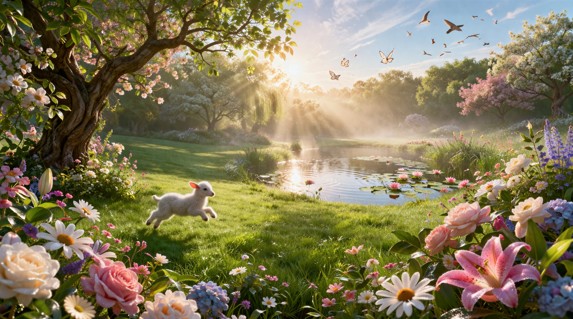
GARDEN OF EDEN
My spirit soars up to the sky,
As I on the lush green carpet lie.
Ecstasy envelopes my always
…melancholy heart,
As, sudden wind blown ripples,
In the pond start.
As the winter suns, warm rays,
Caress my being I do sway
Frolicking and frisking, from here to there,
Like a lamb, the desire, I wish to bear.
May you bloom forever, my Garden of Eden,
Make my thoughts soar upto, The Seventh Heaven.
Art & Culture
The Quiet Weight of Goodbye — When Parting Leaves Behind Echoes of Love, Loss, and Lingering Silence

NO MORE TEARS
As you leave for greener pastures,
Tears flown down the cheeks at your departure.
The migrating bird flutters its wings,
Over for it, is the season to sing.
The Bentley turns round the corner
Disappears from sight, now and forever.
I shall miss your nudge and touch,
For our friendship others could vouch.
But since the ‘Sea of Gold’ is at a distance,
Leave for it right now, this instance.


How the World Is Forced to Fund the Iran War

Scholars Urge UN to Protect Iran’s Scientific Sites Amid Airstrikes Global Academics Warn Attacks Threaten Research, Health, and Civilian Safety

How Iran Humiliated U.S. and Israeli Power


-

 Europe News1 year ago
Chaos and unproven theories surround Tates’ release from Romania
-

 American News1 year ago
Trump expands exemptions from Canada and Mexico tariffs
-

 American News1 year ago
Trump Expels Zelensky from the White House
-

 Pakistan News9 months ago
Comprehensive Analysis Report-The Faranian National Conference on Maritime Affairs-By Kashif Firaz Ahmed
-

 American News1 year ago
Zelensky bruised but upbeat after diplomatic whirlwind
-

 Art & Culture1 year ago
The Indian film showing the bride’s ‘humiliation’ in arranged marriage
-

 Pakistan News1 year ago
Can Pakistan be a Hard State?
-

 Art & Culture1 year ago
International Agriculture Exhibition held in Paris