
Crime
Police release new evidence in timeline of Hackman and his wife’s death


Authorities have discovered new information changing the timeline of when they believe Academy Award winning actor Gene Hackman and his wife, Betsy Arakawa, died.
The couple were found dead in their New Mexico home last month with officials saying the pair had been dead for some time before they were discovered by neighbourhood security.
Officials initially said they believed Arakawa died on 11 February and Hackman died one week later.
The Santa Fe County Sheriff’s Office now says they have confirmed that Arakawa made multiple calls to a health clinic on 12 February for medical treatment, which the clinic told BBC she never was able to receive.

1:20Listen to the 911 call after two bodies found at Hackman residence
The sheriff’s office said they learned of the calls when they received cell phone data from her phone.
They said there were three calls made that morning to Cloudberry Health, a personalized concierge medical practice in the area. She received a fourth call, also from the clinic.
The sheriff’s office noted it never reported an official date of death for her and said that initially they’d stated that Arakawa’s last known activity was on 11 February. Authorities say she’d exchanged emails with a massage therapist and visited a grocery store, pharmacy and a pet store. Garage clicker data showed she returned home around 5:15 p.m. that day.
Dr Josiah Child, who leads Cloudberry Health, told the BBC that while the clinic had never treated Hackman or Arakawa, she had reached out for medical advice.

“She called and described some congestion but didn’t mention any respiratory distress, shortness of breath, or chest pain,” he said.
Arakawa initially had scheduled an appointment for 12 February but cancelled on 10 February, explaining that she needed to care for her husband, Dr Child said.
- ‘Living in a reel’: How Alzheimer’s left Gene Hackman alone in his final days
- Hackman’s children not named in actor’s $80m will
- What is hantavirus, disease that killed Gene Hackman’s wife?
On the morning of 12 February, she called again seeking treatment but because no doctor-patient relationship had been established, the clinic told her she needed to be seen in person.
“There were a couple calls back and forth to just schedule that appointment for the afternoon, but she never showed up,” Dr Child explained. “Our office called back several times and never got an answer.”
The couple were both found dead on 26 February.
Chief Medical Investigator Dr. Heather Jarrell stated that “based on the circumstances, it is reasonable to conclude that [Betsy] passed away first.”
The Santa Fe medical examiner determined she died from hantavirus pulmonary syndrome, a rare rodent-borne respiratory disease.
Authorities believe Hackman died on 18 February – the date of his last recorded pacemaker activity, which showed an abnormal rhythm of atrial fibrillation.
His cause of death was severe heart disease, with advanced Alzheimer’s disease listed as a contributing factor. Experts believe his Alzheimer’s may have prevented him from realising his wife of more than 30 years was dead in the home where he was living.
If he did, experts told the BBC, he likely went through various stages of confusion and grief, trying to wake her up before the disease caused him to become distracted or too overwhelmed to act – a process that likely repeated for days before he, too, died.
A necropsy report also revealed that one of the couple’s three dogs, which had been crated while recovering from surgery, died from starvation and dehydration.
As the investigation continues, representatives for Hackman and Arakawa’s estate have taken legal action to block the release of body camera footage and other visual evidence from their home when their remains were discovered.
A New Mexico judge has issued a temporary restraining order that prevents their release, with a hearing set for March 31.
Taken From BBC News


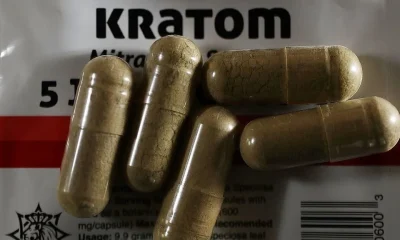





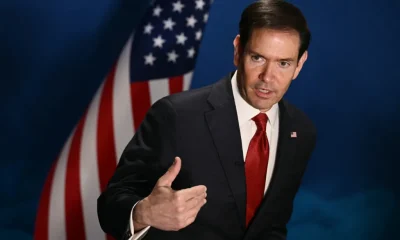




The prime minister has said Russian oligarch Roman Abramovich must “pay up now” to victims of the war in Ukraine or face court action.
Mr Abramovich, the former owner of Chelsea Football Club, pledged in 2022 that the £2.5bn he made from the sale of the club would be used to benefit victims of the Russian invasion of Ukraine.
But there has been a delay in releasing the funds, which are currently frozen in a British bank account, due to a standoff over how exactly they should be used.
Sir Keir Starmer told the Commons on Wednesday: “My message to Abramovich is clear: the clock is ticking.”
The government wants the money to be used for humanitarian aid, but Mr Abramovich insisted it should be used for “all victims of the war” – meaning that Russians could also benefit.
The oligarch cannot access the money under UK sanctions but the proceeds from the Chelsea sale still legally belong to him.
Updating MPs, Sir Keir said the UK had issued a licence “to transfer £2.5bn from the sale of Chelsea Football Club that’s been frozen since 2022.”
And, in a warning to Abramovich, he said: “Honour the commitment that you made and pay up now, and if you don’t we’re prepared to go to court and ensure that every penny reaches those whose lives have been torn apart by Putin’s illegal war.”
And Foreign Secretary Yvette Cooper told the BBC Mr Abramovich “needs to honour that commitment, pay that money”.
Asked if a legal battle could drag out the process for years, Ms Cooper said: “I’m urging him not to try and pursue further court action.”
But she confirmed the government will take the matter to court if he does not act.
Mr Abramovich’s representatives declined to comment.
The Treasury said that under the terms of the licence, the money must go to “humanitarian causes” in Ukraine and cannot benefit Mr Abramovich or any other sanctioned individual.
The government first threatened to sue Mr Abramovich in June.
Chancellor Rachel Reeves said: “It is unacceptable that more than £2.5bn of money owed to the Ukrainian people can be allowed to remain frozen in a UK bank account.”
Mr Abramovich – a Russian billionaire who made his fortune in oil and gas – was granted a special licence to sell Chelsea following Russia’s invasion of Ukraine, providing he could prove he would not benefit from the sale.
He is alleged to have strong ties to Russian President Vladimir Putin, something he has denied.
It is understood that Mr Abramovich has 90 days to act before the UK considers taking legal action.
On Thursday, EU leaders are set to review proposals to use proceeds from frozen Russian assets to support Ukraine’s huge budget and defence needs. Russia has fiercely opposed the proposals.
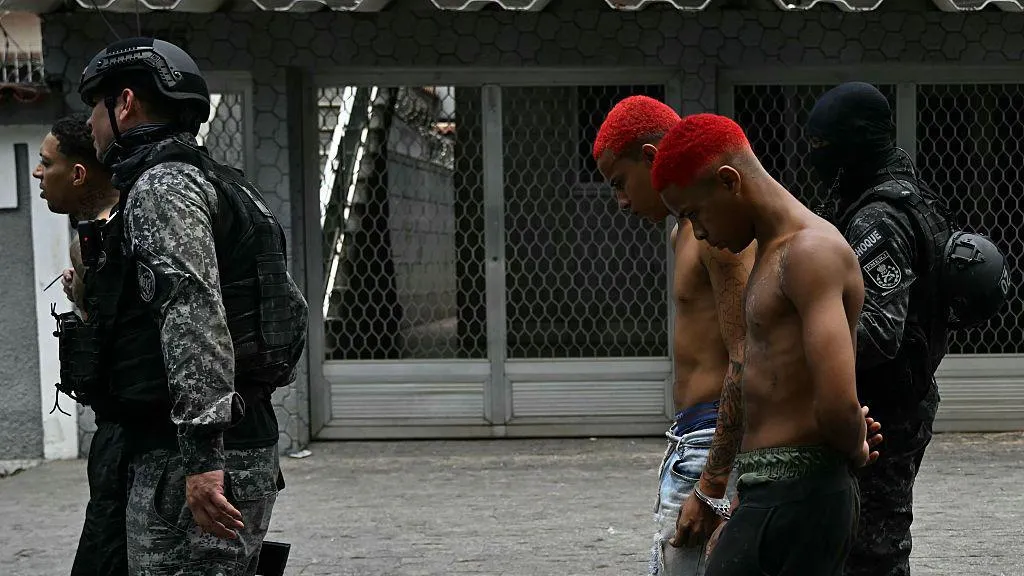
New details which have emerged in the aftermath of Brazil’s deadliest police operation are casting doubts over whether the raid really struck at the heart of one of the country’s most powerful criminal gangs, as was its stated aim.
One hundred and twenty one people, among them four police officers, were killed in the raid on 28 October in Rio de Janeiro.
The governor of Rio de Janeiro state, Claudio Castro, described the police operation as “a success”, posting a photo showing the more than 100 rifles seized by police.
But rights groups have sharply criticised the security forces pointing to the high death toll and what they have described as the “brutality” of their actions.
The operation was the largest ever carried out by Rio’s security forces and saw 2,500 officers deployed to the Alemão and Penha neighbourhoods.
It targeted the Comando Vermelho (Red Command) criminal gang, which rules over the nine-million-square-metre area.
Rio’s public safety secretary, Victor dos Santos, told Reuters that the goal of the operation had been to carry out scores of arrest warrants issued by prosecutors.
But when BBC Brasil cross-checked the list of the deceased published by police against the 68 names on the list of suspects provided by prosecutors, it found that none of them matched.
Local media have also pointed out that even though scores of suspects were arrested during the raid, the man considered the gang’s most powerful leader, Edgar Alves de Andrade, also known as Doca, was not among them.
“Early reports stated that the goal of the operation was to capture high-ranking leaders of the Comando Vermelho (CV),” Carlos Schmidt-Padilla, professor of public policy at the University of California, Berkeley, told BBC Brasil.
“By that metric, it is fair to say the operation failed.”
At a Senate hearing, the deputy intelligence secretary for Rio’s military police stated that the raid had had a “negligible” impact on dismantling Comando Vermelho.
Residents of the Alemão and Penha have also told the BBC that it has done little to loosen the tight grip the CV has on their favelas.
How Rio’s gangs rule through fear and control
They said that their daily lives had barely changed since the mega-operation, describing seeing armed men roaming the community the very next day, even as the bodies of those killed were still being removed.
Comando Vermelho (CV) and groups like it enforce strict rules in the areas they control.
These criminal enterprises have moved beyond the sale of drugs and now hold the monopoly for the provision of gas, cable television, internet and transport.
Residents report being charged over the odds for gas cylinders, often having to pay one third more than in zones not under gang control.
Rules imposed by gang members affect everyday life.
As CV has banned cars working for ride-hailing apps from entering the favelas, locals are restricted to using motorbike taxis and vans which have been authorised by the gangs to operate there.
Even people’s clothing is policed by the gang. In 2020, residents of Penha were told not to wear Chelsea football shirts.
At the time, the jerseys were sponsored by British telecoms company Three, but CV members did not like the number being prominently displayed because it reminded them of a rival gang which happened to have the number three in its name: Terceiro Comando Puro (Pure Third Command).

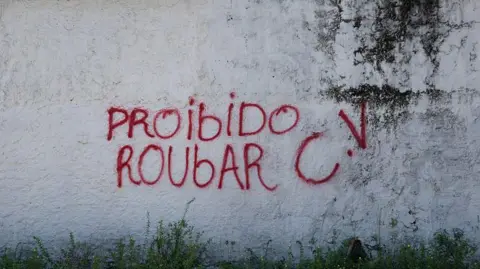
Punishments for what are considered transgressions are extremely harsh. Being caught stealing can mean losing a hand or being burned alive.
Gang members “sit in judgement” over domestic violence cases and those found guilty are beaten or even executed.
Residents are forbidden from engaging in relationships with members of rival factions or with police officers.
They also know not to photograph or film drug dens or any of the armed men driving through their community.
But with mobile phone use ubiquitous, even gangs as powerful as Comando Vermelho struggle to control what gets posted online.
In Rocinha, a favela under CV control, gang members vowed to kill those who leaked a 2020 video showing a CV leader surrounded by rifles and machine guns.
When someone insists on “causing trouble”, the group often resorts to assault and torture.
Police investigation files on Comando Vermelho, seen by the BBC, contain disturbing images.
One shows a woman forcibly submerged in an ice bath, accompanied by a caption accusing her of being “aggressive” and “causing trouble”.
Reports of growing violence and expanding territorial control by Comando Vermelho formed the basis of the complaint filed by Rio’s Public Prosecutor’s Office which led to the massive police operation on 28 October.
And while rights groups labelled it a “massacre” and questioned its effectiveness, Rio de Janeiro State Governor Claudio Castro has announced that more operations against organised crime will follow.
A poll conducted by AtlasIntel suggests that Castro’s approval rating has risen since the raid, and at 47% now stands higher than that of the president, Luiz Inácio Lula da Silva.
President Lula, for his part, has announced that the federal government would launch an investigation into the raid.
But in a post on Instagram published on 11 November, Governor Castro said he would “not back down”.
“Law-abiding citizens can’t take it anymore. Rio has fought back – and the whole of Brazil is fighting back with us.”
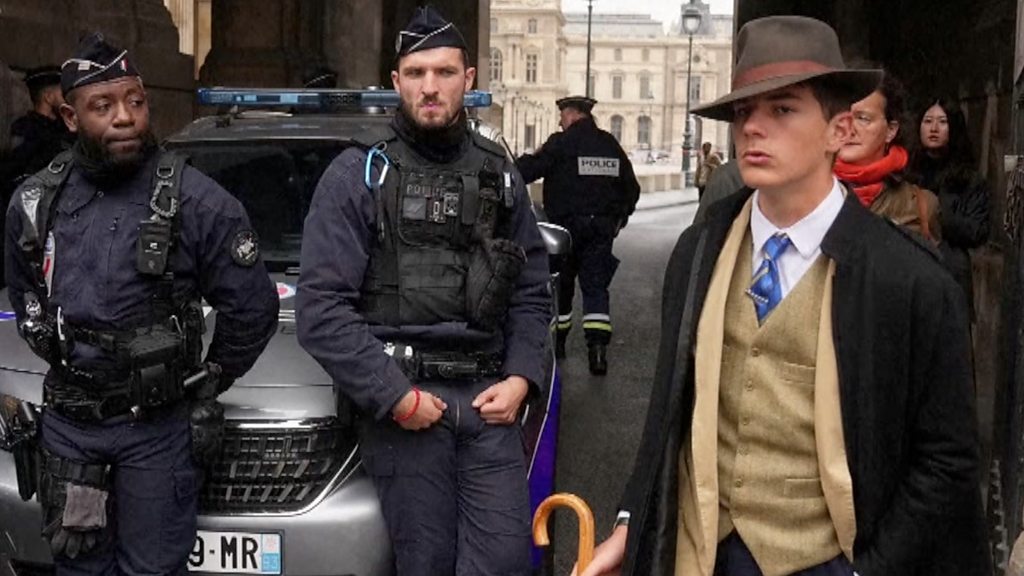
In the three weeks since the Louvre museum heist, as investigators sought to find out who was behind it and why the French crown jewels had been so easy to steal, another mystery remained: who the “fedora man” was.
The dapper youth in a hat was photographed outside the museum that Sunday and went viral on social media, prompting theories about his identity.
The first two mysteries were swiftly settled. The thieves’ carelessness with DNA allowed police to work out their identities. The Louvre director admitted CCTV security was inadequate.
However, the fedora man remained an enigma – until now.
The dandy, it turns out, is a local teenage fan of Sherlock Holmes and Hercule Poirot who just happened to be at a real crime scene.
Pedro Elias Garzon Delvaux, a 15-year-old from Rambouillet, south-west of Paris told the Associated Press (AP) news agency that he had planned to visit the Louvre with his family but found the museum was closed.
“We didn’t know there was a heist,” he said.
As he asked officers about the closure, an AP photographer seeking to capture the security cordon took a picture and included Pedro in the frame.
Pedro only realised the photo had gone viral four days later, when a friend sent him a screenshot asking: “Is that you?”
When he replied that it was, the friend said he had five million views on TikTok. “I was a bit surprised,” Pedro told the AP.
He was even more shocked when his mother called to say the picture had appeared in The New York Times. It made a big impact on him, he said, because he reads that newspaper and “it’s not every day you’re in the New York Times”.
“People said, ‘You’ve become a star’. I was astonished that just with one photo you can become viral in a few days.”
Asked why he wore an old-fashioned waistcoat and a fedora to the museum, Pedro said he began dressing this way recently, inspired by 20th-century statesmen and fictional detectives.
“I like to be chic,” he told the AP. “I go to school like this.”
As wild speculation about the photo of him circulated online – some wondered whether he might be a real detective or an AI fake – Pedro remained silent for weeks.
“I didn’t want to say immediately it was me,” he said. “With this photo there is a mystery, so you have to make it last.”


Quetta’s Daughter, Pakistan’s Pride

Why is Trump a Dictator?

America Must Rebuild Within


-

 Sports4 months ago
South Korea’s Yoo Useong Steps Onto the Global Strongman Stage as World Strongman Federation Professional Athlete
-

 Art & Culture1 year ago
A Survey of Mata-E-Zeest
-

 Europe News2 years ago
Chaos and unproven theories surround Tates’ release from Romania
-

 American News2 years ago
Trump expands exemptions from Canada and Mexico tariffs
-

 American News2 years ago
Trump Expels Zelensky from the White House
-

 Art & Culture2 years ago
Will Snow White be a ‘victim of its moment’? How the Disney remake became 2025’s most divisive film
-

 Entertainment2 years ago
Champions Trophy: Pakistan aim to defend coveted title as historic tournament kicks off today
-

 Pakistan News1 year ago
Comprehensive Analysis Report-The Faranian National Conference on Maritime Affairs-By Kashif Firaz Ahmed