
Pakistan News
Any attempt to divert Pakistan’s water to be treated as act of war, India ‘must make no mistake about it’: PM at UNGA

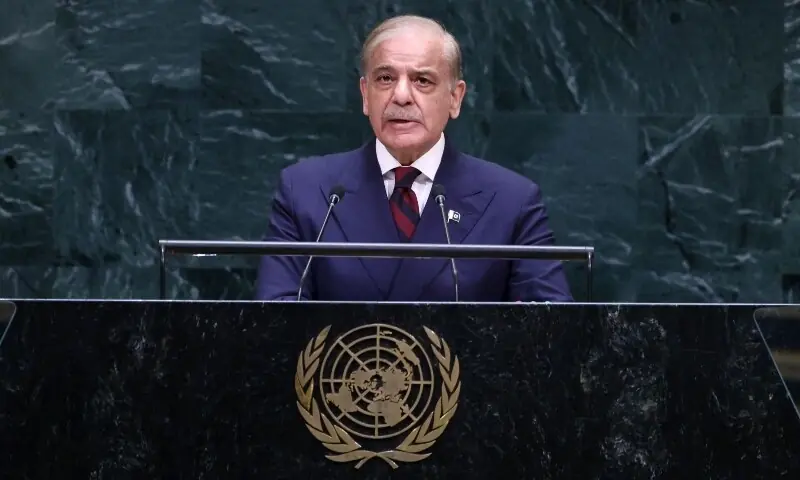
Prime Minister Shehbaz Sharif on Friday said that any attempt by India to divert Pakistan’s share of water would be treated as an “act of war”.
“Any attempt to stop, impede or divert Pakistan’s share of the waters will be treated as an act of war. India must make no mistake about it,” he said during a speech at the 81st session of the United Nations General Assembly (UNGA) in New York, where he called attention to the neighbouring country’s decision to hold the Indus Waters Treaty (IWT) in abeyance.
He highlighted that the country’s claims and actions regarding the treaty had been rejected by UN experts as well as by the Permanent Court of Arbitration, leaving Pakistan “vindicated beyond any ray of doubt” in its position.
“Water must never be weaponised. Rivers should nourish nations, not divide them,” he stressed, calling the Indus river system the “lifeblood” of the entire region.
PM Shehbaz also addressed last year’s brief military conflict with India, which came after an attack on tourists in occupied Kashmir’s Pahalgam that killed 26 tourists — an incident New Delhi blamed on Islamabad without evidence. For its part, Pakistan strongly denied the allegations and called for a neutral investigation.
“Our brave and valiant armed forces, under the courageous leadership of Field Marshal Asim Munir, responded with precision and professionalism,” he said.
He once again praised US President Donald Trump’s “resolute and visionary leadership” in brokering a ceasefire between the two countries in May 2025, stressing that it saved “hundreds of millions of lives”.
“Who knows the extent of devastation that could have taken place had President Trump not stepped in at this critical moment with clarity of thought and action?” he questioned.
“We must therefore ensure that South Asia never reaches this precipice ever again,” he said. This, however, the premier added, required a fair resolution of the Kashmir dispute.
“For eight decades, the Kashmiri people have waited for the United Nations to fulfill its solemn commitment of a free and impartial plebiscite,” he pointed out, adding that they had endured “illegal occupation, arbitrary detention, extrajudicial killings, enforced disappearances, sexual violence and collective punishment” for generations.
He declared that Pakistan would continue to extend its full diplomatic, political and moral support to Kashmiris until they were granted their right to self-determination, terming Kashmir “Pakistan’s jugular vein”.
Pakistan’s peace efforts
During his address, the prime minister also addressed the conflict in the Gulf region and the Middle East, highlighting the loss of lives, economic suffering and pressure faced by critical maritime routes, particularly the Strait of Hormuz.
“At this critical moment, Pakistan chose to act swiftly. Through concerted efforts, Pakistan brought Washington and Tehran under one roof in Islamabad,” PM Shehbaz said, referring to the Islamabad Talks that resulted in the signing of the Islamabad Memorandum of Understanding by the US and Iran in June.
In this regard, he appreciated Chief of Defence Forces Field Marshal Munir, whose “relentless efforts helped create space for diplomacy under exceptionally difficult and challenging circumstances”. He also extended his appreciation to Deputy Prime Minister and Foreign Minister Ishaq Dar for his role in the process.
“Amid the roar of missiles, drones and guns, the voice for diplomacy must echo even louder and stronger,” the premier stated.
“The Strait of Hormuz and Bab al-Mandab are arteries of the global economy. They must remain open, connecting nations, not becoming choke points of confrontation,” he said.
He also condemned, “in the strongest possible terms”, the recent attacks by the Houthis against the kingdom of Saudi Arabia, calling them “deplorable” and expressed Islamabad’s complete solidarity with Riyadh.
He also highlighted the tripartite defence agreement recently signed by Pakistan, Turkiye and Saudi Arabia as a reflection of Pakistan’s commitment to peace.
“This alliance is not directed against any country; it is a collective commitment for defence, stability and peace in the region, and nothing more,” he stressed.
Israel’s ‘genocidal agenda’
PM Shehbaz also restated Pakistan’s support for Palestine, expressing his concern for ongoing Israeli violence in Gaza and the West Bank as well as its continued aggression against Lebanon and Syria.
He said that last year he had mentioned the “heart-wrenching story” of Hind Rajab, a 5-year-old Palestinian girl who was shot dead by Israeli forces in Gaza after being trapped for hours in a car with her family members.
“This year, another tragedy weighs heavy on the heart. This time, it is the deafening cries of the sobbing mother of eight-year-old Wafaa Akila, who embraced martyrdom in this senseless aggression. What should have been the first day of her school became the last day of her life,” he said.
“Does not a child born in Gaza deserve the same life, and the same future as a child anywhere else in the world? The tragedies of Hind Rajab, Wafaa Akila, and countless others will echo through history as an indictment of our collective silence and inaction,” he said.
In particular, he noted that the forcible eviction of Palestinians in the West Bank “clearly reflects Israel’s genocidal agenda”.
“Pakistan believes that the only just and lasting solution is the creation of an independent, sovereign, viable and contiguous state of Palestine based on pre-1967 borders, with Al-Quds Al-Sharif as its capital,” he reaffirmed.
Terrorism and Afghanistan
Talking about terrorism, the premier said: “Terrorism remains one of the gravest threats to international peace and security.”
He said that as a frontline state in combating the menace of terrorism, Pakistan had “fought terrorists in our own cities, in our own mountains and along our frontiers”.
“Pakistan has sacrificed, almost 100,000 precious lives and suffered economic losses exceeding $150 billion. The world is safer today thanks to the valuable sacrifices of our valiant armed forces and brave civilians who took on these terrorists. The peace-loving world must never forget this reality,” he said.
He added that Afghan territory continued to be exploited by the Tehreek-i-Taliban Pakistan and the Balochistan Liberation Army.
“These foreign-funded groups operated from sanctuaries in Afghanistan with the aim of destabilising Pakistan,” he said. The premier said that all such attacks from the territory of Afghanistan “must come to a grinding halt”.
He called on Afghan authorities to fulfill their international commitments and take “verifiable, decisive action to ensure that Afghan soil is never again used against Pakistan or any other country”.
“The fundamental rights of the Afghan people, especially women and girls, must be respected,” he said.
On restoring trust
PM Shehbaz also called attention to the theme of this year’s assembly, saying, “The theme of this session calls upon us to restore trust. But trust cannot be restored by words alone. It must be earned through action.
“We will restore trust when rivers become lifelines of cooperation, not faultlines of conflict. We will restore trust when those who fuelled the climate crisis protect those who suffer most from its devastating consequences. And above all, trust will be restored when the guns are silenced and replaced by handshakes, embraces and smiles,” he said.
He called for the UN to become stronger and more effective, stressing that reform must reflect “the interests and aspirations of the overwhelming majority of member states, not the ambitions of a select few”.
“We live at a dangerous moment. But our future is not predetermined. War is a choice. Peace is also a choice. And sometimes, courage lies not in starting a war but in preventing one,” he said.
“Pakistan has made its choice. We have chosen dialogue over confrontation. We have chosen cooperation over coercion. We have chosen peace over war,” the premier said.
“Let this 81st General Assembly make it a unanimous choice … Let us restore trust. Let us preserve peace. And let us prove that even in a divided world, humanity can still choose to stand together,” he concluded.



Pakistan News
New Chapter for Dragon Boating in Punjab and Khyber Pakhtunkhwa Provincial associations officially set up with sights locked on national competitions and international representation.
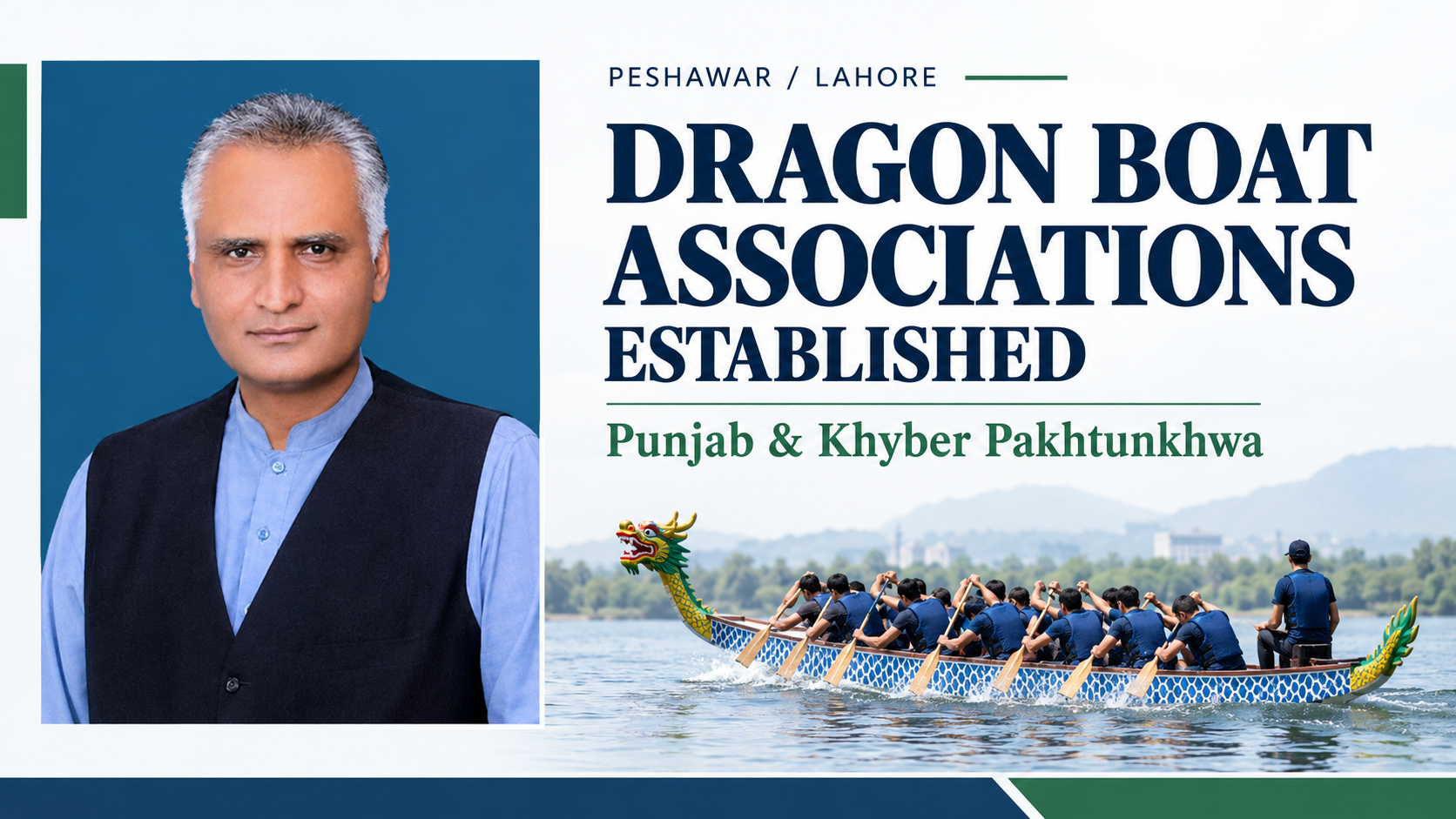
Dragon Boat Associations Established in Punjab and Khyber Pakhtunkhwa
PSHAWAR/LAHORE: Dragon boat associations have been established in Punjab and Khyber Pakhtunkhwa, marking a step towards organising and promoting the sport across Pakistan.
Prominent political and social figure Ameer Bahadur Khan Hoti will serve as president of the Punjab Dragon Boat Association (PDBA), while a notification has been issued confirming the election of former bureaucrat Javed Marwat as president of the Khyber Pakhtunkhwa Dragon Boat Association (KPDBA). At a meeting in Lahore, prominent sports journalist Muhammad Yousuf was elected secretary general of the Punjab association. Uzma Zaidi will serve as senior vice president and Naveed Akhtar Malik as treasurer.
At a separate meeting in Peshawar, Javed Marwat, who previously held several senior administrative positions in the province, was unanimously elected president of the Khyber Pakhtunkhwa association, while renowned sports organiser Naeem Gul was elected secretary general. Shamim Akhtar Jadoon will serve as senior vice president, Junaid Khan vice president and Bilal Aslam as treasurer. Newly elected Punjab association president Ameer Bahadur Khan Hoti said Pakistan’s first dragon boat festival and competitions on the Kabul River had opened new avenues for the sport’s development. He said the enthusiasm shown by participants and the sport’s promising prospects had highlighted the need to establish a Pakistan Dragon Boat Federation to coordinate training, organise competitions and support athletes. Dragon boat associations would be established in all four provinces and the federal capital, Islamabad, before the formal announcement of the national federation, he added.
Newly elected Khyber Pakhtunkhwa association president Javed Marwat said efforts would focus on introducing the sport at the provincial level and providing athletes with opportunities to compete nationally and demonstrate their abilities. Teams would also be sent to represent Pakistan in international competitions. He said the sport would help strengthen people-to-people exchanges and further promote Pakistan-China friendship. Marwat expressed confidence that dragon boat racing would soon gain popularity throughout Pakistan.
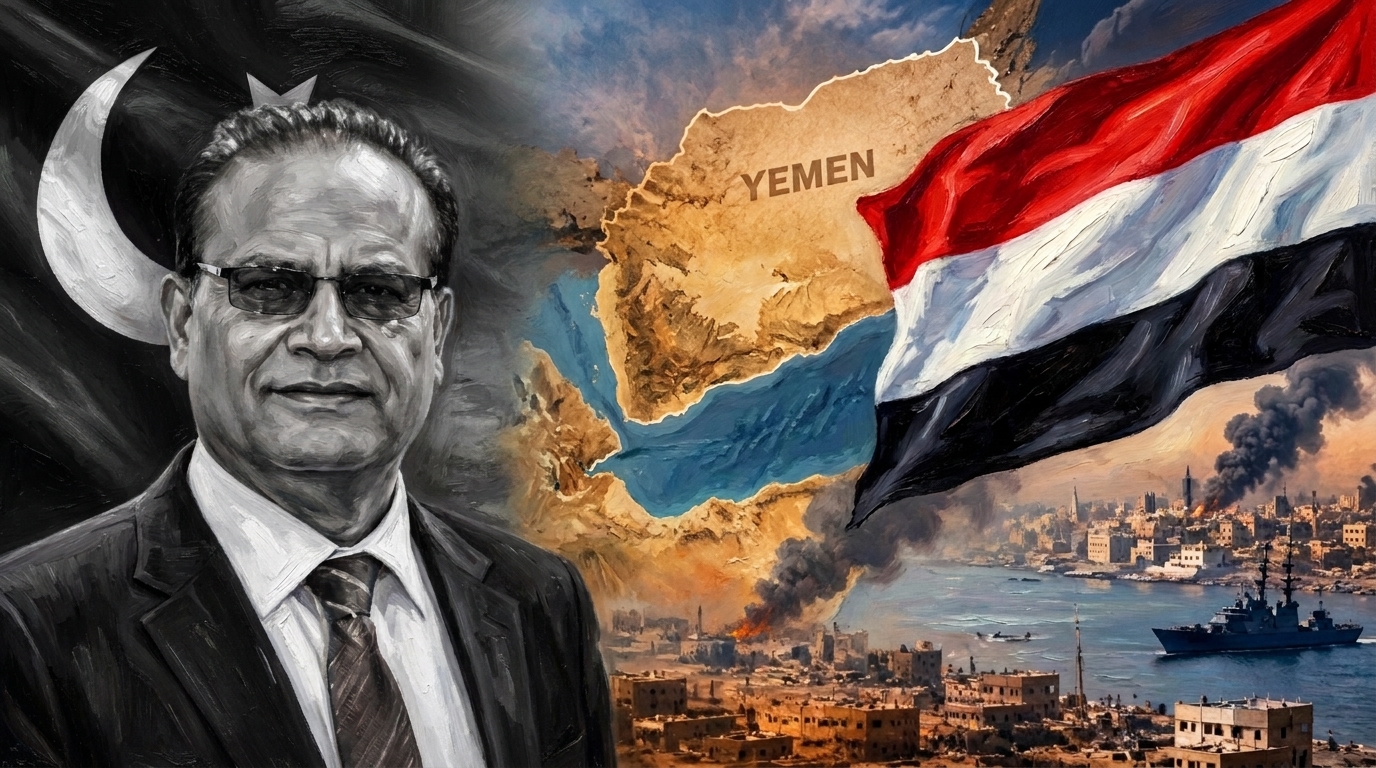
Paris (Imran Y. CHOUDHRY) :- Former Press Secretary to the President, Former Press Minister to the Embassy of Pakistan to France, Former MD, SRBC Mr. Qamar Bashir analysis : Pakistan’s military commitment to Saudi Arabia raises a question that cannot be answered simply by identifying where its soldiers are stationed. Modern warfare allows forces to attack through aircraft, missiles, drones and targeting support without sending infantry across a border. The decisive issue is whether Pakistani personnel and capabilities will participate in hostilities against Yemen’s Houthis—and what consequences could follow.
Scott Ritter, renowned American podcaster, military and geopolitical analyst captures the central danger: Saudi Arabia could obtain through collective defence the Pakistani involvement in Yemen that Islamabad previously resisted. An initially limited commitment could expand through casualties, retaliation and demands for reinforcement, leaving Pakistan responsible for a war whose objectives it does not control.
CNN reported on October 7 that Pakistani troops were already stationed in Saudi Arabia. In the interview, Lieutenant General Ahmed Sharif Chaudhry, director general of Inter-Services Public Relations, declined to disclose their numbers or capabilities. Asked about operations across the Yemeni border, he invoked military confidentiality, explaining that participating countries do not publicly disclose how and where they will employ their forces. His response offered no categorical exclusion of ground operations or offensive action inside Yemen, even as he described Pakistani involvement as defensive.
That distinction matters. Operational secrecy may protect military personnel, but it also leaves the public without clear answers about the mission’s boundaries. The description “defensive” cannot establish those boundaries by itself. Governments routinely invoke defence to justify attacks beyond their territory; the relevant questions concern what forces actually do, whom they target and under whose authority.
Pakistani forces operating from Saudi territory could potentially support or conduct attacks inside Yemen without deploying infantry there. Air operations and targeting assistance could carry substantial consequences. If Pakistani personnel participate in attacks against Houthi positions, Ansarullah could regard Pakistan as belligerent. Tehran could interpret the same activity as participation in a campaign against Iranian regional interests.
The Makkah Joint Defence Agreement, signed by Saudi Arabia, Pakistan and Türkiye on August 7, 2026, reportedly treats an attack against one member as an attack against all three. Its deterrent promise is substantial, but so is the danger of importing one member’s confrontation into the security calculations of the others.
An October 5 statement published by Türkiye’s Foreign Ministry committed the partners to implement collective defence arrangements and rapidly deploy agreed military forces and capabilities to Saudi Arabia, subject to national legislation. Türkiye therefore shares the deployment commitment. However, the evidence reviewed does not establish a Turkish ground combat commitment against the Houthis or an equal distribution of operational risks.
For Islamabad, the unanswered questions are fundamental. Who authorizes Pakistani involvement in cross-border attacks? Can Pakistan refuse a particular operation? Who finances a prolonged deployment, and what conditions permit withdrawal? Confidential operational details need not be published to explain the political mandate governing the use of force.
Pakistan brings potential strengths to the alliance: experienced personnel, established military institutions and longstanding cooperation with Riyadh. Saudi infrastructure and financing could support a substantial deployment. Islamabad’s relationships with both Riyadh and Tehran might also create diplomatic opportunities, provided military involvement does not undermine its credibility as an intermediary.
Yet those strengths do not resolve the weaknesses of an extended campaign. Destroying particular weapons or positions is different from ending an adversary’s ability and determination to fight. Dispersed forces, local networks and adaptation can frustrate superior firepower. Tactical gains could therefore coexist with an expanding mission and an elusive political settlement.
Ritter’s warning is strongest when understood in these terms. Predicting inevitable Pakistani defeat is less useful than asking what victory would require. Protecting defined facilities offers measurable objectives. Permanently eliminating the Houthi threat could entail commitments far beyond what Pakistan initially intended—and costs that additional military capability cannot necessarily overcome.
Saudi financial assistance complicates Islamabad’s freedom of choice. The State Bank of Pakistan confirmed that a $3 billion Saudi deposit maturing in December 2025 was extended for another year. Such support gives Pakistan a substantial interest in maintaining Saudi confidence.
Saudi’s financial influence does not require an explicit threat. A government facing external financing pressures may find it difficult to reject security requests from an important creditor. The danger is that short-term economic reassurance encourages military obligations carrying much greater long-term costs.
Iran introduces a further risk. Pakistani attacks against an Iranian-supported movement could damage relations with a neighbouring country and generate security pressures closer to home. The Houthis also possess their own Yemeni objectives, and attacking them is not automatically equivalent to attacking Iran. Political escalation, however, can advance through perceptions and retaliation before governments agree on legal distinctions.
International law offers no reliable assurance that this confrontation would remain contained. Legal obligations persist, but their enforcement is uneven, and states may invoke self-defence while pursuing military objectives beyond their borders. Pakistan therefore cannot assume that legal distinctions between defending Saudi territory and attacking Houthi positions would restrain retaliation. If Tehran perceives Pakistani operations as threatening its interests, the danger would turn on strategic calculations, perceived threats and the risk of escalation—not simply on competing interpretations of the UN Charter. Shared religion and geographical proximity would offer no dependable protection against that outcome.
Pakistan’s domestic divisions make a widening conflict especially consequential. The supporters of imprisoned former prime minister Imran Khan began marching from Khyber Pakhtunkhwa toward Islamabad on October 4, demanding his release, hospital treatment and family access. An overseas campaign would impose additional demands on resources and political legitimacy amid an already polarized environment.
Parliament’s April 2015 resolution remains relevant. It supported neutrality in Yemen alongside solidarity against threats to Saudi territorial integrity and the holy sites, while urging diplomacy through the United Nations and Organisation of Islamic Cooperation. That distinction deserves renewed parliamentary examination before military commitments overtake political debate.
Pakistan, Saudi Arabia and Türkiye should pursue an emergency OIC initiative linked to UN diplomacy, involving Iran and meaningful Yemeni participation. Reciprocal de-escalation, civilian protection and humanitarian access should take priority. Their collective influence should also sustain action for Palestinian rights rather than dissipate through another prolonged regional confrontation.
The Makkah Pact’s credibility will depend on whether it improves security. Secrecy about military methods cannot replace clarity about political objectives. Before Pakistan’s commitment deepens, its leaders must explain what they are defending, how far that obligation extends and how they intend to prevent it from becoming an open-ended war.
Pakistan News
Pakistan Reaffirms Commitment to Multilateralism, Peace and International Cooperation at the Executive Board of UNESCO
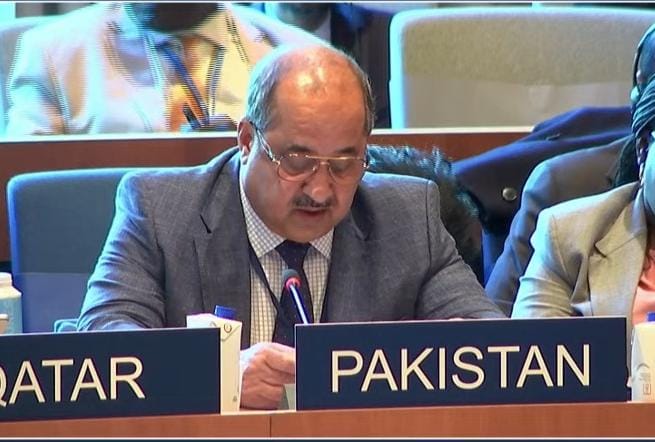
Paris ( Imran Y. CHOUDHRY):- Advisor to the Prime Minister of Pakistan and Representative of Pakistan to UNESCO, Syed Tauqeer Hussain Shah, delivered Pakistan’s national statement at the 225th Session of the UNESCO Executive Board in Paris, France, reaffirming its steadfast commitment to multilateralism, international cooperation and the promotion of peace through dialogue and mutual understanding.
In his statement,
- Underscored Pakistan’s firm support for multilateral institutions, South-South cooperation and collaborative efforts to address global challenges, particularly those confronting developing countries;
- Highlighted the urgent need to protect human life, educational institutions and cultural heritage amid conflicts and crisis, especially in Gaza;
-Called for an international action plan to confront the challenge of out-of-school children;
- Stressed the importance of equitable access to scientific knowledge, international scientific collaboration and reducing technological inequalities;
-Underlined the need to combat racism, misogyny, Islamophobia, disinformation and hate speech, while encouraging responsible and ethical governance of artificial intelligence and emerging technologies; and
- Expressed support for institutional reform of UNESCO to enhance its effectiveness and impact worldwide.


New Chapter for Dragon Boating in Punjab and Khyber Pakhtunkhwa Provincial associations officially set up with sights locked on national competitions and international representation.

Pakistan’s Yemen Dilemma

U.S. Sanctions the International Criminal Court to Shield Netanyahu

South Korea’s Yoo Useong Steps Onto the Global Strongman Stage as World Strongman Federation Professional Athlete
New Chapter for Dragon Boating in Punjab and Khyber Pakhtunkhwa Provincial associations officially set up with sights locked on national competitions and international representation.

A Survey of Mata-E-Zeest


-
 Sports4 months ago
South Korea’s Yoo Useong Steps Onto the Global Strongman Stage as World Strongman Federation Professional Athlete
-
 Pakistan News2 days ago
New Chapter for Dragon Boating in Punjab and Khyber Pakhtunkhwa Provincial associations officially set up with sights locked on national competitions and international representation.
-
 Art & Culture1 year ago
A Survey of Mata-E-Zeest
-

 Europe News2 years ago
Chaos and unproven theories surround Tates’ release from Romania
-

 American News2 years ago
Trump expands exemptions from Canada and Mexico tariffs
-

 American News2 years ago
Trump Expels Zelensky from the White House
-

 Art & Culture2 years ago
Will Snow White be a ‘victim of its moment’? How the Disney remake became 2025’s most divisive film
-

 Entertainment2 years ago
Champions Trophy: Pakistan aim to defend coveted title as historic tournament kicks off today