
Crime
Minorities in Pakistan


11th August is marked as the National Day of Minorities. It is our need of the hour as a country to achieve this very harmonious wave within our state, legal frame-work and social fabric of society. In many various dimensions we may seek guidance from Shariah. If we open heartedly perceive, it is very clear within the Holy Quran, Al Baqra verse 256 that “there is no compulsion in Religion”. Further another mentioning in Sura Kaafiroon “You have your way, and I have my way.”

Alongside we find a constitutional regime of a state promise of protection under the tax called Jizyah incorporated in Sura Tawba verse 29. In Sunnah we find different cases where the Holy Prophet Peace Be Upon Him showed exemplary behaviors towards non-Muslims in each and all respects as for instance at the time of Misak-e-Madina, special provisions from in article 30 to 40 of said Document “for protection of minorities “were added specifically making this document first ever Written Constitutional Document in Islamic and world history. The Messenger of Allah (pbuh) attached the highest importance to protecting the life, honour and wealth of all people. Mentioning the life and wealth of people sacred like Kaa’ba he stopped the ongoing bloodshed forever. Abdullah Ibn Abbas (RA) narrated that Allah’s Messenger (pbuh) delivered a sermon on the Day of Nahr, and asked, “ ‘O people! (Tell me) what is the day today?’ The people replied, ‘It is the forbidden (sacred) day.’ He asked again, ‘What town is this?’ They replied, ‘It is the forbidden (Sacred) town.’ He asked, ‘Which month is this?’ They replied, ‘It is the forbidden (Sacred) month.’ He said, ‘No doubt! Your blood, your properties, and your honour are sacred to one another like the sanctity of this day of yours, in this (sacred) town (Makkah) of yours, in this month of yours.’” (Sahih Bukhari).
In Pakistan, the protection of minority rights has been a subject of significant discussion and concern. The Constitution of Pakistan provides some safeguards for minority communities, but the extent and effectiveness of these protections can and does vary. A very strong legal incorporation within the constitutional domain is awaited in its enforcement in its true letter and spirit as it says in the Preamble to Constitution of Pakistan 1973 “Wherein adequate provision shall be made for the minorities freely to profess and practise their religions and develop their cultures.”
A significant reference of Mr. Ardeshir Cowasjee’s article ‘The sole statesman’ published in Dawn in July of 2000 makes an interesting and honest observation of discrepancy with regard to the word “freely” between the original Objectives Resolution and the Annex inserted into the Constitution by P. O. 14 of 1985. The word “freely”, which appears in the original Resolution now Preamble, was missing from the clause: “Wherein adequate provision shall be made for the minorities to freely profess and practice their religions and develop their cultures;”. This has now been corrected by the Constitution (Eighteenth Amendment) Act, 2010 leaving 25 years with a question mark on history of Pakistan.
Furthermore, in guaranteeing fundamental rights Article 20 promises freedom to profess religion and to manage religious institutions. Going further it provides safeguarding against taxation for purposes of any particular religion under Article 21. Concept of protection is clearly manifested even under Article 22, safeguarding educational institutions with respect to any kind of coercion in respect of religion. Article 25 guarantees equality before the law and equal protection of the law. Through Article 36, the state has been made responsible to safeguard the legitimate rights and interests of the minority communities.
Let’s figure out steps taken in furtherance of guarantees promised by Constitutional regime, to evaluate the challenges and faulities so far. Here we see an historical milestone achievement for Sikh community in the shape of Passage of first ever Sikh Marriage Act which surely is an iconic example. As mentioned in The Bramptonguardian.com on August 6, 2008 “The organization, International Punjabi Foundation, last weekend feted visiting Shariah Court judge Syed Afzal Haider, who has just managed to get Sikh marriages recognized in Pakistan – the world’s first country to give legal status to Sikh marriages. Haider was Pakistan’s federal law minister when he piloted the Anand Marriage Act into law. Later this law formulated its final stage in the shape of Sikh Marriage Act 2024 as manifested by Minister for Minorities Affairs, Mr.Ramesh Singh Arora, who briefed the cabinet that Punjab had become the first province in the world to implement Sikh Marriage Act and resultingly Sikhs from other provinces and countries could come to Punjab for registration of their marriage. Further referring to passage by President of Pakistan who has signed into law “the Christian Marriage (Amendment) Act 2024”, during a special ceremony, held at Aiwan-e-Sadr. The Act provides for raising the marriageable age for Christian men and women to eighteen years. HINDU MARRIAGE ACT, 2017 is a step further in where law paves the way for regulations on registration of marriages and divorce for Hindus and fixes the minimum marrying age for males and females at 18 years-old. This Act aims to provide for solemnization of marriages by Hindu families and for matters ancillary and incidental thereto and advancement towardsconstitutional obligation that the state shall protect the marriage, the family, the mother and the child and also safeguard the legitimate, rights and interests of minorities.
Challenges and Concerns of today ! Concerns of religious minorities are exacerbated by minimal or zero representation of these communities in key public institutions. The Constitution of Pakistan guarantees fundamental rights, including equality of status, of opportunity and before law, social, economic and political justice, and freedom of thought, expression, belief, faith, worship and association, “subject to the law and public morality” to its citizens. Pakistan is a country and realistically an amalgamation of various cultures, ethnicities, languages, religions, sects and sub-sects. It was created on the principles of a democratic nation, which would ensure that, “everyone has the right to take part in the government of his country, directly or indirectly or through freely chosen representatives as ensured and reinforced under Universal Declaration of Human Rights, Article 21 (1). Ninety- five percent of Pakistan’s population is Muslim while the remaining 5% is comprised of Hindus, Christians, Parsis, Ahmadis and a few other denominations. Having a look into workforce participation as women, it’s disappointing that only two percent of minority women work variably as teachers, doctors, nurses, professors or in an office, evidencing their economic marginalization both in formal and informal work.
Looking back on 11th of August, 1948, the Presidential Address to the constituent Assembly of Pakistan by father of Nation; Quaid-e-Azam Mohammad Ali Jinnah, where we clearly conceive, understand , perceive and absorb the following;
“You are free; you are free to go to your temples, you are free to go to your mosques or to any other places of worship in this state of Pakistan. You may belong to any religion or caste or creed that has nothing to do with the business of the State. You will find that in course of time Hindus would cease to be Hindus and Muslims would cease to be Muslims, not in the religious sense, because that is the personal faith of each individual, but in the political sense as citizens of the state”.(11-08-1947).
In Pakistan, the protection of minority rights has been a subject of significant discussion and concern. The Constitution of Pakistan provides some safeguards for minority communities, but the extent and effectiveness of these protections can and does vary. Earnest addressal and redressal is the need of time today if we need to create and witness a harmonious and peaceful societal thread and ethnic fabric within our dear country, Pakistan. Implementation and enforcement of Constitution of Pakistan shall be in its true Letters and Spirit. This can be done through initiatives ranging from constitutional, legal, political, and educational reforms, to affirmative initiatives in order to eliminate discrimination and inequality from society.
From violent attacks like this, to social exclusion and harassment, in Pakistan minority-religion members face discrimination daily. This causes socio-political and economic exclusion, and severe marginalization in all aspects of life.The international community must make more concrete efforts to support the cause.Here notable reference is worth mentioning of the National Commission of Human Rights Report July 2024 emphasizing on need to ensure fairness and transparency in implementation of minority quota within employment. To this end, the NCHR advises the Government of Pakistan to empower the National Commission for Minorities to monitor compliance of both; the minority employment quota and the hiring policy regarding non-Muslims introduced within federal and provincial governments. Further, it is advised that special attention be given to empowering women within minority classes to ensure that they have access to employment as well without any discrimination.Specialized police units trained to deal with minority violence are established although a step towards it is evident in the form of Meesaq Centres. Meesaq Centres have been established in all the districts of the province. IG Dr Usman Anwar said that for the protection of the rights of minorities, and the promotion of inter-faith harmony, the Meesaq Centres have been activated in every district and sub-divisions with majority of minorities. Despite the existence of legislation in Pakistan aimed at safeguarding minority groups, there exists a discrepancy between the intended impact of the law and its practical enforcement. Major reason cited for the lack of execution is the “inadequate education and lack of sensitized special training and behavioural approaches provided to key stakeholders in the field of law enforcement, specifically those who serve as police officers” which is the challenge for Law enforcement institutions today.
Challenges and Concerns of today are much more! Lack of acess to advanced education and vocational training and discrimination against non-Muslim students in Pakistani educational institutions is a common widespread issue. Students from minority groups are often subjected to physical, emotional and psychological abuse, including harassment, bullying, assault, and forced conversions. It is often reported that teachers overlook , disregard, or even contribute to this discrimination. In some urban areas, to the extent of Muslim students being forbidden from using the same bathrooms or drinking from the same water sources as Muslim students. It is eye opening fact that religious minority groups such as Christians are over-represented in Pakistan’s slum settlements, though they are not exclusively inhabited by these minorities.
Absence of possession and property titles signify that the inhabitants are incapable of having credits/loans from banks or monetary establishments to better their livelihoods. Frequently, there is a lack of educational institutions and healthcare facilities within or proximate to settlements, and the government does not supply essential amenities. The economy and cities of Pakistan will be significantly enhanced with the advent of safer, aesthetically pleasing, and more productive residential areas for minorities, as this will enable a substantial influx of individuals to join the workforce formal and informal both. Needless to say in crux that minority groups in Pakistan are deprived of several privileges that are the entitlements and eligibilities to the majority population. Consequently, the task of safeguarding the rights of minority groups in Pakistan is challenging and complex. Civil society and non-governmental organizations, along with the minority groups, play a critical and fundamental role in furthering and promoting the goal aiming towards protection of minority rights and their practical and effective implementation at the state level as it is incumbent upon us to respect mankind as it’s a clear direction by Allah Almighty under Surah Isra verse 70 “Indeed, We have dignified the children of Adam”





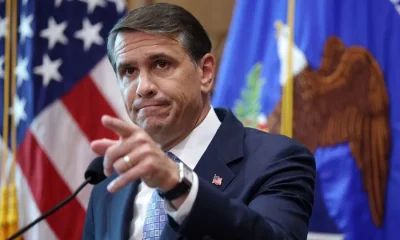


The prime minister has said Russian oligarch Roman Abramovich must “pay up now” to victims of the war in Ukraine or face court action.
Mr Abramovich, the former owner of Chelsea Football Club, pledged in 2022 that the £2.5bn he made from the sale of the club would be used to benefit victims of the Russian invasion of Ukraine.
But there has been a delay in releasing the funds, which are currently frozen in a British bank account, due to a standoff over how exactly they should be used.
Sir Keir Starmer told the Commons on Wednesday: “My message to Abramovich is clear: the clock is ticking.”
The government wants the money to be used for humanitarian aid, but Mr Abramovich insisted it should be used for “all victims of the war” – meaning that Russians could also benefit.
The oligarch cannot access the money under UK sanctions but the proceeds from the Chelsea sale still legally belong to him.
Updating MPs, Sir Keir said the UK had issued a licence “to transfer £2.5bn from the sale of Chelsea Football Club that’s been frozen since 2022.”
And, in a warning to Abramovich, he said: “Honour the commitment that you made and pay up now, and if you don’t we’re prepared to go to court and ensure that every penny reaches those whose lives have been torn apart by Putin’s illegal war.”
And Foreign Secretary Yvette Cooper told the BBC Mr Abramovich “needs to honour that commitment, pay that money”.
Asked if a legal battle could drag out the process for years, Ms Cooper said: “I’m urging him not to try and pursue further court action.”
But she confirmed the government will take the matter to court if he does not act.
Mr Abramovich’s representatives declined to comment.
The Treasury said that under the terms of the licence, the money must go to “humanitarian causes” in Ukraine and cannot benefit Mr Abramovich or any other sanctioned individual.
The government first threatened to sue Mr Abramovich in June.
Chancellor Rachel Reeves said: “It is unacceptable that more than £2.5bn of money owed to the Ukrainian people can be allowed to remain frozen in a UK bank account.”
Mr Abramovich – a Russian billionaire who made his fortune in oil and gas – was granted a special licence to sell Chelsea following Russia’s invasion of Ukraine, providing he could prove he would not benefit from the sale.
He is alleged to have strong ties to Russian President Vladimir Putin, something he has denied.
It is understood that Mr Abramovich has 90 days to act before the UK considers taking legal action.
On Thursday, EU leaders are set to review proposals to use proceeds from frozen Russian assets to support Ukraine’s huge budget and defence needs. Russia has fiercely opposed the proposals.
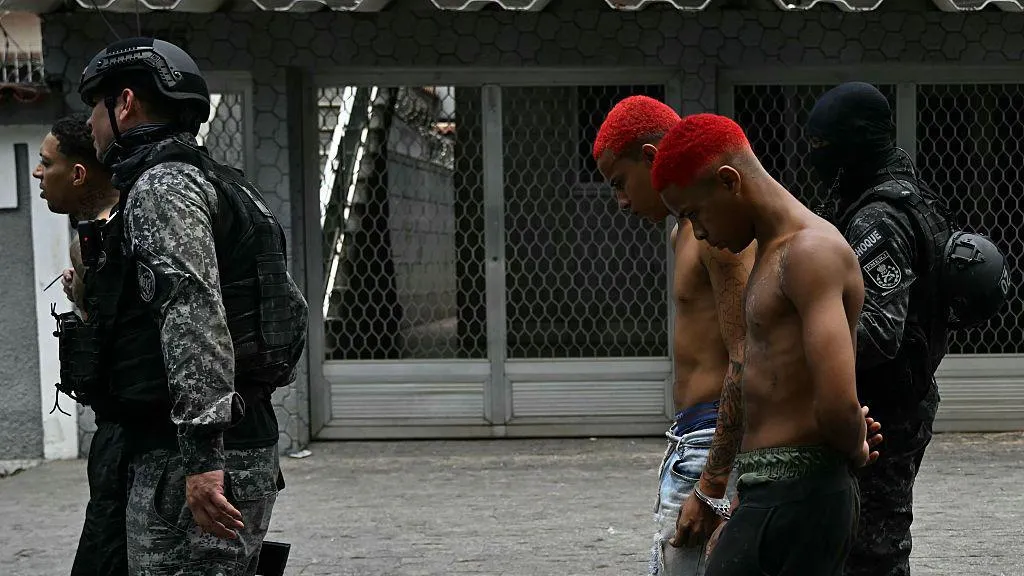
New details which have emerged in the aftermath of Brazil’s deadliest police operation are casting doubts over whether the raid really struck at the heart of one of the country’s most powerful criminal gangs, as was its stated aim.
One hundred and twenty one people, among them four police officers, were killed in the raid on 28 October in Rio de Janeiro.
The governor of Rio de Janeiro state, Claudio Castro, described the police operation as “a success”, posting a photo showing the more than 100 rifles seized by police.
But rights groups have sharply criticised the security forces pointing to the high death toll and what they have described as the “brutality” of their actions.
The operation was the largest ever carried out by Rio’s security forces and saw 2,500 officers deployed to the Alemão and Penha neighbourhoods.
It targeted the Comando Vermelho (Red Command) criminal gang, which rules over the nine-million-square-metre area.
Rio’s public safety secretary, Victor dos Santos, told Reuters that the goal of the operation had been to carry out scores of arrest warrants issued by prosecutors.
But when BBC Brasil cross-checked the list of the deceased published by police against the 68 names on the list of suspects provided by prosecutors, it found that none of them matched.
Local media have also pointed out that even though scores of suspects were arrested during the raid, the man considered the gang’s most powerful leader, Edgar Alves de Andrade, also known as Doca, was not among them.
“Early reports stated that the goal of the operation was to capture high-ranking leaders of the Comando Vermelho (CV),” Carlos Schmidt-Padilla, professor of public policy at the University of California, Berkeley, told BBC Brasil.
“By that metric, it is fair to say the operation failed.”
At a Senate hearing, the deputy intelligence secretary for Rio’s military police stated that the raid had had a “negligible” impact on dismantling Comando Vermelho.
Residents of the Alemão and Penha have also told the BBC that it has done little to loosen the tight grip the CV has on their favelas.
How Rio’s gangs rule through fear and control
They said that their daily lives had barely changed since the mega-operation, describing seeing armed men roaming the community the very next day, even as the bodies of those killed were still being removed.
Comando Vermelho (CV) and groups like it enforce strict rules in the areas they control.
These criminal enterprises have moved beyond the sale of drugs and now hold the monopoly for the provision of gas, cable television, internet and transport.
Residents report being charged over the odds for gas cylinders, often having to pay one third more than in zones not under gang control.
Rules imposed by gang members affect everyday life.
As CV has banned cars working for ride-hailing apps from entering the favelas, locals are restricted to using motorbike taxis and vans which have been authorised by the gangs to operate there.
Even people’s clothing is policed by the gang. In 2020, residents of Penha were told not to wear Chelsea football shirts.
At the time, the jerseys were sponsored by British telecoms company Three, but CV members did not like the number being prominently displayed because it reminded them of a rival gang which happened to have the number three in its name: Terceiro Comando Puro (Pure Third Command).

Punishments for what are considered transgressions are extremely harsh. Being caught stealing can mean losing a hand or being burned alive.
Gang members “sit in judgement” over domestic violence cases and those found guilty are beaten or even executed.
Residents are forbidden from engaging in relationships with members of rival factions or with police officers.
They also know not to photograph or film drug dens or any of the armed men driving through their community.
But with mobile phone use ubiquitous, even gangs as powerful as Comando Vermelho struggle to control what gets posted online.
In Rocinha, a favela under CV control, gang members vowed to kill those who leaked a 2020 video showing a CV leader surrounded by rifles and machine guns.
When someone insists on “causing trouble”, the group often resorts to assault and torture.
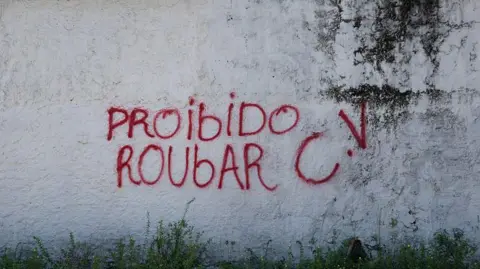
Police investigation files on Comando Vermelho, seen by the BBC, contain disturbing images.
One shows a woman forcibly submerged in an ice bath, accompanied by a caption accusing her of being “aggressive” and “causing trouble”.
Reports of growing violence and expanding territorial control by Comando Vermelho formed the basis of the complaint filed by Rio’s Public Prosecutor’s Office which led to the massive police operation on 28 October.
And while rights groups labelled it a “massacre” and questioned its effectiveness, Rio de Janeiro State Governor Claudio Castro has announced that more operations against organised crime will follow.
A poll conducted by AtlasIntel suggests that Castro’s approval rating has risen since the raid, and at 47% now stands higher than that of the president, Luiz Inácio Lula da Silva.
President Lula, for his part, has announced that the federal government would launch an investigation into the raid.
But in a post on Instagram published on 11 November, Governor Castro said he would “not back down”.
“Law-abiding citizens can’t take it anymore. Rio has fought back – and the whole of Brazil is fighting back with us.”
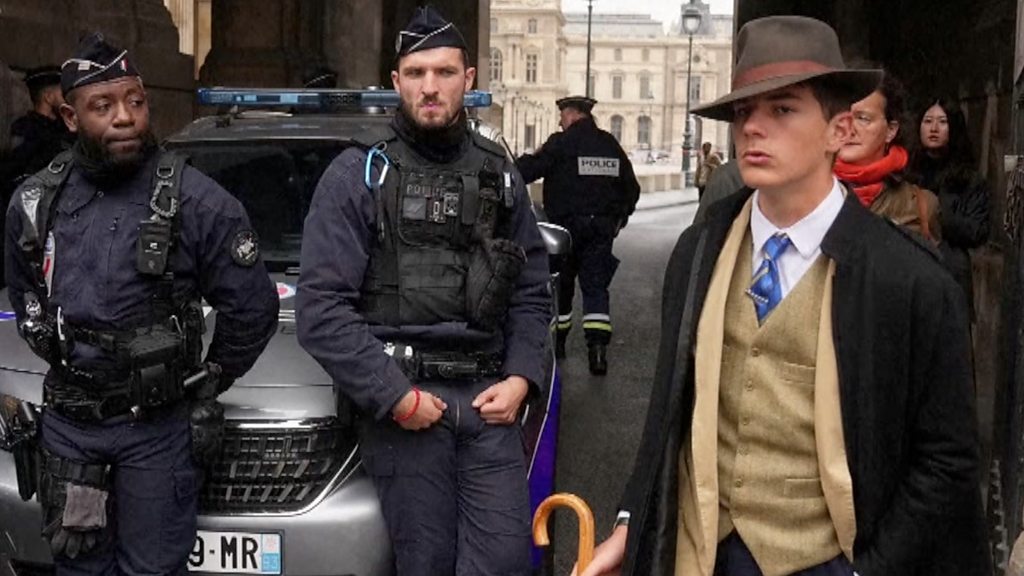
In the three weeks since the Louvre museum heist, as investigators sought to find out who was behind it and why the French crown jewels had been so easy to steal, another mystery remained: who the “fedora man” was.
The dapper youth in a hat was photographed outside the museum that Sunday and went viral on social media, prompting theories about his identity.
The first two mysteries were swiftly settled. The thieves’ carelessness with DNA allowed police to work out their identities. The Louvre director admitted CCTV security was inadequate.
However, the fedora man remained an enigma – until now.
The dandy, it turns out, is a local teenage fan of Sherlock Holmes and Hercule Poirot who just happened to be at a real crime scene.
Pedro Elias Garzon Delvaux, a 15-year-old from Rambouillet, south-west of Paris told the Associated Press (AP) news agency that he had planned to visit the Louvre with his family but found the museum was closed.
“We didn’t know there was a heist,” he said.
As he asked officers about the closure, an AP photographer seeking to capture the security cordon took a picture and included Pedro in the frame.
Pedro only realised the photo had gone viral four days later, when a friend sent him a screenshot asking: “Is that you?”
When he replied that it was, the friend said he had five million views on TikTok. “I was a bit surprised,” Pedro told the AP.
He was even more shocked when his mother called to say the picture had appeared in The New York Times. It made a big impact on him, he said, because he reads that newspaper and “it’s not every day you’re in the New York Times”.
“People said, ‘You’ve become a star’. I was astonished that just with one photo you can become viral in a few days.”
Asked why he wore an old-fashioned waistcoat and a fedora to the museum, Pedro said he began dressing this way recently, inspired by 20th-century statesmen and fictional detectives.
“I like to be chic,” he told the AP. “I go to school like this.”
As wild speculation about the photo of him circulated online – some wondered whether he might be a real detective or an AI fake – Pedro remained silent for weeks.
“I didn’t want to say immediately it was me,” he said. “With this photo there is a mystery, so you have to make it last.”


CM Murad asks authorities to boost polio vaccination across Sindh

Dealers await answers as fuel subsidy rollout begins

Islamabad, Beijing activate joint border commission


-
 Sports3 months ago
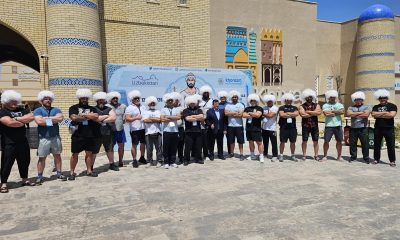
South Korea’s Yoo Useong Steps Onto the Global Strongman Stage as World Strongman Federation Professional Athlete
-

 Art & Culture1 year ago
A Survey of Mata-E-Zeest
-

 Europe News2 years ago
Chaos and unproven theories surround Tates’ release from Romania
-

 American News2 years ago
Trump expands exemptions from Canada and Mexico tariffs
-

 American News2 years ago
Trump Expels Zelensky from the White House
-

 Art & Culture2 years ago
Will Snow White be a ‘victim of its moment’? How the Disney remake became 2025’s most divisive film
-

 Entertainment2 years ago
Champions Trophy: Pakistan aim to defend coveted title as historic tournament kicks off today
-

 Pakistan News1 year ago
Comprehensive Analysis Report-The Faranian National Conference on Maritime Affairs-By Kashif Firaz Ahmed