
Art & Culture
The unseen masterpieces of Frida Kahlo

Lost or little-known works by the Mexican artist provide fresh insights on her life and work. Holly Williams explores the rarely seen art included in a new book of the complete paintings.
You know Frida Kahlo – of course you do. She is the most famous female artist of all time, and her image is instantly recognisable, and unavoidable. Kahlo can be found everywhere, on T-shirts and notebooks and mugs. While writing this piece, I spotted a selection of cutesy cartoon Kahlo merchandise in the window of a shop, maybe three minutes’ walk from my home. I bet many readers are similarly in striking distance of some representation of her, with her monobrow and traditional Mexican clothing, her flowery headbands and red lipstick.
Partly, this is because her own image was a major subject for Kahlo – around a third of her works were self-portraits. Although she died in 1954, her work still reads as bracingly fresh: her self-portraits speak volumes about identity, of the need to craft your own image and tell your own story. She paints herself looking out at the viewer: direct, fierce, challenging.
All of which means Kahlo can fit snugly into certain contemporary, feminist narratives – the strong independent woman, using herself as her subject, and unflinchingly exploring the complicated, messy, painful aspects of being female. Her paintings intensely represent dramatic elements of a dramatic life: a miscarriage, and being unable to have children; bodily pain (she was in a horrific crash at 18, and suffered physically all her life); great love (she had a tempestuous relationship with the Mexican artist Diego Rivera, as well as many other lovers, male and female, including Leon Trotsky), and great jealousy (Rivera cheated on her repeatedly, including with her own sister).
Kahlo has become a bankable blockbuster topic, guaranteed to get visitors through the door
But thats not all they show – her art is not always just about her life, although you could be forgiven for assuming it was. Books are written about her trauma, her love life; she’s been the subject of a Hollywood movie starring Salma Hayek. Kahlo has become a bankable blockbuster topic, guaranteed to get visitors through the door of galleries, even if what they see is often more about the woman than her art.
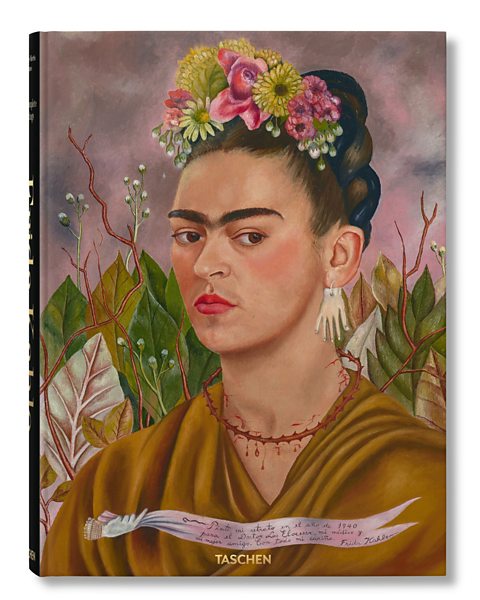
But what about her work? For some art historians, the relentless focus on the person rather than the output has become tiresome, which is why a new, monumental book – Frida Kahlo: The Complete Paintings – has just been published by Taschen, offering for the first time a survey of her entire oeuvre. Mexican art historian Luis-Martín Lozano, working with Andrea Kettenmann and Marina Vázquez Ramos, provides notes on every single Kahlo work we have images of – 152 in total, including many lost works we only know from photographs.
Speaking to Lozano on a video call from Mexico City, I ask if a comprehensive survey of her work is overdue, despite there being so many shows about her all over the world?
“As an art historian, my main interest in Kahlo has been in her work as an artist. If this had been the main concern of most projects in recent decades, maybe I would say this book has no reason to be. But the truth is, it hasn’t,” he says. “Most people at exhibitions, they’re interested in her personality – who she is, how she dressed, who does she go to bed with, her lovers, her story.”
Because of this, exhibitions and their catalogues have often focused on that story, and tend to “repeat the same paintings, and the same ideas about the same paintings. They leave aside a whole bunch of works,” says Lozano. Books also re-tread the same ground: “You repeat the same things, and it will sell – because everything about Kahlo sells. It’s unfortunate to say, but she’s become a merchandise. But this explains why [exhibitions and books] don’t go beyond this – because they don’t need to.”
The result is that certain mistakes get made – paintings mis-titled, mis-dated, or the same poor-quality, off-colour photographs reproduced. But it also means that ideas about what her works mean get repeated ad infinitum. “The interpretation level becomes contaminated,” suggests Lozano. “All they say about the paintings, over and over, is ‘oh it’s because she loved Rivera’, ‘because she couldn’t have a kid’, ‘because she’s in the hospital’. In some cases, it is true – but there’s so much more to it than that.”
The number of paintings – 152 – is not an enormous body of work for a major artist. And yet, astonishingly, some of these havenever been written about before: “never, not a single sentence!” laughs Lozano. “It’s kind of a mess, in terms of art history.”
Offering a comprehensive survey of her work means bringing together lost or little-known works, including those that have come to light in auctions in the past decade or so, and others that are rarely loaned by private collectors and so have remained obscure. Lozano hopes to open up our understanding of Kahlo. “First of all – who was she as an artist? What did she think of her own work? What did she want to achieve as an artist? And what do these paintings mean by themselves?”
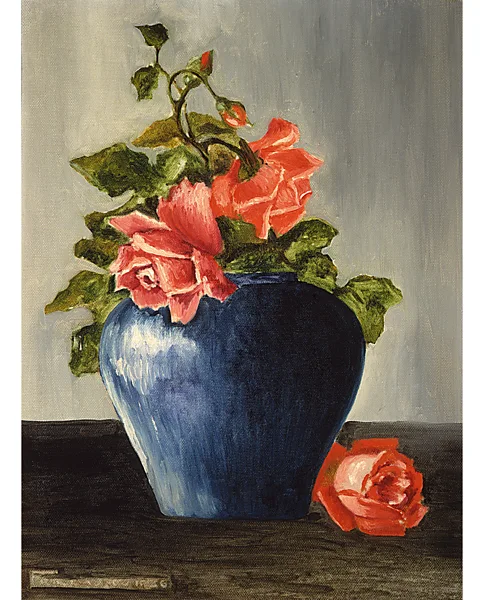
This means looking again at early works, which might not be the sort of thing we associate with Kahlo – but reveal how much she was inspired by her father, Guillermo, a professional photographer and an amateur painter of floral still lifes. Pieces such as the little-known Still Life (with Roses) from 1925, which has not been exhibited since 1953, are notably similar in style to his.
Kahlo continued to paint astonishing, vibrant still lifes her whole career – although they are less well-known to the general public than her self-portraits, less collectable, and less studied. An understanding of their importance to her has been strengthened since Lozano and co discovered documents revealing Kahlo’s life-long interest in the symbolic meaning of plants. She learnt this from her father, and discussed it in letters with her half-sister Margarita (her father’s child from an earlier marriage), who became a nun.
The missing links
Kahlo and Margarita’s letters “talk about the symbolic meaning of flowers and fruits and the garden of Eden, that our body is like a flower we have to take care of because it was ripped off from paradise,” says Lozano. “This is amazing, and proves why this topic of still lifes and flowers had such meaning to her.”
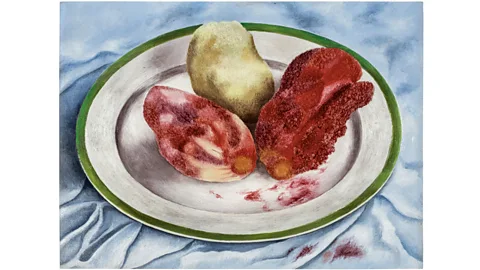
He offers a new interpretation of a painting from 1938, called Tunas, which depicts three prickly pears in different stages of ripening – from green and unripe to a vibrant, juicy, blood-red – as representing Kahlo’s own understanding of her maturation as an artist and person, but as also potentially having religious symbolism (the bloody flesh evoking sacrifice).
The Complete Paintings book also takes pains to reveal the depths of Kahlo’s intellectual engagement with art-world developments – countering the notion that she was merely influenced by meeting Rivera in 1928, or that her work is some self-taught, instinctive howl of womanly pain. Her paintings reveal Kahlo’s research into and experiments in art movements, from the youthful Mexican take on Modernism, Stridentism, to Cubism and later Surrealism.
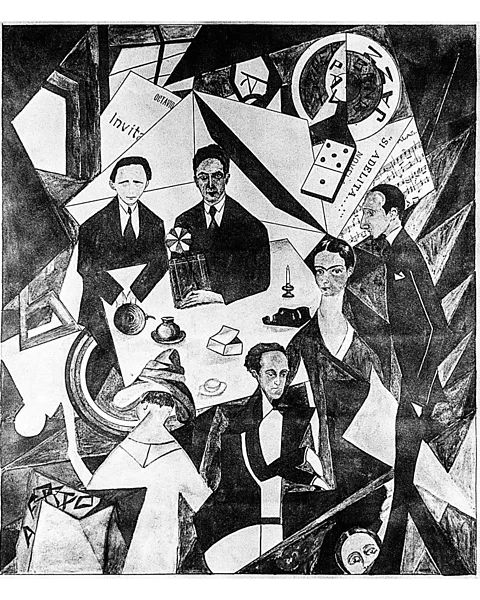
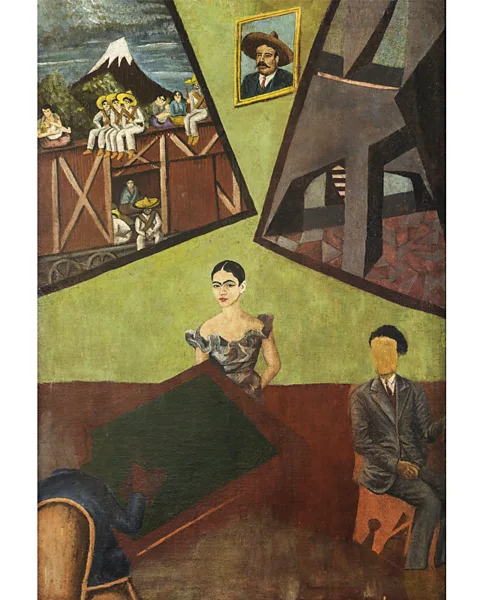
“Frida Kahlo’s paintings were not only the result of her personal issues, but she looked around at who was painting, what were the trends, the discussions,” says Lozano. He points to her first attempts at avant-garde paintings – 1927’s Pancho Villa and Adelita, and the lost work If Adelita, both of which use sharp, Modernist lines and angles – as proof that “she was looking at trends in Mexican art even before she met Rivera”.
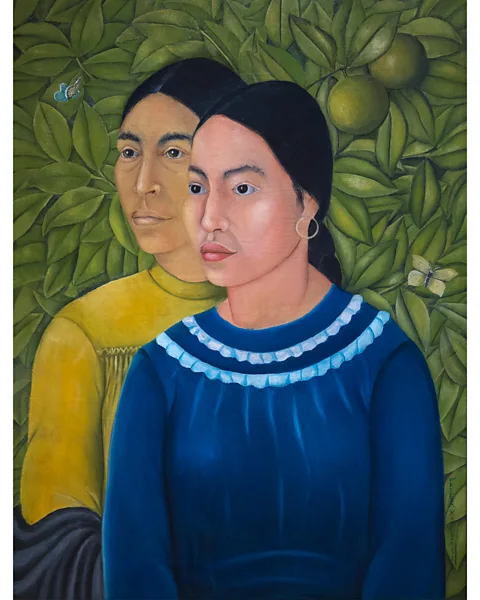
You can also see her interest in Renaissance Old Masters, which she discovered prints of in her father’s library, in early work: it’s suggested her 1928 painting, Two Women (Portrait of Salvadora and Herminia), depicting two maids against a lush, leafy background, was inspired by Renaissance portraiture traditions, as seen in the works of Leonardo da Vinci. Bought in the year it was painted, the location of this work remained unknown until it was acquired by the Museum of Fine Arts, Boston, in 2015.
Given she only made around 152 paintings, a surprising number are lost. But then, Kahlo wasn’t so successful in her lifetime – she didn’t have so many shows, or sell that many works through galleries and dealers. Instead, many of her paintings were sold or given away directly to artists, friends and family, as well as movie stars and other glittering admirers, often living abroad. That means less of a paper trail, making it harder to track down works.
There are some astonishing paintings still missing
In honesty, looking at black-and-white pictures of lost portraits probably isn’t going to prove revelatory to anyone beyond the most hard-core scholars – although there are some astonishing paintings still missing. One lost 1938 image, Girl with Death Mask II, depicts a little girl in a skull mask in an empty landscape; it chills, and we know Kahlo discussed this painting in relation to her sorrow at being unable to conceive. Check your attics, too, for Kahlo’s painting of a horrific plane crash – which we only have a photograph of now – which she’s known to have made in a period of great personal turmoil in the years after discovering her sister’s affair with Rivera in 1935.
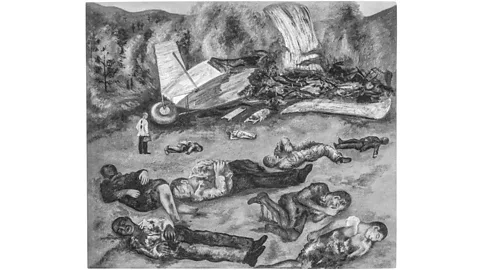
Like another of her very well-known paintings, Passionately in Love or A Few Small Nips, depicting a woman murdered by her husband, The Airplane Crash was based very closely on a real-life news report; Lozano’s team have unearthed both original articles in their research. While Kahlo may have been drawn to these traumatic events because she was suffering pain in her own life, her degree of almost documentary precision in external news stories here should not be overlooked.
Kahlo was an avowed Communist, and politically engaged all her life, but it is in less well-known works from the final years of her life where you see this most explicitly emerge. At this time, she suffered a great deal of pain, and underwent many operations, eventually including amputation below the knee. But Kahlo continued painting till 1953, with difficulty but also with renewed purpose. Her biographer Raquel Tibol documented her saying: “I am very concerned about my painting.
More than anything, to change it, to make it into something useful, because up until now all I have painted is faithful portraits of my own self, but that’s so far removed from what my painting could be doing to serve the [Communist] Party. I must fight with all my strength so that the small amount of good I am able to do with my health in the way it is will be directed toward helping the Revolution. That’s the only real reason for living.”
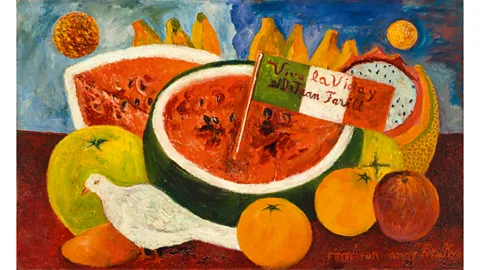
This resulted in works like 1952’s Congress of the Peoples for Peace (which has not been exhibited since 1953), showing a dove in broad fruit tree – and two mushroom clouds, representing Kahlo’s nightmares about nuclear warfare. She became an active member of many peace groups – collecting signatures from Mexican artists in support of a World Peace Council, helping form the Mexican Committee of Partisans for Peace, and making this painting for Rivera to take to the Congress of the Peoples for Peace in Vienna in 1952.
Doves feature in several of her late still lifes – as do an increasing number of Mexican flags or colour schemes (using watermelons to reflect the green, white and red of the flag), suggesting Kahlo’s intention was that her work should show her nationalism and Communism. More uncomfortably, her final paintings include loving depictions of Stalin, as her politics became more militant.
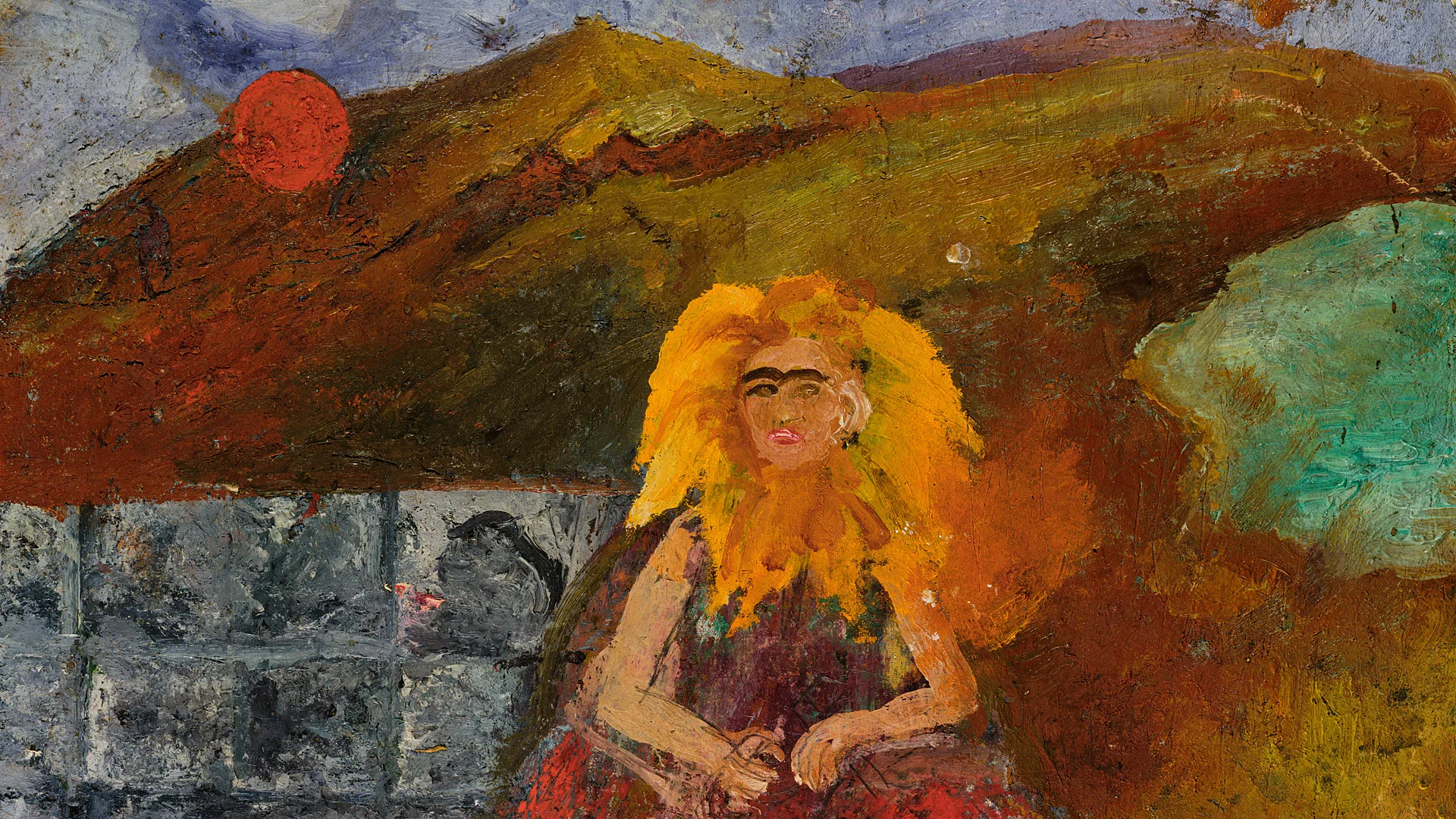
Perhaps her most moving late painting, however, is a self-portrait: Frida in Flames (Self-portrait Inside a Sunflower). It’s harrowing, painted in thick, colourful impasto; shortly before her death, Kahlo slashed at it with a knife, scraping away the paint, frustrated at her inability to make work or perhaps in an acknowledgment that her end was nearing. Tibol, who was witness to this decisive, destructive act, called it “a ritual of self-sacrifice”. “It’s a tremendous image,” says Lozano.
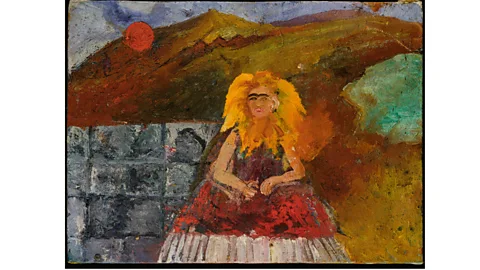
“It’s very interesting in terms of aesthetics – when your body is not working anymore, when your brain is not enough to portray what you want to paint, the only source she’s left with is to deconstruct the image. This is a very contemporary, conceptual position about art: that the painting exists not only in its craft, but also what I think the painting stands for.”
We are left with a painting that is imperfect, certainly a world away from the fine, smooth surfaces and attention to detail of Kahlo’s more famous self-portraits – but it nonetheless is an astonishingly powerful work that deserves to be known. There is something tremendously poignant in an artist so well-known for crafting their own image using their final creative act to deliberately destroy that image. Even in obliterating herself, Kahlo made her work speak loudly to us.
Frida Kahlo: The Complete Paintings is published by Taschen.
Love film and TV? Join BBC Culture Film and TV Club on Facebook, a community for cinephiles all over the world.
If you would like to comment on this story or anything else you have seen on BBC Culture, head over to our Facebook page or message us on Twitter.

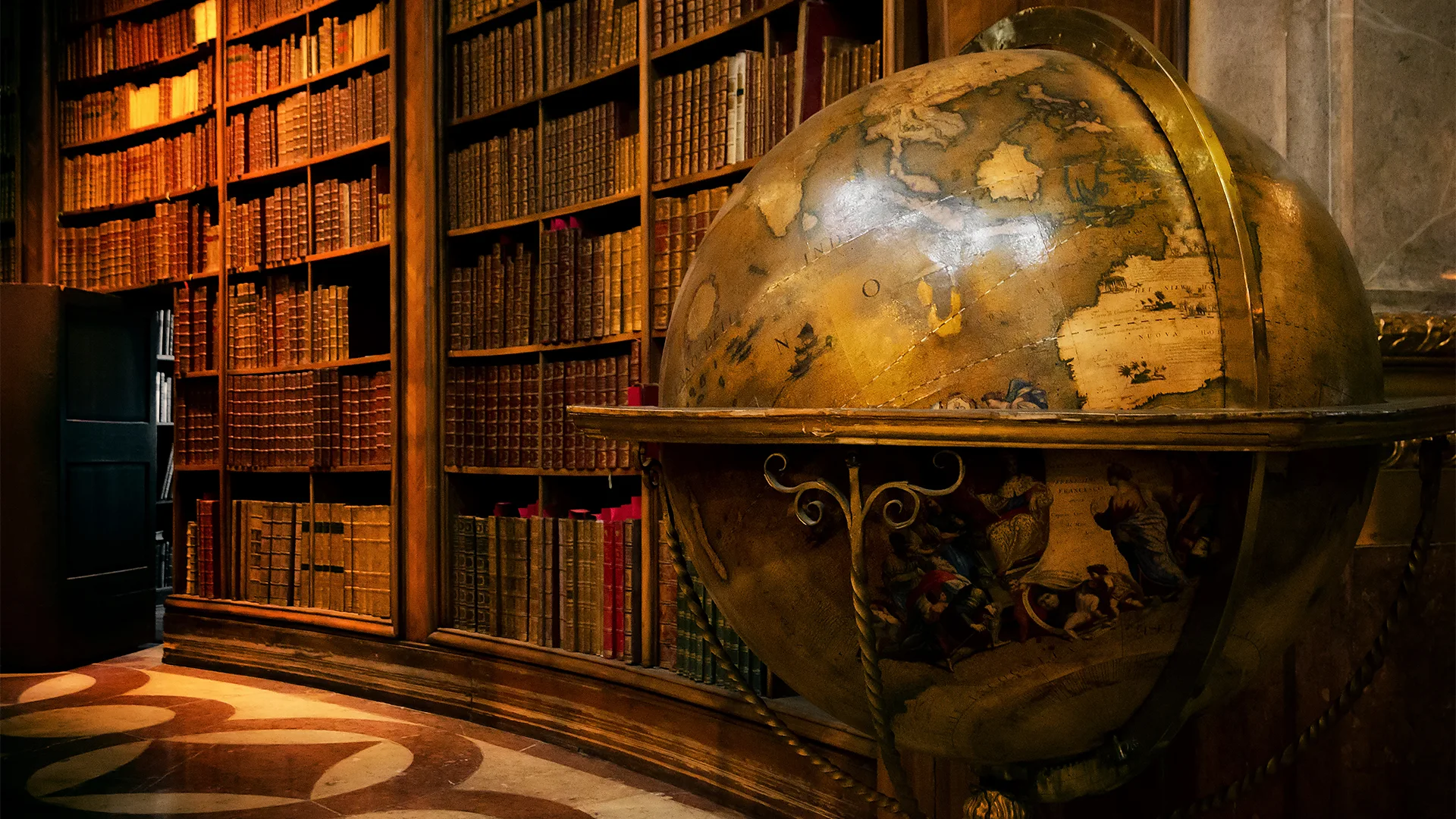
Beautiful, surreal and eerily empty, Vienna’s Globe Museum the only public museum on Earth dedicated to globes, and it – quite literally – tells the story of our world.
It’s a chilly afternoon in Vienna, and the line for the Austrian National Library has already spilled out the door, curling like a ribbon around the grand Josefsplatz square. I’m not in the mood to wait – I’ve already struck out at several crowded nearby attractions where timed-entry tickets were sold out.
Rather than join the queue, I walk down the street and stumble onto a smaller, somewhat hidden site: The Globe Museum. Tucked inside Vienna’s 17th-Century Palais Mollard, it’s the only public museum on Earth dedicated entirely to globes, and one of Vienna’s greatest surprises.
Different worlds
I soon realise that I’ve wandered into another world – or more accurately, many of them.
Just steps from some of the city’s most celebrated, crowded attractions, Vienna’s Globe Museum displays more than 220 rare and antique spheres, most created before 1850, ranging from towering Coronelli globes to tiny, foldable pocket orbs.
Beautiful and surreal, the museum’s extensive collection goes beyond geography to reveal how humanity has mapped and imagined the Earth and heavens above. It’s a chronicle of human curiosity, and – quite literally – the story of our world.
“Globes show the change in our imagination of our planet,” says Nikolaus Schobesberger, the director of museum. “And this is the only place in the world where you can see so many of them at the same time.”
Visitors start by travelling through the Golden Cabinet, a lavish room with centuries-old frescoes depicting scenes from Greek mythology. It’s the backdrop for a stunning array of globe-related instruments, like telluriums, which illustrate the Earth’s orbit around the Sun, and armillary spheres, which use a framework of rings to visualise the movements of celestial bodies.
As I reach the museum’s four main galleries, I realise the whole place is pin-drop quiet. I shuffle slowly from one glass case to another, holding my breath to not disturb the stillness, even though I’m alone with centuries-old objects.
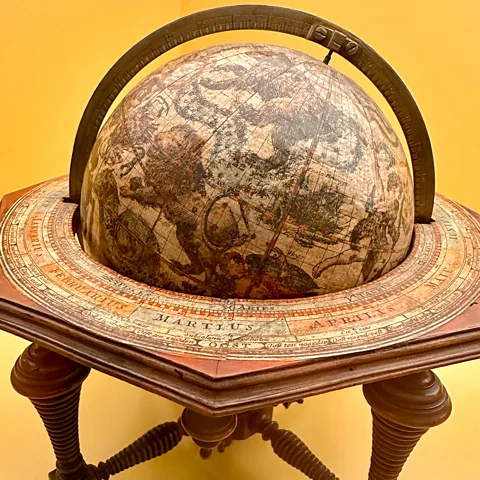
I find myself marvelling at two spherical worlds suspended in time. One is terrestrial, with oceans awash in vivid blues and squiggly brown coastlines. The other is celestial, where mythological creatures and constellations spill across a tea stain-coloured backdrop. Barely bigger than beach balls, these two time capsules were made by the same craftsman 10 years apart in the mid-1500s and preserve a world as it was still coming into focus.
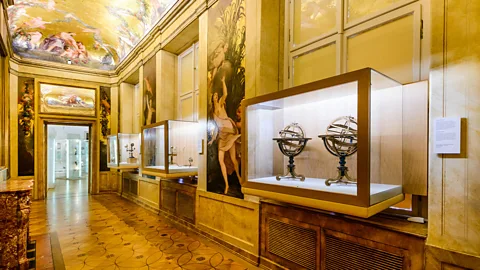
In one, Europe, the Mediterranean and Africa’s coasts are filled with place names, while North America fades into the uncharted Arctic. Asia is distorted, a hypothetical southern continent stands in for Australia and Antarctica and the Pacific is populated by sea monsters instead of islands. In the other, Renaissance astrological observations exist alongside Pegasus taking flight and Perseus brandishing Medusa’s severed head.
“They’re some of the oldest globes we have in our collection,” says Schobesberger.
Moving from one globe to the next, I notice how these relics extend beyond geography and depict what people once believed. Many fill the space of unexplored oceans with dragons, while some confidently depict my home state of California as an island. Some pieces also preserve colonial-era prejudices with elaborately painted scenes depicting Indigenous people as cannibals. On one, African coastlines are dotted with Spanish and Portuguese flags, showing “ownership”.
“They’re a part of this colonial thinking. And so, they’re beautiful art, but you also have to think about the time they were created,” Schobesberger says, explaining that every globe is as much a record of what people knew as what they didn’t. That’s why he believes the museum resonates with all types of people, not just historians or cartography enthusiasts.
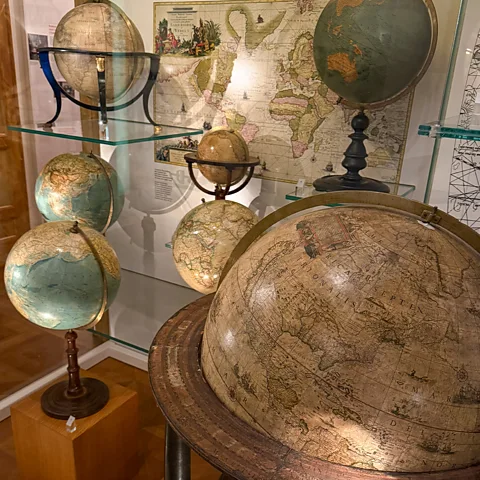
One of Schobesberger’s favourite objects is a lunar globe from 1961. The front portion of the Moon is meticulously mapped. The back, however, is a stark white strip, intentionally left blank because the far side of the Moon had not yet been seen. An updated lunar globe made two years later, also on display, contains the missing portion.
I can’t help but circle back to a showstopper in the front hall, a replica of the Behaim Globe – completed by Martin Behaim in 1492, the year Christopher Columbus sailed west – which shows a world without the Americas. There’s simply an expanse of ocean between Europe and Asia.
“A globe is such a great thing because it’s a small-scale model of our planet, so you can tell stories about the world on it,” he says. “Climate, geology, topography, trade routes, everything.”
From curios to cultural cornerstones
Walking through the museum, visitors can see the globe’s own journey unfold. The earliest examples were luxury objects reserved for aristocrats and wealthy merchants. Over time, globes lost their exclusivity, shrunk in size and became more affordable and popular. They entered schools, appeared in living rooms and even became playthings for children. Today, they are so commonplace that my son even won his desktop globe in a classroom raffle.
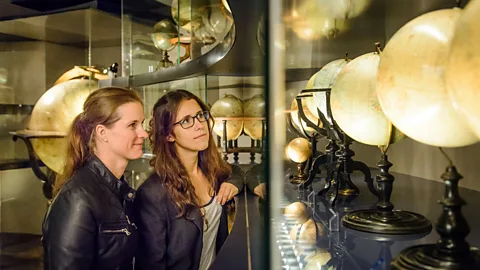
I entered the museum expecting to view globes as historic artefacts, but I’m surprised by how alive they still feel. Even with Google Earth at my fingertips, these tactile objects invite curiosity and imagination in a way that a screen doesn’t.
“It’s not just that the globe is a scientific instrument. It’s also an object which lets you dream of foreign countries,” says Schobesberger.
Globes in pop culture
Beginning 24 September 2026, the museum’s newest exhibition, Globes in Everyday Life, Art and Culture, will explore how globes evolved from a status symbol to a familiar fixture. It also showcases the globe’s enduring place in pop culture, from architecture to art and film, like Charlie Chaplin’s famous dance with an inflatable globe in The Great Dictator. “The main idea was to show that globes are almost everywhere as a part of everyday life,” Schobesberger says.
Schobesberger’s own fascination began as a young child, when he became captivated by the ships, sea monsters and mythical creatures that filled the blank spaces of historical maps and globes. He began to draw his own world maps when he was just six years old.
“You can think about what’s possible on the other side of the world, even when you’re sitting here in Europe,” he says. “Nothing else can capture the imagination quite like it.”
That sentiment resonates with author JF Penn, who stumbled onto the Globe Museum while researching her novel Spear of Destiny, based on a relic housed in Vienna’s Imperial Treasury. Like me, she ended up lingering far longer than planned.
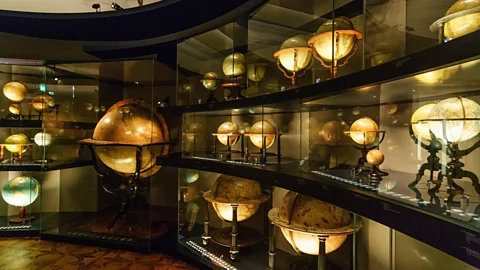
“I particularly loved the oversized antique globes with the patina of age and use,” she says. “I considered how many fingertips have turned them over generations and wondered if they thought of travelling to these far-off places that I do.”
Even after visitors leave Palais Mollard, the search continues. Across Vienna, some 50 globes are perched on rooftops and facades, hidden in plain sight. The museum even charts them on a virtual map in its new exhibit, encouraging people to look upward as they wander the city.
When I finally step back outside, the sky is dark and the streets are even more crowded. Earlier in the day, I had been seeking a quieter corner of Vienna. Instead, I was given a whole new way of seeing the world – a place that’s constantly being redrawn and reimagined.
—
If you liked this story, sign up for The Essential List newsletter – a handpicked selection of features, videos and can’t-miss news, delivered to your inbox twice a week.
This news is taken from BBC News
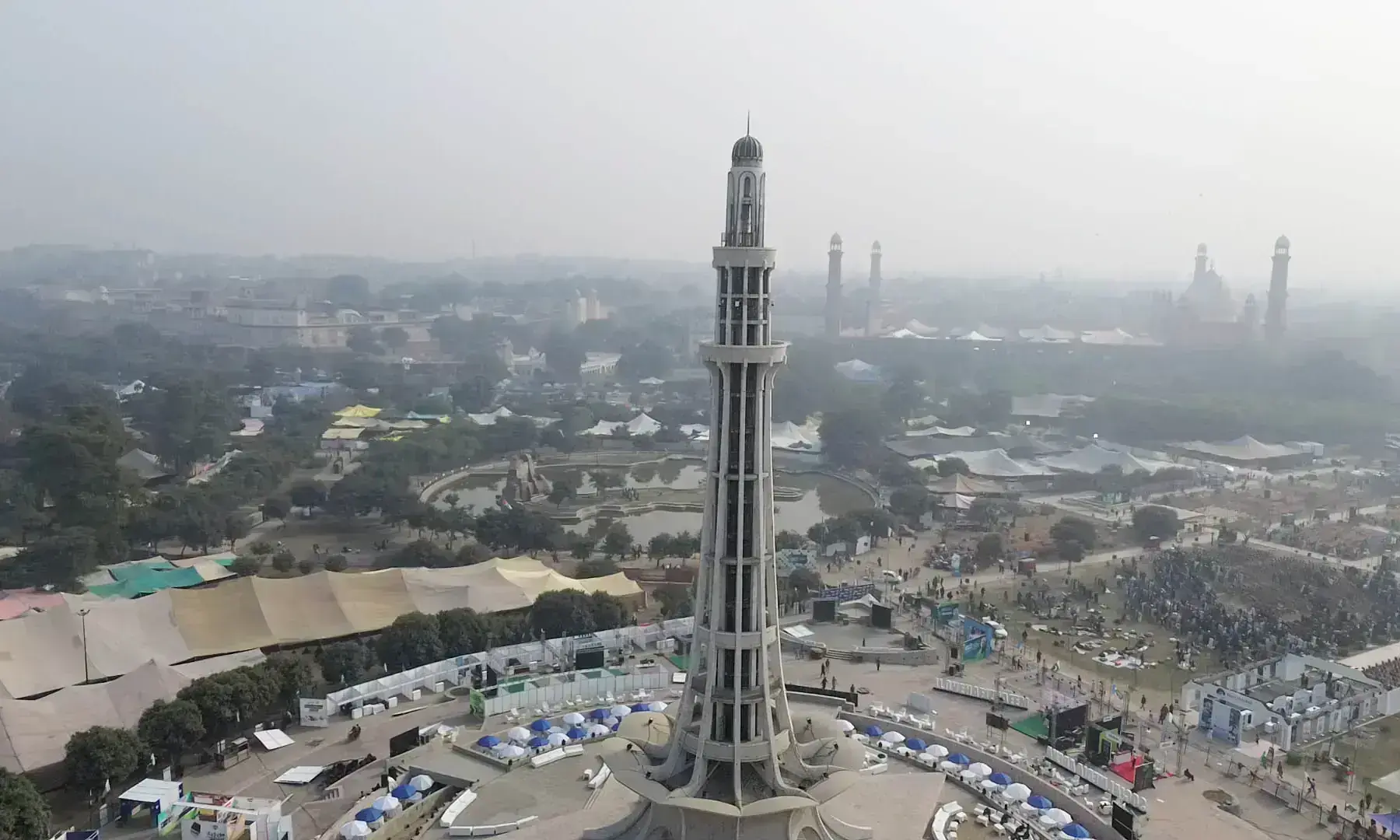
BISHKEK: The city of Lahore has been named the Tourism and Cultural Capital for 2026-27 by the Shanghai Cooperation Organisation (SCO).
The decision was announced at the 26th meeting of the SCO Council of Heads of State in the Kyrgyz capital, which was attended by PM Shehbaz Sharif.
The title of Tourism and Cultural Capital has been rotated annually among SCO member states since 2022, and the designation serves to highlight the prominence of a city that embodies the cultural heritage of the country that takes over the rotating presidency of the organisation.
This year, Pakistan assumed the SCO presidency, with PM Shehbaz defining the theme of the chairmanship as ‘Turning Vision into Action: Connectivity, Innovation and Shared Prosperity’.
Cities that have held the title in the past include Varanasi, India (2022-23), Almaty, Kazakhstan (2023-24), Qingdao, China (2024-25) and Cholpon-Ata, Kyrgyzstan (2025-26).
The decision to designate Lahore as the tourism and cultural capital was taken in April this year, when the heads of tourism administrations of SCO member states met in Bishkek.
The designation is designed to promote people-to-people contacts and tourism among the member states.
Published in Dawn, September 2nd, 2026
Art & Culture
Deputy High Commissioner Haseeb Bin Aziz Inaugurates “Masters of Canvas” Art Exhibition at Pakistan High Commission London
PRESS RELEASE
London, UK — Deputy High Commissioner of Pakistan, Mr. Haseeb Bin Aziz, inaugurated the prestigious art exhibition “Masters of Canvas” at the Pakistan High Commission in London, celebrating the exceptional talent, diversity and enduring legacy of Pakistan’s distinguished artists.

The exhibition brings together the works of renowned senior Pakistani artists and calligraphers Late Ahmed Khan, Late Mashkoor Raza, M.A. Bukhari, Chitra Pritam and Qamar Siddiqui, offering audiences in the United Kingdom a rare opportunity to experience original works of Pakistani art.
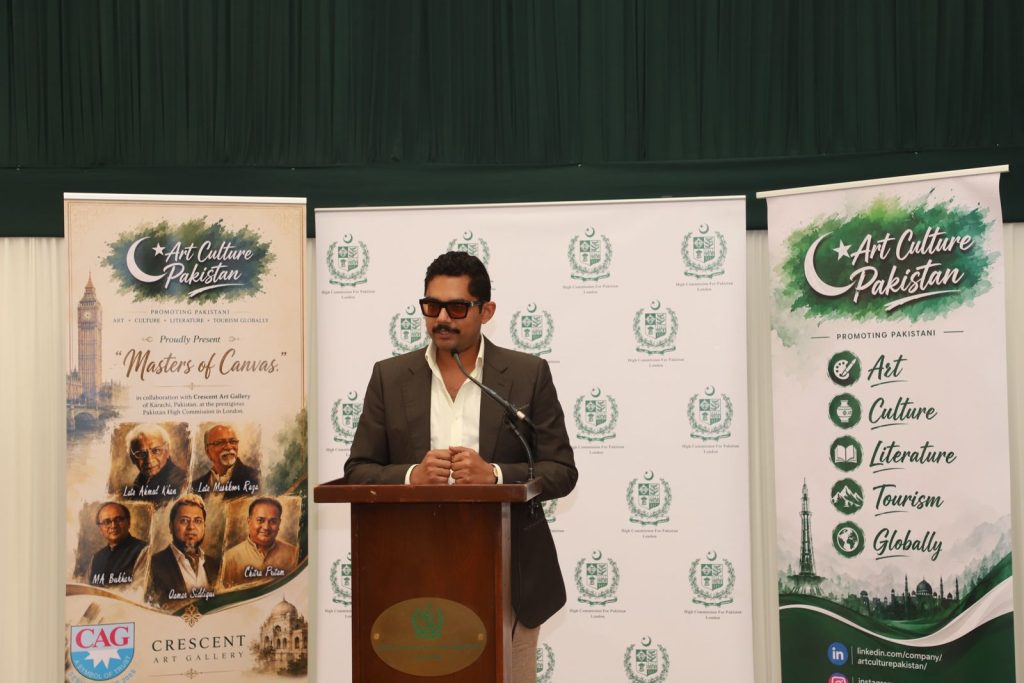
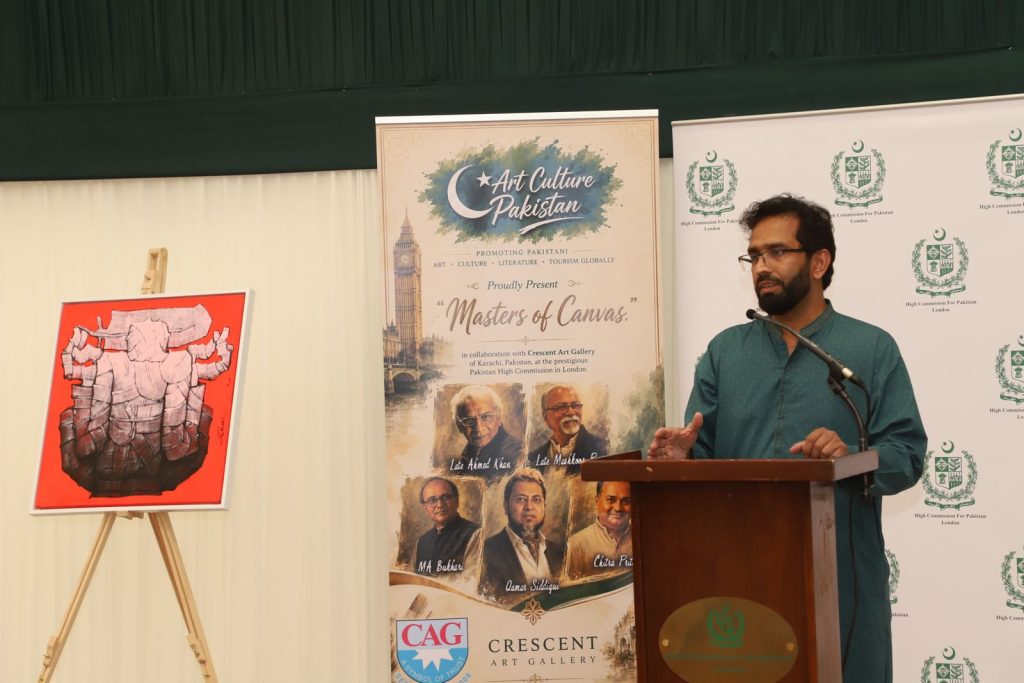
Speaking at the inauguration, Deputy High Commissioner Haseeb Bin Aziz paid tribute to the distinguished artists, appreciating their remarkable contributions to Pakistan’s artistic and cultural heritage. He also commended the efforts of Art Culture Pakistan and Crescent Art Gallery, Karachi, for bringing the work of these celebrated artists to the United Kingdom and providing an important platform for Pakistani art and culture to reach international audiences.

The exhibition is proudly presented by Art Culture Pakistan, an initiative founded by Mr. Akber Mehmood, in collaboration with Crescent Art Gallery, Karachi, founded by Mr. Nasir Javed, together with Mr. Sameer Nasir and curator Ms. Sidra Nasir. Through their continued commitment to the promotion of Pakistani art and culture, the organisations have worked to introduce outstanding Pakistani artists to audiences across Pakistan and internationally.
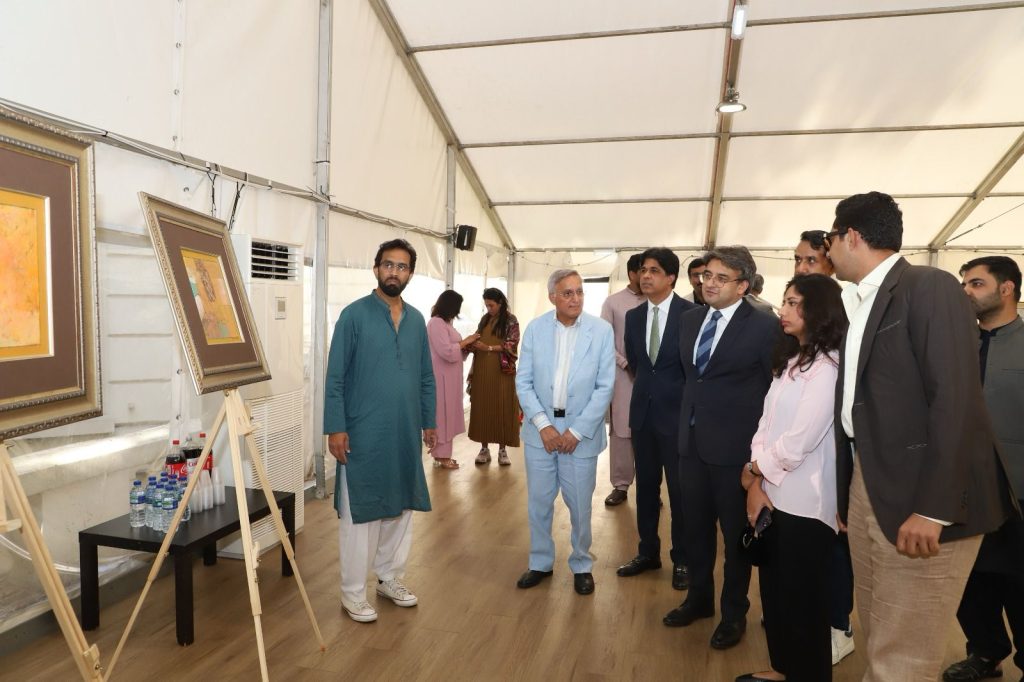
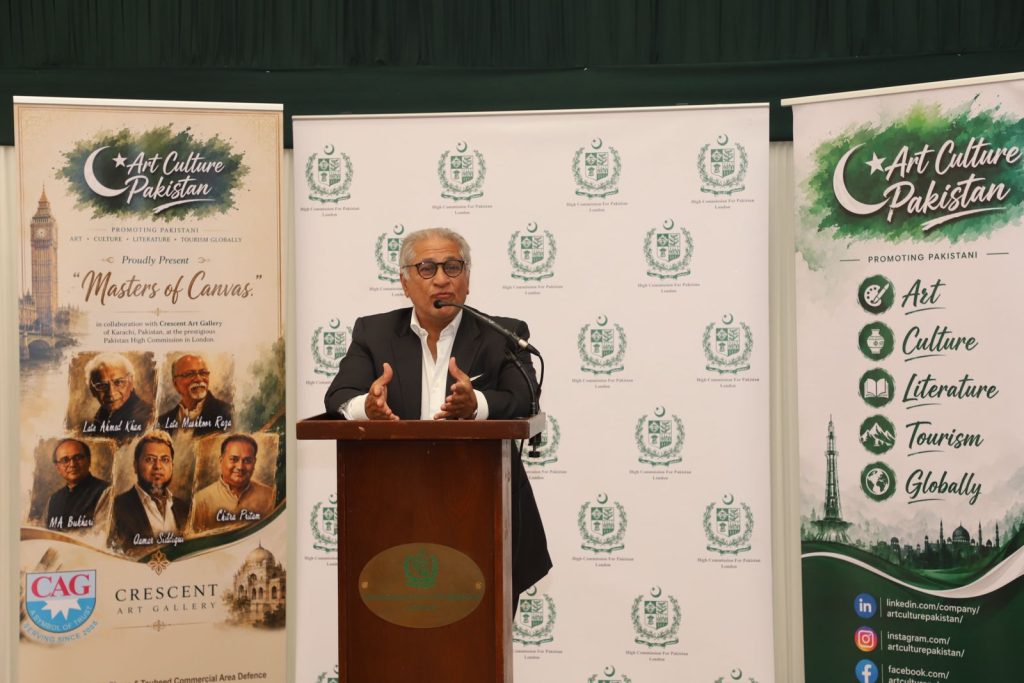
Addressing the gathering, Mr. Sameer Nasir of Crescent Art Gallery encouraged members of the audience to actively participate in and support cultural events of this nature. He emphasised that growing public interest in Pakistani art and culture can help create greater opportunities for cultural exchange and contribute to strengthening Pakistan’s soft image in the United Kingdom and beyond.
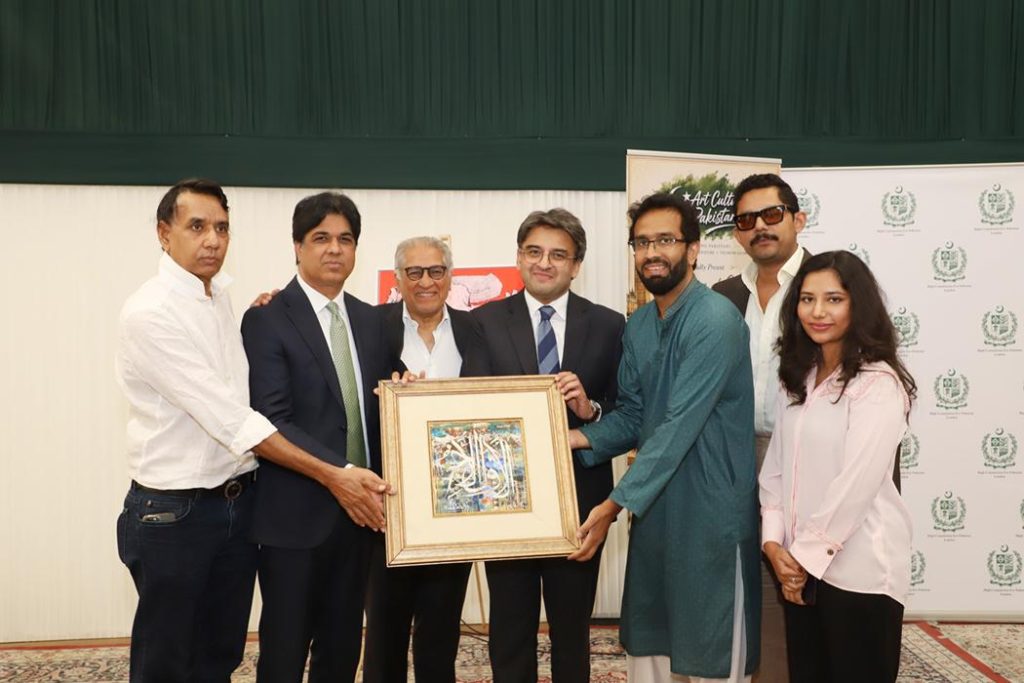
Mr. Asif Rangoonwala of the British Pakistan Foundation also congratulated the organisers for bringing such a prestigious selection of Pakistani artists to London. He described the exhibition as a rare cultural occasion, highlighting the significance of presenting original artworks from Pakistan to London audiences after a considerable period. He encouraged attendees to value and support such unique opportunities to engage directly with Pakistan’s rich artistic heritage.
The event also featured a special video presentation titled “Masters of Canvas,” presented by Mr. Akber Mehmood of Art Culture Pakistan. The presentation introduced the featured artists, showcasing their artworks and highlighting the distinctive genres and artistic approaches that have shaped their careers.
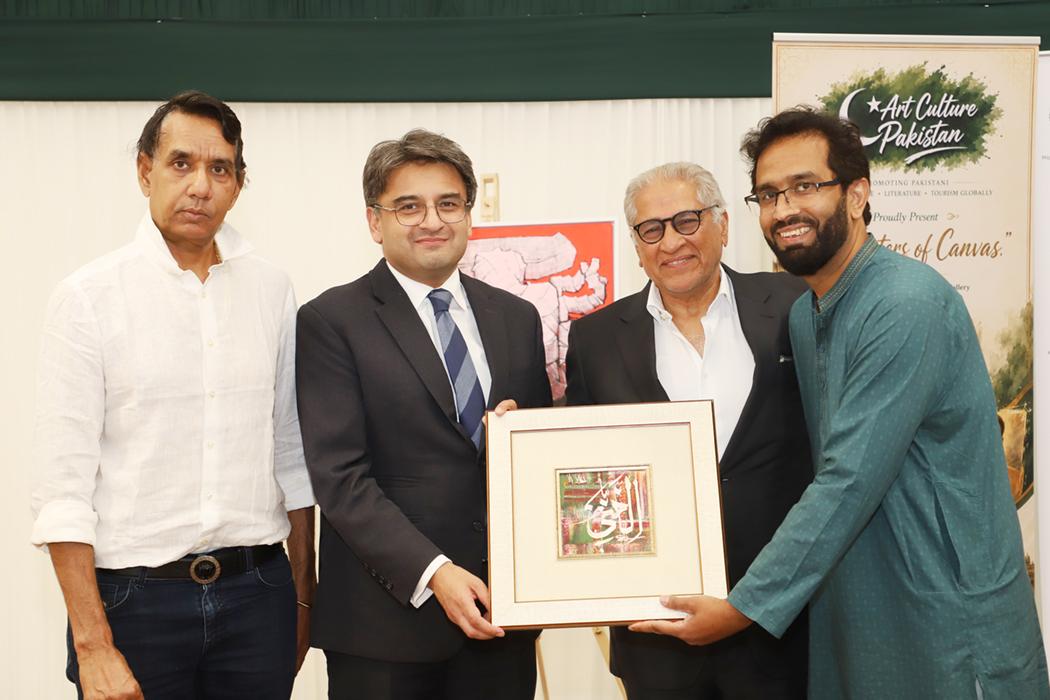
“To conclude the event, exquisite calligraphic masterpieces by the venerable maestro M.A. Bukhari were presented on behalf of Art Culture Pakistan to Deputy High Commissioner Haseeb bin Aziz, British Pakistani Foundation CEO Asif Rangoonwala, and Press Attaché Mr Ali Nawaz Malik.”


The museum charting how humans understand the world

Sexual crimes against women, kids: 80pc of offenders are people known to victims, says Punjab IGP

Shanghai Cooperation Organisation names Lahore as its ‘Tourism and Cultural capital’


-

 Sports3 months ago
South Korea’s Yoo Useong Steps Onto the Global Strongman Stage as World Strongman Federation Professional Athlete
-

 Art & Culture1 year ago
A Survey of Mata-E-Zeest
-

 Europe News2 years ago
Chaos and unproven theories surround Tates’ release from Romania
-

 American News1 year ago
Trump expands exemptions from Canada and Mexico tariffs
-

 American News2 years ago
Trump Expels Zelensky from the White House
-

 Art & Culture1 year ago
Will Snow White be a ‘victim of its moment’? How the Disney remake became 2025’s most divisive film
-

 Pakistan News1 year ago
Comprehensive Analysis Report-The Faranian National Conference on Maritime Affairs-By Kashif Firaz Ahmed
-

 Entertainment2 years ago
Champions Trophy: Pakistan aim to defend coveted title as historic tournament kicks off today