
Art & Culture
“Possession” A Poem on Obsessive Love by Zeenat Iqbal Hakimjee from Harmony


I own you, your every movement is mine
To do as I please
Why did you do this why did you do that
Raise your voice, or your eyelid bat
Its our of the question I won’t let you out of my sight
You belong to me only to me, you are my birth right
Just the other day your momentary absence felt like multitude
Was it the toilet or were you astray,
I am suspicious, you I possess.
Do not leave me, I shall feel the betray,
Your look and smile elsewhere, your touch
Are all for me, me only,
From others, to be kept at bay
Do not ever make a start with darling, for another,
It will make the other want to come hither
I feel bold and beautiful in your presence
But am at a loss in your absence
I own, you, you I possess,











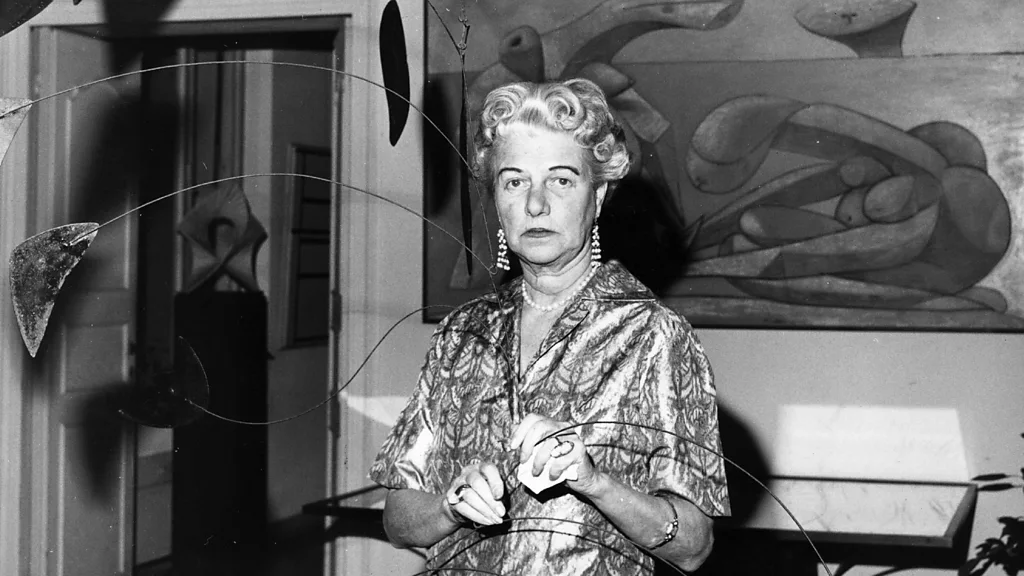
She bravely rescued modernist masterworks from Nazi confiscation and championed the most brilliant artists of the 20th Century – among them Mark Rothko and Jackson Pollock – at the start of their careers. So why was this remarkable art collector sneered at, and remembered mostly for her romantic life?
Peggy Guggenheim was a bohemian free spirit, whose passion for art was matched only by her passion for men. When asked by an interviewer how many husbands she had had, she quipped “My own, or other people’s?” Peggy was born into the hugely wealthy Guggenheim family, which included her uncle Solomon, who went on to found one of the most iconic art museums in New York.
Her insistence on living her life as she chose, turning her back on the life of bourgeois conformity in which she had grown up, led the US writer Gore Vidal to describe her as “the last of Henry James’s transatlantic heroines, Daisy Miller with more balls.” But the fascination with her private life has tended to overshadow just how important she was in transforming our understanding of 20th-Century art.
“I think she’s been underrated. People talk so much about her relationships, all the advisors who helped her make decisions, but Peggy was really groundbreaking herself,” says Gražina Subelytė, co-curator of Peggy Guggenheim in London: The Making of a Collector at The Royal Academy.

An often-overlooked example of her free spirit, and one that would prove to be as valuable as any of the advice she later received, was her decision to escape the rigid social orthodoxy of her family by volunteering in the Sunwise Turn Bookshop in New York. Part bookshop, part art salon, this pioneering, avant-garde establishment – owned and run by women – gave Peggy an insight into how “a woman could do something extremely creative and independent,” says Simon Grant, the exhibition’s co-curator.
Here, Peggy met artists and was encouraged by the cultured clientele to study art history. “Her sister Hazel later said that if it hadn’t been for the Sunwise Turn, Peggy would have been playing golf at the Westchester Country Club,” Grant tells the BBC.
However it would be another 17 years – during which time she settled in England, married and divorced her first husband, the eccentric and sometimes violent English writer Laurence Vail, had two children, and embarked on a number of affairs – before she began to seriously think about setting up her own gallery.

The inheritance of $450,000 (around $5m or £3.8m today) that she received on the death of her mother in 1937 helped fund it. It’s a frequent misconception that Peggy was as wealthy as the other Guggenheims, but her father’s decision to abandon the family mining business and squander his fortune – before going down with the Titanic in 1912 – meant that her side of the family were, relatively speaking, the poor relations.
Her trailblazing London gallery
The new gallery in London was called Guggenheim Jeune, which highlighted Peggy’s position as the younger family member in the art world. Her uncle Solomon was yet to open his museum, but was in the process of building a collection in New York with the aid of Hilla Rebay, widely assumed to be his mistress, who Peggy later described as her “nemesis”. When she wrote to her uncle, at the request of artist Vasily Kandinsky, suggesting he purchase one of his works for his collection, she received a stinging rejection from Rebay stating that with her gallery “you will soon find you are propagating mediocrity, if not trash”.
Everything that Peggy was showing was really and truly groundbreaking – she was making bold choices – Gražina Subelytė
Nothing could be further from the truth. During a trip to Paris in 1937 she had met the Irish novelist and playwright Samuel Beckett, who became another lover and persuaded her to dedicate her life to contemporary art as “a living thing”. With Guggenheim Jeune she would begin doing just that, shaking up the stuffy British art world by injecting a much-needed dose of internationalism.

It opened as it meant to go on with an exhibition by Jean Cocteau that featured drawings on bedsheets depicting his lover’s pubic hair covered with leaves, and later hosted the first UK solo shows dedicated to Kandinsky, Danish Surrealist Rita Kernn-Larsen and Yves Tanguy (who was another lover, and created a beautiful pair of earrings for her).
It also held an innovative exhibition of children’s art which featured work by a young Lucian Freud. “Everything that Peggy was showing was really and truly groundbreaking and she was making bold choices. She was presenting something that was not yet on view in the main museums in London,” Subelytė tells the BBC.
One of the most influential exhibitions was a group sculpture show including work by Jean Arp, Constantin Brâncuși and Henry Moore which completely changed attitudes to contemporary sculpture in the UK. When works destined for the show were stopped by British customs agents who wanted to tax them as imported stone, the then director of the Tate, JB Manson was called in to rule on whether or not they were art. When he declared they were not, the case ended up in the House of Commons where Peggy eventually won the day. “Mr Manson not only lost his case, but pretty soon his job as well. I thus rendered a great service to foreign artists and to England,” Peggy declared.
How she rescued great art from the Nazis
When her gallery closed in 1939, Peggy had dreams of opening a permanent museum of modern art, but the outbreak of war put paid to her plans. Aware that the art she was championing had been labelled “degenerate” by the Nazis, she instead headed to France with the aim of saving an artwork a day.

She amassed an incredible haul which included works by Picasso, Brâncusi, Klee, Mondrian, Magritte and Kandinsky, however when she asked The Louvre if they might look after it in their rural hiding space, she was told her collection was too modern to be worth saving. It eventually left the country with the aid of a shipping agent she’d had an affair with, in crates labelled as household goods.
It was an extraordinarily brave thing for Peggy to do as a Jewish woman. She had a lucky escape in Vichy-controlled Marseilles when police entered the hotel room where she had hidden wads of the black-market cash, needed to facilitate the passage of the various artists she was also helping to escape to New York. These included Max Ernst, to whom she was married from 1941 until 1946.
Arriving safely in New York in 1941 she set about organising her next influential gallery, Art of This Century, which opened its doors in 1942. Here, she championed Mark Rothko and Jackson Pollock, to whom she also gave a monthly stipend which allowed Pollock to quit his job as a carpenter at her uncle’s newly opened Museum of Non-Objective Painting.

Peggy also played a vital role in promoting female artists. The Exhibition of 31 Women, which included work by Frida Kahlo, Leonora Carrington and Méret Oppenheim, was the first all-women show in America.
However, she came to regret her decision to send the womanising Ernst, by then her husband, out to select the works to be included in the show, as in the process he met and fell in love with the painter Dorothea Tanning. Peggy later quipped that she should have only had 30 women in the show.
‘Nymphomaniacal revelations’
Peggy was riding high on the success of the gallery when she released the first version of her autobiography, Out of This Century, an uninhibited account of her life and loves.
There’s no way that she didn’t know that the things she was writing were going to appal her family and the people around her, but she enjoyed it – Francine Prose
It shocked readers and the press alike, with The Chicago Tribute suggesting Out of My Head as a more appropriate title for her “nymphomaniacal revelations”.
“There’s no way that she didn’t know that the things she was writing were going to appal her family and the people around her, but she enjoyed it, I think she really got off on it,” Peggy’s biographer Francine Prose tells the BBC.

Largely on account of the book, when she left New York for Venice in 1947, hoping to finally realise her dream of creating a permanent museum, her reputation obscured her accomplishments. However, she eventually had the satisfaction of showing her collection, to great acclaim, in institutions that had once dismissed her art – The Tate in 1964 and L’Orangerie, then part of The Louvre, in 1974. In 1969 she even showed her collection at The Solomon S Guggenheim Museum in New York in the Frank Lloyd-Wright designed building she once dismissed as “uncle Solomon’s garage.”
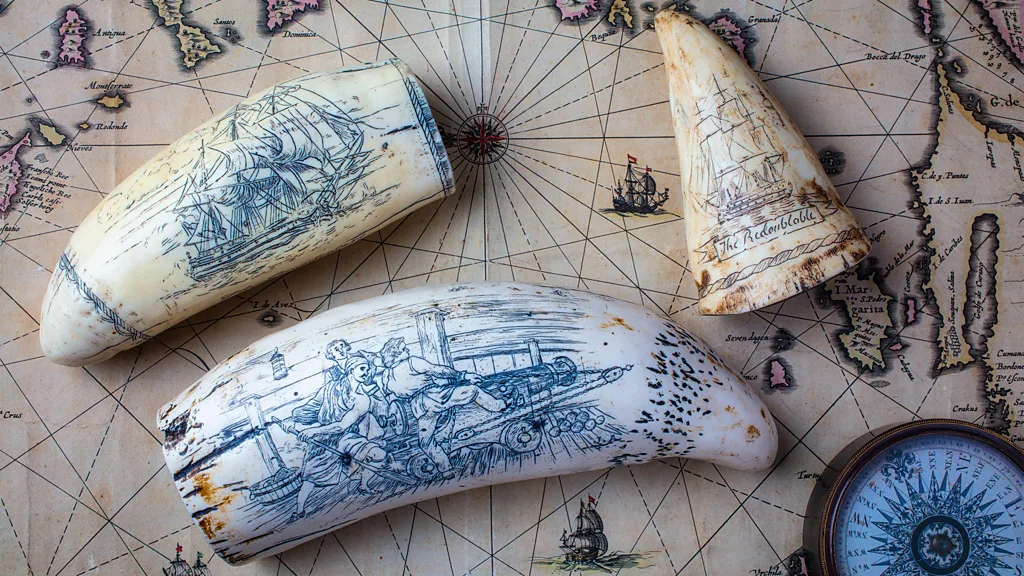
As Moby Dick turns 175, some of the last American scrimshanders grapple with the legacy of maintaining one of the US’s oldest art forms.
Jade Gotauco spent her childhood among the skeletons of giants. Her father, Chet Gotauco, was a scrimshander – an artist who etched images onto the ivory of hunted whales. In pensive moments, she would slip under the arched jaw of a whale in his Rhode Island garden and sit atop a massive vertebra, watching insects scrabble across the porous bone.
“My favourite smell in the world is the sandy aroma of ivory dust,” said Gotauco, now an artist herself. Whale teeth adorn the walls of her studio in New Bedford, Massachusetts; she engraves them with nautical scenes in which sperm whales thrash the ocean to foam and whalers hurl barbed harpoons from minute boats.
Ask Americans about the cultural legacy of whaling, and many will point to Herman Melville’s classic novel Moby Dick, which turns 175 next month. Yet for all the book’s brilliance, it’s scrimshaw – the practice of artistically carving whale teeth and bones, which is considered one of the US’s earliest homegrown art forms – that offers a true insider’s view of the industry.
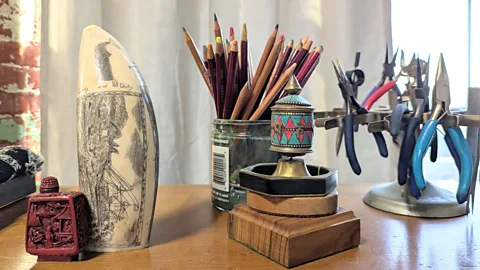
Today, there’s hardly any of those teeth and bones left on the legal market. Some scrimshanders, including Gotauco, believe the art form should disappear with them. “When the ivory is gone, this is over,” she said.
Scrimshaw was developed by sailors whose lives unfolded on whaling grounds around the globe as the industry expanded into a 19th-Century behemoth. They strove to depict a culture that, for a few lucrative decades, made New Bedford North America’s wealthiest city per capita.
Back then, everyone was a scrimshander. Now I’m one of the last – Michael Vienneau
“They saw their experiences as important,” said Marina Wells, an assistant curator at the New Bedford Whaling Museum, which is home to the largest scrimshaw collection is the world. “You see that in their commemoration of whaling scenes, in all their meticulous detail.”
Some of the carvings throb with yearning, depicting homey scenes of faraway families. Others capture sailors rowing fragile, open boats dwarfed by the whales they pursued. They’re communicating “the dangerous, faraway world of whaling”, Wells said. “You have the bloody spouts of the whales after their lungs have been punctured… the intimacy of whalemen interacting with whale bodies that’s really hands-on.”
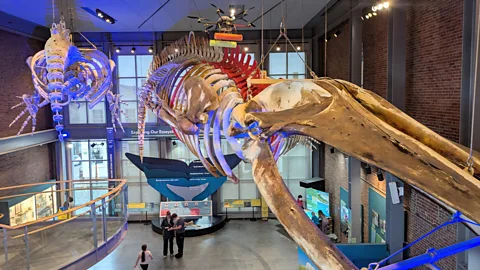
To modern eyes, the scenes evoke the heartbreaking impacts on species hunted to the brink of extinction; yet the whalers, too, were often broken by the industry. At the Seamen’s Bethel, an 1832 mariner’s church located across the street from the museum in New Bedford (and which features in the opening chapters of Moby Dick), such risks are on poignant display. Lining its whitewashed sanctuary are marble cenotaphs commemorating those lost at sea.
“After fastning to a whale, was carried overboard by a line and drowned,” reads the tomb of Captain William Swain. Three sailors from the whaleship Cowper, aged 19, 22 and 24, share another memorial: “All lost by the upsetting of their boat, July 15, 1854, in the Ochotsk Sea.”
They died as American whaling reached a short-lived fever pitch. In 1857, more than 10,000 men worked aboard New Bedford whaleships, half the city’s population at the time. Two years later, petroleum was discovered in Pennsylvania and the ensuing oil rush flooded American cities with kerosene – a comparatively cheap fossil fuel that would eclipse the whale oil used in lamps around the globe.
By the turn of the century, American whaling was all but over.
Scrimshaw lived on, however. The massive scale of the whaling industry produced a glut of teeth and bones, a byproduct that, at the time, had little commercial value. They gathered dust in attics and warehouses.
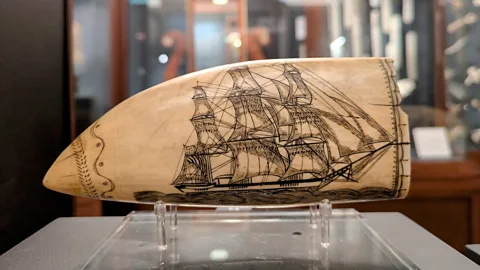
“When I was a kid they had barrels of whale teeth down at the wharves and sold them for a couple of bucks apiece,” recalled Michael Vienneau, a scrimshander on the nearby island of Nantucket, Massachusetts – another onetime whaling hub. Former homes of whaleboat captains surround his small shop, Scrimshander Gallery, in the heart of the island’s historic district. A few blocks away is the Nantucket Whaling Museum, whose own significant scrimshaw collection includes pieces by Nantucket whalemen – and famed scrimshanders – Frederick Myrick and Edward Burdett.
In the 1960s, scrimshawing surged in popularity, part of a folk-craft revival. (It even got a boost from US President John F Kennedy, an avid collector.) That’s when Vienneau got his start, rummaging for cheap whale teeth as a teenager while visiting the island with his family.
“Back then, everyone was a scrimshander,” he said. “Now I’m one of the last.”
In part, that’s because of the 1973 Endangered Species Act, which tightly restricted the sale of marine ivory. Today, scrimshanders engraving whale teeth and bones must work from the dwindling supply of teeth and bones that remain from before the act was passed – Vienneau has a stash in the back of his shop. “You’ll pay several thousand dollars for a raw tooth now,” said Vienneau.
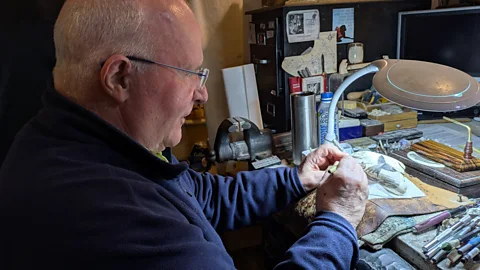
On a recent afternoon, he was sitting at his workstation squinting at a sperm whale tooth he was engraving with a scene of a sailor brandishing a harpoon at the tail of a diving whale. More teeth were piled in a nearby filing cabinet. His dog, Petey, grabbed a tooth and began to chew on it. Vienneau laughed. “Any dog that gnaws on a sperm whale tooth is a scrimshander’s dog,” he said, not getting up.
As whale teeth grew scarce and expensive, some scrimshanders innovated, carving on cow bones and deer antlers. Even comparatively tooth-rich Vienneau experimented. Once, he flew to Alaska on a tip and spent three days digging a 30,000-year-old mammoth tusk out of permafrost near a remote copper mine.
Yet, many purists insist that while such projects are both art and craft, they are not true scrimshaw, since the authentic form relies on the byproducts of historical whaling. Gotauco is one of them. Like some of her peers, she believes this means that scrimshaw is on the brink of extinction.
Gotauco works exclusively on pre-1973 ivory and bones. Nearly a century ago, her grandmother emigrated to Boston from Newfoundland, and among her few belongings was a collection of whale teeth and bones she’d inherited from her family of seal hunters, cod fishermen and whalers. That’s what Gotauco carves in her New Bedford studio, etching images onto the physical remains of her ancestors’ legacy.
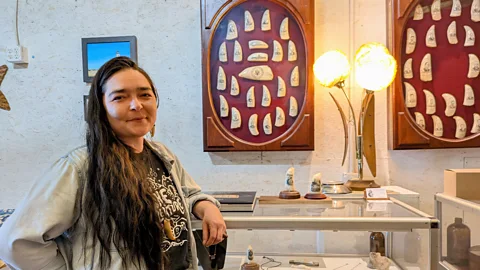
Along with the whale teeth, Gotauco’s grandmother passed along stories of what she said were Mi’kmaq roots. Whales factor into traditional Mi’kmaq stories, and the First Nations community hunted the animals sustainably long before the arrival of Europeans in North America. With her own deep reverence for whales, Gotauco has, at times, felt deeply uneasy about working with ivory.
In the years since she learned how to carve scrimshaw by sitting beside her father in his workshop, Gotauco often wondered about the ethics of using materials pulled from the sea with such violence. Commercial whaling was an environmental disaster and a cruelly dangerous job; the beauty of the art form it spurred still catches at her heart. In the end, she embraced it as a form of remembering, calling it “the best way to honour the whales and whalers”, albeit one that will likely fade in her lifetime.
“When I run out of teeth along with everyone else, I’ll raise a cup to the story’s end,” she said. “May we never get more.”
This News is taken from BBC News
Art & Culture
‘A distinct Canadian character’: The 1920s paintings that changed how the world saw Canada
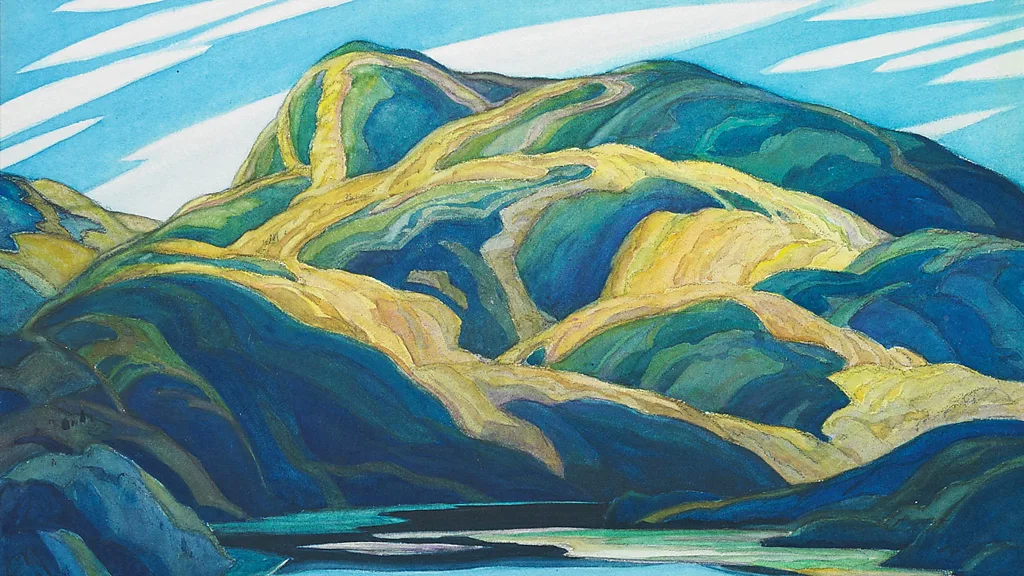
The Group of Seven was Canada’s first internationally recognised national art movement, and they helped create a distinct, modern Canadian identity in the 1920s. As the official Group of Seven Day is celebrated in Canada, what is their legacy – and are their ideas in harmony or conflict with the so-called “Indian Group of Seven”, founded later in the 1970s?
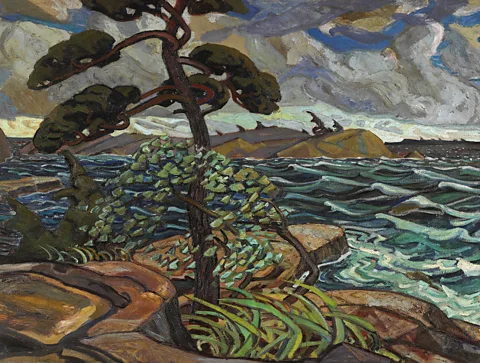
In the 1921 painting Stormy Weather, Georgian Bay, a lone tree perches perilously between a rocky outcrop and a vast, churning lake, buffeted by the elements yet refusing to yield to their force. Executed in rough brushstrokes and simplified lines, it celebrates not only the resilience of Canadian settlers and their ability to survive against all odds, but also the dramatic, untamed landscapes with which they joyfully communed.
The painting by FH Varley is one of the most iconic works by The Group of Seven, a groundbreaking art collective who broke with the dominant tradition of European academic painting to create a uniquely Canadian style that revelled in the country’s vast natural beauty.
The group’s most celebrated works are “almost like what the Statue of Liberty is for the United States,” says Katerina Atanassova, senior curator of Canadian art at The National Gallery of Canada. So beloved are they that 7 July is now celebrated as Group of Seven Day. What is it about their paintings that, for many, embody the Canadian spirit and identity? And where does the group’s work stand in relation to the country’s Indigenous art?
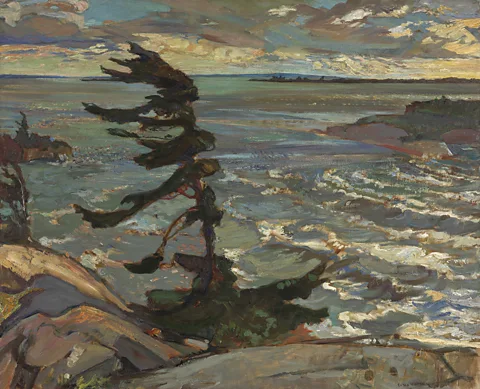
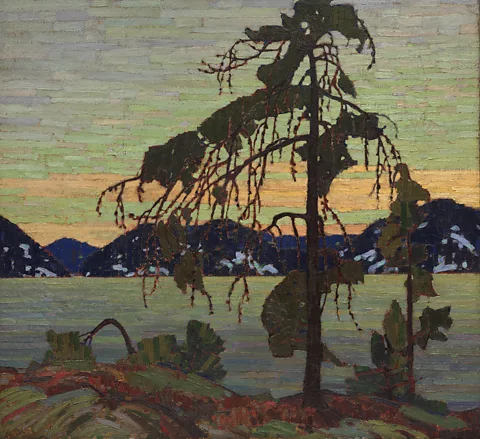
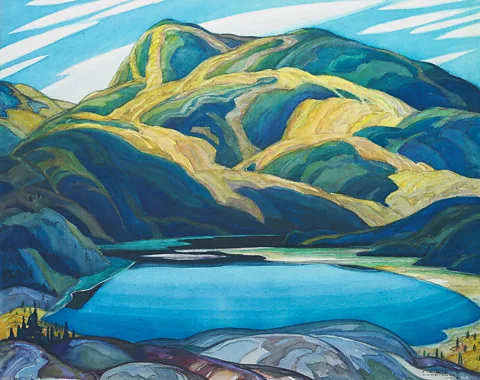
The group which – in addition to Varley – comprised Franklin Carmichael, Lawren Harris, AY Jackson, Franz Johnston, Arthur Lismer and JEH MacDonald remains hugely popular today, as does Tom Thomson, a major influence, who died before its official formation. Their most acclaimed paintings, which include Thomson’s The Jack Pine, The West Wind and Harris’s North Shore, Lake Superior, have become, for many, the national paintings of Canada – embodying the country’s spirit.
A turning point
They began painting in the 1910s, an era when Canada – a self-governing dominion of the British Empire since 1867 – was beginning to find its own social and political identity, but had yet to find an artistic voice. The nascent group was intent on providing just that. A turning point occurred when MacDonald and Harris visited a landmark exhibition of contemporary Scandinavian art in Buffalo, US, in 1913. Norway, Sweden and Finland were all forging their own independent paths at the time. In their sparse landscapes, vividly depicted in flat, bright colours, the two artists saw an expression of national identity that was unequivocally modern.
Their intention was not to portray what nature looked like, but how it made them feel, the emotional state created by the starry sky and the windswept pine – Katerina Atanassova
The aesthetic and intellectual inspiration they took from the Scandinavians was strengthened by the influence of Thomson, a self-taught artist and graphic designer who frequently embarked on lengthy trips into the wilderness, often by canoe, to paint and sketch. “He embodied that ideal, that direct experience that every artist wants to have,” Atanassova tells the BBC. It was Thomson who “started the images of the solitary tree”, and inspired the future Group of Seven artists to see that the Canadian wilderness “can be viewed as modern and painted as modern”, says Atanassova.
Thomson’s death in 1917, at the age of only 40, turned him into a cultural legend, and when the group officially formed in 1920, “the goal was defined that they ought to follow in his footsteps,” says Atanassova. Their intention “was not to portray what nature looked like, but how it made them feel, the emotional state created by the starry sky, the windswept pine or the barren coastal line on the north shore of Lake Superior.” The initial response to their innovative approach was anything but favourable. One review of their first exhibition compared their work to “the contents of a drunkard’s stomach”.
Somewhat ironically, it would take the approval of the very people from whom they were trying to distance themselves to change public opinion. The group’s work was selected for the British Empire Exhibition, held at Wembley in 1924, where it received a rapturous response with the British press praising its “distinct Canadian character. ” Recognition abroad meant that it “suddenly became popular in Canada”, explains Atanassova.
The fact that this “distinct Canadian character” excluded the Indigenous population has led to criticism of the group in some quarters, although Atanassova feels that this is unfair. “You don’t see any signs of civilisation in [the Group of Seven’s] paintings,” she says. They were “looking for untamed nature in the tradition of modern Scandinavian art”, which meant that they also excluded any sign of industrialisation.
While that may be true, we are now painfully aware that in the areas the group were travelling to, they could not have painted Indigenous populations if they had wanted to. The government’s brutal policies, begun in the late 19th Century, had seen them forcibly removed to reservations or residential schools where their movement was restricted and their cultural practices suppressed.
‘The Indian Group of Seven’
These policies had a devastating effect on all aspects of Indigenous life, including artistic production and recognition, a fact that led to the formation of another group of seven in the early 1970s, the Professional Native Indian Artists Incorporated (PNIAI). Jackson Beardy, Eddy Cobiness, Alex Janvier, Norval Morrisseau, Daphne Odjig, Carl Ray and Joseph Sanchez first started meeting in Odjig’s craft shop in Winnipeg.
“They were quite distinct in that they were the first self-organised Indigenous-artists-run arts advocacy group that was formally incorporated that ever existed in Canada,” says Michelle LaVallee, Director of the Indigenous Ways and Decolonization Department and Curatorial Initiatives of the National Gallery of Canada. She herself is Ojibway and a member of the Chippewas of Nawash Unceded First Nation.
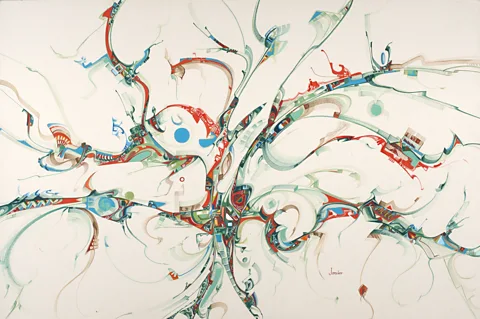
Although they all had different styles and opinions, they wanted to band together to support other artists and challenge exclusionary practices and the narrow view of what “native” art actually was. “We had no one to show our work, so we had to do it ourselves. We acknowledged and supported each other as artists when the world of fine art refused us entry… Together we broke down barriers that would have been so much more difficult faced alone,” Odjig later said.
“At that time, there were no Indigenous curators, no Indigenous people working in institutions,” LaVallee tells the BBC. And where Indigenous art was collected it tended to be relegated to ethno-centric galleries rather than the contemporary fine art collections in which the artists felt they deserved to be exhibited. “It really wasn’t held in the same esteem as [work by their] non-Indigenous peers, even though it is the first and the most authentic art that can be and should be called Canadian,” says LaVallee.
The first art of this land was Indigenous, and the first people of these lands were Indigenous, and that needs to be recognised – Michelle LaVallee
Although the media soon dubbed them “the Indian Group of Seven”, LaVallee isn’t sure they would have appreciated the name. “They were very intentional about what they called themselves,” she says. It was very important for them to have “Professional” and “Native Indian” present in the name of the group.
While LaVallee herself likes the paintings of the Group of Seven, she points out that their approach to landscape is vastly different to the PNIAI. “A lot of the PNIAI’s works you would look at and not necessarily call it a landscape.” They are different ways of referencing the land”. Alex Janvier often incorporated maps in his works, while Norval Morrisseau “draws those connections between land and animals and spirits”. It is art by “somebody from the land versus settlers coming and appreciating the land”, she says.
Even if the Group of Seven weren’t conscious of doing so, they “would have contributed to the circumstances around how Indigenous people were being perceived and treated”, says LaVallee. This was largely down to the way their art was used to “create this popular narrative of Canada” which was picturesque but “excluded the Indigenous populations”, she says.
The PNIAI played a vital role in correcting that, and LaVallee credits her own position – as one of the senior management of the National Gallery of Canada – to their activism. “For me to get to a place like that would not have happened had these earlier artists not fought for these types of rights and opportunities and created avenues of support and camaraderie between Indigenous peoples,” she says.
The National Gallery now displays Indigenous and non-Indigenous art side by side in the same galleries. LaVallee emphasises that this is not meant to “erase or discredit any existing histories”.
“Part of the change we’re trying to assert is the idea that, yes, within Canada, it’s very multicultural, but the first art of this land was Indigenous, and the first people of these lands were Indigenous, and that needs to be acknowledged and respected and recognised.”
In the 1970s, the Group of Seven’s work may have been interpreted by some as exclusionary and colonial, but in the 21st Century it is largely viewed differently. For today’s outdoor-loving Canadians, the group’s art is a celebration of the country’s outstanding natural beauty. It embodies, says Atanassova, “that raw connection with nature – and it’s exactly the nature you see [in the paintings]. The lakes are the same, the skies are the same. It’s an expression of your own experience. What you see and what you feel and what you live.”
Art by the Group of Seven is displayed at the National Gallery of Canada, Ottawa.
—
If you liked this story, sign up for The Essential List newsletter – a handpicked selection of features, videos and can’t-miss news, delivered to your inbox twice a week.
Taken From BBC News


Heiress Peggy Guggenheim scandalised high society – and transformed modern art

Israeli attacks have turned Gaza into ‘toxic wasteland’, Oxfam says

Longest-ever UN climate talks end with no deal as deep divisions exposed

New Chapter for Dragon Boating in Punjab and Khyber Pakhtunkhwa Provincial associations officially set up with sights locked on national competitions and international representation.

South Korea’s Yoo Useong Steps Onto the Global Strongman Stage as World Strongman Federation Professional Athlete

A Survey of Mata-E-Zeest


-
 Pakistan News1 month ago
New Chapter for Dragon Boating in Punjab and Khyber Pakhtunkhwa Provincial associations officially set up with sights locked on national competitions and international representation.
-
 Sports5 months ago
South Korea’s Yoo Useong Steps Onto the Global Strongman Stage as World Strongman Federation Professional Athlete
-
 Art & Culture1 year ago
A Survey of Mata-E-Zeest
-

 Europe News2 years ago
Chaos and unproven theories surround Tates’ release from Romania
-

 American News2 years ago
Trump expands exemptions from Canada and Mexico tariffs
-

 Art & Culture2 years ago
Will Snow White be a ‘victim of its moment’? How the Disney remake became 2025’s most divisive film
-

 Pakistan News1 year ago
Comprehensive Analysis Report-The Faranian National Conference on Maritime Affairs-By Kashif Firaz Ahmed
-

 Entertainment2 years ago
Champions Trophy: Pakistan aim to defend coveted title as historic tournament kicks off today