
Paris (Imran Y. CHOUDHRY) :- Former Press Secretary to the President, Former Press Minister to the Embassy of Pakistan to France, Former MD, SRBC Mr. Qamar Bashir analysis : Within forty-eight hours, Donald Trump displayed three contradictions defining his presidency. He opened the door to Russian diesel, honoured immigrant innovators while restricting skilled immigration, and presented both decisions as “America First”—even as he moved the country away from its immigrant-built, pluralistic tradition toward narrower nationalism.
The Russian diesel decision is the most immediate reversal. Since Russia invaded Ukraine in 2022, Washington has tried to deny Moscow the energy revenue financing its war. Yet on October 9, Trump announced a deal with Vladimir Putin for an immediate shipment of 300,000 tons of Russian diesel, followed by much larger deliveries. The Treasury Department simultaneously issued a licence authorizing transactions involving the sale, delivery and importation of Russian diesel until April 2027.
Trump defended the deal as relief for farmers, truckers and consumers facing punishing fuel prices. Lowering costs is legitimate. But a president who speaks constantly of strength has chosen dependency on a state sanctioned for aggression. Six senators from both parties called for an immediate reversal, and Republican Senator Thom Tillis questioned its legality. “Peace through strength” becomes difficult to understand when economic discomfort produces retreat from a policy designed to constrain the aggressor.
The second contradiction is even more revealing. On October 8, Trump presented the National Medal of Science and the National Medal of Technology and Innovation to six technology leaders. Five—Elon Musk, Sergey Brin, Jensen Huang, Lisa Su and Satya Nadella—were born outside the United States. Trump praised them as national treasures and celebrated their contributions to American supremacy in space, semiconductors, computing and artificial intelligence.
These honours unintentionally proved what anti-immigration nationalism tries to deny: much of America’s scientific greatness has an immigrant face. Nadella came from India and previously worked in the United States on an H-1B visa. Brin arrived from the Soviet Union. Musk came from South Africa, while Huang and Su were born in Taiwan. America did not lose by admitting them. It multiplied its wealth, knowledge and global power.
Yet hours before the ceremony, Vice President JD Vance accused Microsoft of abusing skilled-worker programmes, and the administration suspended Microsoft from a process used to sponsor foreign employees for permanent residence. Trump has also extended restrictions on certain H-1B entrants. Visa abuse should be investigated, American workers must not be displaced through fraud, and wage suppression should not be tolerated. But reform is different from treating foreign talent first as a threat and later—after producing billions and historic inventions—as a national treasure.
The contradiction could hardly be sharper: award yesterday’s immigrants while closing the door on tomorrow’s innovators. America cannot know in advance which foreign student, engineer, physician or entrepreneur will become the next Nadella, Huang or Brin. A visa system designed only for already famous “geniuses” misunderstands how achievement develops. Talent needs entry, education, opportunity, failure and time. If fear replaces openness, the next generation of innovators will build its companies, laboratories and patents in Canada, Europe, China or the Gulf—not in America.
This brings us to the third and deeper shift: the movement from American pluralism toward exclusionary nationalism. Trump designated English as the country’s official language and speaks of immigration largely through the vocabulary of invasion, crime and cultural loss. A common language can strengthen communication, and secure borders are a legitimate responsibility of the government. But unity is not uniformity. The United States became powerful because it converted different languages, cultures and experiences into a common civic identity.
Nationalism becomes destructive when it demands that newcomers erase themselves before they can belong. It forgets that immigrants harvest American food, staff hospitals, conduct research, found companies, pay taxes and serve in the armed forces. Trump celebrates their achievements only after success makes them impossible to ignore, while policies and rhetoric make the path harder for those still trying to contribute. That is not a coherent national strategy. It is economic self-sabotage dressed as patriotism.
The same contradiction runs through Trump’s conduct abroad. At the United Nations, he presented himself as a peacemaker while asking whether he should “annihilate” the Islamic Republic of Iran and drive it “into hell.” In Oklahoma, he mixed nuclear installations with unsupported claims about Iranian “drug factories.” In Nebraska, he spoke of Iran taking out Los Angeles or San Diego and called the situation a “small price to pay.” The White House later said he meant that war was preventing such destruction. That may explain his intended message, but it cannot delete the words the world heard.
Trump praises law while attacking institutions that might restrain powerful governments. He called the International Criminal Court “evil” and “rogue” and urged member states to abandon it. He defends sovereignty, yet his administration controls Venezuelan oil-related revenue and gold sales while refusing to provide Congress with a complete public accounting. Treasury Secretary Scott Bessent described the arrangement as potentially one of the largest assets ever placed on the United States balance sheet, yet could not clearly say whether funds were flowing to the American government, private companies or other U.S. persons.
At home, Trump celebrates constitutional freedom while retaliating against critical journalism. His administration excluded CNN, MS NOW and Politico from White House access; a federal judge ordered temporary restoration. When major television networks suspended pool coverage in solidarity, the Justice Department opened an antitrust inquiry. A press permitted to praise but punished for criticism is not free. It is merely tolerated until it becomes useful.
Trump also claims unmatched economic credibility while repeatedly inflating announced investment. He has cited more than $20 trillion, whereas the White House’s own published figure is about $11 trillion—and much of that consists of pledges and long-term announcements rather than completed investments. He praises technological leadership while renaming artificial intelligence “superintelligence,” as though branding resolves genuine dangers involving surveillance, employment, autonomous weapons and human control. He mocks climate warnings while withdrawing America from international climate cooperation.
Even his oath to defend the Constitution sits uneasily beside repeated flirtation with a third term. Such ideas are introduced as jokes, repeated as trial balloons and gradually normalized. If his party ever obtained the required congressional supermajorities, Trump would not hesitate to pursue an amendment creating a third-term route. Three-fourths of the states would still have to ratify it, but constitutional limits survive only when citizens refuse to treat attacks upon them as entertainment.
These are not isolated slips. They form a governing pattern: sanction Russia, then buy its diesel; honour immigrants, then obstruct their successors; proclaim peace, then threaten annihilation; invoke sovereignty, then control another nation’s assets; praise freedom, then punish the press; defend the Constitution, then test its limits.
America’s greatness was never created by nationalism alone. It came from constitutional restraint, scientific openness, immigrant energy, credible alliances and the disciplined use of power. Trump’s contradictions weaken each of those foundations. Unless confronted, “America First” may leave America paying Russia, losing innovators, dividing its people and alarming the world.
Trump’s Contradictions: Fueling Unrest in America and Abroad
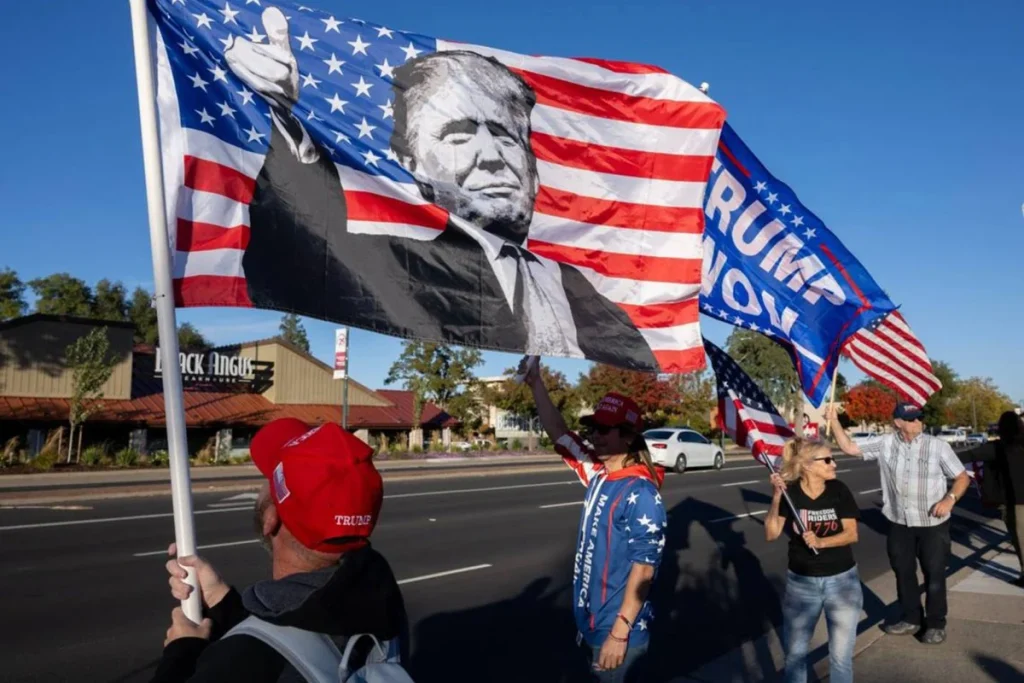
Trump’s Contradictions: Fueling Unrest in America and Abroad