
Paris (Imran Y. CHOUDHRY) :- Former Press Secretary to the President, Former Press Minister to the Embassy of Pakistan to France, Former MD, SRBC Mr. Qamar Bashir analysis : The war in the Middle East has now moved far beyond the battlefield. What initially appeared as a regional military confrontation has evolved into a systemic global crisis—one that is tightening its grip not only on governments and markets, but on ordinary people struggling to sustain daily life. The closure of the Strait of Hormuz, combined with targeted disruption of oil infrastructure, has triggered a cascading breakdown across energy supply chains, aviation networks, and tourism-dependent economies. The world is no longer merely watching a war; it is experiencing its economic consequences in real time.
At the center of this unfolding crisis lies the global jet fuel market—a sector often overlooked in geopolitical analysis, yet one that sustains the arteries of globalization. Prior to the conflict, global jet fuel demand had recovered strongly, reaching approximately 107 billion gallons annually in 2024, with projections climbing to nearly 7.2 million barrels per day by early 2026. This demand was supported by a finely balanced supply network spanning North America, Asia, and the Middle East. Today, that balance has been violently disrupted.
The Middle East, which typically contributes around 20% of global jet fuel supply, has seen a dramatic collapse in its effective output. War-related damage to refineries, combined with the strategic closure of the Strait of Hormuz, has removed an estimated 320,000 tons of jet fuel per day from global circulation. At the same time, approximately 3 million barrels per day of refining capacity across the الخليج region has either been shut down or rendered inoperable. This is not a marginal disruption—it is a structural shock to the global energy system.
Jet fuel prices have responded accordingly. Within weeks, prices surged from approximately $85–90 per barrel to well above $200, representing one of the sharpest increases in modern energy market history. For the aviation industry, where fuel accounts for up to one-third of operating costs, this is nothing short of catastrophic. Airlines are no longer operating in a demand-driven environment; they are navigating a survival crisis defined by cost pressures and supply scarcity.
The impact is most visible in Europe, where the aviation sector—and by extension, the tourism economy—is deeply exposed. Europe imports roughly 25–30% of its jet fuel from the Persian Gulf. With supply lines disrupted, airlines have begun aggressive capacity cuts. Major carriers have canceled thousands of flights ahead of the critical summer season. Lufthansa alone has reportedly removed tens of thousands of flights from its schedule, while other carriers are grounding aircraft, optimizing routes, and operating only essential services.
This contraction strikes at the heart of Europe’s economic model. Tourism is not a peripheral sector; it is a foundational pillar. The continent generates between $600 and $700 billion annually from tourism, supporting millions of jobs and contributing significantly to GDP in countries such as Spain, Italy, France, and Greece. This entire ecosystem depends on affordable, reliable air travel. Without it, hotels remain empty, restaurants lose customers, and entire regional economies begin to contract.
The crisis is not confined to Europe. In Asia-Pacific, where airlines depend heavily on Middle Eastern fuel flows, the situation is even more acute. Carriers have entered emergency operational modes, securing limited fuel supplies and preparing for prolonged disruption. Even in the United States—buffered by its status as a major producer—airlines face massive financial strain. Leading carriers have warned of billions of dollars in additional fuel costs, threatening profitability and forcing difficult operational decisions.
What makes this crisis particularly dangerous is its compounding nature. Aviation is not only about passenger mobility; it is a critical component of global trade. High-value goods, pharmaceuticals, and time-sensitive cargo depend on air freight. As flight capacity shrinks, supply chains tighten, prices rise, and inflationary pressures intensify. Indeed, energy analysts have already warned that this crisis could add nearly 0.8% to global inflation—an alarming figure in an already fragile economic environment.
Meanwhile, the maritime dimension of the conflict is adding further instability. The Strait of Hormuz, through which nearly one-fifth of the world’s oil supply normally passes, has become a contested zone. Tankers are being intercepted, diverted, and in some cases seized. Insurance costs have soared, discouraging shipping companies from entering the region. Even where fuel is available, the ability to transport it safely has become uncertain.
China’s position offers a temporary buffer but not immunity. With substantial strategic reserves and a diversified energy portfolio, including large-scale investments in renewable energy, China can withstand short-term shocks. However, as the world’s manufacturing hub, any prolonged disruption will inevitably impact its output. A slowdown in Chinese production would have global consequences, affecting supply chains and economic growth worldwide.
This brings into focus a critical strategic question: what is the underlying objective of this disruption? One interpretation—gaining increasing traction—is that the closure of the Strait of Hormuz is not merely a byproduct of conflict, but a strategic lever. By constraining Middle Eastern supply, global demand is redirected toward alternative producers, most notably the United States. Over the past decade, the U.S. has transformed into a leading exporter of oil and liquefied natural gas. In a constrained market, its leverage increases significantly.
For Iran, the situation presents a profound strategic dilemma. Maintaining the closure of the Strait exerts pressure on adversaries but simultaneously inflicts economic pain on the wider world. Reopening the waterway, on the other hand, could reposition Iran as a stabilizing force while exposing the broader dynamics at play. It would restore global supply flows, ease economic pressures, and potentially shift international opinion.
From a strategic standpoint, reopening Hormuz could neutralize the leverage derived from disruption. It would deny the United States to exploit scarcity and would reestablish a degree of economic normalcy. More importantly, it would demonstrate that stability—not disruption—is the stronger strategic position in an interconnected global system.
The world today is facing more than an energy crisis. It is confronting the fragility of a system built on uninterrupted flows—of fuel, goods, people, and capital. When one critical node collapses, the effects ripple outward, disrupting industries and livelihoods across continents.
If the current trajectory continues, the consequences will be severe. Aviation networks may contract further, tourism economies could enter recession, and global trade may slow significantly. Inflationary pressures will rise, and economic uncertainty will deepen. What began as a regional conflict risks becoming a global economic turning point.
The solution lies not in escalation, but in recalibration. Restoring the free flow of energy through critical waterways, stabilizing supply chains, and reengaging in meaningful diplomacy are essential steps. The alternative is a prolonged period of economic disruption with far-reaching consequences.
The Strait of Hormuz is no longer just a geographic chokepoint. It has become the pivot on which the global economy now turns.
How Iran War Is Grounding the World Economy
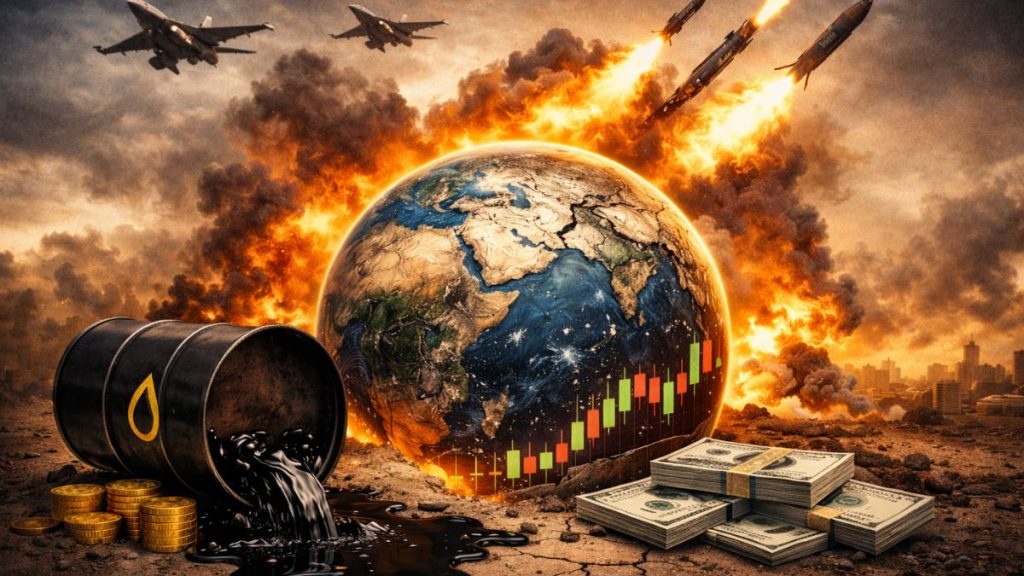
How Iran War Is Grounding the World Economy