
Paris (Imran Y. CHOUDHRY) :- Former Press Secretary to the President, Former Press Minister to the Embassy of Pakistan to France, Former MD, SRBC Mr. Qamar Bashir analysis : For more than a century, Cuba has occupied a unique place in the geopolitical imagination of the United States. Barely 90 miles from Florida, the island has long been viewed by Washington not merely as another Caribbean nation, but as a strategic frontier whose political orientation directly affects American security, trade routes, and regional dominance. Today, under President Donald Trump, the rhetoric surrounding Cuba has once again intensified. Trump recently described Cuba as a “failing nation” lacking oil, economic vitality, and civic infrastructure, portraying it as a country from which people are desperately fleeing. Simultaneously, Washington has revived historical legal cases, tightened sanctions, and launched what many analysts describe as a renewed “maximum pressure” campaign against Havana.
The latest turning point came with the indictment of former Cuban leader Raúl Castro over the 1996 downing of aircraft belonging to the “Brothers to the Rescue” organization. The symbolism of announcing the case on May 20—the anniversary of Cuba’s formal independence from Spain under U.S. oversight—was impossible to ignore. For many observers, this was not merely a legal action but a geopolitical message that Washington intends to reshape Cuba’s future once again.
To understand America’s enduring obsession with Cuba, one must look beyond ideology and examine geography, diaspora politics, military calculations, energy security, and historical psychology. Cuba sits at the entrance of the Gulf of Mexico and near some of the busiest maritime routes in the Western Hemisphere. Any rival-aligned government on the island has always been perceived in Washington as a direct strategic threat. During the Cold War, this fear culminated in the Cuban Missile Crisis, when Soviet missiles stationed in Cuba nearly triggered nuclear war.
Even after the collapse of the Soviet Union, Cuba retained immense symbolic and strategic importance. For American policymakers, the survival of a communist state only miles from U.S. shores represented unfinished business. For Cuba, resisting American pressure became a symbol of sovereignty and anti-imperial defiance. That unresolved historical conflict continues to shape policy today.
One of the most overlooked but powerful dimensions of U.S.-Cuba relations is the influence of the Cuban diaspora in America. According to recent demographic estimates, nearly 2.9 million people of Cuban origin now live in the United States, with around 1.6 million concentrated in Florida alone. Their political influence, particularly in South Florida, is enormous. Cuban Americans have historically voted in high numbers and have exercised outsized influence over U.S. foreign policy toward Havana.
For decades, anti-communist Cuban exiles formed one of the most powerful lobbying communities in American politics. Leaders such as Marco Rubio became symbols of this political influence, pushing for sanctions, regime pressure, and hardline policies toward Havana. Surveys show a large majority of Cuban Americans in Florida continue to support strong pressure on the Cuban government and largely align with Republican foreign policy positions.
Yet this diaspora influence creates a strategic dilemma for Washington. If Cuba collapses economically or descends into war, millions of Cuban Americans would be emotionally, politically, and socially affected. A humanitarian catastrophe could ignite enormous demonstrations, media campaigns, refugee sponsorship drives, and political pressure inside the United States itself. Any military operation causing widespread civilian casualties would deeply divide the Cuban-American community. While some exiles support regime change, many would strongly oppose destruction of their homeland or the killing of civilians.
Washington also fears the practical consequences of collapse. A conflict or economic implosion could trigger a migration crisis larger than the 1980 Mariel boatlift, sending tens of thousands of desperate refugees toward Florida. Managing such a crisis would place enormous pressure on U.S. social services, border agencies, and local politics. The White House would therefore face a contradiction: trying to weaken the Cuban government while simultaneously preventing total collapse that could destabilize domestic American politics.
Another critical factor is energy geopolitics. The modern United States increasingly views control over energy resources and shipping routes as central to maintaining global power. Recent confrontations involving Venezuela and Iran reveal a broader strategic pattern: securing influence over oil-producing regions and the maritime chokepoints through which energy flows.
The Strait of Hormuz remains one of the world’s most important oil arteries. Any disruption there affects global prices, shipping insurance, and economic stability. If tensions in the Persian Gulf intensify or Hormuz becomes partially blocked, the United States would increasingly depend on Western Hemisphere energy routes and Atlantic-based supply chains. In that context, Cuba gains enormous strategic importance.
Cuba sits near the maritime corridors connecting the Gulf of Mexico, Caribbean shipping lanes, and Atlantic energy routes. Control or influence over Cuba strengthens America’s ability to secure oil transportation from the Gulf Coast, Latin America, and Atlantic markets. Washington fears that a hostile Cuba aligned with China, Russia, or Iran could threaten surveillance, naval access, logistics, or energy movement near U.S. territory.
This explains why Cuba is viewed not merely as a poor island nation, but as a strategic node in the larger architecture of global energy and maritime security. Just as Washington seeks influence over the Persian Gulf and the Strait of Hormuz, it also seeks dominance over the Caribbean basin and Gulf maritime network. The objective is not simply controlling oil reserves, but controlling the routes, chokepoints, and geopolitical environment through which global energy moves.
At the same time, Cuba’s relationships with Russia and China intensify American concerns. U.S. officials increasingly warn about alleged Chinese intelligence facilities and Russian military cooperation on the island. Whether exaggerated or not, such developments reinforce Washington’s long-standing fear of rival powers establishing strategic footholds near U.S. shores.
Yet overt military action against Cuba would carry extraordinary risks. Cuban President Miguel Díaz-Canel has warned that any invasion would trigger a “bloodbath with incalculable consequences.” Cuba’s military is vastly weaker than America’s, but Havana’s doctrine relies on asymmetric warfare, territorial militias, and prolonged resistance designed to make occupation politically and economically costly.
History also warns against simplistic assumptions. Iraq and Afghanistan demonstrated that weaker nations can still impose immense costs on stronger powers through insurgency and social resistance. Cuba’s dense urban areas, mountainous terrain, and strong nationalist identity could transform any intervention into a prolonged crisis rather than a quick victory.
Ultimately, America’s fixation with Cuba is about far more than communism or democracy. It is about geography, maritime dominance, energy security, diaspora politics, and the psychology of power. Great powers rarely tolerate independent strategic actors near their borders. Washington sees Cuba not simply as an island, but as a critical piece in the larger struggle for influence over the Western Hemisphere and global trade routes.
But history also shows that pressure alone rarely produces stable outcomes. Attempts to reshape nations through sanctions, coercion, or military threats often create resistance, instability, and humanitarian suffering. Cuba’s future will depend not only on American strategy or Cuban resilience, but on whether both nations can eventually escape the cycle of confrontation and historical resentment that has defined their relationship for more than a century.
Why USA Wants to Overrun Cuba
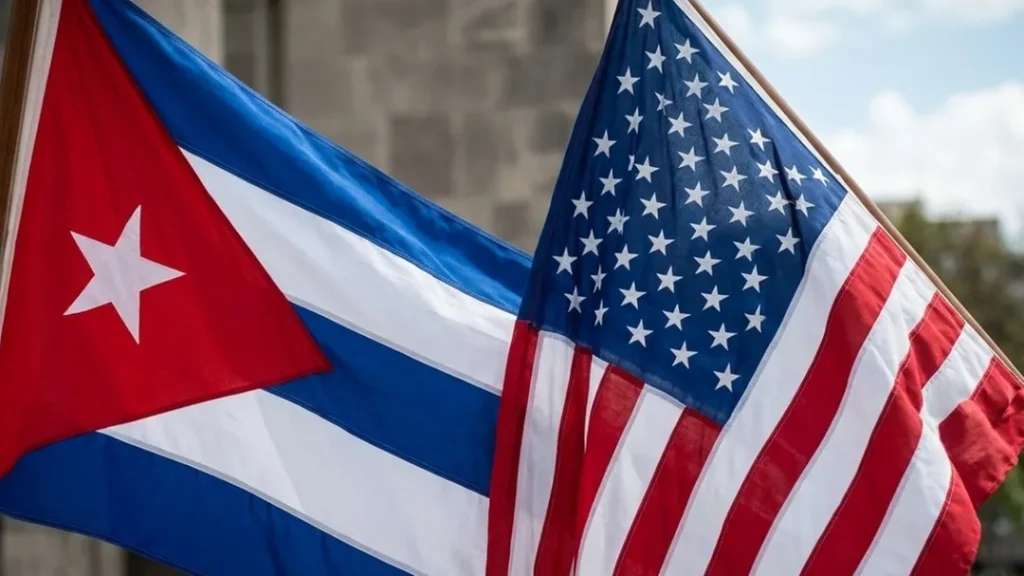
Why USA Wants to Overrun Cuba