
Paris (Imran Y. CHOUDHRY) :- Former Press Secretary to the President, Former Press Minister to the Embassy of Pakistan to France, Former MD, SRBC Mr. Qamar Bashir analysis : President Donald Trump’s upcoming visit to Beijing on May 14–15, 2026, may become one of the most consequential diplomatic moments of his presidency—not because it demonstrates American dominance, but because it symbolizes the dramatic transformation of global power relations. Once the uncontested architect of the global order, the United States now approaches China not from a position of overwhelming superiority, but from a position increasingly shaped by economic necessity, military exhaustion, geopolitical isolation, and strategic dependency.
For years, President Trump has repeatedly described Chinese President Xi Jinping as his “friend,” much like he has referred to Russian President Vladimir Putin and other global leaders. Yet international diplomacy has never operated on permanent friendships. Nations pursue interests, not emotions. Beneath the public compliments and ceremonial gestures lies one of the fiercest strategic rivalries in modern history.
From the moment Trump returned to office, virtually every Senate confirmation hearing for his cabinet nominees revolved around one central theme: China as America’s principal adversary. The United States’ grand strategy was unmistakable—contain China’s rise, weaken its economic reach, obstruct the Belt and Road Initiative, challenge its influence over maritime trade routes, and prevent Beijing from replacing Washington as the world’s dominant power.
Yet the geopolitical landscape has evolved in ways few in Washington anticipated.
The prolonged Iran conflict has fundamentally altered perceptions of American power. The United States and Israel entered the confrontation with sweeping objectives: to curb Iran’s nuclear ambitions, dismantle its ballistic missile and drone capabilities, weaken its regional influence, and potentially force political capitulation. However, months later, many of those objectives remain unmet. Iran’s political structure survived, its military resilience remained intact, and its regional alliances endured.
This outcome has had profound global consequences. Across policy circles in Washington, questions are now openly being asked about the limits of American military power. Reports in Congress and the Senate increasingly acknowledge the heavy depletion of expensive precision-guided weapons systems, including Patriot missile batteries and THAAD interceptors. Analysts warn that replenishing these arsenals could take years and require enormous industrial expansion.
The war has therefore produced not only military strain but psychological damage to the image of American invincibility.
For China, this changing environment creates strategic opportunity.
Beijing enters the Trump-Xi summit with growing confidence. Over the past decade, China has systematically insulated itself from external shocks. It built enormous strategic oil reserves, accelerated renewable energy deployment, diversified supply chains, expanded naval and space capabilities, and reduced dependence on vulnerable Western-controlled systems.
Today, China dominates the global rare earth minerals industry—critical for electronics, batteries, aerospace systems, missiles, electric vehicles, and advanced defense manufacturing. The United States remains deeply dependent on Chinese rare earth processing and magnet production, especially as Washington attempts to replenish military stockpiles consumed during the Iran war. Even senior American officials acknowledge that building an alternative ecosystem could take many years.
This dependency significantly weakens Washington’s leverage.
The irony is striking. While the United States once sought to economically isolate China, it now desperately requires Chinese cooperation to stabilize critical industrial and military supply chains.
The upcoming Beijing talks are expected to focus heavily on trade stabilization, rare earth exports, shipping security, artificial intelligence, Taiwan, and Iran. According to multiple reports, Washington also seeks to establish a new “Board of Trade” mechanism to formalize economic coordination between the world’s two largest economies. The United States hopes China will increase purchases of American soybeans, aircraft, agriculture, energy products, and industrial goods. But beneath these economic discussions lies a deeper geopolitical reality: the United States increasingly needs China to help stabilize the international system.
The Iran war has disrupted shipping lanes, endangered energy flows, rattled financial markets, and exposed vulnerabilities across the global economy. Washington is now reportedly urging Beijing to pressure Tehran into reopening and stabilizing the Strait of Hormuz, through which a substantial share of the world’s oil and LNG passes. Yet China’s position on Iran differs sharply from Washington’s.
China has consistently resisted unilateral U.S. sanctions and remains one of Iran’s largest energy customers. Beijing views Iran not merely as an oil supplier but as a strategic node in Eurasian connectivity. At the same time, China has carefully balanced relations with Gulf Arab states, Russia, and Western economies. Unlike the United States, Beijing has largely avoided direct military entanglement while expanding economic influence across continents. This strategic patience has enhanced China’s global image.
At the same time, America’s relations with traditional allies have visibly deteriorated. Trump’s repeated demands regarding NATO burden-sharing, controversial rhetoric toward Europe, pressure over Greenland, and transactional diplomacy have frustrated many longstanding allies. European leaders who once aligned instinctively with Washington increasingly pursue independent relations with Beijing.
In recent years, multiple European delegations have traveled to China seeking investment, trade partnerships, and economic stability. This trend reflects not only Europe’s commercial interests but also a broader perception that China now represents predictability and long-term planning, while the United States increasingly appears driven by short-term political calculations. The symbolic implications are enormous.
For decades, American alliances formed the foundation of U.S. global supremacy. If allies gradually hedge toward China economically and diplomatically, the strategic balance of the international system changes fundamentally.
The Taiwan issue further complicates the summit. For years, Taiwan relied heavily on implicit American military backing. However, after the Iran conflict exposed strains on U.S. military readiness and weapons inventories, questions naturally emerge regarding Washington’s ability to sustain simultaneous large-scale confrontations in multiple theaters.
China understands this reality. Beijing is unlikely to aggressively force the Taiwan issue during Trump’s visit, but it recognizes that America’s credibility has been weakened. Trump himself previously suggested Taiwan should pay more for U.S. protection, reinforcing perceptions that American commitments may be transactional rather than absolute.
At the same time, China’s military modernization continues at remarkable speed. Beijing has expanded naval capabilities, advanced space programs, strengthened missile systems, and invested heavily in artificial intelligence and cyber warfare. China’s technological and industrial rise is now occurring on a scale unprecedented in modern history.
The contrast with America’s current challenges is increasingly visible. Economically, China continues diversifying energy sources and reducing fossil fuel dependency through renewable infrastructure. Militarily, it avoids prolonged foreign wars while preserving industrial capacity. Diplomatically, it expands partnerships without demanding ideological alignment. Strategically, it plays a long game.
This does not mean the United States has collapsed or China has “won” globally. America still possesses immense military power, technological innovation, financial influence, and alliance networks. However, the perception of unstoppable American supremacy has undeniably weakened.
Trump’s Beijing trip therefore represents more than a diplomatic visit. It symbolizes a historic transition toward a more multipolar world order.
The United States enters these talks seeking trade relief, industrial cooperation, shipping stability, rare earth access, and geopolitical de-escalation. China enters the talks seeking recognition of its status, protection of its economic interests, stability for continued growth, and gradual expansion of its global influence.
Both sides need each other. But increasingly, it appears they need each other on terms far more equal than at any point in recent decades. That reality alone marks one of the most significant geopolitical transformations of the 21st century.
Trump’s China Visit in a Changing World Order
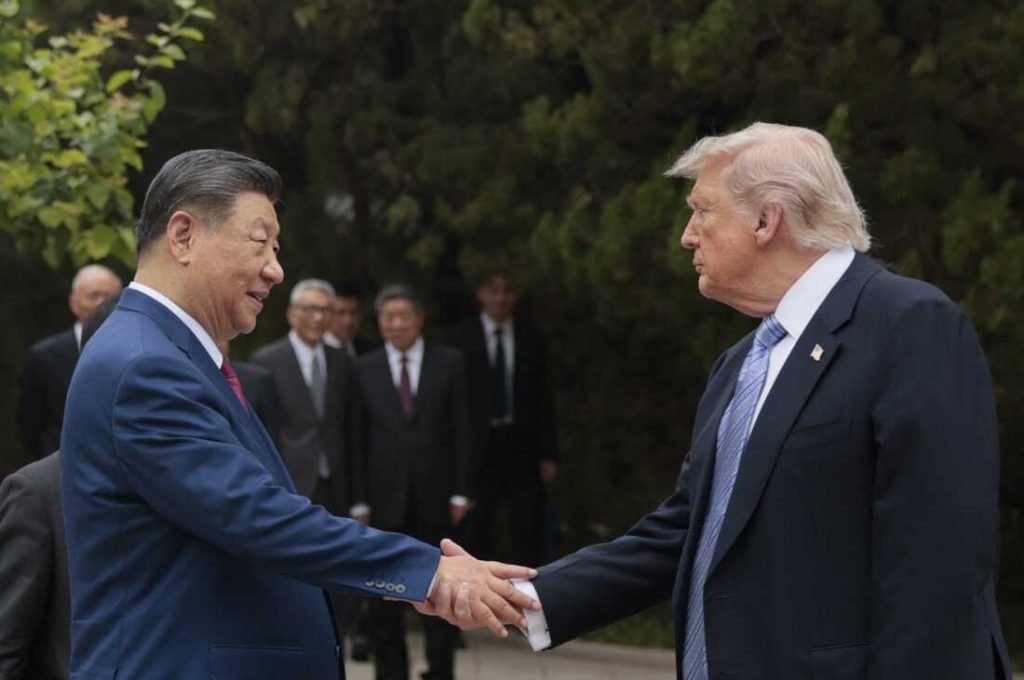
Trump’s China Visit in a Changing World Order