
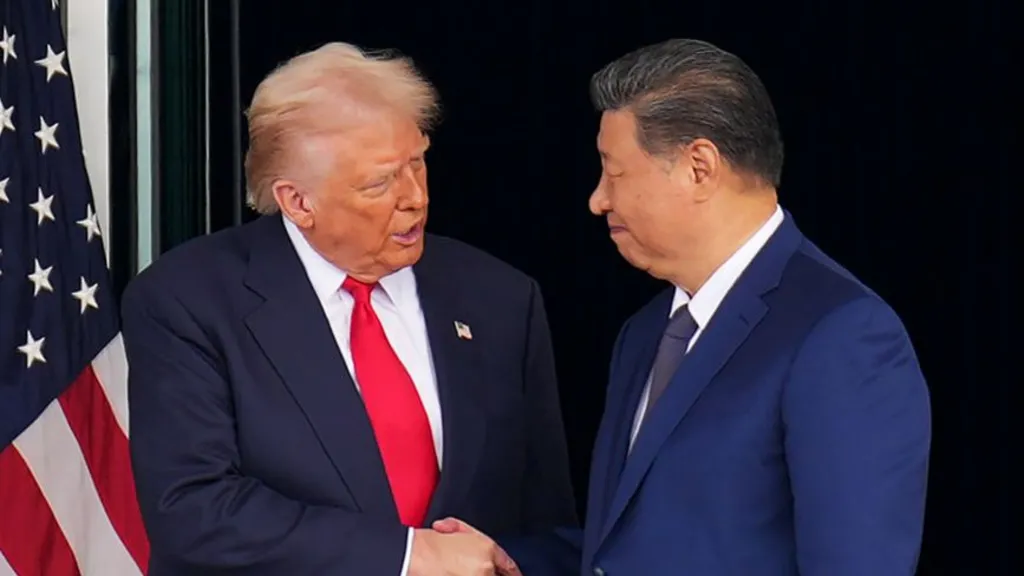
US presidential trips abroad have traditionally been an opportunity to display the power of the American nation on the world stage. Donald Trump’s five-day swing through eastern Asia, on the other hand, has been a display of the power of Trump – but also, at times, of that power’s limitations.
Trump’s stops in Malaysia, Japan and South Korea over the course of the first four days were an exercise in pleasing a sometimes mercurial American president. It was an acknowledgement that Trump, with the flick of a pen, could impose tariffs and other measures that have the potential to devastate the economies of export-dependent nations.
His sit-down with Chinese leader Xi Jinping on Thursday, however, was something entirely different.
It was a meeting of equals on the global stage, where the stakes for both nations – for their economies, for their international prestige, for the welfare of their people – were enormous.
With China, Trump may flick his pen, but such actions come with consequences. They come with a cost.
For the first four days, Trump’s most recent foray into global diplomacy was smooth sailing.
Each stop was punctuated by a blend of traditional trade negotiations – deals made under the shadow of Trump’s “reciprocal” tariffs – and personal accommodations that at times bordered on the obsequious.
In Malaysia, Trump secured access to critical minerals and made progress toward finalising trade arrangements with south-east Asian nations. He also presided over a treaty that should ease border tensions between Thailand and Cambodia – the kind of “peace deal” the American president loves to tout.
In Japan, Trump’s Marine One flew past a Tokyo Tower lit red, white and blue – with a top in Trumpian gold.
Newly elected Prime Minister Sanai Takaichi detailed $550bn in Japanese investments in the US and offered the American president a gift of 250 cherry trees for America’s 250th birthday, and a golf club and bag that belonged to Shinzo Abe, the assassinated former prime minister who bonded with Trump in his first term.
She also became the latest foreign leader to nominate Trump for his much-desired Nobel Peace Prize.
Not to be outdone, South Korea welcomed Trump with artillery firing a 21-gun salute and a military band that played Hail to the Chief and YMCA – the Village People song that has become a Trump rally anthem.
President Lee Jae Myung held an “honour ceremony” for Trump during which he gave the American leader his nation’s highest medal and a replica of an ancient Korean dynastic crown.
Lunch with Lee featured a “Peacemaker’s Dessert” of gold-encrusted brownies. Later that day, the Koreans served Trump vineyard wine at an intimate dinner in Trump’s honour with six world leaders attending the Asia-Pacific Economic Conference summit.