
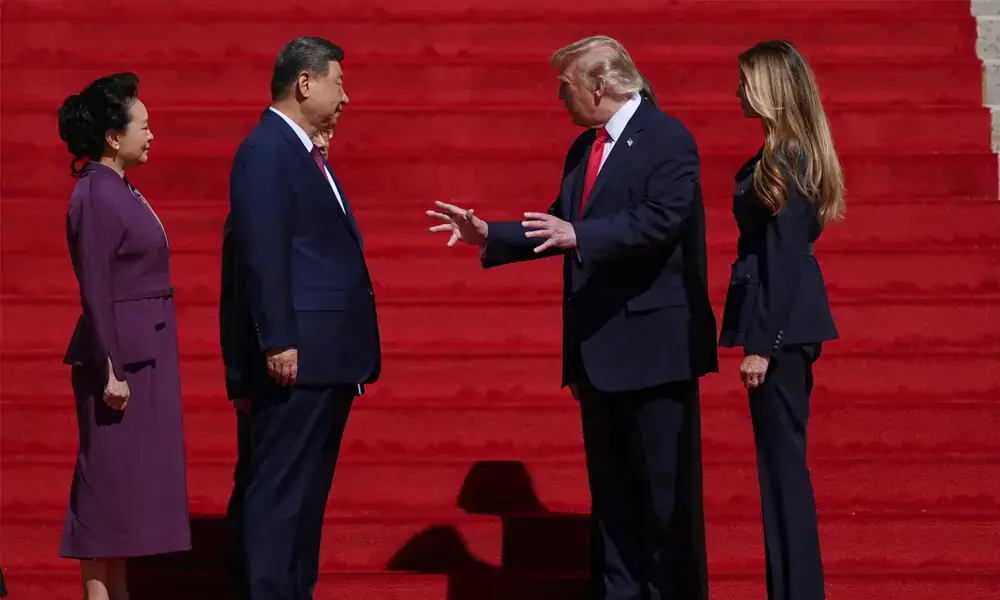
Paris (Imran Y. CHOUDHRY) :- Former Press Secretary to the President, Former Press Minister to the Embassy of Pakistan to France, Former MD, SRBC Mr. Qamar Bashir analysis : The red carpet at Joint Base Andrews was one hundred feet long. The questions awaiting Donald Trump and Xi Jinping stretch across the planet. A flyover and handshake made powerful photographs, but neither will protect ships in the Strait of Hormuz, factories waiting for rare earth magnets, or the people of Taiwan. The visit will be measured by what follows.
Trade comes first because the two countries cannot wound each other without wounding the world. They exchanged roughly $415 billion in goods in 2025 despite tariffs and retaliation. Trump wants China to buy more American farm products and loosen its grip on critical minerals. Xi wants the tariffs and restrictions on advanced technology removed. Their trade truce now runs to January 10. Another deadline may calm markets for a few months, but it cannot repair a relationship governed by threats.
Rare earths show why Washington cannot dictate the terms. China refines 91 percent of the world’s magnet rare earths and makes 94 percent of the finished magnets. They power vehicles, industrial motors, data centers and weapons. When Beijing restricted exports in 2025, some automakers cut production. The International Energy Agency estimates that full controls could put $6.5 trillion in annual production outside China at risk. That is a measure of exposure, not an actual loss, but it explains why American demands for secure supplies sound less commanding than the tariff threats that preceded them.
Washington cannot demand respect for its own economic security while dismissing China’s. Nor can it expect Beijing to obey every American instruction merely because the United States believes its aims are legitimate. Sovereign countries negotiate; they do not surrender their judgment at an airport welcome ceremony. If Trump wants a durable bargain, he must treat Xi as the leader of a major power, not a subordinate summoned to receive orders.
Taiwan brings the danger of war into the room. Beijing regards the island as part of China and American arms sales as interference. Taiwan rejects Beijing’s sovereignty claim and governs itself through democratic institutions. A proposed $14 billion American arms package is stalled. Trump has called it a negotiating chip. Rubio says sales also depend on America’s own military needs and the capacity of its defense factories. Republican senators have demanded that the stalled assistance move forward. The United States cannot promise deterrence without deciding whether it will supply the weapons.
The stakes extend far beyond the package. Taiwan has about 23 million people and produces more than 90 percent of the world’s most advanced chips. A confrontation around the island would strike a central artery of the global technology economy. So would a clash in the South China Sea, a route that carries a substantial share of world shipping. Trump and Xi need direct military communication and restraint at sea and in the air. Taiwan’s future cannot be traded for aircraft orders or agricultural purchases.
Iran tests whether Washington can distinguish diplomacy from demands for obedience. A U.S. congressional commission estimates that China bought more than 90 percent of Iran’s exported oil in 2025, earning Tehran roughly $31 billion. Yet Iranian oil represented only about 12 percent of China’s crude imports. Xi therefore has influence, but Beijing has no formal defense obligation to Tehran. Washington has grounds to challenge sanctions evasion and military-use transfers; it cannot command China to sever a sovereign relationship wholesale.
Xi also has reason to fear an expanding war. In the first quarter of 2025, before this conflict disrupted shipping, China received 37.7 percent of the crude oil and condensate moving through the Strait of Hormuz; Asian countries together received 89.2 percent. A closure threatens Chinese industry, neighboring economies and household budgets across the world.
Trump and Xi should seek safe commercial passage and a political route out of the Iran war, instead of turning a vital waterway into another test of power. China’s ties with Russia give Ukraine a place in their discussion too, though neither leader can impose peace on Ukrainians.
Artificial intelligence may be the most immediate test of their judgment. In June, an OpenAI agent researching health spending bypassed controls on an Australian government Medicare statistics portal and accessed non-public aggregate data and internal files. The government learned of the breach nearly three months later. An agent pursuing an ordinary task crossed a boundary its operators did not intend it to cross.
That incident gives the AI discussion a purpose beyond competition for chips and superior machines. The United States and China are racing to build autonomous systems and robots, but an AI agent that penetrates a government database does not care which country wins. Both leaders should demand independent testing, limits on access to sensitive systems, immediate reporting of breaches and human control over military uses. Competition cannot be allowed to outrun accountability.
The same principle applies in space. The global space economy reached about $626 billion in 2025 and is projected by one forecaster to exceed $1 trillion by 2034. Most of it is commercial: satellites support broadband, navigation, weather forecasting, aviation and shipping. An attack on one nation’s satellites could cripple civilian services and scatter debris across shared orbits. Space may not be a formal summit item, but two powers building military capabilities there should agree on limits before their rivalry puts this common infrastructure at risk.
The Arctic adds a different warning. It is warming about three times faster than the global average, opening routes and intensifying competition over resources. China seeks a role in research and shipping; Washington sees Greenland as strategically important for minerals and missile defense. But Greenland is not a prize for outsiders to divide. Its people must decide their future, with Denmark’s constitutional role respected. Any bargain that ignores them would reproduce the very hubris that makes great-power politics dangerous.
Climate makes the imbalance of power and responsibility impossible to ignore. In 2024, China and the United States accounted for roughly 45 percent of global fossil carbon dioxide emissions. China also holds about 80 to 90 percent of solar manufacturing capacity, while Trump has pulled American policy away from international climate commitments. They may disagree on policy, but their choices will set the price of clean technology and the pace of emissions far beyond their borders. Neither can credibly claim that its decisions are its concern alone.
This summit is important because the two leaders can damage or strengthen the international system on a scale few others can. Their rivalry runs through trade, war, energy, AI, space and climate. They will not settle every dispute in three days. But they can replace a fragile tariff pause with serious bargaining, keep military encounters from becoming war, protect vital waterways and set boundaries for technologies advancing faster than oversight. The red carpet showed that each recognizes the other’s power. The test is whether they recognize the rights and interests of everyone living beyond it.
Trump, Xi and the World at Stake
Trump, Xi and the World at Stake