
Paris (Imran Y. CHOUDHRY) :- Former Press Secretary to the President, Former Press Minister to the Embassy of Pakistan to France, Former MD, SRBC Mr. Qamar Bashir analysis : The Iran–United States standoff has reached a decisive moment. After weeks of tension, destruction, and global anxiety, President Donald Trump has signaled that a peace agreement with Iran is not only possible but near. Reuters reported on April 16 that Trump said he might go to Islamabad if the deal is signed there, while Pakistan confirmed that diplomacy is still active even though no date has yet been fixed for another round of talks. That makes Islamabad not just a venue, but the emerging diplomatic center of one of the world’s most dangerous crises.
At the heart of this breakthrough are two long-standing sticking points. First, Iran’s willingness to formally commit that it will not pursue nuclear weapons. Second, Trump’s claim that Iran is prepared to hand over what he called the buried enriched material or “nuclear dust” after earlier strikes on key nuclear sites. Whether every detail is ultimately verified through a final written accord remains to be seen, but politically these two points give both sides a framework to claim success: Washington can say it stopped nuclear escalation, and Tehran can say it preserved the state while opening the door to sanctions relief and normal engagement.
This shift comes at a staggering cost. The conflict has already killed thousands across the region, disrupted trade, and shaken financial markets. The Strait of Hormuz remains the central economic flashpoint. Official and major news reporting continues to note that roughly one-fifth of global oil trade moves through that corridor, so any disruption there instantly becomes a worldwide inflation tax. Reuters has also reported fuel stress inside the United States, while AP has warned that Europe faces severe jet-fuel pressure if normal flows do not resume. In other words, this war has not remained a battlefield event; it has become a global cost-of-living event.
Against this backdrop, Trump’s possible visit to Islamabad to sign a peace agreement with Iranian leaders is not symbolic theater. It is a strategic turning point. A signing in Pakistan would show that the crisis has moved from bombs to bargaining, from blockades to diplomacy, and from military coercion to structured de-escalation. For Iran, such a meeting would signal the possible beginning of normalized state-to-state relations with the United States after more than four decades of sanctions, hostility, and mutual distrust. For Washington, it would create a face-saving exit from a risky conflict while preserving its declared objective of preventing an Iranian nuclear weapons path.
For Iran, the economic upside is enormous. Even partial sanctions relief could unlock tens of billions of dollars a year by restoring oil export capacity, reopening access to financing channels, and reviving deferred investment. A reasonable peace-dividend range for Iran is $50–100 billion annually, including renewed oil sales and broader economic normalization. For the United States, the gain lies less in direct trade and more in avoided damage: lower energy prices, less inflation pressure, reduced military expenditure, and calmer markets. If a durable accord brings oil down meaningfully from crisis highs, the U.S. and its consumers could benefit from a broader global energy relief effect worth well over $100 billion, while averted war escalation could spare Washington and its allies additional costs running into the hundreds of billions. These are not marginal improvements; they are strategic savings.
Domestic politics in Washington have helped push events in this direction, but that factor should be understood as a nudge, not the whole story. The War Powers Resolution in the House failed by just 213–214, with one Republican voting present, a narrower margin than the earlier 212–219 vote, showing that resistance to a prolonged Iran war is growing. That tightening gap matters because it warns the White House that escalation is becoming politically more expensive. But the larger story is not congressional arithmetic; it is that the administration now sees more value in a deal than in a drawn-out confrontation.
Europe also stands to gain substantially. AP’s reporting on jet-fuel risk underscores how quickly Gulf supply disruption can hit European transport, tourism, freight, and manufacturing. If Hormuz normalizes and oil and refined-product flows resume, Europe could avoid tens of billions in emergency energy costs and secondary losses. A prudent estimate is that Europe’s peace dividend could reach $100–200 billion annually through lower fuel costs, restored industrial confidence, and reduced inflationary strain. The Middle East itself could gain even more. Stabilized energy markets, improved investor sentiment, reduced shipping risk, and resumed regional projects could yield $200–400 billion a year in combined benefits across Gulf producers, transport corridors, and reconstruction-linked sectors.
China and Russia both have major stakes in de-escalation, though in different ways. China, as a giant energy importer and a leading Belt and Road power, gains from open sea lanes, cheaper hydrocarbons, and secure corridor expansion westward. Russia, though an energy exporter, still benefits from lower geopolitical volatility in trade and finance and from more stable Eurasian connectivity. It is reasonable to estimate that China’s direct and indirect peace dividend could run to $80–120 billion annually, while Russia’s could be in the $20–40 billion range through steadier energy planning, logistics, and regional commerce. Those figures are necessarily scenario-based, but the direction is beyond dispute: peace pays, and war taxes everyone.
However, the country that may gain the most strategically from this accord is Pakistan. Pakistan’s role as mediator has already elevated its standing. It hosted the talks, kept channels open after the 21-hour breakdown in Islamabad, and retained the confidence of both Washington and Tehran at a time when very few capitals could do so. That diplomatic success now has a direct economic translation. Pakistan’s existing two-way goods trade with the United States was about $7.23 billion in 2024, with the U.S. remaining Pakistan’s largest goods export market at $5.12 billion. Iran and Pakistan, meanwhile, have publicly targeted $10 billion in annual bilateral trade. If peace removes sanctions-related friction and unlocks energy and transit cooperation, Pakistan could realistically position itself for an incremental economic gain of $15–25 billion annually within a few years: roughly $7–8 billion from scaling Pakistan-Iran trade toward the $10 billion target, $3–5 billion in annual energy savings from a revived Iran-Pakistan gas pipeline, $1–2 billion from stronger U.S.-Pakistan trade and investment momentum, and several more billions from transit, logistics, warehousing, border markets, services, and Gulf-linked agriculture and infrastructure inflows. Over a decade, if corridor integration through CPEC extends into Iran and toward Central Asia and the Middle East, Pakistan’s cumulative strategic economic upside could run into the tens of billions more, potentially crossing $50 billion in combined direct and indirect value. This is why the Islamabad peace track is not merely diplomatic theater for Pakistan; it is a possible economic turning point.
That is also why the peace dividend for Pakistan is larger than simple trade arithmetic. Peace would strengthen Pakistan’s reputation with Washington, Tehran, Beijing, Riyadh, Ankara, and the Gulf monarchies all at once. It would improve investor confidence at a moment when Pakistan still needs reserve support and external financing, as shown by the recent additional $3 billion Saudi support package reported by Reuters. A successful mediation would allow Pakistan to market itself not as a security risk at the edge of crises, but as the state that prevented a wider war and made regional commerce possible. That kind of reputational shift lowers financing risk, improves deal flow, and can turn diplomacy into development.
At the geopolitical level, the emerging U.S.-Iran rapprochement may also reorder the regional equation. Israel, long a central force in the confrontation with Iran, appears less central to the actual peace architecture now taking shape. The more Washington and Tehran negotiate directly, the more the region shifts from confrontation through intermediaries to pragmatic statecraft. That does not erase old rivalries, but it does signal that the next chapter may be written less by missile launches and more by summit tables.
Yet caution remains necessary. The ceasefire is still fragile. Verification of nuclear commitments, sequencing of sanctions relief, security guarantees, shipping normalization, and the politics of implementation in Tehran and Washington will all matter. A single military incident or political reversal could still spoil the process. But even with that uncertainty, the direction of travel is now clearer than it was days ago: diplomacy has regained momentum because war has exposed its own unbearable cost.
Still, the balance sheet is compelling. The war may already have inflicted global economic damage in the high hundreds of billions of dollars. Peace, by contrast, could unlock a multi-year dividend that plausibly reaches $1–2 trillion across energy, trade, shipping, reconstruction, investment, inflation relief, and avoided military escalation. In that larger picture, Pakistan’s role is neither ceremonial nor incidental. It is central. Islamabad has offered the table, the channel, and the trust that others could not. If the accord is signed there, Pakistan will not merely have hosted history. It will have helped redirect it.
Trump to Visit Islamabad to Seal Iran Peace Deal
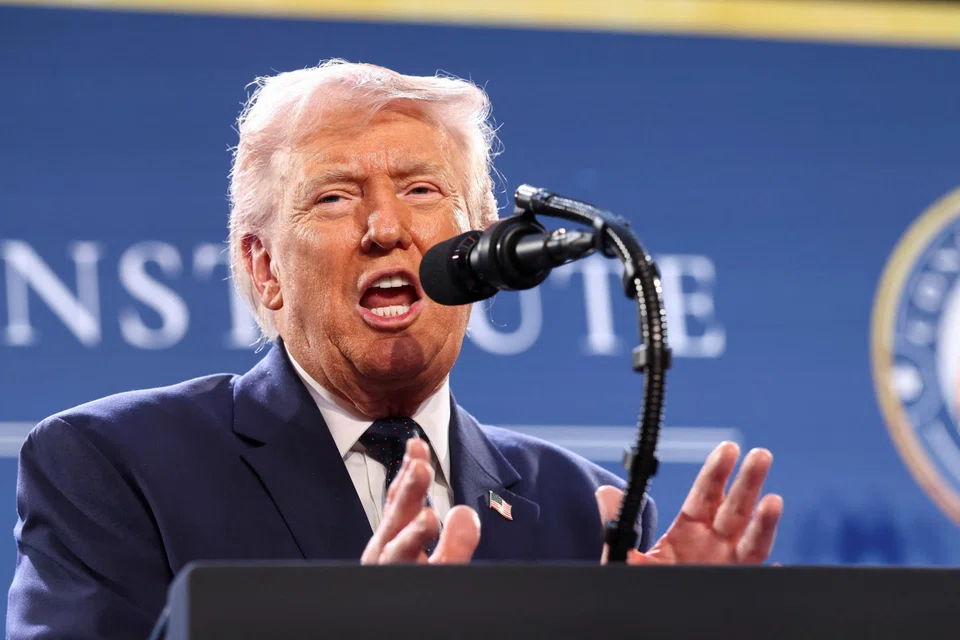
Trump to Visit Islamabad to Seal Iran Peace Deal