
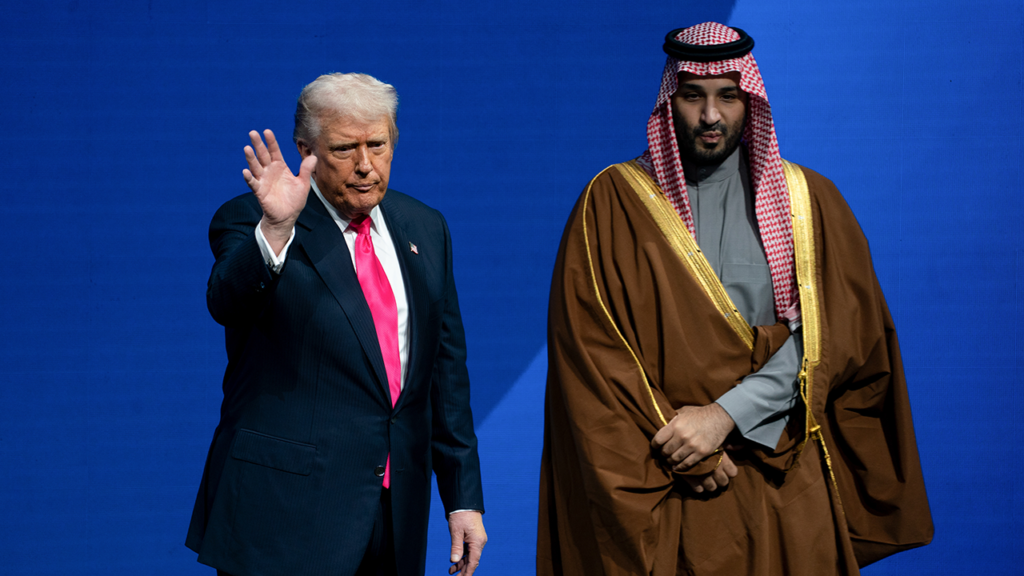
Paris (Imran Y. CHOUDHRY) :- Former Press Secretary to the President, Former Press Minister to the Embassy of Pakistan to France, Former MD, SRBC Mr. Qamar Bashir analysis : The grand state dinner hosted by President Donald Trump for Saudi Crown Prince Mohammed bin Salman was more than a ceremonial display of power; it marked a turning point in global politics and signaled a new era in the U.S.–Saudi relations. In a night filled with diplomatic theatre and historic announcements, Trump declared that Saudi Arabia had fulfilled and expanded its earlier commitments, raising its total promised investment in the United States from USD 600 billion to a staggering USD 1 trillion. At a time when global markets remain volatile and geopolitical tensions are escalating, such an unprecedented financial commitment is not just an economic boost — it is a strategic recalibration of the world’s most critical alliances.
Trump also announced a dramatic upgrade in Saudi Arabia’s status, declaring the Kingdom a Major Non-NATO Ally (MNNA) — a designation reserved for America’s most trusted security partners. Only 20 countries hold this status, and the inclusion of Saudi Arabia marks one of the most consequential geopolitical decisions of this decade. The designation opens doors for enhanced defense cooperation, priority access to advanced U.S. weapons, joint research programs, and expanded military training — all of which further elevate Saudi Arabia as the anchor of Middle Eastern security. With the region facing ongoing instability — from the Gaza crisis to shifting alliances after the Abraham Accords — Trump’s move makes clear that the U.S. intends to rely on Riyadh as its principal stabilizer.
In an even more startling announcement, Trump revealed that the United Nations had approved a global “Board of Peace,” an unprecedented multinational initiative intended to oversee conflict resolution in Gaza and the broader region. Trump further stated that he would serve as the head of this board, with internationally recognized leaders from across continents joining the council. Although the details remain vague, the symbolism was unmistakable: Trump sought to position the United States not simply as a mediator, but as the architect of a new peace framework for the Middle East — one that would integrate Arab leadership rather than marginalize it. For decades, peace in the region was considered either unattainable or politically inconvenient. Yet Trump declared with confidence that “for the first time, peace is established in the Middle East,” contrasting sharply with decades of diplomatic stagnation.
Crown Prince Mohammed bin Salman, in his address, praised Trump for the warm reception and the trust placed in Saudi Arabia’s expanding global role. He highlighted Vision 2030’s successes — from the opening of the Kingdom to foreign tourism and investment to the acceleration of tech innovation and industrial diversification. According to MBS, the infusion of Saudi capital into critical U.S. sectors such as artificial intelligence, space exploration, advanced defense manufacturing, cyber security, and electric vehicles would create tens of thousands of high-quality American jobs while strengthening the long-term security and economic resilience of the United States. Trump echoed this sentiment, saying the partnership “strengthens American security because money is coming in, jobs are being created, and our industries are expanding.”
Yet instead of covering the trillion-dollar investment, the MNNA designation, or the UN-endorsed peace initiative, much of the American media fixated on a brief, contentious moment during Trump’s interview on ABC. When the journalist pressed Trump about the murder of Jamal Khashoggi, Trump lashed out, calling her “a nasty reporter from a nasty network,” accusing her of attempting to embarrass his “honored guest.” What should have been a footnote in an evening of historic announcements became, in American media hands, the dominant headline. CNN, ABC, MSNBC, and several major outlets spent hours dissecting the exchange, replaying the clip endlessly, and debating ethical angles — while largely ignoring the massive geopolitical and economic significance of the evening.
This lopsided coverage exposes a deeper truth about American media culture: controversy sells better than diplomacy. A trillion-dollar bilateral agreement — one of the largest foreign investment pledges in U.S. history — received only a fraction of the airtime given to a tense reporter-president exchange. A United Nations-backed peace council, a designation elevating Saudi Arabia into America’s closest security circle, and a USD 20–40 billion U.S. weapons package designed to rebalance Middle Eastern military power were overshadowed by a single provocative question about a crime committed six years earlier.
None of this is to diminish the seriousness of the Khashoggi affair or the suffering of his family. But the stark imbalance raises a legitimate question: Is the American media more interested in sensationalism than in informing the public about transformative geopolitical developments? The disproportionate reaction confirms why Trump has spent years criticizing mainstream networks, often calling them biased, selective, and adversarial to constructive diplomacy.
The agreement between Trump and MBS goes far beyond ceremonial declarations. The multi-billion-dollar U.S. arms sale — including advanced missile defense systems, long-range precision munitions, and next-generation surveillance platforms — will fundamentally upgrade Saudi Arabia’s military posture. This brings significant consequences: Israel, long accustomed to enjoying unchallenged regional military superiority, will now face a more balanced power environment. For the first time in decades, another Middle Eastern country will possess the capability to deter Israeli unilateralism. This shift could compel Israel to adopt more cautious strategies, knowing that its regional monopoly on advanced weaponry is no longer absolute.
The partnership will also embolden Saudi Arabia — and other Gulf nations — to question the necessity of hosting extensive U.S. military bases on their soil. These bases, originally justified as security guarantees for Gulf monarchies, have increasingly functioned as outposts for protecting Israel’s regional interests. With Saudi Arabia’s defense capabilities rising and U.S.–Saudi relations deepening, these states may eventually demand that the U.S. limit or restructure its military footprint in the region.
Economically, the ripple effects are global. A stable Middle East, backed by enhanced Saudi defense capacity and U.S.-Saudi political alignment, ensures more reliable oil supply routes, reduced price volatility, and protection for energy-dependent developing countries. Many nations across Asia and Africa spend up to 40 percent of their foreign exchange reserves on oil imports; even modest price spikes can destabilize their economies. Therefore, any partnership that promotes stability in the Gulf directly strengthens global economic security.
Trump described his May visit to Saudi Arabia as “out of this world,” praising the royal welcome and the Kingdom’s commitment to investing USD 600 billion within its borders under Vision 2030. Now, with an additional USD 400 billion pledged toward U.S. sectors, Saudi Arabia is positioning itself as not only a Middle Eastern powerhouse but a central pillar in America’s industrial future. MBS has repeatedly emphasized that the Kingdom seeks partnerships that uplift both sides, and this vast investment — one of the largest in modern financial history — underscores his ambition to place Saudi Arabia at the forefront of global transformation.
The new U.S.–Saudi partnership carries enormous promise. It symbolises not only economic cooperation but a redefined approach to security, diplomacy, and global leadership. It signals to Israel that unchecked impunity will no longer be tolerated, and to the wider world that peace in the Middle East is no longer a distant dream but an emerging reality shaped by political courage rather than political convenience. As the strategic marriage between Trump and MBS deepens, one can hope that this partnership ushers in a lasting period of stability, prosperity, and fairness — a Middle East where power is balanced, justice prevails, and nations cooperate not through coercion, but through shared vision and mutual interest.
Trump–MBS: A Trillion-Dollar Partnership
Trillion-Dollar Partnership