
Paris (Imran Y. CHOUDHRY) :- Former Press Secretary to the President, Former Press Minister to the Embassy of Pakistan to France, Former MD, SRBC Mr. Qamar Bashir analysis : The United States and Israel presented the war against Iran as an urgent campaign to prevent nuclear proliferation. Six months later, that justification has collided with an extraordinary move by the Pentagon: American officials are seriously discussing using nuclear weapons against Iranian targets.
Former Representative Marjorie Taylor Greene has claimed that nuclear use was discussed in strategy meetings, while Tucker Carlson, America’s most influential and resourceful journalist and podcaster having millions of followers across the globe has disclosed that nuclear options against Kharg Island and Pickaxe Mountain appeared in Pentagon slide presentations.
The contradiction at the center of the war is difficult to ignore. Washington and Israel argued that Iran could not be trusted with nuclear weapons because their possible use would be intolerable. If the same governments are now contemplating a nuclear attack to force Iran’s submission, they risk destroying the moral and strategic distinction on which their original case for war rested.
The United States and Israel began their campaign against Iran on February 28. Trump initially suggested it would take approximately four or five weeks. By August 28, however, it had reached the six-month mark, with no permanent settlement and no clear definition of victory.
Hostilities connected to Lebanon continued, negotiations stalled and Washington shifted the center of its strategy toward blockades, sanctions and threats against countries doing business with Tehran. Trump, who once forecast a quick conclusion, now says he has no timetable for ending the conflict.
The costs are substantial. The Pentagon has acknowledged more than 750 wounded American service members, while reporting cited by lawmakers puts the number of American deaths at 18. Defense Secretary Pete Hegseth told a Senate hearing that the war had cost approximately $37.5 billion by July, he demanded another 78 Billion as supplementary grant whereas the defence budget has been increased from $ 900 billion in 2025 to $1.5 Trillion in 2026. These figures do not include every indirect economic cost, replenishment expense or loss sustained by regional partners.
Yet the United States and Israel have also failed to achieve any of their declared objectives. Iran’s government remains in power. Tehran has not surrendered, accepted permanent disarmament or abandoned its regional influence. Preventing an opponent from achieving its central objectives can itself constitute strategic success. By that measure, Iran’s survival and continued resistance expose the limits of overwhelming military superiority.
The tactical-nuclear controversy did not arise in a vacuum. The Pentagon has acknowledged that it is reviewing American nuclear strategy and seeking a broader range of options for regional conflicts. Undersecretary of Defense for Policy Elbridge Colby has spoken of providing more credible or “rational” nuclear choices. Admiral Richard Correll, commander of U.S. Strategic Command, has discussed an escalation spectrum that includes the possibility of a limited nuclear exchange.
After conventional military operations failed to compel Tehran’s submission and depleted important American weapons stockpiles, the search for broader nuclear options strongly suggests that Iran is a principal—perhaps the immediate—scenario driving the discussion. The troubling implication is that nuclear weapons are being reconsidered because conventional force failed to accomplish Washington’s objectives.
Pickaxe Mountain must be understood in the context of Iran’s struggle to preserve its military and technological capabilities against vastly more powerful adversaries. The deeply buried complex near Natanz is commonly portrayed as evidence of sinister intentions, though no public evidence proves that Iran has stored a nuclear weapon there—or that it possesses a nuclear weapon at all.
Iran’s decision to place sensitive infrastructure underground is not, by itself, proof of a weapons program. After years of sabotage, assassinations and threatened or actual airstrikes, dispersing and hardening military and nuclear facilities is also an unsurprising survival strategy. Had Iran left every important asset exposed, American and Israeli air power could have destroyed much of its defensive capacity and potentially opened the way to regime change.
This discrepancy strikes at the foundation of the war’s stated rationale. The American intelligence had not established that Tehran possessed a nuclear weapon or had made a final decision to build one. Uranium enrichment, including Iran’s claimed right to peaceful enrichment under the Nuclear Non-Proliferation Treaty, is not identical to manufacturing a bomb.
The danger is that Washington may now be considering nuclear means to accomplish objectives that its conventional campaign failed to achieve. The term “tactical nuclear weapon” should not disguise that reality. “Tactical” describes an intended military role; it does not make the explosion humane, limited or reliably controllable. Such a weapon can still cause mass death, radiation exposure, environmental contamination and escalation beyond the region. Iran’s underground construction would then appear not as proof that war was necessary, but as evidence of why a weaker country believed concealment and hardening were essential to its survival.
The first wartime nuclear detonation since Nagasaki would transform international security. It could erode the already fragile norm against nuclear use and encourage other nuclear-armed states to describe their weapons as practical instruments of conventional warfare.
India and Pakistan have repeatedly confronted one another while possessing nuclear arsenals. North Korea has developed weapons capable of threatening South Korea, Japan and potentially the United States. Russia has issued nuclear threats during its confrontation with Ukraine and NATO. If Washington normalized limited nuclear employment against a nonnuclear adversary, every one of these governments would gain a precedent with which to justify its own conduct.
A nuclear strike might also produce precisely the proliferation pressure the war was supposed to prevent. Governments could conclude that only a deliverable nuclear arsenal protects them from coercion or regime change. The lesson would not be that nuclear weapons are too dangerous to possess; it would be that countries without them remain vulnerable to countries that have them.
Harvard professor Stephen Walt told Carlson that the postwar world could be “substantially more dangerous.” He pointed not only to great-power competition among the United States, China and Russia, but also to the deterioration of restraints governing force, assassination and escalation. Once powerful states treat exceptional measures as ordinary, weaker states inevitably adapt.
Ending the war would require acknowledging that military power cannot guarantee every political objective. That may be uncomfortable for a president whose public identity depends on winning. But accepting an imperfect settlement is less humiliating than turning a strategic disappointment into a nuclear catastrophe.
Regional governments also have agency. States hosting American forces would face retaliation and possible contamination if their territory supported a nuclear attack. They should demand binding assurances that their bases will not be used to initiate nuclear hostilities. Their interests are not identical to those of Israel, Iran or Washington.
The broader international community should insist on renewed negotiations, independent nuclear inspections, protection for civilian infrastructure and compliance with international law by every participant. Diplomatic pressure must apply consistently, whether the alleged violator is Iran, Israel or the United States.
A war launched in the name of preventing nuclear danger must not become the event that makes nuclear warfare normal again.
Trump Contemplate Using Nukes Against Iran
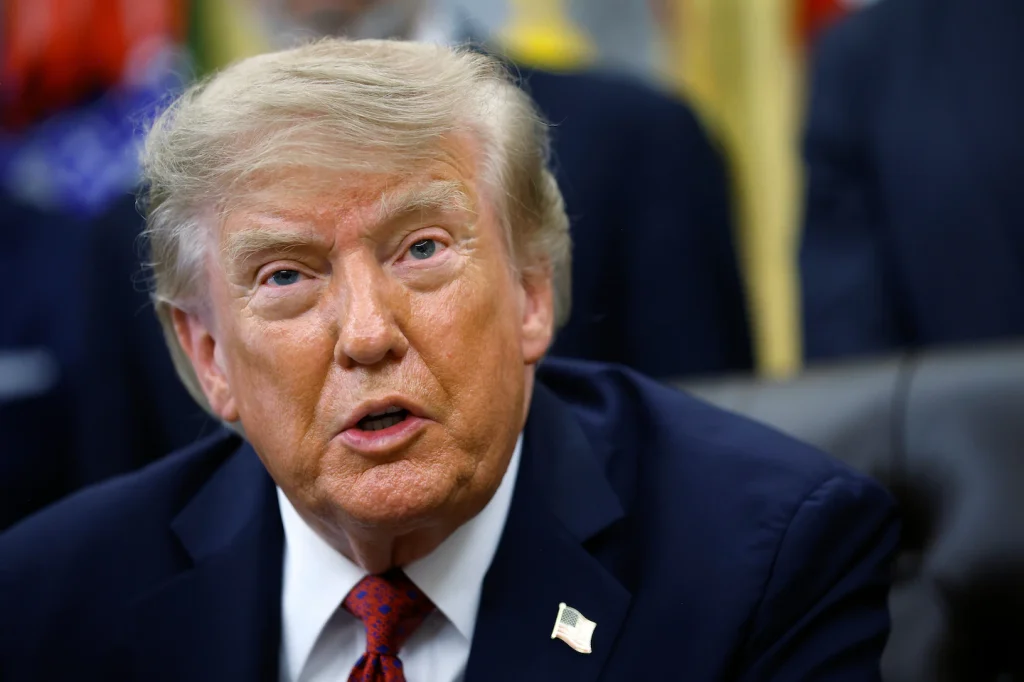
Trump Contemplate Using Nukes Against Iran