
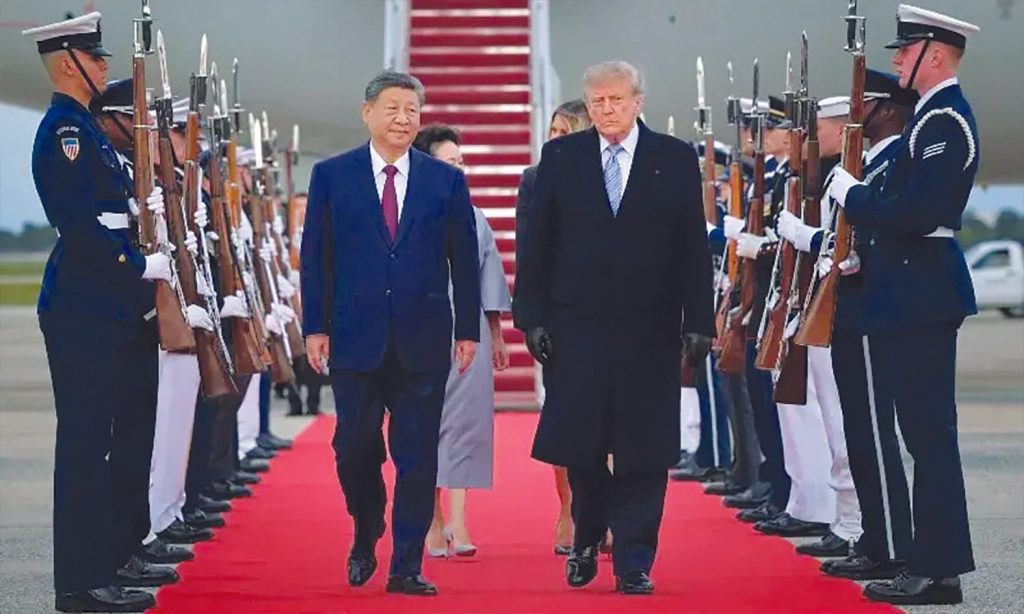
Paris (Imran Y. CHOUDHRY) :- Former Press Secretary to the President, Former Press Minister to the Embassy of Pakistan to France, Former MD, SRBC Mr. Qamar Bashir analysis : The red carpet has been rolled away, the state dinner has ended, and President Xi Jinping has left Washington. The three-day visit was presented as a landmark in relations between the world’s two largest economies. Its clearest practical result was a two-month extension of their trade truce. Trump and Xi gained time to talk again. The rest of the world gained no comparable assurance about the wars, supply chains and technologies on which its future depends.
China’s account says the two leaders exchanged views on the Middle East and Ukraine. That brief diplomatic phrase should not be mistaken for a substantive negotiation on either war. Their positions on who bears responsibility, whose security counts and what an acceptable settlement would require begin so far apart that the published outcome contains no common proposal. They addressed trade, artificial intelligence and Taiwan too. On the questions where agreement would matter most, ceremony filled the space that policy might have occupied.
The Iran war explains why even a declared understanding on the Middle East proved elusive. Washington defends the military campaign it launched with Israel; Beijing condemns the strikes on Iran’s sovereignty and favors diplomacy. While the summit was ongoing, Iranian President Masoud Pezeshkian in a separate interview, recalled an Oman-mediated Geneva proposal to dilute Iran’s 60 percent uranium and accept verification. Oman’s mediator had described a deal as within reach before the strikes began. Pezeshkian’s interview underscored the path abandoned when Washington chose force. Trump and Xi approached the war from opposite premises and announced no common course.
China also buys most of Iran’s exported oil and depends on Gulf shipping. Washington wants Beijing to pressure Tehran, while Beijing sees American military pressure as a cause of regional instability. The two leaders could exchange views on the conflict, but neither offered a joint plan for ending it or protecting the trade routes on which many countries depend.
Ukraine exposed a comparable clash of explanations. Beijing gives weight to Moscow’s account that Western involvement in Ukrainian politics and NATO’s expansion threatened Russian security. Washington and its European partners see Russia’s invasion as an attack on Ukraine’s sovereignty and arm Kyiv to resist it. China cooperates closely with Russia; the United States supports Ukraine. These positions define different starting points for a peace discussion. Beijing cannot easily endorse a principle that outside powers may determine another country’s political future while insisting that foreign powers must stay out of what it considers the Taiwan question. Yet Ukraine’s people also have a sovereign voice that no bargain between great powers can erase. The leaders exchanged views, but there is no published evidence that they negotiated a common peace formula.
Taiwan makes these disagreements even more combustible. Beijing insists on its claim to the island and objects to American arms sales. Washington maintains its own commitments and security ties, while Taiwan’s people govern themselves and face the consequences of any bargain made over their heads. The Chinese readout emphasized Xi’s warning on Taiwan but announced no new understanding. For a summit devoted to strategic stability, the absence of a visible mechanism to prevent a military incident matters more than the warmth of the photographs.
Trade produced the one measurable reprieve. The truce that faced a November deadline has reportedly been extended until January. That postpones a return to the tariff and export-control escalation that shook industries on both sides. It also moves the next decision beyond the American midterm elections. Buying time has value when two economies are tightly connected. Yet the extension leaves the basic contest untouched: Washington restricts advanced chips and presses China over purchases and market access, while Beijing controls vital stages of the rare-earth magnet supply chain.
Those magnets are essential to vehicles, industrial motors, electronics and defense equipment. China refines about 91 percent of the world’s magnet rare earths and makes about 94 percent of finished magnets. An American tariff threat cannot instantly create the processing capacity that took China decades to build. Equally, Chinese export controls can injure its customers without settling its complaints about U.S. technology restrictions. The truce suspends the next collision; it does not remove the weapons each side has placed on the negotiating table.
Artificial intelligence revealed a similar gap between aspiration and agreement. Xi has urged that AI serve the public and remain under human control. In July he offered developing countries 5,000 AI training and seminar opportunities over five years, along with cooperation centers and wider access to applications. Chinese developers have also released influential open models. That is a serious bid to shape who benefits from AI, although China’s companies and government have commercial and strategic interests of their own.
American companies, meanwhile, have poured capital into chips, data centers and models, seeking both technological leadership and enormous returns. Some American developers also publish open models and research. The real divide is therefore more complicated than a generous China facing an exclusively profit-seeking America. It lies in who controls the computing power, sets the rules, bears the risks and receives the gains. A state dinner attended by technology executives offered a stage for that question, but the summit produced no public agreement on testing frontier systems, reporting dangerous incidents or restraining autonomous military uses.
Space presents the same danger on a larger canvas. China has publicly opposed turning orbit into a battlefield, while the United States has acknowledged deploying space-control weapons. Both powers depend on satellites for navigation, communications and security. China, too, has strategic capabilities and interests in space; declarations of peaceful intent deserve scrutiny from every side. Yet there was no announced summit understanding on protecting civilian satellites or preventing debris and attacks from spreading a terrestrial conflict into shared orbits.
Xi and Trump may meet again at the APEC and G20 gatherings later this year. More meetings can prevent miscalculation, and the tariff extension keeps negotiations alive. But the measure of a summit is what it changes. Iran remains at war, Ukraine remains at war, Taiwan remains exposed to confrontation, critical minerals remain an instrument of pressure, and AI and space remain arenas of accelerating rivalry. Washington gave the visit every symbol of respect. The harder act of respect would have been to acknowledge that neither nation can secure its own future by treating the world’s common interests as bargaining chips.