
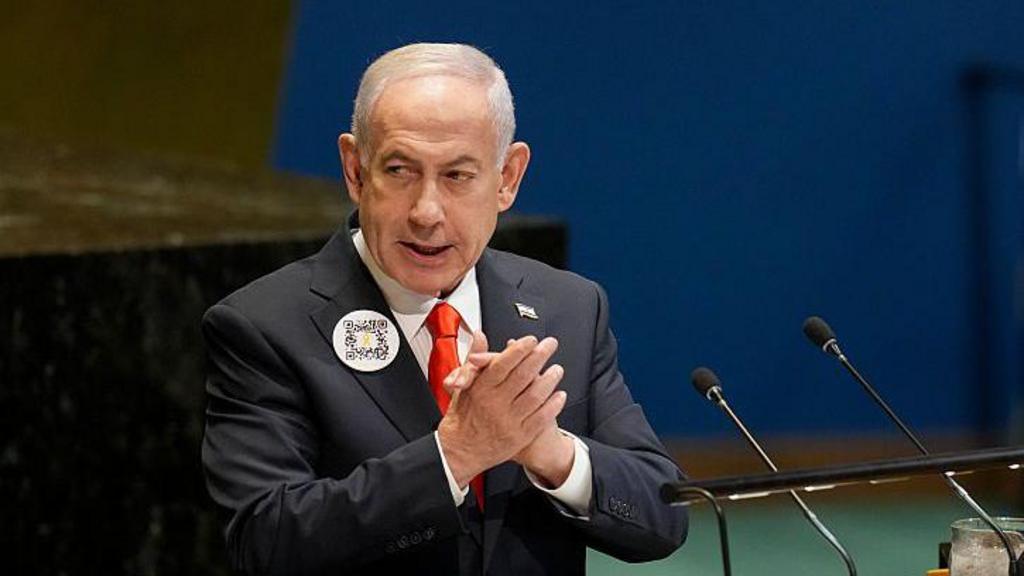
Paris (Imran Y. CHOUDHRY) :- Former Press Secretary to the President, Former Press Minister to the Embassy of Pakistan to France, Former MD, SRBC Mr. Qamar Bashir analysis : The confrontation at the United Nations exposed a widening divide: the United States and Israel’s leadership on one side, and a broad international rejection of their account of the Middle East conflict on the other. Washington and Netanyahu have constructed a narcissistic political worldview in which their fears command universal attention, their violence demands justification, and the suffering of others must remain subordinate.
They expect the world to see Gaza, Iran, and settlement expansion in the West Bank exclusively through their lens. The diplomats walking out as Netanyahu approached the podium delivered a blunt answer: the world cannot be ordered to see what they see, excuse what they excuse, or forget what they wish forgotten. Other nations can examine the destruction, hear the testimony, and reach their own conclusions. Military power cannot compel agreement, and repetition cannot turn a self-serving narrative into truth.
President Trump raised the prospect of annihilating Iran. Netanyahu defended Israel’s military campaigns, insulted departing diplomats, attacked Western governments, and berated the elected mayor of the city hosting him. Outside, protesters demanded an end to American arms supplies sustaining the destruction. Inside, Netanyahu demanded recognition of Israel’s right to defend itself while dismissing the objections raised against its conduct. The contradiction could hardly have been more glaring.
Iran is a nation, not a target awaiting destruction. Its children, workers, teachers, and elderly people are not interchangeable with its government or military command. Threatening annihilation from a podium established to prevent catastrophic warfare mocks the institution’s purpose. What meaning does international security retain when the powerful threaten entire countries and then demand that everyone else demonstrate restraint?
Iranian President Masoud Pezeshkian answered with photographs of the dead: the assassinated Ali Khamenei and children killed at the Minab school. Washington accused Iran of terrorism; Iran’s president presented the victims of violence inflicted upon his country. Whatever judgement one makes about Tehran’s leadership, its children cannot inherit a death sentence because of their government. Their humanity requires neither American approval nor Israeli recognition.
Then came Netanyahu and his denunciation of the diplomats walking out as “moral cowards.” What courage, precisely, was he claiming? The courage to dismiss international condemnation? To ridicule those refusing to applaud? The empty seats did not represent every nation, but they exposed the distance between his government’s self-justification and the judgement of many countries assembled before him. Insulting the audience could not answer the indictment.
Netanyahu’s international isolation is becoming a devastating indictment of his leadership. The International Criminal Court arrest warrant restricts his ability to travel to many countries, once-steadfast allies Britain, France, and Canada have imposed sanctions targeting Israeli settlements, and dozens of diplomats abandoned the chamber as he began speaking.
His government could purchase 500 billboards across Manhattan, but it could not purchase international legitimacy. Outside, protesters demanded an end to the weapons supplies sustaining Israel’s campaigns; inside, empty seats exposed the limits of his defiance. This is the humiliation of a leader who mistakes the capacity to inflict destruction for the authority to command respect. Calling his critics cowards cannot conceal the reality: he is leading Israel deeper into diplomatic estrangement while demanding that the world applaud the policies driving it there.
His attack on New York Mayor Zohran Mamdani made that arrogance unmistakable. Netanyahu accused him of supporting Hamas, which Mamdani denied. A visiting prime minister has no mandate to supervise American democracy or dictate whom New Yorkers should elect. He may answer criticism, but his office grants him no authority over the city’s mayor. Americans owe a foreign leader neither political obedience nor silence. Friendship between countries cannot mean that American politicians become acceptable only when they satisfy the government of Israel.
Outside the United Nations, that criticism had a distinctly American voice. Protesters demanded an end to the arming of Israel and called for Palestinians and Iranians to be allowed to live. Police detained demonstrators, including actors Susan Sarandon and Hannah Einbinder, congressional candidate Darializa Avila Chevalier, and city council member Chi Ossé. These were people exercising their right to challenge policies supported by their own government.
Their presence shattered any convenient equation between Washington’s policy and unanimous American consent. Netanyahu could praise Trump inside the chamber; he could not make the dissent outside disappear. Americans are entitled to question where their weapons go, what their taxes sustain, and whether their country’s alliances advance peace or perpetuate destruction. No visiting leader can legitimately demand exemption from those questions.
His assault on Western governments followed the same pattern. Britain, France, and Canada had announced sanctions targeting Israeli settlements. Netanyahu accused their leaders of surrendering to antisemitic mobs. Measures directed at settlements became, in his telling, evidence of moral collapse. But opposition to settlement expansion does not constitute hatred of Jews. Antisemitism must be confronted; it cannot become a shield against scrutiny of state policy.
Other responses were equally pointed. Qatar said Netanyahu’s attacks diverted attention from responsibility for policies on the ground. Turkey’s presidential communications director, Burhanettin Duran, said his accusations could not obscure Gaza’s humanitarian catastrophe or international legal proceedings. The answer to criticism was accountability, not an expanding catalogue of enemies.
His treatment of settler killings illustrated the problem. The BBC reported his suggestion that perhaps two or three people were killed annually, then cited UN figures recording hundreds of Palestinians killed in the context of settler attacks since the beginning of 2023. These are human beings, not inconvenient arithmetic. Minimising their deaths diminishes the violence confronting entire communities.
The pager display carried a menace beyond its reference to the operation against Hezbollah. Before an institution dedicated to peace, Netanyahu brandished a reminder that communications devices could become instruments of assassination. The gesture could be read as a warning to governments walking out or imposing sanctions: defy Israel and consider how far its reach might extend. Operations in Iran, Lebanon, and Syria gave that implied warning its chilling force. This was intimidation dressed as triumph—an exhibition of lethal capability that invited critics to contemplate consequences beyond the diplomatic chamber.
October 7 cannot provide permanent immunity from judgement. The murder of Israeli civilians and hostage-taking were atrocities. Their victims deserve justice. Palestinian children did not consequently lose their rights. No atrocity authorises unlimited destruction, and no ancient religious promise can serve as a modern eviction order. Any vision of Greater Israel built upon Palestinian dispossession deserves rejection. That judgement concerns political domination, not Jewish identity.
Iran’s nuclear programme also requires answers beyond slogans. Pezeshkian says Tehran was prepared to dilute highly enriched uranium and accept international verification. Those insisting upon war must explain why negotiated restraints cannot achieve their stated objective.
Americans deserve that explanation before more soldiers and resources are committed. Their country is not an inexhaustible military account for another government’s ambitions. Every dollar consumed by destruction is unavailable for another public need.
The governments that walked out must likewise move beyond symbolism. Empty seats cannot feed children or protect families. Protest must produce action.
Washington and Netanyahu may insist upon their own account of this conflict. They cannot demand ownership of everyone else’s judgement. The dead, the displaced, and the bereaved remain visible beyond their carefully constructed lens. The walkout exposed the failure of their demand for unquestioning acceptance. The next test is whether the governments rejecting that demand will act with the courage their convictions require.
The World Refuses Washington and Netanyahu’s Distorted View
The World Refuses Washington and Netanyahu’s Distorted View