
Paris (Imran Y. CHOUDHRY) :- Former Press Secretary to the President, Former Press Minister to the Embassy of Pakistan to France, Former MD, SRBC Mr. Qamar Bashir analysis : For more than half a century, the United States and Israel have been viewed as inseparable strategic partners in the Middle East. Successive American administrations, regardless of party affiliation, generally aligned their regional policies with Israel’s security concerns, often treating the two nations’ interests as largely identical.
Yet the diplomatic developments that followed the recent Iran war suggest that this assumption may no longer hold true. Rather, it is the beginning of something far more consequential: the gradual decoupling of American strategic interests from Israel’s broader regional agenda.
The clearest evidence of this shift is not coming from Tehran or Islamabad. It is coming from within the United States itself. The political shockwave generated by Tucker Carlson’s public break with the Republican Party illustrates a growing debate within conservative America.
Carlson, one of the most influential voices on the American right, declared that he could no longer support a political movement that, in his view, places the interests of a foreign country ahead of those of the United States. Whether one agrees with his conclusion or not, the significance lies in the fact that such criticism is no longer confined to the political fringes. Questions that were once whispered are now being discussed openly among conservatives, libertarians, progressives, and independent voters alike.
The debate intensified following the U.S.-Iran diplomatic initiative that emerged after the war. The architecture of this process is noteworthy. Rather than attempting to solve every dispute at once, the framework creates a pathway for addressing complex issues over time. The objective is not to produce instant solutions but to establish a structure capable of managing disagreements before they escalate into war.
Pakistan’s role in this process has been particularly significant. Iranian President Masoud Pezeshkian’s visit to Islamabad on 23rd June underscored the importance Tehran attaches to Pakistan’s mediation efforts. Prime Minister Shehbaz Sharif reaffirmed Pakistan’s commitment to facilitating dialogue and helping both sides move toward a durable peace. The symbolism was powerful: a regional Muslim power acting as a bridge between Washington and Tehran at a moment when military confrontation seemed inevitable only months earlier.
Yet the most important development may be the evolution of American objectives themselves. For years, Israeli strategic thinking has viewed Iran’s nuclear program, ballistic missile capability, drone industry, cyber warfare assets, Revolutionary Guard networks, and relationships with Hezbollah, Hamas, and the Houthis as components of a single threat architecture. From this perspective, lasting security requires not merely preventing nuclear weaponization but substantially weakening Iran’s broader ability to project power throughout the region.
The emerging American position appears different. President Donald Trump has drawn a clear distinction between Iran’s nuclear ambitions and its conventional military capabilities. In remarks that surprised many observers, Trump argued that if neighboring states possess missiles, drones, cyber capabilities, and conventional deterrent forces, it would be difficult to justify denying Iran every means of self-defense.
Interestingly, the MOU is formally bilateral between Washington and Tehran, mediated by Pakistan and Qatar. But its effects reach Israel, Hezbollah, Hamas, the Houthis, Gaza, Lebanon, the Strait of Hormuz, and the GCC. None of these actors fully sits at the table. The assumption is simple: America will manage Israel and its Arab allies; Iran will manage Hezbollah, Hamas, and the Houthis. If that assumption holds, the deal can reshape the region. If it fails, the Middle East may again slide into fire.
Israel is the elephant in the room. Netanyahu has already signaled that Israel reserves “full freedom of action” in Lebanon, even while Washington tries to stabilize the ceasefire. That statement exposes the central problem: America may want de-escalation, but Israel still wants operational freedom. If Israel refuses to follow Washington’s larger strategy, then the U.S. will have to decide whether it is a superpower or merely Israel’s security subcontractor.
These goals of the USA and Israel are not identical but divergent. This divergence became more visible when Israeli Prime Minister Benjamin Netanyahu reaffirmed Israel’s determination to maintain operational freedom in Lebanon, even as diplomatic efforts sought to stabilize ceasefire arrangements. While Washington is investing political capital in de-escalation and negotiation, Israel continues to conduct military operations against threats it considers immediate and existential.
The growing gap between these approaches represents the core of the emerging decoupling. The debate surrounding Senator Lindsey Graham, a close associate of Donald Trump and staunch supporter of Israel. Graham openly warned that if the talks failed, which he hoped will, President Trump would seize control of the Strait of Hormuz by force, place the strategic waterway under American control, and charge transit fees on commercial shipping to recover the costs of military operations. He further declared that if Iran resisted such a move, the United States would “obliterate” Iran.
More significantly, Graham linked the success or failure of the negotiations to a broader regional realignment involving the expansion of the Abraham Accords and the normalization of relations between Israel and key Arab states. His comments reflected the traditional strategic school that has dominated Middle East policy debates for decades: maintain maximum pressure, preserve overwhelming military leverage, and keep the option of force constantly on the table.
The implications of Israel’s manipulative ability extend beyond the USA. Across Western democracies and especially in the UK parliament, public debate is intensifying over the role of Israeli influence, its lobbying networks, campaign financing, and the relationship between national interests and alliance commitments. Discussions that once centered exclusively on security concerns now increasingly include questions about accountability, transparency, and whether governments are acting primarily in the interests of their own citizens.
Nevertheless, the direction of travel appears increasingly clear. America is beginning to define its Middle East strategy through the lens of American interests rather than through automatic alignment with the preferences of Israel.
The real story of the current negotiations is therefore larger than Iran, larger than Israel, and larger than any single agreement. It is the story of a superpower rediscovering the distinction between partnership and dependency, between alliance and alignment, between supporting an ally and adopting all of that ally’s objectives as its own.
If that trend continues, historians may one day view post-Iran-war diplomacy not merely as a ceasefire initiative, but as the moment when Washington began charting a more independent course in the Middle East. And that may prove to be the most significant geopolitical shift of all.
The Great Decoupling of the United States and Israel
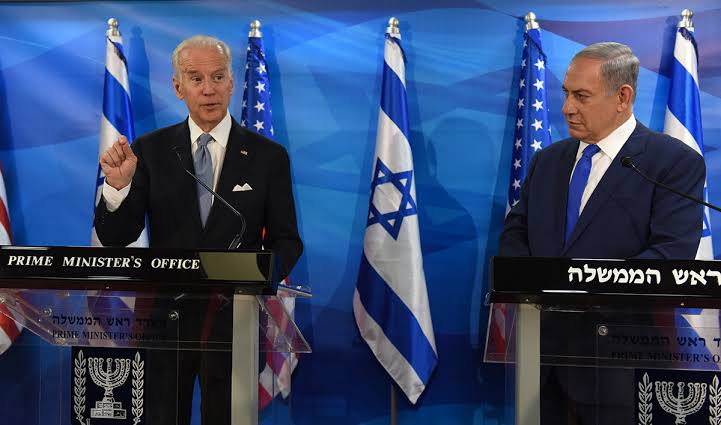
The Great Decoupling of the United States and Israel