
Paris (Imran Y. CHOUDHRY) :- Former Press Secretary to the President, Former Press Minister to the Embassy of Pakistan to France, Former MD, SRBC Mr. Qamar Bashir analysis : Humanity’s reach into space may be approaching a new threshold. Starship, one of the largest and most powerful rockets ever built, is designed to move people and immense quantities of cargo far beyond Earth. Elon Musk’s vision extends from permanent settlements on the Moon and Mars to an eventual human presence across the solar system. Those outposts could become bases for scientific discovery and deeper exploration, while the search for life and potentially habitable worlds continues far beyond our neighboring planets. A home in another star system remains a distant dream, but every such ambition begins with the practical ability to launch, travel and return. SpaceX’s planned September 28 flight is one step toward proving that ability.
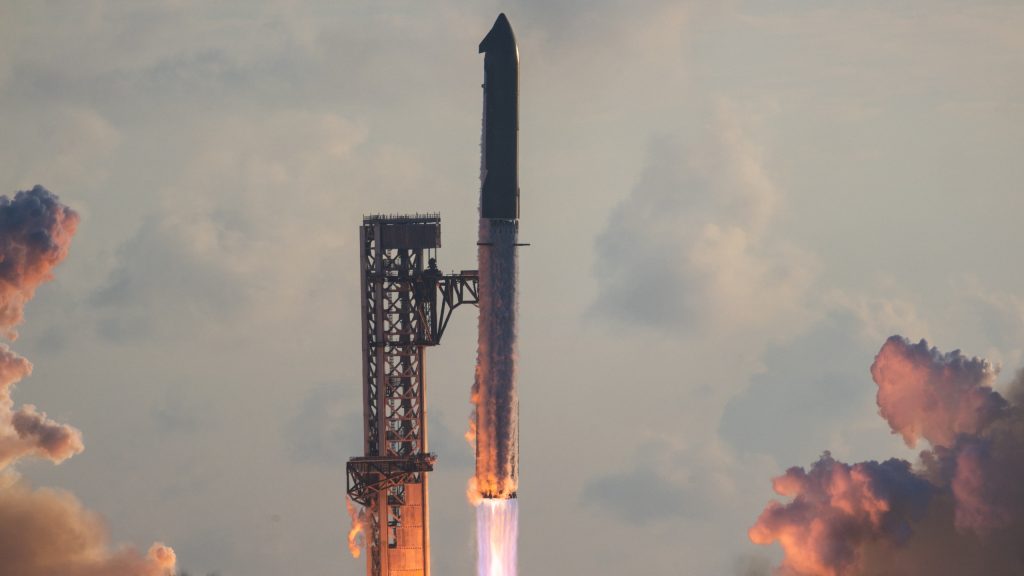
SpaceX lists a 75-minute window beginning at 8:15 a.m. Eastern time, or 7:15 a.m. at Starbase in South Texas. The vehicle consists of the Super Heavy booster and the Starship upper stage. Together they stand roughly 400 feet tall, placing Starship among the most imposing machines ever flown. This will be a test flight without people aboard. The countdown can still be delayed by weather, a technical concern or a final operational decision, even after regulatory authorization.
Starship’s first major task is to carry its cargo into orbit, the path that lets a spacecraft circle Earth. SpaceX plans for the upper stage to make six trips around the planet and release 26 new Starlink internet satellites along the way. Engineers will also gather information about its engines, its protective heat shield and how it behaves during a much longer flight than earlier Starship tests. These results could help turn a remarkable rocket into a dependable transport system for satellites, scientific equipment and, eventually, supplies and people traveling farther from Earth.
This journey matters because reaching orbit with useful cargo is a foundation for more ambitious destinations. The Moon would require repeated deliveries of equipment and fuel; Mars would demand still greater endurance and carrying capacity. Flight 14 cannot prove that Starship is ready to land on either world, but it can give scientists and engineers knowledge needed to build toward those missions. A successful flight would broaden the possibilities for public research programs and private companies alike, while inviting them to imagine experiments, services and expeditions that existing rockets cannot easily support.
The satellites aboard are Starlink Version 3 spacecraft, intended to join SpaceX’s broadband network rather than serve as inert demonstration articles. Three carry cameras to examine Starship’s heat shield, which protects the spacecraft as it comes back through the atmosphere. Successful deployment would show that the enormous vehicle can begin doing useful work while still in development. It would also tie the rocket more tightly to SpaceX’s satellite business: larger carrying capacity could support the next generation of Starlink, while demand for those satellites provides a reason to fly Starship frequently.
The proposed mission would last almost ten hours. After gathering data in orbit, Starship is supposed to restart an engine to leave orbit, pass through the atmosphere and splash down in the Pacific west of Chile. The Super Heavy booster is expected to splash down separately in the Gulf of Mexico. There is no plan to catch either stage at the launch site on this flight. The dramatic images of tower arms grabbing a descending rocket belong to another part of Starship’s development, and full routine reuse remains a future objective.
For much of the space age, journeys on this scale could be organized only by governments. NASA brought astronauts to the Moon and built generations of scientific knowledge, but the enormous cost and specialized machinery limited how often such missions could be attempted. SpaceX is changing that picture by investing private capital and engineering talent in a rocket it hopes to fly repeatedly. Its earlier Starship tests have brought breakthroughs and setbacks alike. Flight 14 will show whether that work can now carry a useful payload around Earth, a capability on which more ambitious journeys depend.
The greater promise lies in combining NASA’s experience with the drive and resources of private enterprise. NASA has chosen SpaceX to develop a Starship lander for its Artemis Moon program. It has also contracted with Blue Origin, the space company founded by Amazon founder Jeff Bezos, for a separate lunar lander. These are different companies bringing different designs to a shared undertaking. Government research, safety standards and long-term goals can work alongside private invention and competition to make future Moon bases, and perhaps one day settlements on Mars, more achievable.
Reaching a permanent base on another world would take many more steps. Crews would need food, shelter, equipment and a reliable way to return; ships would need fuel and frequent flights. NASA’s oversight work identifies refueling spacecraft in orbit as a major challenge for its lunar plans. Every Starship test helps engineers understand part of the journey, while reminding them how much remains to be developed. The speed of progress will depend on whether public expertise and private engineering can solve those problems together.
That partnership could also widen participation in exploration. Universities might send research instruments, companies might develop new services and national space agencies might share knowledge gathered across missions. Starship is being built to serve several purposes, from deploying internet satellites to supporting the journey to the Moon. If its capacity and repeated flights become dependable, ideas that now remain on laboratory benches could have a path into space. Its most lasting contribution may be the opportunities it creates for scientists and engineers beyond SpaceX itself.
The FAA’s approval is significant, but it should be understood precisely. It authorizes the specified launch and reentry operations after regulatory review; it does not certify that the vehicle will reach orbit or that every experiment will work. The flight team will still make operational calls as conditions unfold. If the rocket lifts off on September 28, the public will be watching a genuine attempt at a historic technical milestone, with measured data likely to matter more than the first few seconds of footage.
By the end of the mission, the meaningful questions will be concrete: Did Starship enter a stable orbit? Did the 26 satellites deploy? Could it restart its engine, leave orbit and reenter as planned? What did the heat shield and booster teach engineers? Success would bring Musk’s dream of transporting people and cargo to sustained bases on the Moon and Mars a step closer, while leaving formidable work ahead. It would be a small step in the immense journey toward other worlds, and a large leap in the capabilities humanity will need to undertake it.
Starship’s Flight Toward a New Space Age
Starship’s Flight Toward a New Space Age