
Paris (Imran Y. CHOUDHRY) :- Former Press Secretary to the President, Former Press Minister to the Embassy of Pakistan to France, Former MD, SRBC Mr. Qamar Bashir analysis : While browsing today’s international news, one story stopped me and filled my heart with both pride and anguish: Jalila Haider, a Hazara woman born, raised and educated in my hometown, Quetta, has won the 2026 Right Livelihood Award, announced today, September 30. Presented by the Stockholm-based Right Livelihood Award Foundation, the distinction is widely known as the “Alternative Nobel Prize,”.
This year, just four recipients—two women and two women-led organizations—were selected from 200 nominations across 72 countries. Haider was recognized for challenging ethnic persecution, state repression and discrimination against women through her legal work and activism.
For recipients, such recognition brings international visibility to their struggles and strengthens their ability to rally support; for Pakistan, Haider’s achievement highlights the courage and humanity of citizens defending its most vulnerable communities.
Amid reports of conflict and suffering, here was a Pakistani woman honored for standing beside people whom violence and indifference had pushed into the shadows. The news brought pride, but also anguish over the injustices that made her work necessary—and memories of a city whose humanity I once knew intimately.
Quetta, nestled like a bowl among towering hills, was beautiful for more than its landscape and refreshing weather. During my years of education, from 1970 to 1984, its greatest attraction was the fellowship between its communities. In the Quetta I remember, differences of ethnicity, language and religious tradition did not prevent friendship. We studied, played and visited one another, sharing a city that felt like home to us all.
I watched Hazara families advance through education, commerce, public service and sport. Their businesses grew, their young people distinguished themselves, and their contribution became woven into Quetta’s everyday life. Their achievements enriched the city. Remembering that shared life makes the subsequent persecution especially painful: people who helped build our hometown were increasingly denied the freedom to live safely within it.
I witnessed that atmosphere deteriorate as the Soviet invasion of Afghanistan in 1979 drew our region into confrontation between Moscow and Washington. In my observation, foreign ideological rivalries, money and weapons deepened divisions among people who had lived together. I saw resentment grow around Hazara and Punjabi advancement in commerce and public employment. These memories carry the pain we shared as neighbours: the gradual destruction of trust, followed by violence against familiar families.
The consequences were merciless. Hazaras were attacked in markets, on roads and while travelling to worship. Human Rights Watch recorded that two major bombings in Quetta in January and February 2013 killed at least 180 Hazaras. Such figures describe the scale, but cannot convey the anguish within each household. Every victim left relationships, responsibilities and hopes that no compensation or official condolence could restore.
For me, this tragedy has a familiar face: Abrar Hussain, the celebrated Hazara boxer who trained us during our school and college years. He brought distinction to Pakistan in international competition. When I later served in Quetta as deputy income tax commissioner, I knew him in his sports administration role. In June 2011, he was murdered in the city he had served. A man who strengthened Pakistan’s reputation abroad could not be protected at home.
Fear drove families away from their neighbourhoods, livelihoods and memories. Some sought safety elsewhere in Pakistan; others rebuilt their lives overseas, including in Australia. Those who remained faced restricted movement and shrinking opportunities. The loss extended beyond households. Quetta itself was diminished whenever a family left because it could no longer trust that its children would return safely from school, work or the market.
This was the environment in which Jalila Haider chose to stand her ground. Born in 1984, she lost her father when she was twelve. Her mother raised six children and supported her determination to study law. In 2010, she earned her degree from University Law College, Quetta, becoming the first woman lawyer from Pakistan’s Hazara community. Behind that achievement stood a mother’s resolve and a daughter’s refusal to surrender.
Her legal practice, established in 2011, became a refuge for people whose cases others considered dangerous or unrewarding. According to her award biography, her firm has handled more than 7,000 cases and helped restore freedom of movement to more than 600 political activists and human rights defenders. She has represented women seeking divorce, custody and inheritance rights, alongside refugees, transgender people and those facing wrongful accusations.
The dangers were personal. She survived the 2016 bombing that devastated Balochistan’s legal community. She has endured detention, online harassment and death threats. Nevertheless, she continued appearing for people whose vulnerability often made them easy to abandon. In a setting where professional advancement can reward silence, her willingness to accept difficult cases gave frightened families someone prepared to listen and act.
In 2018, she carried that determination into a seven-day hunger strike against the targeted killing of Hazaras. She demanded direct engagement from the army chief, refusing to accept assurances from officials unable to deliver security. The protest brought negotiations between the military leadership and Hazara women. The award foundation credits it with contributing to a sustained decline in attacks, although the community’s insecurity and displacement remained unresolved.
Her work also recognises that justice requires the means to survive. Through We the Humans, founded in 2015, she has helped more than 400 widows of terrorism victims gain financial independence. Rug weaving, childcare, education and literacy support connect income with dignity. A widow able to support her children acquires something beyond financial relief: greater freedom to make decisions about her family’s future.
As a founding member of the Women’s Democratic Front, Haider also helped pioneer Balochistan’s first Women’s March. Her advocacy reaches women facing forced marriage and honour violence, crossing the boundaries of her own community. That breadth matters. Having experienced persecution, she has refused to make another person’s ethnicity or identity a condition for receiving help.
Pakistan owes women like her more than ceremonial praise. They need protection, functioning courts and institutions that respond before desperation forces a hunger strike. Their work reveals both the courage within our society and the distance between constitutional promises and everyday experience. Supporting them would allow more families to recover the ordinary security that violence has stolen.
Pakistan is too often viewed through an unfavourable lens in the international media, with few stories allowing its humanity and courage to shine. Finding Jalila Haider’s recognition among the day’s top ten world news stories filled my heart with pride, even as it revived the agony of everything our Hazara community has endured.
May this honour bring her greater dignity, respect and protection, and inspire many more Jalila Haiders across Pakistan and the world to join the struggle for justice and freedom. May their courage restore hope to those pushed into the shadows and challenge the label of “illegal” imposed on human beings through no fault of their own, but by systems, borders and laws that fail to recognise their humanity.
Quetta’s Daughter, Pakistan’s Pride
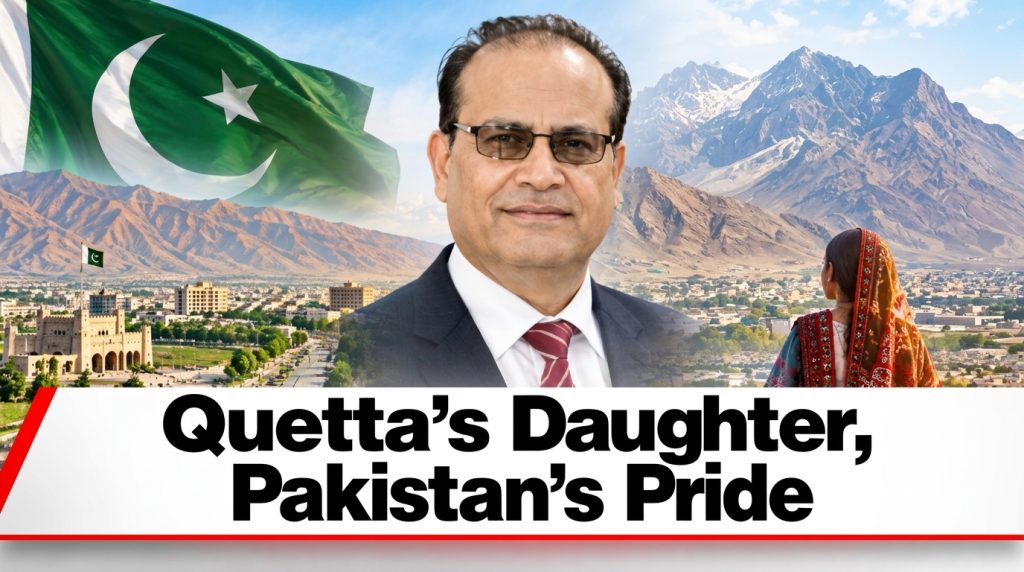
Quetta’s Daughter, Pakistan’s Pride