
Paris (Imran Y. CHOUDHRY) :- Former Press Secretary to the President, Former Press Minister to the Embassy of Pakistan to France, Former MD, SRBC Mr. Qamar Bashir analysis : The flames of war that engulfed the Middle East in recent weeks carried within them the terrifying potential to redraw the map of the world through destruction. What began as a regional confrontation between the United States, Israel, and Iran rapidly escalated into a crisis with global consequences. Military rhetoric crossed dangerous thresholds, with open threats targeting Iran’s critical infrastructure—its nuclear facilities, power grids, bridges, and military backbone—raising fears of a full-spectrum assault designed to force submission.
Had such an operation been executed, the consequences would have been catastrophic. Iran, with its vast missile arsenal and advanced drone capabilities—and widely believed to be at the threshold of nuclear capability—would not have remained passive. A retaliatory strike on Israel could have unleashed unprecedented destruction, targeting cities, strategic installations, and possibly even triggering a nuclear exchange. Gulf states hosting U.S. bases would have become immediate targets, dragging Saudi Arabia, the United Arab Emirates, Qatar, and Bahrain into direct conflict. The Strait of Hormuz—the artery through which nearly 20 percent of the world’s oil flows—would almost certainly have been shut down.
The economic consequences alone would have been devastating. Iran’s infrastructure losses could have ranged between $500 billion and $1 trillion. Israel, under sustained retaliation, might have faced damages of $150 billion to $300 billion. The Gulf economies, dependent on energy exports and stability, could have suffered losses exceeding $1 trillion. For the United States, prolonged military engagement combined with economic fallout—rising oil prices, inflation, and market disruption—could have pushed total losses beyond $2 trillion. Globally, the shutdown of Hormuz and the collapse of energy supply chains could have triggered a shock of $3 to $5 trillion, bringing total worldwide losses into the staggering range of $5 to $10 trillion.
Beyond numbers, the human and civilizational cost would have been immeasurable. A region that carries millennia of history—Persian, Arab, Islamic, and global heritage—could have been reduced to rubble. Under international law, threats to destroy an entire civilization are not merely rhetoric; they raise grave concerns under the Genocide Convention and the laws governing armed conflict. The world was not just approaching war—it was approaching the edge of irreversible devastation.
At that moment, when diplomacy appeared exhausted and escalation seemed inevitable, an unexpected actor emerged to alter the course of events. Pakistan, often underestimated in global strategic discourse, stepped into the center of the geopolitical chessboard. It was not the wealthiest nation, nor the most militarily dominant, but it possessed something far more decisive in that moment: access, credibility, and the ability to communicate with all sides.
Pakistan’s intervention was deliberate, sustained, and executed under extreme pressure. Its leadership maintained simultaneous engagement with Washington, Tehran, Riyadh, Ankara, and Beijing—building a web of communication when mistrust had paralyzed direct dialogue. The challenge was unprecedented: active hostilities, hardened positions, and a rapidly shrinking window before irreversible escalation.
In the final hours, direct engagement with decision-makers in the United States proved decisive. As military deadlines approached and the threat of devastating strikes loomed, Pakistan urged restraint. That call was not ignored. A pause was granted, opening the narrowest window for diplomacy to take hold.
At the same time, Pakistan leveraged its credibility with Iran. Convincing Tehran to accept a ceasefire required overcoming deep suspicion and fear of strategic deception. The ceasefire was framed not as submission, but as a tactical pause—one that preserved sovereignty while preventing catastrophic loss. This delicate balance could only be achieved by a state trusted by both sides, and Pakistan fulfilled that role.
The diplomatic architecture that followed was equally significant. Pakistan facilitated broader alignment by engaging China, whose influence provided additional assurance to Iran. Regional powers were brought into the process, reinforcing momentum toward de-escalation. In this intricate framework, Pakistan acted as the central connector—linking adversaries, global powers, and regional actors into a single, fragile but functional process.
The outcome was a breakthrough that few had considered possible. A ceasefire was secured at the last possible moment. Oil markets stabilized, global panic subsided, and the world stepped back from the brink. More importantly, a pathway to dialogue was established, with negotiations shifting to Islamabad—transforming Pakistan into the epicenter of high-stakes diplomacy.
This moment marked a profound shift in Pakistan’s global standing. A country often viewed through the prism of regional challenges had demonstrated its capacity to operate at the highest level of international diplomacy, managing a crisis involving nuclear-capable adversaries under active conflict conditions.
The significance of this achievement extends beyond the Middle East. It has reshaped perceptions across the region, particularly in South Asia. In India, Pakistan’s emergence as a central diplomatic actor has triggered a wave of political and media reaction. Sections of the Indian media have expressed visible frustration, portraying Pakistan’s role as an unexpected and uncomfortable development in a domain where India has long sought recognition as a rising global power.
Political opposition within India has reportedly questioned the government’s relative absence from this critical geopolitical moment. The narrative gaining traction is one of missed opportunity—where India, despite its economic and strategic ambitions, found itself on the sidelines while Pakistan occupied the diplomatic center stage. Commentators and analysts have debated whether India’s foreign policy posture—often perceived as aligned with specific blocs—limited its ability to act as a neutral mediator in a conflict requiring balanced engagement with all sides.
This contrast has amplified the perception of Pakistan’s diplomatic success. While Islamabad engaged across divides, maintaining working relationships with both Western and regional powers, India’s position appeared more constrained. The result has been a rare reversal in regional diplomatic optics, where Pakistan is viewed as a facilitator of peace while India faces scrutiny over its strategic positioning.
Meanwhile, Pakistan’s role has continued beyond the ceasefire. Diplomatic channels remain active to ensure the truce holds and to prevent escalation in secondary theaters such as Lebanon. The effort now is not only to sustain the ceasefire but to transform it into a durable peace framework—an undertaking far more complex than securing the initial pause in hostilities.
This evolving role reflects a deeper transformation. Pakistan has moved from being a participant in regional dynamics to becoming a platform for resolving them. It has demonstrated that influence in the modern world is not solely a function of economic size or military strength, but of trust, access, and the ability to act decisively in moments of crisis.
The road ahead remains uncertain. The ceasefire is fragile, and the underlying issues remain unresolved. Yet the immediate danger—the descent into a war that could have caused trillions in damage and untold human suffering—has been averted.
History often remembers the moments when destruction was prevented rather than inflicted. At a time when powerful nations were speaking the language of annihilation, Pakistan spoke the language of restraint and negotiation. It convinced adversaries to pause, brought them to the table, and created a pathway where none existed.
If the current process leads to lasting peace, this moment will be recorded as a turning point—not only in the conflict itself, but in the evolution of global diplomacy. And at the center of that transformation will stand Pakistan, a nation that, against all expectations, helped steer the world away from the brink of catastrophe and toward the possibility of peace.
Pakistan at the Heart of a High-Stakes Global Chess Game
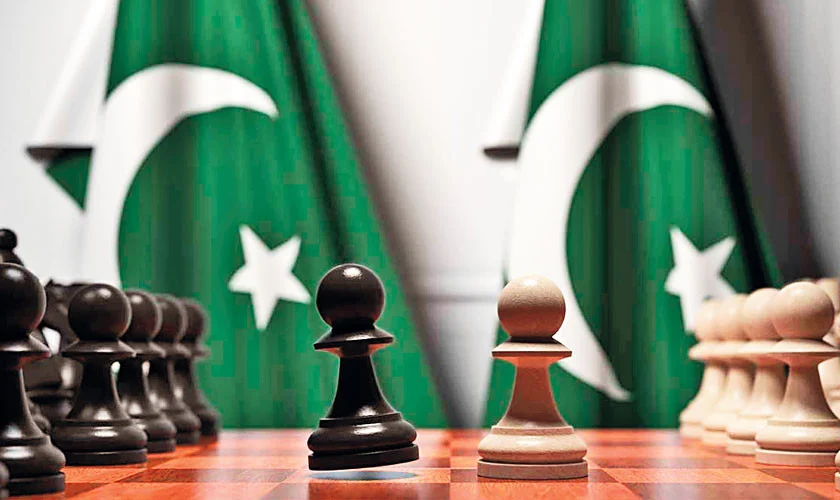
Pakistan at the Heart of a High-Stakes Global Chess Game