
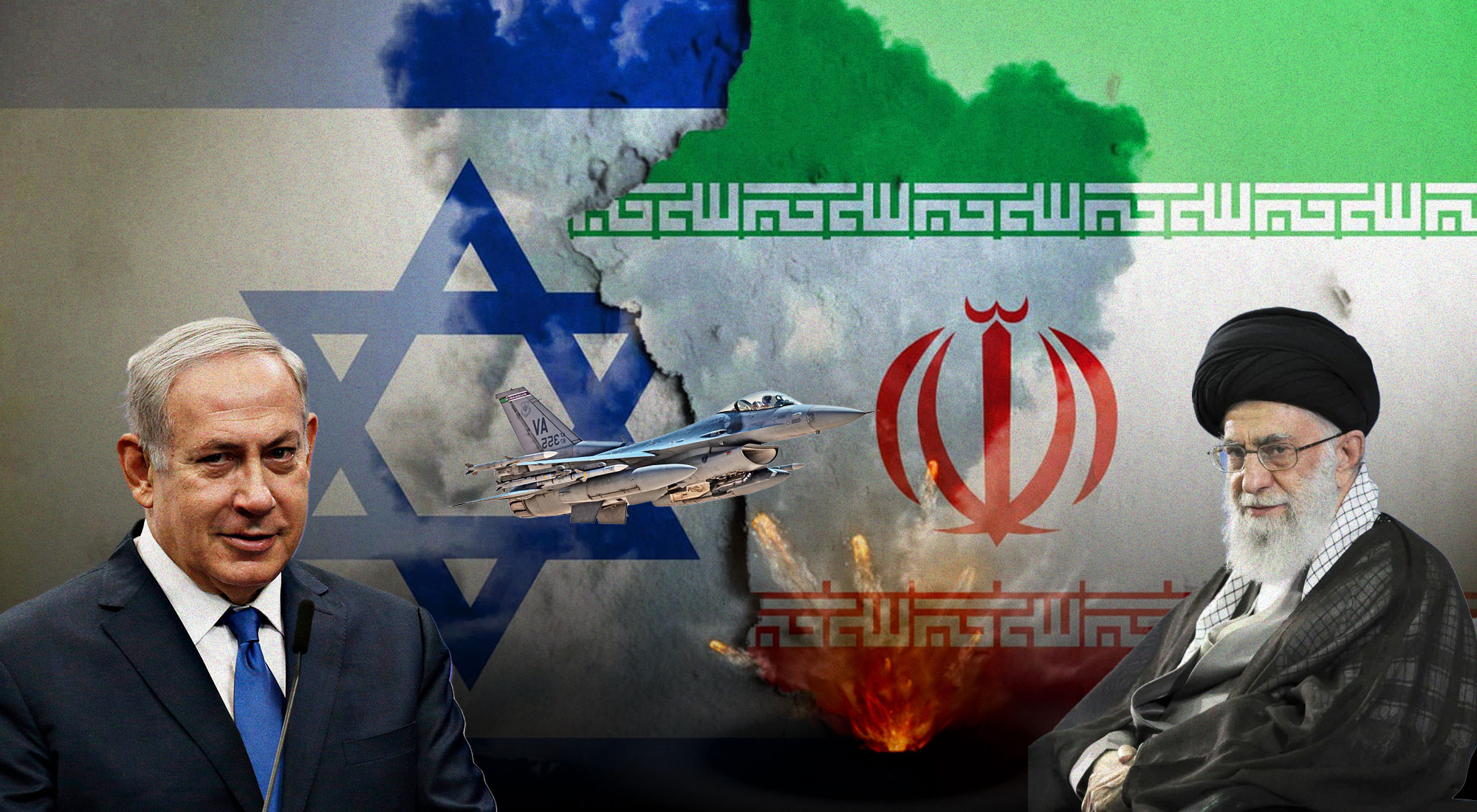
Paris (Imran Y. CHOUDHRY) :- Former Press Secretary to the President, Former Press Minister to the Embassy of Pakistan to France, Former MD, SRBC Mr. Qamar Bashir analysis : During the height of the Israel–Iran confrontation, Benjamin Netanyahu once again returned to his most familiar refrain: that peace in the Middle East—and by extension global stability—requires “regime change” in Iran. It was not a new idea, nor even a new sentence. It was the same narrative he had relentlessly promoted against Saddam Hussein, Muammar Gaddafi, Bashar al-Assad, and Palestinian leaders such as Ismail Haniyeh.
In every case, the promise was identical: remove the leader, and peace will follow. In every case, the result was the opposite—state collapse, prolonged civil war, regional destabilization, mass displacement, and the rise of extremism. Iraq did not become peaceful after Saddam Hussein; it descended into sectarian violence that killed hundreds of thousands. Libya did not stabilize after Gaddafi; it fractured into rival militias and became a transit hub for arms and human trafficking. Syria’s attempted regime change ignited one of the worst humanitarian disasters of the 21st century. Gaza, after repeated leadership assassinations, remains trapped in endless cycles of war.
Yet Netanyahu now repeats the same formula for Iran—this time targeting not merely political leadership but the entire ideological structure of the Islamic Republic, including its supreme leadership and the Islamic Revolutionary Guard Corps.
At one critical moment, even Netanyahu himself acknowledged that Israel’s military apparatus had Iran’s leadership “locked in.” According to public statements later echoed in Western media, Israeli intelligence and strike capabilities were ready, awaiting only political clearance. That final authorization, however, never came. Donald Trump, despite his otherwise confrontational posture toward Iran, reportedly withheld the green light. Whether due to fear of uncontrollable escalation, economic consequences, or intelligence assessments predicting catastrophic regional blowback, the decision spared Iran’s leadership—and possibly the region—from immediate catastrophe.
Today, however, the situation appears far more dangerous. Protests inside Iran—some organic, some amplified—are now being framed internationally as the prelude to regime collapse. Western intelligence narratives increasingly mirror those seen before Iraq in 2003 or Libya in 2011. The Central Intelligence Agency has historically played such roles before, and Iran itself is no stranger to this pattern.
The first modern regime change in Iran occurred in 1953, when the CIA and Britain’s MI6 overthrew Prime Minister Mohammad Mossadegh after he nationalized Iran’s oil industry, expelling Anglo-American corporate control. The result was the installation of the Shah, whose authoritarian rule—backed by Western security services—lasted until 1979. When the Shah later attempted to reclaim economic sovereignty and assert independence, he too became expendable. The Islamic Revolution that followed did not emerge in a vacuum; it was the direct outcome of decades of foreign manipulation.
Since 1979, hostility between Iran and Israel has remained constant, driven by ideology, regional rivalry, and competing security doctrines. But the current moment feels different. It is not merely about Iran. It is about a global order unraveling.
The second term of President Trump has accelerated this breakdown dramatically. In just over a year, Washington has openly undermined the United Nations, weakened NATO, and normalized threats of territorial acquisition—from Greenland to Venezuela. The seizure of assets, the weaponization of sanctions, and the use of military force outside UN authorization have become routine rather than exceptional.
Recent U.S. naval seizures in the Caribbean—targeting vessels carrying oil allegedly destined for China, some flying Russian or Chinese flags—represent a dangerous escalation. This is not law enforcement; it is strategic provocation. By intercepting energy supplies linked to China and Russia, Washington is signaling willingness to internationalize conflict zones and draw both powers into kinetic confrontation.
This shift reflects a deeper reality: the United States has failed to contain China economically and has been unable to decisively defeat Russia militarily through proxy war in Ukraine. As economic and diplomatic leverage erodes, kinetic power becomes the last remaining tool. The danger is that military reach replaces strategic wisdom.
Europe, meanwhile, stands weaker than at any time since World War II. Decades of dependency on U.S. security guarantees have hollowed out independent defense capacity. If Washington chooses to act unilaterally—whether in the Arctic, Greenland, or beyond—Europe has little capacity to resist or even influence outcomes. The old alliance-based order is being replaced by raw power politics.
What we are witnessing is not isolated crises but a systemic transformation. Venezuela, Gaza, Iran, Somalia, Nigeria, Ukraine, Greenland—these are not disconnected flashpoints. They are symptoms of a collapsing rules-based system. International law, once imperfect but functional, is being abandoned openly. The very institutions designed to prevent global war are being sidelined by the powers that created them.
This trajectory is unsustainable. A world governed by regime change, sanctions warfare, naval seizures, and unilateral military action is not a stable world. It is a prelude to catastrophe. A third world war—if it comes—will not resemble the first two. It will be faster, more technologically devastating, and far less controllable.
History has already delivered its verdict on regime change as a strategy. It does not produce peace. It produces chaos, radicalization, and endless war. Iran will not be the exception. Nor will the Middle East be pacified by repeating the same failed experiment under a different banner.
There remains only one rational path forward: diplomacy, restraint, and the revival of international institutions—not as tools of dominance, but as platforms for collective survival. The alternative is a world governed by force alone, where no nation, however powerful, remains immune from the consequences.
Let us hope sanity prevails—before repetition becomes annihilation.
Israel-U.S. Fixation on Regime Change in Iran
Israel-U.S. Fixation on Regime Change in Iran