
Paris (Imran Y. CHOUDHRY) :- Former Press Secretary to the President, Former Press Minister to the Embassy of Pakistan to France, Former MD, SRBC Mr. Qamar Bashir analysis : The war that has engulfed the Middle East over the past several weeks is no longer merely a confrontation of missiles, drones, and military doctrines. It is rapidly revealing itself as a deeper contest over geography, energy, and long-term global control. Beneath the smoke of bombed installations and the rhetoric of national security lies a far more consequential objective: the redrawing of the world’s most critical energy routes. What began as a campaign justified on the basis of an “imminent threat” from Iran is now unfolding into a strategic effort that could permanently alter how oil flows from the Gulf to the rest of the world.
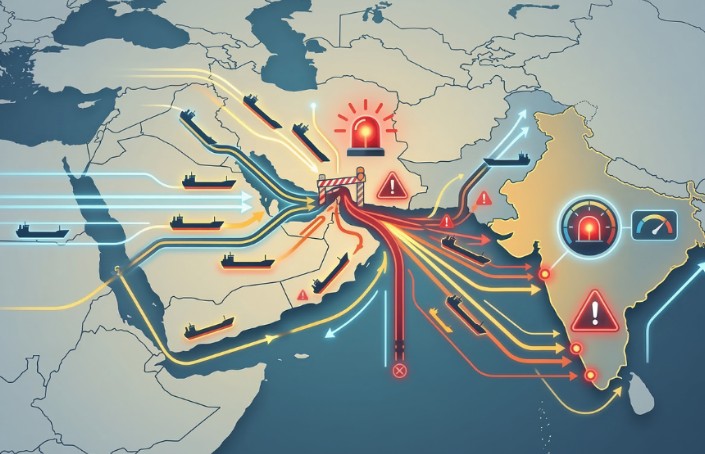
At the heart of this transformation lies the Strait of Hormuz, the narrow maritime corridor through which nearly one-fifth of the world’s oil supply passes every day. For decades, this chokepoint has served as both a lifeline and a vulnerability for global energy markets. Any disruption here—whether through war, sanctions, or sabotage—immediately reverberates across continents, sending oil prices soaring and economies into instability. The current conflict has demonstrated just how fragile this artery truly is. Tanker attacks, rising insurance premiums, and rerouted shipping lanes have exposed the risks of relying on a single, narrow passage for such a massive share of global oil.
It is within this context that a striking and controversial vision has emerged. Israeli leadership, through a series of statements and strategic hints, has pointed toward the possibility of bypassing the Strait of Hormuz altogether. The idea is deceptively simple yet geopolitically profound: construct a pipeline that would transport oil from Gulf producers across the Arabian Peninsula and into Israel, where it could then be shipped via Mediterranean ports to Europe and beyond. Such a route would eliminate dependence on Hormuz, neutralize Iran’s ability to disrupt global energy flows, and reposition Israel as a central hub in the international oil trade.
While versions of this idea have existed in policy circles for years—most notably through discussions around the Eilat-Ashkelon pipeline—the present war appears to have injected new urgency into its consideration. What was once a theoretical infrastructure project is now being framed as a strategic necessity. The logic is clear: if Hormuz can be disrupted, then it must be bypassed. And if it is bypassed through Israeli territory, then Israel gains unprecedented leverage over the energy lifelines of both Europe and parts of Asia.
This raises a deeply uncomfortable question: was the war itself, at least in part, shaped by this long-term vision? The official justification centered on the notion of an imminent Iranian threat—particularly the fear that Iran might soon develop nuclear weapons and long-range missile capabilities capable of striking Europe or even the United States. Yet, as the conflict has progressed, cracks have begun to appear in this narrative. Statements from U.S. intelligence officials in congressional hearings have indicated that Iran neither possessed the immediate capability to strike the United States nor demonstrated an intent to do so in the near term.
Instead, the threat appears to have been framed in hypothetical terms—what Iran could become, rather than what it currently is. The argument shifted from “imminent danger” to “imagined future risk.” This distinction is not merely semantic; it raises serious questions about the legitimacy of the war itself. If the threat was not immediate, then the rationale for initiating such a large-scale conflict becomes far more questionable.
Against this backdrop, recent military actions take on a different meaning. Strikes on Iranian energy infrastructure, including major gas fields and oil facilities, appear less like isolated tactical operations and more like components of a broader strategic script. By provoking Iranian retaliation—particularly against regional oil installations and shipping routes—the conflict has effectively demonstrated the vulnerability of the Strait of Hormuz. In doing so, it has strengthened the case for alternative routes, including the proposed pipeline through Israel.
Iran, for its part, has responded in a manner that underscores its own strategic leverage. By targeting shipping lanes and signaling its ability to disrupt Hormuz, Tehran has shown that it can impose a global cost for any sustained aggression against it. The result is a paradox: every escalation that threatens global oil supply simultaneously reinforces the argument for bypassing the very chokepoint Iran influences.
Yet the conflict is not confined to economic and strategic calculations alone. It carries within it the risk of a far more dangerous escalation—one rooted in religion and symbolism. Reports of missile debris landing dangerously close to Jerusalem’s most sacred sites, including the Western Wall and the Dome of the Rock, serve as a stark reminder of how quickly this war could transcend geopolitics and ignite a broader global crisis. Had these sites been directly struck, the consequences would have been catastrophic, drawing in millions of believers and transforming a regional war into a wider religious confrontation.
Meanwhile, a subtle but significant divergence appears to be emerging between the United States and Israel. Washington has signaled, through public statements, that it believes major military objectives have already been achieved. Claims that Iran’s military capabilities have been severely degraded suggest a desire to declare victory and potentially de-escalate. Israel, however, has articulated a far more open-ended vision of the conflict. Its leadership continues to emphasize that multiple objectives remain unfulfilled, and that the endgame is still distant.
This divergence is critical. While the United States bears the overwhelming financial and reputational burden of the war—spending billions of dollars, straining alliances, and facing global criticism—Israel stands to gain the most if its long-term strategic goals are realized. The transformation of Israel into a central energy transit hub would not only enhance its economic position but also grant it leverage over countries dependent on Middle Eastern oil.
For the United States, the costs are mounting. Beyond the direct military expenditures, estimated at nearly a billion dollars per day, there is the erosion of credibility. Allies question Washington’s consistency, adversaries exploit its vulnerabilities, and neutral states grow increasingly wary of its intentions. The perception of having entered a war based on speculative threats rather than concrete evidence further undermines its standing.
In contrast, Israel’s potential gains are structural and enduring. Control over a major alternative energy corridor would place it at the center of global oil logistics, allowing it to influence supply, pricing, and strategic alignment. Such a shift would echo historical precedents, where control over key transit routes—whether the Suez Canal or the Strait of Malacca—translated into geopolitical dominance.
As the war continues, the world stands at a crossroads. If the Strait of Hormuz remains unstable and the pipeline vision gains momentum, we may be witnessing the beginning of a new global energy order. One in which traditional chokepoints are bypassed, new corridors are established, and power is redistributed accordingly.
The question is no longer who is winning on the battlefield. It is who will control the pathways through which the world’s lifeblood—its energy—flows. In that contest, the most decisive victories may not be measured in territory captured or enemies defeated, but in pipelines laid and routes redefined.
Israel Hijacks Global Oil Flow
Israel Hijacks Global Oil Flow