
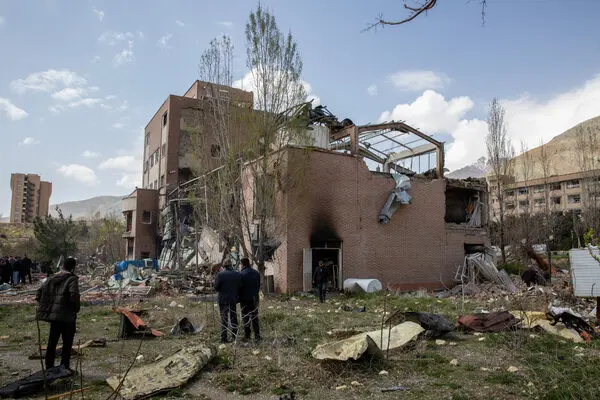
Paris (Imran Y. CHOUDHRY) :- Former Press Secretary to the President, Former Press Minister to the Embassy of Pakistan to France, Former MD, SRBC Mr. Qamar Bashir analysis : In the arid expanse of Iran’s Central Plateau, a mountain known as Kuh-e Kolang Gaz La, or “Pickaxe Mountain,” has become the central pivot upon which the fate of the Middle East now turns. More than just a geological formation, it represents a new, terrifying phase in the long-standing conflict between Iran, the United States, and Israel. As President Donald Trump publicly threatens to bomb the site—a facility buried so deep it may be impervious to America’s most powerful conventional weapons—the world is witnessing the failure of military hegemony and the birth of a new, multipolar reality.
Pickaxe Mountain is not a new site of uranium enrichment, but a fortress carved out of desperation. Its construction was a direct response to years of sabotage and strikes, including a 2020 attack on the Natanz centrifuge manufacturing plant widely attributed to Israel .
Iranian officials, tired of their above-ground facilities being vulnerable, vowed to move their most sensitive work into the “heart of the mountain” . Satellite imagery and expert analysis, including assessments from the James Martin Center for Nonproliferation Studies, suggest the facility lies between 80 and 100 meters—or potentially deeper—beneath the summit.
To put this in perspective, the U.S. military’s premier bunker-buster, the 30,000-pound GBU-57 Massive Ordnance Penetrator (MOP), is designed to penetrate up to 60 meters of earth before detonating . The depth of Pickaxe Mountain is deliberately engineered to render this technological marvel obsolete .
Despite the attacks on Iran’s main nuclear sites—Fordow, Isfahan, and Natanz—during the 2025 and 2026 conflicts, Pickaxe Mountain has remained untouched . This has led to intense speculation about what lies inside. While Iran insists the facility is merely a centrifuge manufacturing plant to replace the destroyed site at Natanz, experts are skeptical.
The scale of the construction, spanning 2.7 square kilometers and featuring multiple entrances and hardened defenses, suggests it is capable of housing a full-scale uranium enrichment plant . Israeli intelligence now claims that thousands of centrifuges were moved into the mountain’s tunnels last fall, representing a “fallback” nuclear capability that could allow Iran to continue its program even under relentless bombardment .
This intelligence has sparked a very public spat between the leaders of the United States and Israel. When Israeli Prime Minister Benjamin Netanyahu arrived in Washington to present evidence of Iran’s activities at Pickaxe Mountain, he was met not with gratitude, but with a sharp public rebuke.
Trump, appearing on Fox News, dismissed the necessity of Netanyahu’s intelligence, stating, “I don’t need Bibi to tell me that. Bibi is telling me that because he wants me to stay involved.” He added, “I know exactly what’s going on at Pickaxe. It’s not a big problem” .
This public dressing down highlighted a fundamental fracture in the alliance . American officials reportedly view Netanyahu as unreliable, and there is a growing sense in Washington that Israel “sees what it wants to see” in the intelligence, pushing for an escalation that the U.S. may not want . Trump’s irritation was palpable; he questioned why Netanyahu had to “announce it to the world” instead of simply telling him privately .
This rupture is significant. It suggests that the U.S. is weary of a war that has failed to deliver decisive results, while Israel, fearing an Iranian bomb, is desperate to see the military campaign through to its conclusion. However, the reality on the ground suggests that brute force—specifically air power—is no longer the decisive factor it once was.
Iran’s resilience, demonstrated through its ability to survive decades of sanctions and major military strikes, is a testament to the limitations of American firepower. The Biden administration’s stated goal of preventing a nuclear-armed Iran has been thwarted not by a lack of will, but by Iran’s strategic patience and its ability to harden its assets.
The conflict has now entered a paradoxical phase: the weapons designed to destroy Iran’s program, like the MOP, may be insufficient to penetrate its new defenses, rendering billions of dollars in military hardware ineffective . Iran’s message is clear: if it truly wishes to cross the threshold to a nuclear weapon, no conventional force on Earth can stop it.
Simultaneously, Iran has demonstrated its strategic prowess in another theater: the Strait of Hormuz. Tehran has been engaging in a high-stakes diplomatic and military confrontation with the U.S. and its allies, fundamentally rewriting the rules of the waterway that carries one-fifth of global oil. Iran has forcefully ejected the United States from any role in managing the strait.
Through negotiations with Oman, Tehran has proposed a new arrangement where the northern shipping lane remains entirely under Iranian control . When Oman suggested a 50-50 joint control formula, Iran rejected it outright . Deputy Foreign Minister Kazem Gharibabadi has declared that the strait “will never return to its pre-war arrangements,” warning that any European warship attempting to approach would be a “legitimate target” .
This is not merely a military blockade; it is a geopolitical revolution. By seizing control of the Hormuz waterway, Iran is undermining the hegemonic design of the United States, which has long controlled the flow of oil and gas to the world.
The U.S. naval dominance in the region, once unquestioned, is being challenged by a nation that has demonstrated it is willing to close the strait to force a new status quo. The economic hardship inflicted by the war and the soaring energy prices have put immense pressure on the Trump administration, forcing it to pause attacks and engage in “good talks” with a regime it has spent years trying to cripple .
The “pause” in the war, rather than being a genuine diplomatic breakthrough, has been cynically perceived as a way to restock depleted American weapons stores—a cycle of attrition that has already proven costly.
Ultimately, the saga of Pickaxe Mountain and the seizure of the Strait of Hormuz reveals a profound truth: the era of unipolar military dominance is over. Iran, a nation subjected to severe economic hardship for over 30 years, has built a resilient economy, a formidable defensive system, and an effective offensive strategy that has blunted the full might of the U.S. military.
The failure of the U.S. and Israel to break the will of the Iranian people or secure their strategic objectives is a landmark event. It signals that military force alone cannot dictate the outcome of modern conflicts, a lesson already evident in the standoffs between Russia and Ukraine.
The world is witnessing the decline of brute force as the ultimate arbiter of international disputes. As Iran prepares to continue its nuclear program, shielded by mountains and defended by a nation that has proven its mettle against a superpower, it stands as a potent symbol that the future of global conflict will be decided not just by bombs, but by endurance, strategy, and an unyielding defense of sovereignty.