
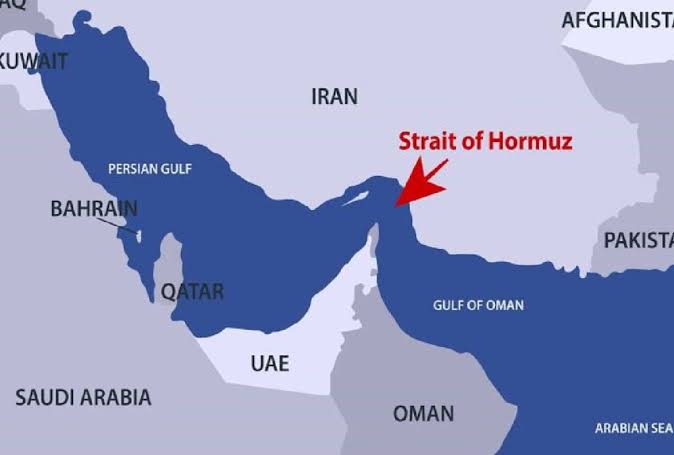
Paris (Imran Y. CHOUDHRY) :- Former Press Secretary to the President, Former Press Minister to the Embassy of Pakistan to France, Former MD, SRBC Mr. Qamar Bashir analysis : The war with Iran is no longer merely a contest of missiles, aircraft and naval power. It has become a struggle over the arteries through which the world’s energy flows. For months, the United States, Israel and regional producers have searched for ways to reduce dependence on the Strait of Hormuz. Israel has proposed pipelines carrying Gulf energy westward to its Mediterranean ports, while other projects envisage moving Iraqi and regional oil toward the Mediterranean. But events of recent days demonstrate a fundamental weakness in this strategy: bypassing one vulnerable chokepoint does not abolish geography. It merely transfers the vulnerability somewhere else.
Israeli Prime Minister Benjamin Netanyahu made his vision explicit in March. He proposed oil and gas pipelines running westward across the Arabian Peninsula to Israeli Mediterranean ports, arguing that such infrastructure could eliminate dependence on maritime chokepoints.
The broader search for alternative corridors has also involved proposals linking Iraqi energy resources with Syria’s Mediterranean coast. These projects potentially create enormous commercial opportunities for transit countries, ports, construction companies and international energy corporations. The contest, therefore, is not simply over oil. It is increasingly over who will build, operate and influence the infrastructure carrying that oil.
Saudi Arabia already possessed the most important working example of the bypass strategy. Its 1,200-kilometre East-West Pipeline, or Petroline, carries crude from the kingdom’s eastern producing regions across the Arabian Peninsula to Yanbu on the Red Sea. As Hormuz became increasingly dangerous, this pipeline became enormously important. Roughly four million barrels per day were moving through the system, allowing Saudi Arabia to export without sending those barrels through Hormuz.
Then came the drones. Saudi authorities say several drones launched from Iraqi territory attacked the East-West Pipeline system in the Riyadh and Madinah regions. The attacks caused injuries and damage and forced authorities to shut the pipeline as a precaution while technical teams assessed its safety. The entire 1,200-kilometre pipeline did not need to be physically destroyed. A sophisticated energy artery depends upon pumping stations, controls and associated infrastructure. Damage at strategically important points can interrupt the entire flow.
The economic consequences could be enormous. Saudi Arabia reportedly has enough exportable crude stored at Yanbu to maintain current flows for only about five to seven days if Petroline remains closed. After that, as much as four percent of global oil supply could be jeopardised.
Repair estimates remain uncertain, ranging from days to weeks. The important strategic lesson is therefore not whether Petroline can eventually be repaired. Of course it can. The lesson is that the principal functioning escape route from Hormuz has itself demonstrated its vulnerability.
This is where Iran’s strategic depth becomes important. Tehran does not require conventional naval supremacy over every kilometre of Hormuz to exercise extraordinary leverage there. Commercial shipping operates according to risk. One successful missile or drone attack can force shipowners, insurers and cargo operators to reconsider whether a voyage remains commercially acceptable.
The same logic increasingly applies at the other end of the Arabian Peninsula. Yemen’s Iran-aligned Houthis have advanced along the Red Sea coast and reached Perim Island, situated inside Bab el-Mandeb—the narrow gateway connecting the Red Sea with the Gulf of Aden. Saudi Arabia’s Petroline may bypass Hormuz by terminating at Yanbu, but tankers sailing from the Red Sea toward Asian markets still confront the geography surrounding Bab el-Mandeb. The alternative route therefore possesses a chokepoint of its own.
This is what I describe as Iran’s strategic checkmate of the Hormuz-bypass concept. I do not use “checkmate” to mean that Iran possesses uncontested sovereignty over two international waterways or has defeated American military power. My argument is economic and strategic. Iran and forces aligned with it possess sufficient capabilities across different theatres to make alternative energy routes vulnerable. In commercial transportation, the ability credibly to threaten passage can sometimes be almost as consequential as physically occupying it.
The deeper story concerns money and power. Every new pipeline creates winners. Construction companies receive contracts. Energy corporations acquire projects. Transit countries collect revenues. Ports gain business. Investors obtain returns. Countries hosting terminals acquire additional strategic importance. Israel’s proposed Mediterranean corridor could enhance its position as an energy bridge. American companies participating in Middle Eastern energy and infrastructure projects can obtain major commercial opportunities. Regional governments, meanwhile, seek diversified routes that reduce their dependence on waterways vulnerable to war.
Yet the cruel paradox is that Middle Eastern oil-producing countries risk carrying a disproportionate share of the immediate damage. Their pipelines become targets. Their export terminals require protection. Their production revenues become vulnerable to interruption. Their cities face missile and drone threats, while insurance and transportation costs rise. Saudi Arabia’s present predicament illustrates the danger: an infrastructure system designed to provide strategic security from Hormuz has itself become exposed to the expanding battlefield.
The widening conflict around Bab el-Mandeb demonstrates another limitation of purely military calculations. A superpower can deploy aircraft carriers, destroyers, missile defences and tens of thousands of personnel, yet commercial shipping requires something more difficult to guarantee: confidence. A shipping company contemplating a billion-dollar vessel and valuable cargo does not ask merely which navy is stronger. It asks whether the ship can complete its voyage safely, whether insurance remains available and whether the potential profit justifies the possibility of catastrophic loss.
That is why geography continues to defeat attempts to declare Hormuz irrelevant. A pipeline across Saudi Arabia substitutes pumping stations and hundreds of kilometres of exposed infrastructure for the strait. A Syrian corridor would traverse another politically sensitive landscape. An Israeli Mediterranean corridor would require enormous investment, security and regional cooperation. And Red Sea exports must still confront the security environment surrounding Bab el-Mandeb. There is no magic line on a map capable of removing geopolitical risk.
The Iran war has consequently evolved into something much larger than the conflict with which it began. It is simultaneously a military confrontation, an energy war and a contest over the future architecture of global petroleum transportation. The question is no longer simply who produces Middle Eastern oil. Increasingly, it is who builds the pipelines, controls the ports, protects the waterways and possesses leverage between the wellhead and the consumer.
The architects of alternative corridors hoped to diminish Iran’s greatest geographical advantage by diminishing Hormuz itself. Instead, the expanding conflict is demonstrating that energy routes cannot simply escape geography. Close one chokepoint and another becomes indispensable. Build a pipeline and the pumping stations become strategic assets. Shift exports toward the Red Sea and Bab el-Mandeb assumes greater importance.
That is the strategic irony of this war. The attempt to make Hormuz irrelevant may instead have demonstrated just how difficult it is to make Iran’s geography irrelevant. The map of the Middle East has not changed. What has changed is the number of places on that map where the world’s energy lifelines can now be threatened.
Iran Checkmates the Hormuz Bypass
Iran Checkmates the Hormuz Bypass