
Paris (Imran Y. CHOUDHRY) :- Former Press Secretary to the President, Former Press Minister to the Embassy of Pakistan to France, Former MD, SRBC Mr. Qamar Bashir analysis : The political rise of Zohran Mamdani in New York City and Abdul El-Sayed in Michigan represents a significant development in American democracy. Their stories are not identical, and their political offices carry very different powers, but both have challenged the traditional assumption that Muslim candidates must soften their identities, dilute their convictions or seek approval from powerful political establishments before becoming electorally acceptable.
Mamdani has already completed the more difficult half of his journey. After winning New York City’s Democratic mayoral primary in 2025, defeating former Governor Andrew Cuomo, he won the general election on November 4, 2025, and became mayor on January 1, 2026. El-Sayed, by contrast, has won Michigan’s Democratic nomination for the United States Senate but must still defeat Republican Mike Rogers in the November 2026 general election. His primary victory was narrow—less than one percentage point—but politically remarkable because he overcame a nationally supported establishment candidate and tens of millions of dollars in outside spending.
Some factual distinctions are essential. New York City is not one of America’s 50 states. It is a city within New York State, governed through five boroughs: Manhattan, Brooklyn, Queens, the Bronx and Staten Island. Nevertheless, its population, financial power, media influence and global diplomatic presence give its mayor an international profile unusual for a municipal official. The city hosts the headquarters of the United Nations and receives presidents, prime ministers and diplomats from across the world.
Mamdani was born in Kampala, Uganda, to filmmaker Mira Nair, who was born in India, and Mahmood Mamdani, a prominent Ugandan academic of Indian ancestry. He later became an American citizen. El-Sayed was born in Michigan and is the son of Egyptian immigrants. Therefore, Mamdani is himself an immigrant, while El-Sayed is a native-born American from an immigrant family. Both, however, embody the experience of Muslim families establishing themselves within American society.
Their professional beginnings were also different. Mamdani worked as a housing counsellor, helping homeowners facing foreclosure, and participated in electoral campaigns before winning a seat in the New York State Assembly in 2020. He defeated an established incumbent in the Democratic primary and was subsequently reelected. His political identity developed through tenant advocacy, public transportation campaigns and democratic-socialist organizing.
El-Sayed followed a more academic and administrative path. He studied medicine and public health, became an epidemiologist and served as Detroit’s health director before later leading health and human-services work in Wayne County. His first major electoral campaign was an unsuccessful run for governor of Michigan in 2018. Instead of disappearing after that defeat, he remained active through public-policy work, writing, broadcasting and grassroots organization. By the time he entered the 2026 Senate race, he had converted a previous defeat into statewide recognition and a more experienced political operation.
Both men have been notably open about their Muslim faith. However, sincerity of belief is ultimately personal and cannot be scientifically measured by journalists or political opponents. What can be examined is consistency. Neither candidate hid his Muslim identity when it became politically inconvenient. Both discussed how faith influenced their understanding of justice, economic inequality and public service. Their campaigns did not present Islam as a demand for special treatment; rather, they situated Muslim identity within the broader American principles of equality, dignity and constitutional citizenship.
This openness became more important because both faced opposition connected to their criticism of Israeli government policies. Mamdani was attacked over his views on Palestinian rights, while El-Sayed called for ending American military assistance to Israel and described the destruction in Gaza as genocide. AIPAC and aligned organizations became deeply involved in the Michigan primary. Reports estimated that pro-Stevens and anti-El-Sayed outside spending reached tens of millions of dollars, making the contest one of the most expensive Democratic primaries in American history. Rather than retreating, El-Sayed used the intervention to argue that Michigan’s political choices should not be controlled by billionaires or outside lobbying organizations.
Nevertheless, it would be inaccurate to say that all Democrats and Republicans united against either candidate. Mamdani received substantial support from progressive Democrats, democratic socialists, trade-union members, young voters and immigrant communities. El-Sayed was endorsed by national progressive figures, including Bernie Sanders and Alexandria Ocasio-Cortez. Their victories were rebellions against particular party establishments, not victories achieved entirely without political allies.
The strongest similarity between the two campaigns is their economic populism. Mamdani built his mayoral campaign around making New York affordable. His proposals included expanded child care, rent protections, affordable housing, improved buses, higher wages and publicly supported grocery initiatives. After taking office, his administration announced child-care funding, housing reforms designed to accelerate affordable construction, stronger action against irresponsible landlords and a grocery discount programme covering essential foods. His administration has also set a long-term goal of producing 200,000 affordable homes over ten years.
These actions demonstrate both the possibilities and limitations of municipal power. A mayor can influence housing enforcement, city services, transportation, child care and business regulation. However, major tax changes, transit financing and many housing policies require cooperation from the New York governor, state legislature and city council. Mamdani is therefore discovering that winning an election is different from converting every campaign promise into law.
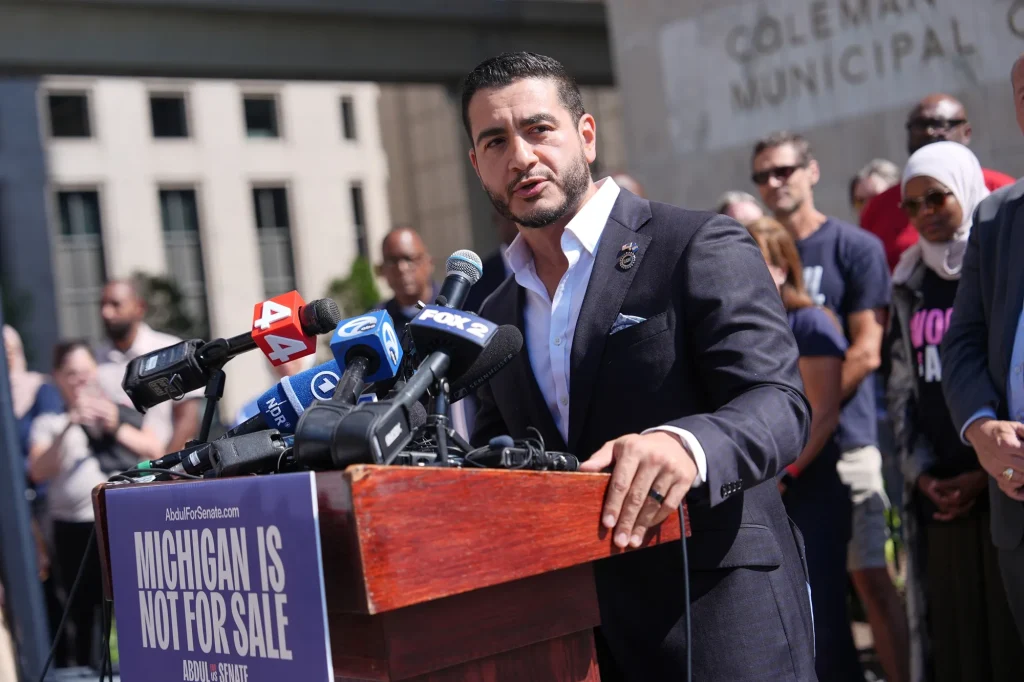
El-Sayed’s agenda is similarly focused on affordability but operates at the federal level. His stated priorities include removing private money from politics, reducing household costs and passing Medicare for All. He also supports affordable or free child care, stronger taxation of billionaires, labour rights and an end to American military assistance for Israel.
As a senator, however, El-Sayed would not possess the direct executive authority available to a mayor. He could introduce legislation, vote on federal budgets, question administration officials, confirm judges and executive nominees, and use Senate committees to investigate healthcare companies, military expenditure and corporate power. But Medicare for All or sweeping campaign-finance reform would require support from the House of Representatives, a Senate majority and the president. His success would consequently depend on coalition-building, negotiation and the balance of power in Washington.
There are also important differences in political philosophy. Mamdani is publicly identified with democratic socialism and has emphasized public provision of essential services. El-Sayed is a progressive Democrat but is not generally presented as a formal member of the Democratic Socialists of America. His politics combine universal healthcare, anti-corporate populism, public-health expertise and institutional reform. Mamdani emerged primarily from urban grassroots activism; El-Sayed rose through academic achievement, public administration and statewide campaigning.
Their electoral environments are equally different. New York City strongly favours Democrats, meaning that Mamdani’s greatest obstacle was the Democratic primary. Michigan is a genuine swing state. El-Sayed must win independents, union households, suburban voters, Arab and Muslim Americans, African Americans, young progressives and some moderate Democrats while facing an experienced Republican opponent. His primary victory was historic, but the general election will be the decisive test.
If elected, El-Sayed would become the first Muslim member of the United States Senate. Mamdani has already become New York City’s first Muslim mayor. Their rise does not prove that prejudice has disappeared, nor does it guarantee that progressive economic programmes will succeed. It does show that American voters can support candidates who openly identify as Muslim, defend immigrants and challenge powerful financial and foreign-policy interests.
Mamdani broke an important barrier. El-Sayed has reached the threshold of another. Their shared message is that Muslim politicians need not choose between religious identity and American citizenship. They can declare both openly, submit their programmes to the voters and be judged by their ability to improve ordinary lives.
Whether El-Sayed completes the journey will be decided in November. But his primary victory, following Mamdani’s breakthrough in New York, has already established a larger truth: a new generation of American Muslim leadership is no longer asking merely to be accepted. It is seeking—and increasingly winning—the authority to govern.
From Mamdani to El-Sayed: Reshaping America’s Politics
From Mamdani to El-Sayed: Reshaping America's Politics