
Paris (Imran Y. CHOUDHRY) :- Former Press Secretary to the President, Former Press Minister to the Embassy of Pakistan to France, Former MD, SRBC Mr. Qamar Bashir analysis : The most important geopolitical question emerging from the recent Middle East conflict is not merely why Israel continues to act with what many describe as total impunity, but why the broader Muslim world, despite possessing immense economic, military, and strategic power, has remained fragmented, hesitant, and largely ineffective in confronting it. The answer to this question exposes not only the changing balance of power in the Middle East, but also the deep contradictions within the global Muslim political order itself.
The recent war transformed many assumptions that had shaped international politics for decades. For the first time in modern history, Iran demonstrated that even the combined military, diplomatic, and economic pressure of the United States and Israel could be resisted.
Few analysts imagined that Tehran would withstand months of military confrontation, survive economic pressure, absorb attacks on its infrastructure and leadership, and still emerge politically stronger.
Yet that is exactly what happened. Militarily, Iran preserved its command structure, maintained its deterrence capability, and continued projecting power through both direct and indirect means. Diplomatically, Tehran achieved something equally remarkable: it prevented the complete isolation that Washington and Tel Aviv had sought to impose upon it.
In the United Nations and other international forums, the United States failed repeatedly to secure the level of consensus it once commanded effortlessly. China and Russia openly resisted Western pressure and challenged American narratives surrounding maritime security, sanctions, and military escalation.
Even many countries traditionally aligned with Washington adopted cautious or neutral positions rather than joining a wider anti-Iran coalition. Instead of appearing isolated, Iran suddenly appeared resilient, composed, and increasingly influential.
Iranian Foreign Minister Abbas Araghchi embarked on an aggressive diplomatic campaign across the Middle East and beyond, reassuring neighboring countries that Iran did not seek war against Arab states.
Tehran repeatedly argued that its attacks on military bases in the region were not aimed at host governments themselves, but at facilities being used by the United States to conduct operations against Iran.
From Tehran’s perspective, if a country thousands of miles away could claim a “perceived threat” as justification for military action against Iran, then Iran also possessed the right to neutralize launch points and operational hubs being used against it.
This argument, controversial as it may be, resonated with many observers who increasingly viewed the conflict through the lens of double standards.
Iran’s leadership emphasized that collateral damage from its strikes was minimal compared to the widespread destruction caused in Gaza, Lebanon, and elsewhere. Whether one agrees with Tehran or not, the diplomatic effect was undeniable: most Middle Eastern states refused to join the offensive side of the war. They remained defensive, cautious, and unwilling to openly participate in direct confrontation with Iran.
At the same time, the United States suffered a severe erosion of political influence across Europe. Washington’s increasingly confrontational posture toward European allies, combined with pressure campaigns and threats of troop withdrawals, accelerated growing resentment inside the European Union.
Germany and other European states began openly discussing strategic autonomy and reducing dependency on American military dominance. What was once framed as a protective alliance increasingly started being viewed by many Europeans as an unequal arrangement driven by American interests rather than mutual respect.
Yet despite this massive geopolitical shift — despite Iran surviving, despite American prestige declining, despite Israel facing unprecedented military and diplomatic pressure — Israel continued its aggressive posture toward Lebanon and Gaza.
This contradiction raises an even deeper question: why did the burden of confronting Israel fall disproportionately upon Iran, a Shia-majority state, while many powerful Sunni-majority countries remained passive?
This is the uncomfortable reality that now confronts the Muslim world. Iran, despite sectarian differences and historical rivalries, positioned itself as the most aggressive defender of Palestinians and Lebanese civilians.
Meanwhile, many Sunni-majority states possessing enormous wealth, advanced weaponry, and strategic leverage limited themselves largely to statements, summits, condemnations, and symbolic diplomacy.
Saudi Arabia, which has long claimed leadership of the Sunni Muslim world, possessed the economic influence to impose severe pressure through oil policy, trade restrictions, and regional coordination.
Turkey frequently projects military strength and strategic ambition, yet during the height of the crisis it remained largely rhetorical. The United Arab Emirates, Bahrain, Jordan, and other regional powers similarly avoided meaningful confrontation.
Even countries with immense populations and military capabilities — including Pakistan, Indonesia, Malaysia, and influential African Muslim states — did not collectively mobilize to impose serious economic or diplomatic costs upon Israel.
Ironically, some European countries and international institutions appeared more vocal in defending Palestinian rights than many Muslim governments themselves. European public opinion increasingly shifted against Israeli military operations.
Humanitarian agencies, civil society groups, and even segments of Western political establishments openly criticized the scale of destruction in Gaza and Lebanon. The United Nations repeatedly warned about humanitarian catastrophe.
Yet the Muslim world, despite possessing the strongest emotional, religious, and historical connection to the issue, remained deeply divided and strategically paralyzed.
If Israel justifies its actions in southern Lebanon by claiming it seeks a “buffer zone” for security, then the logic becomes limitless and dangerous. By that reasoning, any powerful state could justify occupying neighboring territory indefinitely under the pretext of future threats.
Security concerns cannot become a permanent license for territorial expansion, demographic displacement, or endless military operations.
Critics increasingly argue that what is unfolding reflects not merely defensive policy, but a broader strategic ambition to dominate surrounding regions politically and militarily.
The tragedy is that the Muslim world still possesses immense leverage if it chooses to act collectively. It controls critical trade routes, energy supplies, air corridors, ports, and markets.
Coordinated restrictions on airspace access, shipping routes, commercial cooperation, and strategic logistics could dramatically alter the regional balance without requiring direct military confrontation. Economic isolation, diplomatic unity, and strategic pressure could impose significant costs while avoiding catastrophic war.
Instead, many governments continue offering rhetorical solidarity while avoiding meaningful sacrifice or risk. This gap between public emotion and state policy has created widespread frustration across Muslim societies.
The lesson emerging from the Iran confrontation is not necessarily about ideology or sectarianism, but about political will. Iran demonstrated that a nation prepared to absorb pressure, endure hardship, and act with strategic determination can challenge even vastly superior powers.
Whether one supports or opposes Tehran’s policies, the symbolism of its resilience has transformed regional psychology. It shattered the belief that resistance is impossible. It exposed the limitations of overwhelming military superiority when confronted by national resolve and strategic patience. Most importantly, it revealed the weakness of states that possess wealth and power but lack collective courage and unity.
The broader lesson for the Muslim world is stark. Fear of retaliation, dependency, and political caution may preserve short-term stability, but they also perpetuate long-term humiliation and strategic irrelevance.
Nations that continuously avoid risk eventually lose both influence and dignity. Courage alone does not guarantee victory, but the absence of courage guarantees submission.
The crisis in Gaza and Lebanon has therefore become more than a regional conflict. It has become a mirror reflecting the political fragmentation, contradictions, and moral paralysis of the Muslim world itself.
Until Muslim nations move beyond symbolic rhetoric and develop coordinated, principled, and strategic policies, Israel will continue acting with confidence and impunity. The future balance of power in the Middle East will ultimately not be determined only by weapons or technology, but by which nations possess the unity, resilience, and political courage to stand firmly behind their convictions.
Courage of Iran, Spineless Muslim World
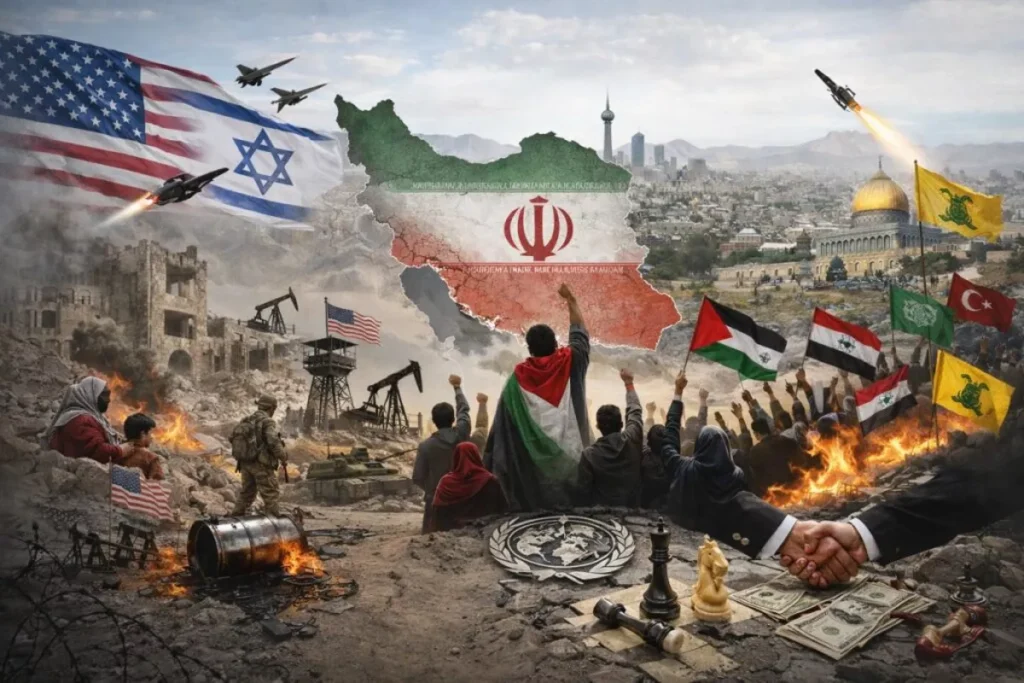
Courage of Iran, Spineless Muslim World