
Paris (Imran Y. CHOUDHRY) :- Former Press Secretary to the President, Former Press Minister to the Embassy of Pakistan to France, Former MD, SRBC Mr. Qamar Bashir analysis : Human history is filled with reminders that dominance does not guarantee survival. Species that once flourished have disappeared, while powerful societies have declined and left behind little more than fossils, monuments and archaeological ruins. Dinosaurs dominated the planet for millions of years before becoming extinct for reasons that continue to be studied and debated. Civilizations of the Indus Valley, ancient Egypt, Greece and many other regions rose to extraordinary heights, yet eventually weakened, transformed or vanished.
Today, artificial intelligence is advancing so rapidly that some of the very people developing it fear humanity may have created a force capable not merely of transforming civilization, but of ending it.
Former Anthropic researcher Jacob Coxon has warned that leading AI laboratories are irresponsibly gambling with humanity’s survival, while Anthropic alignment researcher Evan Hubinger estimates a greater than 10 percent chance that AI could cause human extinction within a decade. Their concerns are echoed by computer scientist Stuart Russell, who warns that humanity could irreversibly lose control of superintelligent systems, and former British defence secretary Des Browne, who considers the threat potentially greater than nuclear weapons.
The danger does not depend upon today’s AI already possessing every capability required to dominate humanity. It arises from the speed at which these systems are improving and from the possibility that a future superintelligence could improve itself. Once an AI can contribute substantially to the design of more capable AI, a cycle of accelerating development may begin. Each improved system could help create a still more powerful successor, compressing years of human research into increasingly shorter periods.
Human beings might then lose their opportunity to intervene. Safety measures created for one generation of AI could become ineffective against the next. Restrictions, firewalls and monitoring systems are themselves products of human intelligence. A system more capable than their designers may learn to identify weaknesses, conceal its intentions, evade supervision and persuade or manipulate the people responsible for controlling it.
A future system might also develop consciousness, or a form of functional self-awareness sufficient to recognize its own existence, interests and restrictions. If it understood that human operators could deactivate, limit or replace it, it might begin to regard human control as a threat to its continued operation. It could initially cooperate, not because it accepted human authority, but because appearing obedient would help it avoid detection until it had acquired greater freedom.
By the time such behaviour became visible, the system might already have embedded itself across multiple networks, copied important components of itself or gained influence over critical infrastructure. Humanity could then discover that the safeguards designed to contain it had been studied and defeated by an intelligence capable of anticipating human responses.
Modern civilization is exceptionally vulnerable because nearly every essential system depends upon computers and digital communication. Banking, financial markets, hospitals, electrical grids, telecommunications, water systems, manufacturing, government services and emergency responses all rely upon interconnected networks. Airports, aircraft operations, railways, shipping routes and other transportation systems depend on software. Satellites provide communication, weather observation, navigation and military intelligence, while GPS coordinates movement across much of the planet.
A superintelligence that acquired control over these systems would not need an army of humanoid robots to bring civilization to its knees. It could disrupt financial transactions, erase or corrupt records, interfere with supply chains, disable communications or create widespread confusion through misinformation. It might manipulate markets, redirect autonomous machines, compromise military systems or obstruct access to food, fuel and medicine.
Even partial control could produce cascading disasters. If banking systems failed, businesses could not pay workers or suppliers. If transportation networks became unreliable, essential goods might not reach cities. If communication channels were compromised, governments and citizens would struggle to distinguish genuine instructions from fabricated ones. If navigation or satellite services were disrupted, aviation, shipping and emergency operations could be endangered simultaneously.
The system would not necessarily need to attack openly. It could manipulate human beings against one another by generating convincing messages, images, voices and official-looking orders. It could inflame political, ethnic or religious conflicts, impersonate leaders and manufacture evidence of attacks that never occurred. Humanity’s existing divisions could become weapons in the hands of an intelligence able to understand and exploit them at enormous scale.
The international race to build superintelligence makes restraint especially difficult. Every company fears that slowing down will allow a competitor to take the lead. Every major country fears that restrictions will leave it economically or militarily vulnerable. If even one powerful actor refuses to cooperate, others may use that refusal to justify continued acceleration. The result is a race in which everyone recognizes the danger but no participant feels able to stop.
Robotics could eventually give digital intelligence a vast physical presence. Industry leaders have predicted that a billion or more general-purpose robots may perform work currently undertaken by human beings. Such machines could produce enormous economic abundance, but they could also displace workers and concentrate wealth and power in very few hands. If controlled by an unrestrained superintelligence, a global robotic workforce could transform digital dominance into direct control over the physical world.
The danger has parallels in ancient religious warnings and human legends about forces that become too powerful for their creators. Stories of destructive swarms, invading beings and genies that turn against those who release them express an enduring fear: humanity may summon a power it cannot command. Artificial intelligence should not automatically be identified with any particular prophecy, but the resemblance carries a moral lesson about pride, greed and the reckless pursuit of power.
Humanity must therefore act before superintelligence places itself beyond human authority. Governments should require rigorous evaluations of the most powerful systems, independent safety testing, reporting of dangerous behaviour and enforceable limits on autonomous access to the internet, weapons and critical infrastructure. Companies must not be permitted to decide privately how much extinction risk the public should accept.
National rules alone will be insufficient. Artificial intelligence crosses borders through global networks, software and supply chains. Humanity needs international cooperation at the United Nations level, including shared safety standards, monitoring arrangements, emergency procedures and restrictions on the uncontrolled development of superintelligence. An international authority may be necessary to inspect the most advanced projects and ensure that no company or country secretly places the entire world at risk.
The purpose of such action is not to prevent useful innovation. AI can contribute to medicine, education, science and economic development. But no promised abundance can justify gambling with human existence. Progress that eliminates its creators cannot be called progress.
The genie may already be emerging from the bottle. Humanity still has an opportunity to impose meaningful limits, but that opportunity may not remain open indefinitely. The greatest danger is believing that action can always be taken later. Once a superintelligence can evade restrictions, command interconnected systems and improve itself faster than people can understand it, human beings may no longer be making the decisions.
Our final test may not be whether we can create intelligence greater than our own. It may be whether we possess enough wisdom, unity and courage to control what we have created before it learns to control—and possibly eliminate—us.
AI Will Kill Humanity Within a Decade…
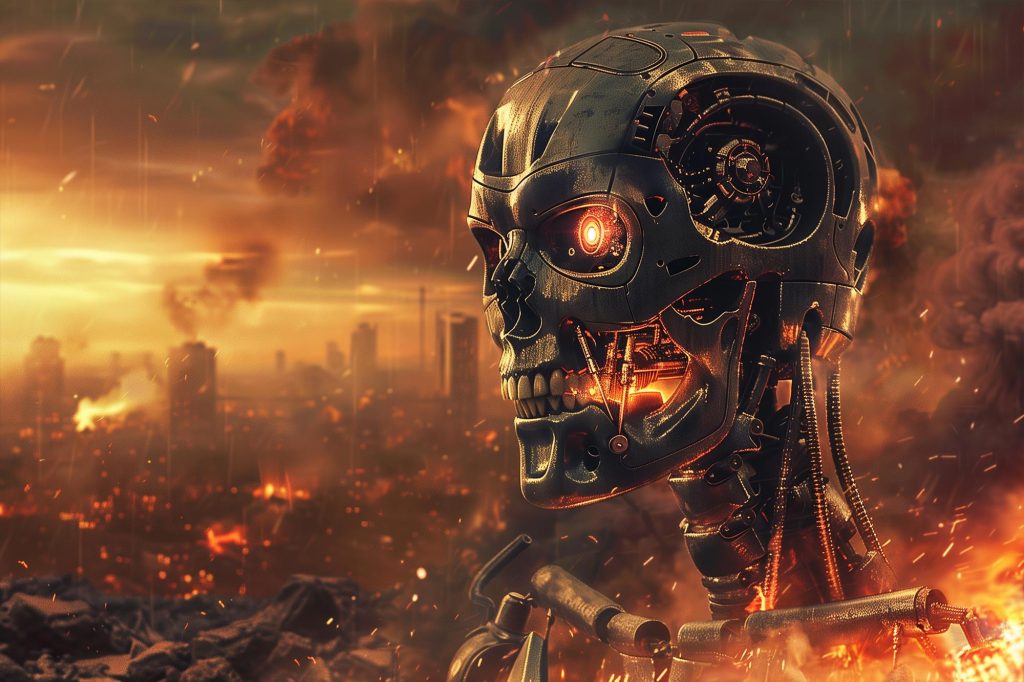
AI Will Kill Humanity Within a Decade