
Paris (Imran Y. CHOUDHRY) :- Former Press Secretary to the President, Former Press Minister to the Embassy of Pakistan to France, Former MD, SRBC Mr. Qamar Bashir analysis : A striking observation by a renowned Jewish religious scholar widely circulated in social and traditional media that Muslims cannot be defeated through conventional military means alone raises a question far larger than the conflict in which his remarks are being circulated.
He attributes Muslim resilience to spiritual strength rooted in faith, prayer, sacrifice and an understanding of life and death extending beyond material existence. His observation points toward a broader proposition: military superiority may destroy physical capabilities, but it does not necessarily vanquish a people whose spiritual foundations remain intact.
History repeatedly demonstrates the distinction between defeating an army and defeating a nation. Armies may be destroyed, governments removed, economies crippled and territories occupied, yet a people can recover if their faith, identity and collective conviction survive.
This phenomenon is not peculiar to Islam. Judaism, Christianity, Hinduism, Buddhism and other great religious traditions have endured persecution, displacement and political upheaval because something deeper than material strength continued to sustain their communities.
In Islam, this spiritual foundation begins with iman: belief in Allah, His angels, His revealed books, His prophets and messengers, and the Hereafter. These convictions find practical manifestation through the declaration of faith, five daily prayers, fasting, zakat and pilgrimage to Makkah.
Together they cultivate discipline, sacrifice, accountability and attachment to purposes transcending material life. The stronger this relationship between belief and practice becomes, the more profoundly it shapes the believer’s response to fear, hardship, suffering and death.
This is where conventional deterrence encounters a different equation. Military power normally seeks to raise the cost of resistance until surrender appears preferable to continued suffering. But a person who regards earthly existence as temporary, sacrifice as meaningful and death as a transition rather than absolute extinction may calculate those costs differently.
Physical destruction remains painful, but its capacity to compel submission diminishes when the convictions sustaining resistance are stronger than fear.
The Jewish scholar’s observation becomes particularly significant in this context. The strength confronting an army is not merely the weapon carried by a fighter but the conviction residing within the person carrying it. A missile can be destroyed, an installation demolished and an army weakened, yet if the belief system producing courage and endurance survives, resistance can regenerate. The deeper contest therefore extends beyond weapons to the spiritual foundations sustaining collective purpose.
This introduces another dimension of confrontation. If spiritual conviction strengthens a population, weakening that conviction becomes another means of weakening resistance. Doubt may be directed toward fundamental beliefs; attachment to worship may be eroded; materialism may displace spiritual purpose; internal divisions may be encouraged; and succeeding generations may gradually become detached from the traditions through which religious identity is renewed. The battlefield then extends beyond territory into the mind, heart and spiritual consciousness of society.
Religious communities, however, are not without spiritual guardianship. Islam has its scholars, shaykhs, Sufi traditions and awliya, just as other religions possess their own spiritually accomplished personalities and inherited traditions of guidance. Within Islamic spiritual understanding, accomplished figures have historically strengthened belief, preserved sacred knowledge and exercised responsibility for communities entrusted to their care. Their role has often been to reinforce faith precisely when political, cultural or external pressures threatened to weaken it.
The history of Islam offers powerful examples. Across the Indian subcontinent, Indonesia, Malaysia and other parts of Asia, Islam frequently established deep social roots not primarily through military conquest but through merchants, scholars, Sufi shaykhs and spiritual personalities. Their influence came through character, teaching, service, devotion and spiritual attraction. Khanqahs, zawiyas and religious circles became centers of learning, charity and community cohesion, allowing spiritual influence to reach where political authority or military force never could.
This history illuminates the concept of spiritual jurisdiction. Within the religious framework, highly attained personalities carry responsibility not only for individual disciples but for wider communities or territories. They strengthen faith, respond to spiritual disturbances, preserve unity and protect the religious consciousness of those within their sphere. If a community’s spiritual foundations are challenged, such guardians seek to fortify belief and practice and, within this understanding, counter hostile spiritual influence through their own spiritual resources.
The same broad principle appears in different forms across other religions. Judaism has its rabbis, sages and mystical traditions; Christianity its saints, clergy, monastic orders and contemplative lineages; Hinduism its gurus, yogis and spiritual masters; Buddhism its monks, teachers and accomplished practitioners. Their doctrines are different, yet each tradition recognizes personalities whose spiritual attainment gives them responsibilities extending beyond ordinary religious instruction.
This creates, within the spiritual realm, something comparable to deterrence in the physical realm. Spiritual aggression cannot necessarily be assumed to remain unanswered. A community whose beliefs are challenged may respond by strengthening its own religious foundations, reviving worship, restoring unity and reinforcing the institutions through which sacred knowledge is transmitted. Spiritual attack can therefore generate spiritual defence, and spiritual defence can create counterbalancing pressure. In this sense, religious civilizations possess a form of spiritual strategic depth.
Afghanistan provides a powerful modern illustration of why physical superiority alone cannot guarantee complete victory. The United States and its allies possessed overwhelming advantages in aircraft, satellites, drones, precision weapons, intelligence and financial resources. The Taliban possessed nothing remotely comparable. Yet after two decades, foreign forces departed and the Taliban returned to Kabul. Political and strategic failures played major roles, but one undeniable factor was that the conviction sustaining resistance was never extinguished.
Iran offers another contemporary illustration. Whatever one’s political judgment of Tehran, the ability of Iranian society to withstand immense military, economic and psychological pressure cannot be understood exclusively through inventories of missiles or military hardware. Religion, nationalism, historical memory, collective sacrifice and a deeply cultivated narrative of resistance have all contributed to national cohesion. Destruction of infrastructure or military assets does not automatically produce collapse when the population continues to perceive endurance as meaningful.
This is precisely why the spiritual dimension matters in strategic calculations. A military installation can be rebuilt. Weapons can be replaced. Economic damage, however severe, can eventually be repaired. But the decisive question is whether a people still possess the conviction to absorb hardship and rebuild. If the answer remains yes, physical defeat may be temporary. When conviction itself collapses, however, even a materially powerful society may become vulnerable from within.
The lesson is not that one religion must spiritually conquer another. On the contrary, durable spiritual strength comes primarily from strengthening one’s own foundations. Muslims strengthen Islam through faith, prayer, knowledge, character, service and unity. Jews preserve Judaism through their sacred traditions and communal institutions. Christians, Hindus and Buddhists likewise safeguard their civilizations by transmitting their own spiritual inheritance with confidence, discipline and continuity.
That is the deeper importance of the Jewish scholar’s observation. A country may possess the world’s most sophisticated weapons and still fail to achieve complete victory over a people whose spiritual will survives every physical blow. Conversely, a materially weaker nation may endure overwhelming pressure if its people remain united by deeply rooted belief, disciplined practice and spiritual leadership.
A military can conquer territory; it cannot automatically conquer conviction. Governments may fall, armies may retreat and economies may suffer devastating losses, yet civilizations can rise again so long as the spiritual foundations that give their people identity, courage and purpose remain alive. A nation is therefore not completely defeated when its weapons are destroyed, but when the spiritual power sustaining its will to survive has been broken.
A Nation’s Real Strength Rests in Spirituality, Not Military Might
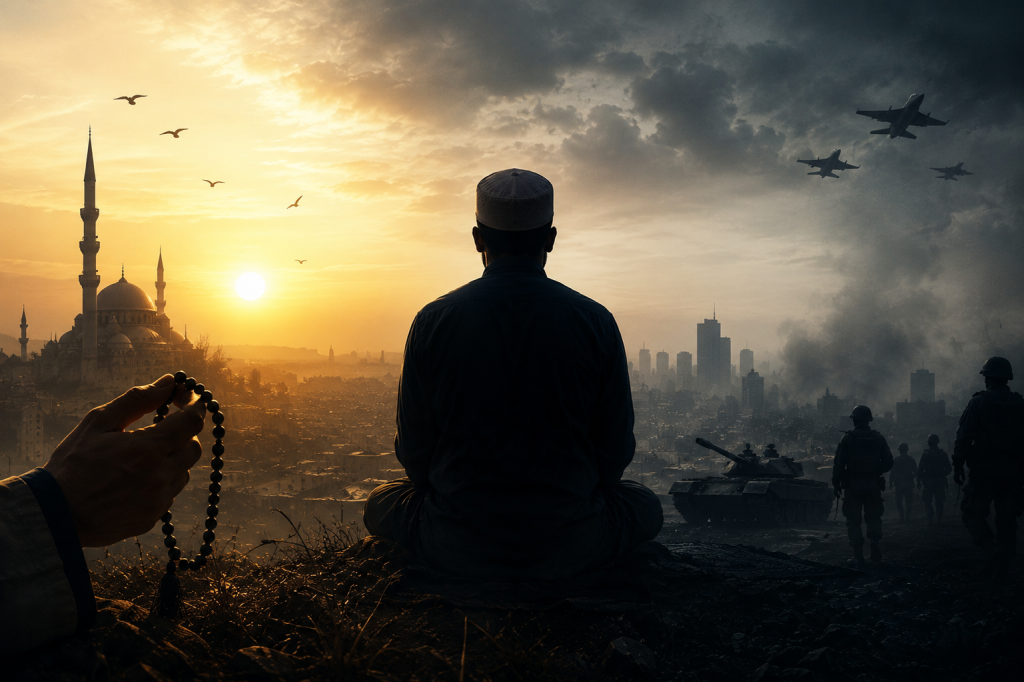
A Nation’s Real Strength Rests in Spirituality, Not Military Might