
Paris (Imran Y. CHOUDHRY) :- Former Press Secretary to the President, Former Press Minister to the Embassy of Pakistan to France, Former MD, SRBC Mr. Qamar Bashir analysis : Twenty-five years after the attacks of September 11, 2001, the United States and people around the world once again remember a day of extraordinary loss. The anniversary recalls not only the violence inflicted upon innocent people, but also the courage demonstrated by passengers, first responders, service members, public employees and ordinary citizens who moved toward danger to help strangers.
On that morning, 19 members of al-Qaeda hijacked four commercial aircraft. Two were deliberately flown into the World Trade Center towers in New York, and a third struck the Pentagon. Passengers and crew members aboard United Airlines Flight 93 resisted the hijackers before the aircraft crashed near Shanksville, Pennsylvania.
The attacks killed 2,977 people from 90 countries: 2,753 in New York, 184 at the Pentagon and 40 aboard Flight 93. These figures do not include the 19 hijackers. Hundreds of first responders were among the dead, while many other people later developed illnesses connected to toxic exposure at Ground Zero.
The courage displayed amid the catastrophe remains one of its most enduring lessons. Their conduct demonstrated that heroism does not always begin with preparation, authority or recognition. It can arise when ordinary people recognize a responsibility toward others and choose to act. That spirit also appeared in the days following the attacks, when people donated blood, supported bereaved families and volunteered in rescue and recovery efforts.
Newly declassified intelligence materials have continued to illuminate what officials knew about the broader threat from Osama bin Laden and al-Qaeda before the attacks. At the same time, 9/11 has generated numerous competing conspiracy theories. Some allege that elements within the United States government had advanced knowledge and deliberately failed to intervene; others claim that American agencies actively facilitated the plot to justify subsequent wars and expanded state power.
Additional theories attribute foreknowledge or participation to Israel or Mossad, allege assistance from Saudi officials or other foreign actors, question whether controlled demolition caused the collapse of the World Trade Center buildings, dispute the accepted accounts of the Pentagon strike and Flight 93, or suggest that unusual financial transactions revealed advance knowledge.
These claims differ substantially and should not be treated as established facts, but their continuing circulation reflects enduring public suspicion about intelligence failures, possible undisclosed interests, who benefited from the attacks, and whether the complete story has ever been made public. Their existence therefore remains part of the wider historical and political legacy of 9/11, deserving acknowledgment and careful examination without prematurely converting either suspicion or official conclusions into unquestionable truth.
Irrespective of finality of the conclusive findings, the attacks transformed security practices throughout the world. Airports adopted more intrusive screening procedures, intelligence agencies expanded surveillance and information sharing, and governments strengthened systems for tracking terrorism financing. The United States created the Department of Homeland Security, reorganized its intelligence structure and launched what became known as the “war on terror.”
The consequences extended far beyond American borders. Military operations in Afghanistan began in 2001, and the United States invaded Iraq in 2003. Counterterrorism operations subsequently expanded across parts of the Middle East, Africa and South Asia. These wars removed governments, disrupted militant organizations and produced political changes, but they also caused prolonged instability, displacement, economic destruction and enormous loss of life.
Brown University’s Costs of War project estimated that direct violence in the major post-9/11 war zones killed between 897,000 and 929,000 people during the first two decades after the attacks. That total included civilians, members of national militaries, opposition fighters, journalists, humanitarian workers and American and allied service members. The project estimated the financial cost at approximately $8 trillion.
Those figures demonstrate why remembrance cannot be limited to a single country or nationality. The murder of civilians on September 11 was abhorrent. The suffering of civilians in Afghanistan, Iraq, Syria, Yemen, Gaza, the West Bank and other conflict zones is also a profound human tragedy. Historical circumstances, legal responsibility and political causes differ from one conflict to another, but grief does not become less real when it crosses a border.
This principle does not erase the legal distinction between civilians and combatants. International humanitarian law specifically requires parties to armed conflicts to distinguish between them. Civilians may not be deliberately targeted, while all parties must observe the requirements of distinction, proportionality and precaution.
The universal value of human life should nevertheless remain at the center of public policy. A parent grieving in New York experiences the same fundamental human loss as a parent grieving in Baghdad, Kabul, Gaza, Kyiv or any other city affected by violence. Recognizing this shared humanity does not excuse terrorism, remove the right of states to protect their populations or settle disputes over the legality of particular military operations. It establishes a moral starting point: civilian life must not be treated as expendable.
That lesson is especially urgent in 2026. Armed conflicts continue to destabilize several regions, damage essential infrastructure and disrupt international trade. The continuing confrontation involving the United States and Iran has affected energy markets and navigation through the Strait of Hormuz. Brent crude briefly reached approximately $108 per barrel in September before easing, illustrating how rapidly regional warfare can impose costs upon people far from the battlefield.
History repeatedly shows that wars presented as short or decisive can become prolonged. Military planners can calculate targets, weapons and troop numbers, but they cannot reliably control every political, economic and humanitarian consequence. Armed conflict can create new grievances, displace populations, weaken institutions and produce cycles of retaliation that outlast the leaders who initiated it.
The anniversary also asks societies to consider what “never forget” should mean. It must mean preserving the names and stories of those who died. It must mean supporting survivors, first responders and families still living with the physical and emotional consequences of the attacks. It must mean honoring the passengers of Flight 93, whose collective action may have prevented the hijackers from striking another target in Washington.
But remembrance should also influence future decisions. If commemorations praise those who saved human lives while public policy accepts avoidable civilian suffering elsewhere, remembrance becomes incomplete. The courage of 9/11 should inspire vigilance against terrorism, but also restraint, honesty and determination to prevent new generations from experiencing comparable grief.
The lasting tribute to the victims is therefore not an endless expansion of war. It is the patient construction of a world in which fewer families receive news that a loved one has been killed by terrorism, bombardment or military escalation. That requires reliable intelligence, accountable government, protection of civilians, international cooperation and serious investment in diplomacy.
Humanity cannot restore what was taken on September 11, 2001. It can decide what meaning to draw from the loss. Twenty-five years later, the most worthy lesson is that courage should protect life, power should be restrained by law, and remembrance should renew the pursuit of peace. The dead are honored not only when their names are spoken, but when the living work to ensure that the suffering experienced that day is not inflicted upon other innocent people.
25 Years After 9/11: Remembrance Must Strengthen the Pursuit of Peace
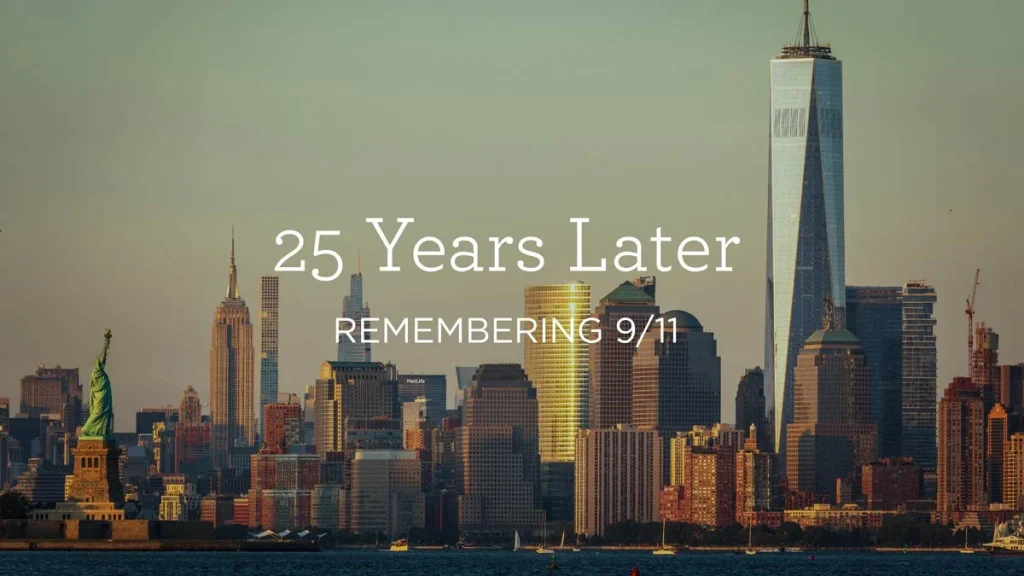
25 Years After 9/11: Remembrance Must Strengthen the Pursuit of Peace